

The right approach to classification of failures is to adopt a standards-based taxonomy, not a homemade tagging system. ISO 14224’s hierarchy paired with IEC 61508’s detectability categories gives maintenance teams a common language for everything from a leaking pump seal to a normal geological fault crossing a pipeline route. Both examples share the same logic: separate what happened from why, then decide how urgently it matters.
En resumen:
- Adopting a standards-based failure classification like ISO 14224 and IEC 61508 ensures consistent, hierarchical data that differentiates cause, mode, mechanism, and effect for better diagnosis.
- Recognizing failure stages such as incipient, degraded, functional, and total allows for targeted maintenance actions and improved trend analysis based on intervention timing.
- Proper classification depends on capturing structured data including equipment type, specific maintainable items, observed effects, and detection method, reducing ambiguous reporting.
- Machine learning models can classify failure modes accurately when trained on disciplined, consistent data, but require human oversight to prevent misclassification from vocabulary drift.
- Using standardized failure codes enhances maintenance efficiency by enabling faster routing, better inventory planning, and easily searchable failure histories across large asset populations.
Índice
- What is classificação de falhas and why does the criteria matter?
- Which standards should you adopt for a failure taxonomy?
- What failure modes and symptoms should you recognise by asset type?
- How do you classify failures in practice on the shop floor?
- Can LLMs classify failure modes automatically, and should you trust them?
- How does failure classification change maintenance strategy?
- What standardisation actually buys a maintenance team
- How Fullyops turns failure codes into faster maintenance decisions
- Standards and research worth reading next
- Sources
- PREGUNTAS FRECUENTES
What is classificação de falhas and why does the criteria matter?
Classificação de falhas, or failure classification, is the practice of sorting equipment and system breakdowns by consistent, repeatable criteria rather than free text. Done properly, it turns a maintenance log into a diagnostic dataset. Four axes do most of the work, and confusing them is the single most common mistake technicians make.
Causa is what triggered the failure (corrosion, fatigue, a software bug). Mode is the observable way the item failed (vibration, leakage, seizure). Mechanism is the physical or chemical process that produced the mode (pitting, spalling, thermal breakdown). Effect is what happened downstream (unplanned shutdown, reduced output, safety trip). A pump can show the mode “leakage” with the mechanism “seal wear” caused by “misalignment,” producing the effect “reduced flow.” Writing “pump broke” loses all four.
Detectability changes what you do next. A failure spotted immediately by an operator needs a different response than one that stays hidden until a safety system is called on to act, and the IEC 61508 / PDS framework treats detected and undetected failures as fundamentally different risk categories, each requiring its own test regime.
- Incipient: early signs, often only visible on condition-monitoring data.
- Degraded: performance has dropped but the asset still runs.
- Functional: the asset can no longer perform its intended duty.
- Total: complete breakdown, usually forcing a shutdown.
Record the stage at the time of intervention, not just the end state. That single habit makes trend analysis possible later.
Which standards should you adopt for a failure taxonomy?
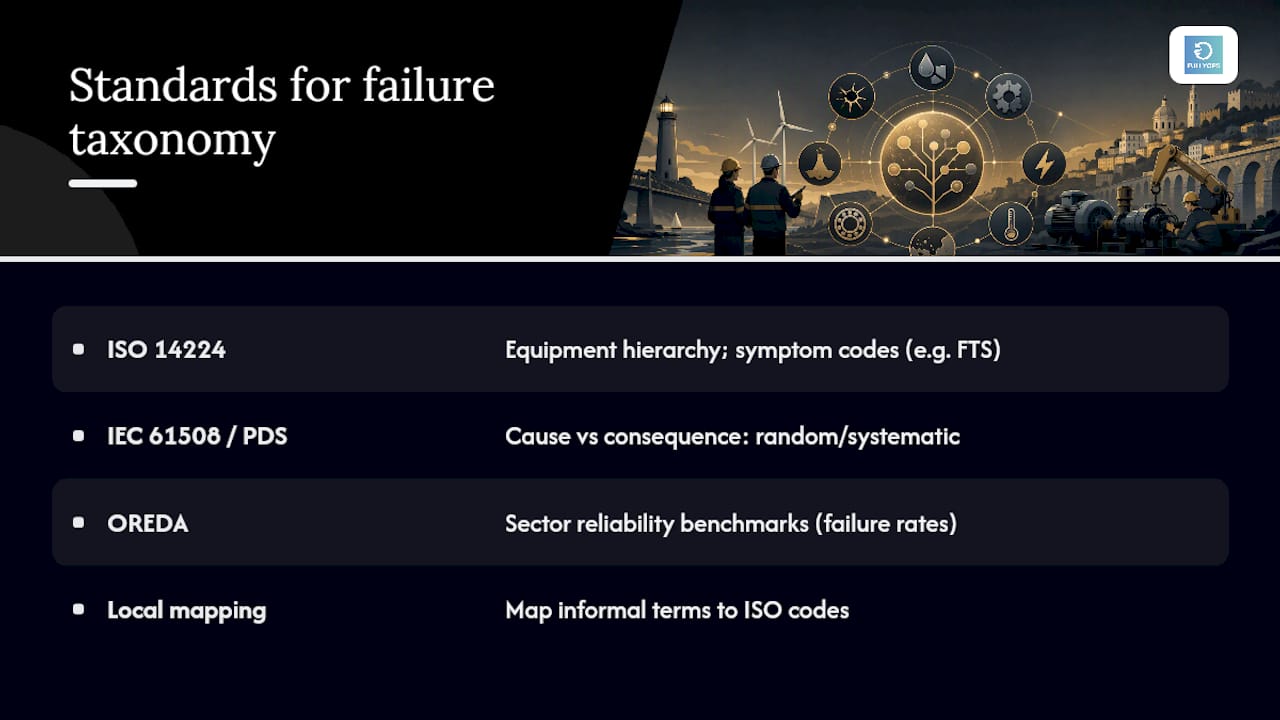
Most maintenance teams don’t need to invent a coding system. ISO 14224, IEC 61508, OREDA, and the PDS method already cover the ground, and picking one deliberately beats drifting into an ad hoc mix of engineer shorthand.
ISO 14224 structures data as equipment class, subunit, maintainable item, failure mode, and failure mechanism. Its failure-mode code list includes entries such as FTS (fails to start), STP (fails to stop), VIB (vibration), OHE (overheating), and ERO (erosion), giving inspectors a shared vocabulary across sites and even across companies.
IEC 61508 and the PDS method work differently: they classify by cause and consequence rather than symptom. A failure is either random (a component simply wears out) or systematic (a design or specification flaw), and separately either safe or dangerous, detected or undetected. This distinction is what drives proof-test intervals on safety-critical instrumented systems.
OREDA offers sector-specific reliability data for offshore and process equipment, useful when you need benchmark failure rates rather than just a coding scheme. If your site already logs failures informally, map those local terms to ISO 14224 codes first. That mapping exercise alone usually exposes years of inconsistent labelling.
A recent structural study found that machine-learning models predicted flexure, shear, and flexure-shear failure modes in reinforced concrete columns using only material strength and reinforcement ratio as inputs, with the random forest model performing best in an experimental study of reinforced concrete column failure modes. That result matters here because it shows classification schemes work even where failure mechanisms are complex and multi-variable, not just for simple mechanical parts.
What failure modes and symptoms should you recognise by asset type?
Every asset class has its own tell-tale signs, and recognising them quickly is what separates a five-minute diagnosis from a half-day teardown.
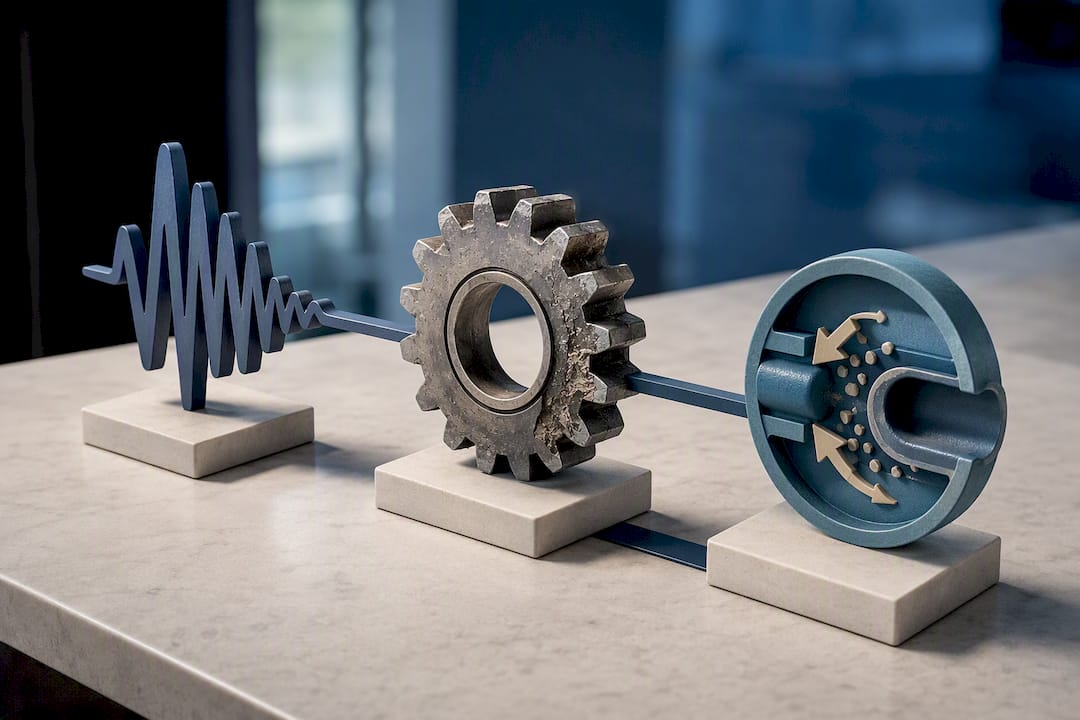
- Rotating equipment: vibration is the classic early warning, often tracing back to bearing fatigue, imbalance, or misalignment. Rising vibration alongside falling lubricant pressure usually points to lubrication starvation before mechanical damage sets in.
- Electrical systems: overheating, short circuits, insulation degradation, and loose connections dominate. A thermal camera reading above expected baseline on a terminal block is often the first sign of a connection failure, not insulation breakdown.
- Structural and reinforced concrete elements: flexure, shear, and combined flexure-shear failures each leave distinct crack patterns. Diagonal cracking near supports signals shear; vertical cracking mid-span signals flexure.
- Control and software systems: systematic faults (a coding error, a bad configuration) behave very differently from random hardware faults (a failed sensor). Treating a repeatable software bug as a random fault wastes time chasing a hardware cause that doesn’t exist.
- Geological faults: relevant wherever civil or pipeline engineering meets ground movement. A normal fault occurs where rock pulls apart under tension; a reverse fault forms under compression, pushing one block over another; a strike-slip fault involves lateral movement, as along the San Andreas system. Engineers assessing foundation or pipeline routes need to know which type crosses their site, because each implies a different loading and displacement risk.
How do you classify failures in practice on the shop floor?
A taxonomy is only useful if the data entering it is consistent. Every work order should carry the same minimum fields, whatever the asset.
- Equipment class and subunit (e.g. centrifugal pump, mechanical seal).
- Maintainable item (the specific part replaced or repaired).
- Observed effect (what the operator or technician actually saw or measured).
- Suspected mechanism (the physical process behind the mode, even if provisional).
- Detectability (detected during operation, or found only during inspection or test).
- Timestamp and operating conditions (load, temperature, running hours since last service).
A well-coded entry reads: “Centrifugal pump P-102, mechanical seal, observed effect: leakage (ISO 14224 code LEA), suspected mechanism: seal face wear, detected during routine walk-round, 8,200 running hours.” That single line supports trend analysis; “pump leaking again” does not.
The most common error is labelling a symptom as a cause — writing “noise” as the failure mode when noise is actually the observed effect of a mechanism such as gear wear or cavitation. ISO 14224’s separation of mode from mechanism exists specifically to stop that conflation.
Consejo profesional: Keep a printed or digital code sheet at the point of work order creation. Technicians who have to recall codes from memory default to vague free text within a fortnight.
Standardised logging like this is what makes root-cause analysis workflows actually work, because the input data already carries the structure a root-cause tool needs.
Can LLMs classify failure modes automatically, and should you trust them?
Automated failure-mode classification has moved well past experimental status, but it still depends heavily on how it’s set up. Research testing large language models against annotated maintenance work orders found that a fine-tuned GPT-3.5 model reached a Micro-F1 score of roughly 0.81, up from about 0.46 for the same model without fine-tuning. That gap is the whole story: an off-the-shelf model performs little better than guessing on domain-specific failure text.
A workable pilot workflow looks like this:
- Label a representative sample of historical work orders using a controlled code list, ideally ISO 14224-aligned.
- Fine-tune the model on that annotated set rather than relying on general-purpose prompting.
- Validate using Micro-F1 and a confusion matrix, not raw accuracy, since failure categories are rarely balanced.
- Keep a human reviewer in the loop for low-confidence predictions before codes reach reporting dashboards.
The main pitfall is vocabulary drift. Technicians describe the same failure mode a dozen different ways, and a model trained on messy synonyms will misclassify consistently. Start automation only once your manual coding is already disciplined; a model trained on inconsistent labels will just automate the inconsistency faster.
How does failure classification change maintenance strategy?
Classified failure data should drive decisions, not sit in a report nobody reads. Each category maps to a specific action.
- Dangerous undetected failures push testing frequency up, since these are the failures that only surface during an actual demand on the safety system.
- Incipient-stage failures justify scheduling predictive checks before the item degrades further, catching problems while repair is still cheap.
- Recurring failure modes on the same maintainable item point to a design or specification issue worth escalating, rather than repeated like-for-like replacement.
Useful KPIs built from classified data include mean time between failures broken down by failure mode (not just by asset), recurrence rate for the same mode on the same item, and classification accuracy itself, tracked against audit samples. A site that sees a rising trend in incipient vibration codes on a specific pump family should shorten its vibration-monitoring cadence and pre-order the bearing kits most likely to be needed, rather than waiting for a functional failure to trigger a reactive purchase order.
What standardisation actually buys a maintenance team
Standardised classification pays off less in the big catastrophic failures and more in the hundreds of small, ambiguous ones that never get written up properly. A site running consistent ISO 14224 coding tends to see fewer repeat callouts, because the second technician on a recurring fault can actually see what the first one found instead of re-diagnosing from scratch. That single change, shared visibility into structured failure history, does more for triage speed than most predictive-maintenance investments on their own. Platforms like Fullyops that attach these codes directly to work orders make that history searchable rather than buried in free-text notes.
— Pedro
How Fullyops turns failure codes into faster maintenance decisions
Manually cross-referencing spreadsheets against an ISO 14224 code sheet works for a handful of assets, but it collapses once a site runs hundreds of work orders a month. Fullyops attaches standardised failure and mode codes directly to each work order at the point of creation, so a technician logging “vibration, bearing, detected on walk-round” produces structured, searchable data automatically rather than a free-text note someone has to interpret later. That means fewer miscoded entries, faster routing to the right specialist, and inventory forecasts built on actual failure-mode history rather than guesswork. Reporting dashboards then surface recurrence trends by failure mode without anyone building a spreadsheet pivot table by hand. If your team is ready to move from ad hoc logging to a structured, proceso de gestión de órdenes de trabajo built around real failure data, book a demo to see how the coding fields map onto your existing asset register.
Standards and research worth reading next
For deeper reference: ISO 14224 taxonomy guidance, IEC 61508 failure categories, and the LLM-based FMC study, alongside routine inspection guidance for facility programmes.
Sources
- Classificador de Falhas de Equipamentos | ISO 14224 — Vibromera
- Chapter 3. Failures and Failure Classification (SIS / NTNU)
- Large Language Models for Failure Mode Classification: an Investigation
- Machine-learning-based prediction of column failure modes (Applied Sciences, MDPI)
PREGUNTAS FRECUENTES
What are the main types of failures?
Failures are typically classified by cause (random or systematic), effect (safe or dangerous), detectability (detected or undetected), and lifecycle stage (incipient, degraded, functional, or total), with ISO 14224 adding specific failure-mode categories like vibration, overheating, and leakage.
What is a shutdown failure (falha de desligamento)?
A shutdown failure occurs when equipment or a safety system fails to stop operation when required, corresponding to the “fails to stop” (STP) mode in the ISO 14224 code list, and it is treated as a dangerous failure if undetected.
What is a normal fault?
In geology, a normal fault forms where rock is pulled apart under tension, causing one block to slip downward relative to the other along a steeply angled fracture plane.
What are geological faults and why do engineers care?
Geological faults are fractures in rock where movement has occurred, classified mainly as normal, reverse, or strike-slip depending on the direction of movement, and engineers assess them when siting foundations, pipelines, or tunnels near active fault zones.