

Coordinating teams spread across multiple postcodes while managing urgent repairs, tight schedules, and rising costs often feels like an endless juggling act for HVAC operations managers. The drive for greater efficiency and cost control has made digital asset management solutions a top priority, transforming how you allocate technicians, monitor equipment, and ensure customer satisfaction. This overview shows how integrated field service management turns complex operations into streamlined, data-driven processes, giving you the clarity and agility to get ahead of maintenance challenges before they impact your business.
Table of Contents
- What Is Field Service Management Today?
- Modern Workflows and Intelligent Automation
- Core Modules: Assets, Technicians, Analytics
- Integrating Field Service with Existing Systems
- Cost Efficiency and Risk Reduction Strategies
Key Takeaways
| Point | Details |
|---|---|
| Modern FSM Integration | Field Service Management has evolved into a data-driven operation that coordinates technicians, equipment, and customer relations to enhance service efficiency. |
| Customer Experience Focus | Today’s FSM emphasises customer experience, providing real-time updates and transparent communication that improve retention and service quality. |
| Intelligent Automation Advantages | Automation reduces manual errors and administrative burden, allowing technicians to focus on service while improving decision-making through data integration. |
| Cost Efficiency and Risk Management | Implementing strategic scheduling and predictive maintenance significantly lowers operational costs while mitigating risks associated with compliance and service failures. |
What Is Field Service Management Today?
Field service management has fundamentally shifted from a collection of scattered processes to a coordinated, data-driven operation that directly impacts your bottom line. At its core, FSM coordinates your most valuable resources—technicians, equipment, parts inventory, and customer relationships—to execute work activities away from your office. This means managing everything from scheduling multiple HVAC teams across different postcodes, dispatching technicians to emergency calls, tracking parts usage in real-time, to ensuring customers receive consistent service quality. Unlike the old days of phone calls, clipboards, and disconnected spreadsheets, modern field service management integrates scheduling, dispatching, and work order management into one cohesive system that your entire team can access instantly.
What makes today’s FSM fundamentally different from five years ago is the integration of intelligent data sources. Your HVAC operations now benefit from real-time information flowing from IoT sensors installed on customer equipment, enterprise asset management systems tracking maintenance histories, and mobile applications that put customer details, job specifications, and compliance requirements directly into a technician’s hands before they even arrive at the site. This connectivity enables your dispatchers to make smarter decisions—routing the closest available technician with the right skills and parts inventory, rescheduling proactively before equipment fails, and capturing data at point-of-service that flows immediately back into your systems. The result is shorter repair times, reduced repeat visits, and technicians who spend more time fixing units and less time hunting for information.
For HVAC companies specifically, modern FSM addresses your sector’s most pressing challenges. You manage seasonal demand fluctuations where summer cooling emergencies demand rapid response, complex equipment requiring specialised knowledge, stringent customer expectations around appointment windows, and rising pressure to control maintenance costs whilst maintaining service quality. FSM software enables you to optimise technician routes to reduce travel time between jobs, predict maintenance needs before breakdowns occur, track warranty compliance automatically, and generate accurate invoices at point-of-service. The platform captures real-time data on technician productivity, parts usage patterns, and customer satisfaction, giving you the operational visibility needed to make decisions based on actual performance rather than assumptions. Whether you’re managing a team of ten technicians or several hundred across multiple regions, field service management today provides the infrastructure to scale efficiently.
Beyond operational mechanics, modern FSM reflects a shift towards customer experience as a competitive differentiator. Your customers expect appointment notifications, real-time technician tracking, transparent pricing, and responsive communication. FSM systems enable you to deliver this—sending automated updates, capturing customer feedback immediately after service completion, and building service history that helps your team provide better recommendations during future visits. This transparency and responsiveness directly influence customer retention and your ability to cross-sell preventative maintenance contracts.
Pro tip: Start by mapping your current workflow—from customer call through invoicing—to identify where information gaps occur. These gaps are where digital FSM creates the most immediate value for your operations.
Modern Workflows and Intelligent Automation
The shift from manual coordination to intelligent automation represents the most significant change in field service operations over the last decade. Where your team once relied on dispatchers making educated guesses about technician availability or managers manually reviewing timesheets, modern FSM systems now automate these decisions using real-time data. Robotic process automation and AI-driven workflows now handle repetitive tasks that consumed hours of back-office time—data entry, invoice generation, appointment scheduling, and compliance documentation all execute without human intervention. This automation doesn’t replace your team. Instead, it frees technicians from administrative work and gives managers time to focus on strategic decisions rather than operational firefighting.
Consider how scheduling works in a modern system. When a customer calls requesting an HVAC service, the system instantly evaluates multiple variables simultaneously: technician location and current workload, required skills and certifications, parts inventory availability, travel time estimates, and customer preferences. Predictive analytics and workforce management integration then optimise the assignment to maximise first-time fix rates—meaning the technician arrives with exactly the right expertise and parts, reducing callbacks and repeat visits. This is fundamentally different from a dispatcher manually phoning around trying to find someone available. The system continuously adapts throughout the day as new calls arrive, technicians complete jobs ahead or behind schedule, and unexpected emergencies demand immediate response. Real-time rescheduling happens automatically, keeping your entire operation flowing smoothly without constant manual intervention.
Intelligent automation also transforms how your business handles predictive maintenance and asset management. Rather than waiting for equipment failures, automation reshapes business processes by identifying patterns in IoT sensor data that indicate approaching problems. A commercial HVAC unit showing gradual temperature drift or increasing vibration patterns triggers an automated work order before the customer even knows there is an issue. Your technician arrives proactively, completes maintenance, and prevents costly downtime. This shifts your business model from reactive repairs to proactive service, improving customer satisfaction whilst reducing overall service costs. The system tracks every intervention, continuously learning which maintenance actions prevent future failures and which customer segments benefit most from preventative programmes.
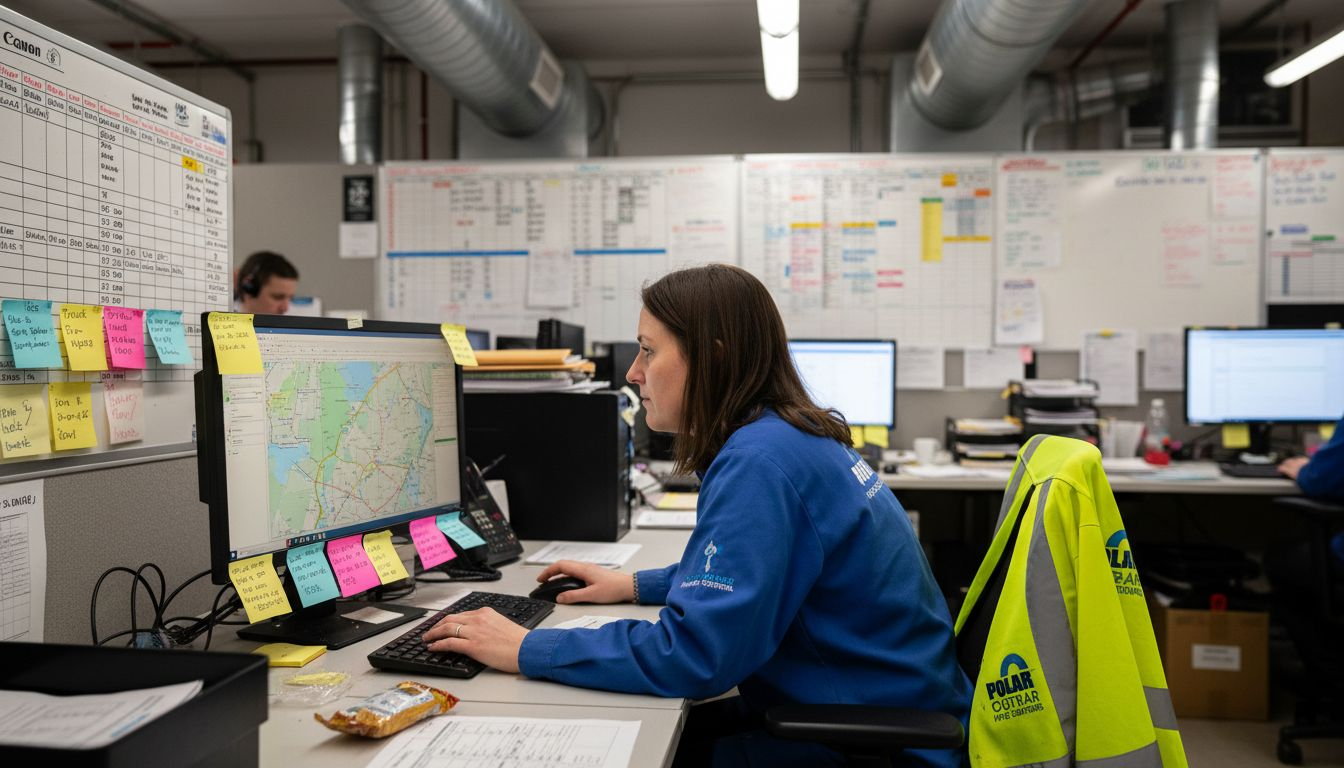
What makes this particularly powerful for your HVAC operations is that intelligent automation reduces human error whilst improving decision quality. Technicians receive optimised routes that account for traffic patterns and job complexity, not simple address proximity. Work orders automatically include relevant customer history, previous repair attempts, warranty status, and regulatory requirements. Invoices generate at point-of-service with accurate labour calculations, parts costs, and applicable charges, eliminating billing disputes. Customer feedback automatically feeds back into performance metrics, helping you identify which technicians deliver exceptional service and which areas need additional training. This data-driven approach means your team makes decisions based on facts rather than assumptions, leading to better resource allocation and operational efficiency.
The following table compares the impact of manual processes and intelligent automation in field service management:
| Aspect | Manual Processes | Intelligent Automation |
|---|---|---|
| Scheduling Efficiency | Prone to delays and bottlenecks | Real-time, optimised job assignment |
| Error Rate | Higher due to manual entry | Reduced through automated workflows |
| Customer Experience | Inconsistent communication | Timely updates, proactive service |
| Data Quality | Fragmented, risk of loss | Accurate, instantly accessible |
Pro tip: Start automation with high-volume, repetitive tasks like invoice generation or appointment confirmation rather than complex decision-making processes. Quick wins build momentum and buy-in from staff who see the benefits immediately.
Core Modules: Assets, Technicians, Analytics
Modern field service management systems rest on three foundational pillars that work together to transform how you manage operations. The asset management module tracks every piece of equipment your customers own, documenting installation dates, warranty periods, maintenance history, and performance data. This isn’t simply a database of serial numbers. Asset lifecycle management integrates real-time sensor data with historical maintenance records, allowing your system to predict when equipment will fail before it causes customer problems. For HVAC companies, this means tracking commercial rooftop units, residential heat pumps, and emergency generators across hundreds of customer sites, knowing exactly which units require preventative maintenance, which are approaching warranty expiration, and which customers are candidates for upgrade recommendations. The system automatically generates maintenance schedules based on manufacturer recommendations and actual performance patterns, so your team never misses a critical service window.
The technician management module operates as your mobile workforce command centre. It tracks technician qualifications, certifications, availability, skill gaps, and historical performance metrics. When a service request arrives, the system doesn’t simply find someone available—it locates the technician with the right expertise, matching their certifications against job requirements whilst considering their current location and workload. This module also captures what happens in the field: time spent on each task, parts used, customer feedback, and compliance documentation. For field service operations managers, this visibility is transformative. You can identify which technicians consistently achieve first-time fixes, which jobs take longer than expected, and where training gaps exist. Scheduling and dispatching optimisation ensures the right technician reaches the right location at the right time with the correct tools and parts, dramatically reducing repeat visits and customer dissatisfaction.
The analytics module transforms raw operational data into actionable intelligence that drives business decisions. Rather than wondering whether your service quality is improving or costs are rising, analytics provides clear metrics on technician utilisation rates, first-time fix percentages, average job duration by equipment type, parts inventory turnover, customer satisfaction trends, and profitability by service category. You can identify seasonal demand patterns, recognise which customer segments generate highest revenue, and spot technicians needing additional support. Real-time dashboards show current operational status—how many active jobs exist, which technicians are idle, which customer calls are waiting—enabling immediate response to bottlenecks. Predictive analytics go further, forecasting equipment failure risks, identifying customers likely to churn, and recommending pricing adjustments based on demand patterns.
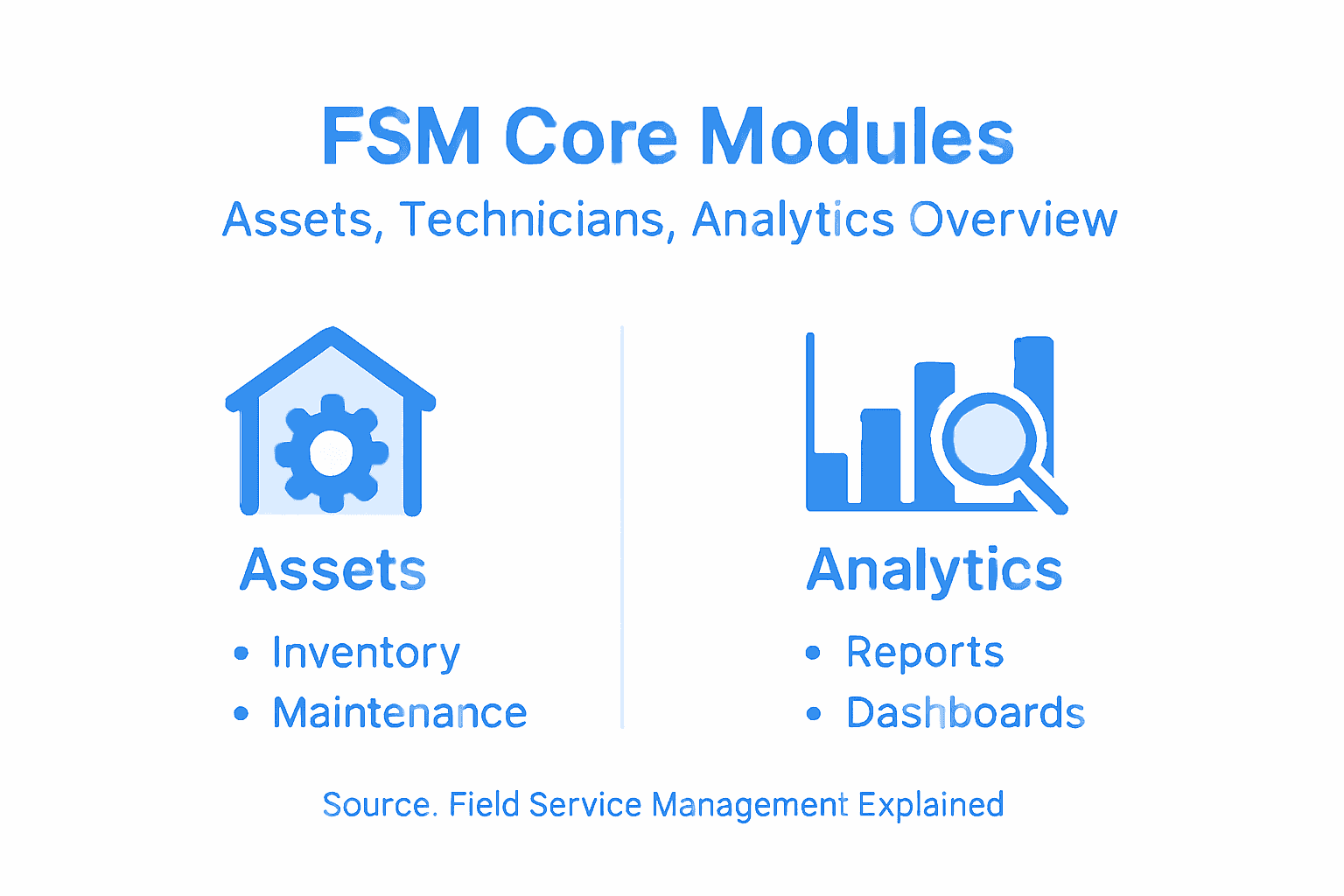
These three modules operate as an integrated system, not separate tools. Asset data feeds the scheduling engine, which assigns appropriate technicians. Technician performance metrics refine future scheduling decisions. Customer satisfaction feedback linked to specific technicians and assets identifies training opportunities and equipment reliability trends. Analytics reveal which combinations of technician skill, asset type, and customer location produce optimal outcomes, continuously improving your operations. For HVAC companies managing complex seasonal demand, multiple technician skill levels, and equipment warranties spanning years, this integration transforms field service from a reactive scramble into a predictable, measurable, continuously improving operation. You know what’s happening across your entire operation in real-time, understand why it’s happening based on historical data, and can predict what will happen next based on current trends.
Here is a summary of the main FSM system modules and their direct benefits for HVAC operations:
| Module | Core Function | Benefit for HVAC Teams |
|---|---|---|
| Asset Management | Tracks equipment lifecycle and sensors | Proactive maintenance and fewer emergency repairs |
| Technician Management | Matches skills to jobs, tracks metrics | Improved first-time fix rates and efficient routing |
| Analytics | Transforms data into business insights | Informed decisions, higher profitability |
Pro tip: Begin by establishing reliable asset and technician data foundations—clean, complete, accurate baseline information is essential for analytics to provide meaningful insights that actually improve your operations.
Integrating Field Service with Existing Systems
Most HVAC companies don’t operate with field service management as their only business system. Your finance team uses accounting software to track invoices and payments. Your sales team maintains customer records in a CRM system. Your warehouse manages parts inventory through procurement tools. Your technicians need access to asset histories, customer information, and job specifications. When these systems don’t communicate, you create information silos where your finance department can’t match invoices to completed work, your sales team doesn’t know what service problems customers are experiencing, and your warehouse orders parts that technicians already have in stock. Integration bridges these gaps, creating a unified information flow that serves every department.
When FSM software connects with your existing systems, it transforms how operational data moves through your business. ERP integration with FSM systems unites finance and operations management, allowing finance to automatically reconcile invoices against completed work orders without manual data entry. Your accounting team sees exactly what labour and materials were used on each job, enabling accurate costing and profitability analysis by customer or service type. When a technician completes a job in the field, the system automatically generates an invoice with correct labour rates, parts costs, and applicable service charges, eliminating billing errors and accelerating cash collection. Parts consumed during service automatically feed inventory management systems, triggering purchase orders when stock falls below minimum thresholds. Your finance team gains unprecedented visibility into field service profitability, understanding which services generate profit margins and which drain resources.
CRM integration delivers equal value on the customer-facing side. When a customer calls requesting service, your team sees their complete history: previous HVAC installations, maintenance records, service issues, warranty status, and communication preferences all appear on screen instantly. Your technicians arrive prepared, knowing what equipment they’re servicing and what problems the customer experienced previously. After service completion, customer feedback automatically feeds into your CRM, building a record of service quality that informs future interactions and identifies customers ready for preventative maintenance contracts. Your sales team identifies upsell opportunities based on actual equipment age and failure patterns rather than guesses. Marketing campaigns target customers whose equipment is approaching manufacturer-recommended service intervals, positioning your company as proactive rather than reactive.
The integration complexity varies depending on your existing systems. Basic integration might connect FSM to accounting software, ensuring financial data flows accurately. Advanced integration links FSM with multiple systems simultaneously—accounting for invoicing, CRM for customer history, inventory management for parts tracking, GPS for route optimisation, and IoT sensors for predictive maintenance data. Modern FSM platforms offer pre-built connectors to common business systems, simplifying integration without requiring extensive custom development. However, successful integration requires careful planning: mapping data flows between systems, establishing which system owns each data type, ensuring data quality standards across platforms, and training staff on how integrated systems change their workflows. When executed properly, integration transforms your operation from a collection of disconnected tools into a coordinated ecosystem where decisions are informed by complete, real-time information from across your entire business.
Pro tip: Start integration with the system that creates the most operational friction today. If invoicing accuracy consumes back-office time, prioritise ERP integration first. If customer service quality suffers from missing equipment history, prioritise CRM integration. Quick wins justify further integration investment.
Cost Efficiency and Risk Reduction Strategies
Field service operations consume significant resources in ways that aren’t always obvious until you measure them. Your technicians spend time driving between jobs when better routing could save 15 to 20 percent of travel time. Equipment fails unexpectedly, forcing emergency service calls that cost three times as much as planned maintenance. Parts sit in inventory gathering dust while technicians improvise with stock that doesn’t match job requirements. Repeat visits occur because technicians lack complete information on their first attempt. Each inefficiency compounds the others, draining profitability whilst increasing customer frustration. Digital transformation directly attacks these cost drivers through strategic, measurable interventions that improve both bottom-line performance and service quality.
The most immediate cost savings come from strategic scheduling and route optimisation that minimise travel time and fuel consumption. Rather than dispatching the nearest available technician, modern systems account for traffic patterns, job complexity, technician skills, and geographic clustering to create routes that reduce driving time significantly. For an HVAC company with ten technicians covering a metropolitan area, optimising routes by just 10 percent translates to one additional productive day per week across your team. That’s 5 percent more jobs completed without hiring additional staff. Fuel costs drop proportionally. More importantly, technicians spend more hours serving customers and less time sitting in traffic, improving both their job satisfaction and your service capacity. Preventive maintenance scheduling delivers equally impressive returns. Rather than reacting to breakdowns, digital systems identify equipment approaching failure through sensor data and performance patterns. Scheduling maintenance during planned windows costs a fraction of emergency repairs. You avoid customer downtime, reduce technician overtime, and build customer loyalty by demonstrating proactive care. For large commercial HVAC contracts, the difference between reactive and preventive models can shift annual maintenance costs by 20 to 30 percent.
Inventory management represents another significant opportunity. When technicians don’t have parts in stock, they either make repeat trips or improvise with incompatible components, both expensive outcomes. When warehouse staff overstock parts based on guesses, capital sits idle and obsolete inventory accumulates. Digital systems track what parts technicians actually use on specific jobs, identifying purchasing patterns and optimal stock levels by location. You reduce overstocking of slow-moving items while ensuring high-velocity parts remain available. Improved first-visit fix rates directly reduce costs by eliminating repeat service calls. When technicians arrive with incomplete information or insufficient skills, they schedule follow-up visits. When they arrive prepared with complete customer history, correct diagnostic tools, and appropriate parts, they resolve issues immediately. Training programmes informed by performance data target skill gaps where they actually impact outcomes. Technicians working with mobile access to knowledge bases resolve issues faster and with greater accuracy. For HVAC companies, where complex diagnostics and specialised knowledge directly impact success rates, this knowledge accessibility translates to measurable cost reduction and customer satisfaction improvement.
Risk reduction strategies complement cost efficiency efforts, protecting your business from expensive failures. Compliance documentation automatically captured during service execution ensures regulatory requirements are met consistently, avoiding costly penalties or liability exposure. Equipment maintenance records stored centrally protect you from warranty claims disputes by providing complete audit trails. Customer communication tracking reduces misunderstandings that lead to disputes. Technician skill verification ensures only qualified personnel handle specialised work, protecting both customers and your company from liability. Data security protections prevent breaches that could expose customer information. These safeguards cost far less than managing litigation, regulatory investigations, or reputation damage from service failures. Digital systems also reduce weather and seasonal demand volatility through predictive modelling. When you understand demand patterns historically and can forecast them accurately, you right-size your team, negotiate better vendor terms, and manage cash flow more effectively. The combination of cost efficiency improvements and risk reduction transforms field service from a high-cost, high-risk operation into a controlled, predictable, profitable business.
Pro tip: Measure your current cost baseline before implementing changes. Track travel time per technician, parts inventory turnover, first-visit fix rates, and repeat visit frequency. These metrics become your baseline for demonstrating ROI and identifying which improvements deliver the fastest financial payback.
Unlock the Power of Digital Field Service Management with FullyOps
The article highlights critical challenges in modern field service management such as inefficient scheduling, scattered asset data, and the need for real-time insights to reduce costs and improve customer satisfaction. If your HVAC or maintenance operations struggle with manual workflows, unpredictable equipment failures, or limited visibility into technician performance, FullyOps offers the intelligent automation and integrated asset management you need. Our platform transforms how you schedule, manage resources, and track assets by delivering real-time data, optimised routes, and seamless integration with your existing business systems.
Take control of your operations today by leveraging the core solutions detailed in the article—asset lifecycle tracking, technician skills matching, and powerful analytics—within a unified SaaS environment. Discover how FullyOps can reduce downtime, boost first-time fix rates, and enhance overall operational efficiency. Ready to move from reactive repairs to proactive maintenance with smarter field service workflows? Visit FullyOps Solutions now to start streamlining your field service operations and experience the difference intelligent digital transformation can make.
Frequently Asked Questions
What is field service management (FSM)?
Field service management (FSM) coordinates technicians, equipment, parts inventory, and customer relationships to efficiently execute work activities away from the office. Modern FSM integrates scheduling, dispatching, and work order management into a cohesive system.
How has digital transformation impacted field service management?
Digital transformation has shifted field service operations from manual processes to data-driven, intelligent automation. It enables real-time information flow from IoT sensors and other data sources, leading to smarter scheduling, proactive maintenance, and improved customer satisfaction.
What are the key benefits of adopting modern FSM software for HVAC companies?
Modern FSM software helps HVAC companies optimise technician routes, predict maintenance needs, track warranty compliance, and improve service quality. It enhances operational visibility and efficiency, resulting in reduced repair times and increased customer satisfaction.
How can intelligent automation improve technician productivity?
Intelligent automation minimizes repetitive tasks and schedules jobs based on real-time data, allowing technicians to focus more on repairs rather than administrative duties. It improves first-time fix rates by ensuring technicians have the required information and parts available before arriving on site.
Recommended
- Blog – FullyOps
- Field Service Management: Optimize & Boost Efficiency – FullyOps
- Home – FullyOps
- Field Service Management: How to Structure, Manage & Motivate Your Team – FullyOps
- Digital Marketing – Why It Matters for Local Contractors