

Juggling technician schedules across multiple service zones often leads to missed appointments and mounting downtime for field service managers. With growing customer expectations and an unpredictable workload, finding effective solutions is vital. This guide reveals how modern digital tools, such as Resource Scheduling Optimisation, can help you accurately align your workforce capabilities with service demand, improve technician deployment, and maintain operational resilience—resulting in smarter scheduling that minimizes losses and keeps clients satisfied.
Table of Contents
- Step 1: Assess Organisational Requirements And Resource Capacity
- Step 2: Configure Scheduling Parameters And Digital Tools
- Step 3: Assign Technicians Based On Skills And Availability
- Step 4: Optimise Routes And Schedule Adjustments In Real Time
- Step 5: Verify Schedule Efficiency With Performance Analytics
Quick Summary
| Key Insight | Explanation |
|---|---|
| 1. Conduct a resource capacity audit | Assess technicians’ skills and availability to identify gaps and optimise service delivery efficiently. |
| 2. Implement dynamic scheduling tools | Use digital tools for real-time resource allocation, ensuring efficient technician matching and operational adaptability. |
| 3. Establish a robust skills matrix | Document technician capabilities to enhance matching accuracy and improve overall service quality. |
| 4. Apply real-time route optimisation | Implement algorithms to adjust routes based on live data, reducing travel time and enhancing productivity. |
| 5. Leverage performance analytics | Use performance metrics to inform scheduling decisions and continuously improve service efficiency and customer satisfaction. |
Step 1: Assess organisational requirements and resource capacity
Successfully deploying field service technicians requires a strategic approach to understanding your organisation’s operational landscape. In this critical first step, you will systematically evaluate your current resource capacity and align your workforce capabilities with service demands.
Begin by conducting a comprehensive audit of your existing technician pool, focusing on skill matching and availability. Map out each technician’s specific expertise areas, certifications, geographical coverage zones, and current workload capacity. This granular assessment helps identify potential gaps or constraints in your service delivery model. Consider factors like specialised technical skills, equipment familiarity, travel radius, and individual productivity metrics. Create a detailed skills matrix that documents each technician’s strengths and limitations, enabling more intelligent resource allocation.
Your next phase involves analysing historical service data to predict future requirements. Review past service records, tracking patterns such as peak service periods, common job types, average appointment durations, and geographical service concentrations. Modern optimization techniques leverage AI to analyse workforce capabilities and predict potential scheduling challenges. By understanding these trends, you can proactively adjust staffing levels, plan training interventions, and develop more responsive scheduling strategies.
Expert Recommendation: Create a dynamic resource tracking spreadsheet that updates in real time, allowing instant visibility into your technician workforce capacity and skill distribution.
Step 2: Configure scheduling parameters and digital tools
Configuring your field service scheduling system requires precise setup of parameters that enable intelligent resource deployment and streamline operational workflows. This critical step transforms your scheduling approach from manual guesswork to data driven strategic management.

Start by establishing comprehensive scheduling configuration parameters that reflect your organisation’s unique operational requirements. These parameters should include technician work hours, geographical service zones, skill specialisations, vehicle capacities, and individual productivity baselines. Pay close attention to defining flexible business rules that account for travel times, appointment buffer periods, and emergency response protocols. Your goal is creating a dynamic scheduling framework that can automatically match the most appropriate technician to each service request while minimising unnecessary travel and maximising workforce efficiency.
Next, integrate digital scheduling tools that support real-time optimisation and intelligent resource allocation. Salesforce Field Service’s scheduling system enables organisations to develop sophisticated scheduling policies that adapt to changing operational conditions. Implement features like automated matching algorithms, real-time location tracking, and predictive scheduling capabilities. These technologies allow your dispatchers to make informed decisions, balance workloads dynamically, and respond swiftly to unexpected service demands or technician availability changes.
Expert Recommendation: Conduct monthly system audits to validate and refine your scheduling parameters, ensuring your digital tools continuously evolve with your operational landscape.
The following table summarises key scheduling parameters and their business impact:
| Scheduling Parameter | Description | Business Impact |
|---|---|---|
| Technician Work Hours | Defines start and end times per technician | Ensures compliance and prevents overwork |
| Geographical Service Zones | Allocates technicians to specific regions | Reduces travel time; boosts responsiveness |
| Skill Specialisation | Documents unique technician capabilities | Matches right skills to complex jobs |
| Vehicle Capacity | Considers available equipment per vehicle | Enables accurate job and load assignment |
| Appointment Buffer Periods | Time allocated between service appointments | Minimises delays and avoids overruns |
Step 3: Assign technicians based on skills and availability
Assigning the right technician to the right job is a critical component of efficient field service management. This step focuses on creating a strategic matching process that maximises your workforce potential and ensures customer satisfaction through precise resource allocation.
Implement universal resource scheduling techniques that go beyond simple availability matching. Develop a comprehensive skills matrix that captures each technician’s unique capabilities including specific certifications, equipment expertise, geographical knowledge, and performance history. Your goal is to create an intelligent system that automatically pairs service requests with technicians who possess the exact skill set required. This approach involves mapping granular competencies such as specific equipment models, specialised repair techniques, and complex diagnostic skills.
Refine your assignment strategy by establishing a dynamic prioritisation framework that considers multiple factors beyond basic skill matching. This includes evaluating technician workload, travel distances, historical performance metrics, and individual strengths. Integrate real time tracking mechanisms that allow for instantaneous adjustments when unexpected changes occur such as technician unavailability or urgent service requests. By developing a flexible yet structured assignment process, you create a responsive system that can rapidly adapt to changing operational demands while maintaining high service quality standards.
Expert Recommendation: Implement a quarterly skills assessment programme to continuously update and refine your technician capability database, ensuring your resource allocation remains precise and current.
Step 4: Optimise routes and schedule adjustments in real time
Route optimisation represents the critical nexus between efficient resource deployment and superior customer service. This step focuses on transforming your field service scheduling from a static process to a dynamic, responsive operational strategy.
Real-time scheduling optimization enables your organisation to adapt rapidly to unexpected operational challenges. Implement intelligent routing algorithms that continuously analyse technician location, traffic conditions, job complexity, and service priority. These systems should automatically recalculate routes when disruptions occur, minimising travel time and maximising technician productivity. Your goal is creating a fluid scheduling environment where last minute changes become opportunities for efficiency rather than logistical nightmares.
Advanced route optimization requires a multifaceted approach that goes beyond simple geographical mapping. Integrate predictive analytics that consider historical performance data, traffic patterns, and individual technician capabilities. Develop a sophisticated policy engine that can make instantaneous decisions about schedule modifications, ensuring that urgent client needs are met without disrupting overall operational workflows. This approach transforms your scheduling from a reactive process to a proactive strategic tool that continuously seeks the most efficient resource allocation.
Expert Recommendation: Conduct weekly performance reviews of your routing algorithms, identifying and refining the decision making parameters to incrementally improve operational responsiveness.
Here’s a comparison of traditional versus AI-driven route optimisation methods:
| Aspect | Traditional Routing | AI-Driven Routing |
|---|---|---|
| Adaptability | Limited, manual changes | Real-time, automatic adjustments |
| Data Usage | Basic static data | Dynamic, uses live traffic data |
| Efficiency Gains | Modest improvements | Significant productivity boost |
| Response to Disruption | Slow and reactive | Instant, predictive adaptation |
| Customer Satisfaction | Variable | Consistently high |
Step 5: Verify schedule efficiency with performance analytics
Verifying scheduling efficiency requires a systematic approach to measuring and interpreting your field service operational metrics. This critical final step transforms raw data into actionable insights that drive continuous improvement across your organisation.
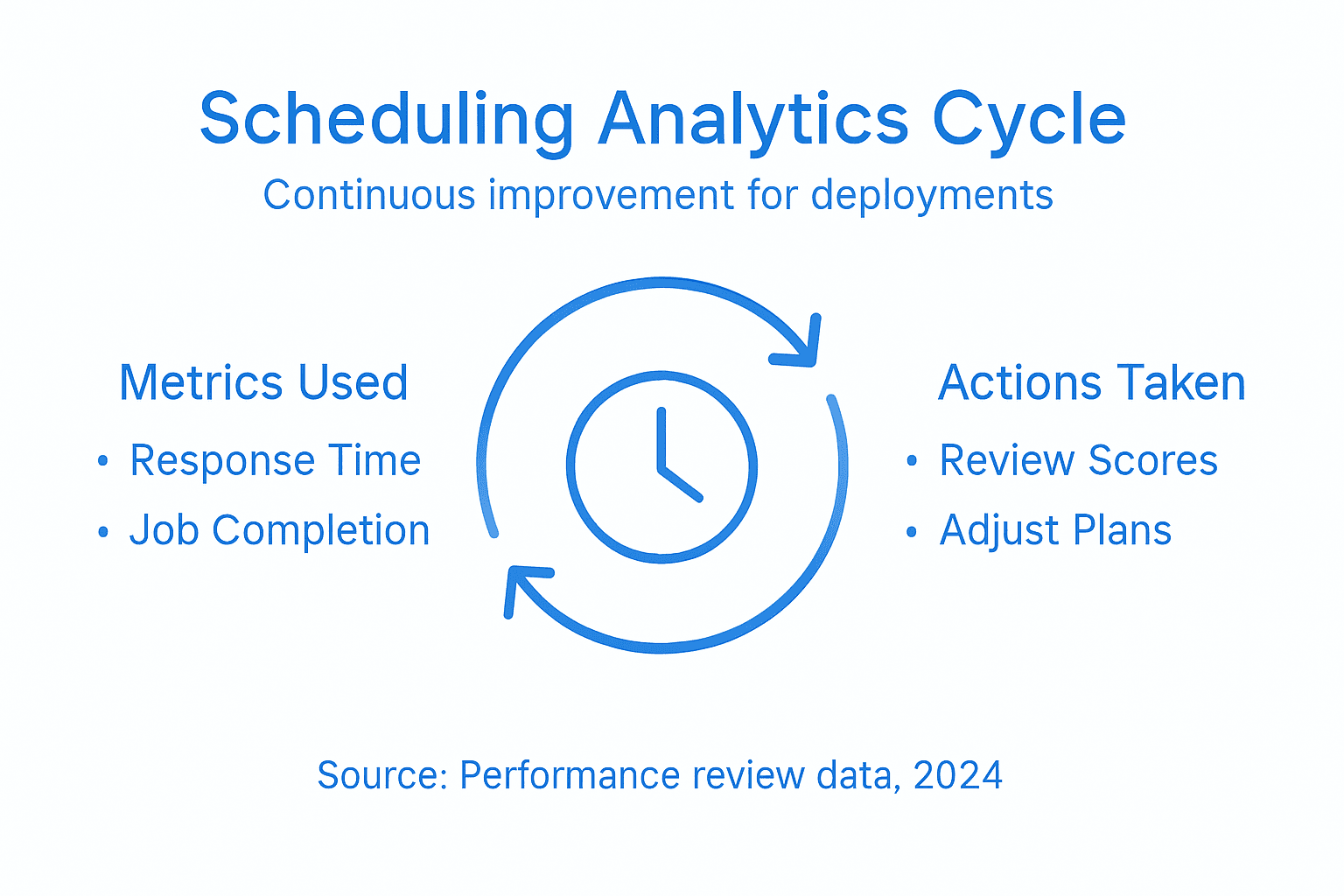
Performance analytics in service scheduling provides a comprehensive framework for evaluating technician deployment effectiveness. Establish a robust set of key performance indicators that go beyond surface level measurements. These should include nuanced metrics such as technician utilization rates, first time fix percentages, average travel times, appointment adherence, and customer satisfaction scores. Create a centralised dashboard that captures these metrics in real time, allowing immediate visibility into your operational performance. The goal is to develop a granular understanding of your scheduling effectiveness that enables proactive rather than reactive management.
Develop a continuous improvement cycle that uses your performance analytics as a strategic tool for refinement. Regularly analyse the collected data to identify patterns, bottlenecks, and opportunities for optimization. Look for trends in technician performance, geographical service variations, and scheduling efficiency. Use predictive modelling techniques to forecast potential future challenges and preemptively adjust your scheduling strategies. This approach transforms performance analytics from a passive reporting mechanism into an active driver of operational excellence.
Expert Recommendation: Implement a monthly cross functional review meeting where scheduling performance data is transparently discussed, ensuring all teams contribute to ongoing optimization efforts.
Unlock Seamless Technician Deployment with FullyOps
Managing field service scheduling requires more than just assigning tasks. As highlighted in the “Field Service Scheduling Guide for Efficient Technician Deployment,” coordinating technician skills, availability, real-time route optimisation, and performance analytics are essential to reduce downtime while boosting service quality. Organisations struggling with manual scheduling constraints and inefficient resource allocation face delayed responses and increased operational costs.
FullyOps offers a powerful SaaS platform designed specifically to address these challenges. Our solution digitises work orders, tracks technician skills and availability, and delivers intelligent scheduling supported by real-time analytics. With modules tailored for technicians, managers, and back office teams, you gain full visibility and control over your workforce, enabling you to adapt swiftly to changing demands and optimise routes effortlessly. Discover how you can elevate your field service operations by exploring FullyOps Solutions.
Take control of your field service scheduling today. Visit FullyOps and experience a platform that transforms complex scheduling into simple, automated workflows. Start optimising your technician deployment now and ensure your organisation meets customer expectations with precision and efficiency.
Frequently Asked Questions
How can I effectively assess my organisation’s resource capacity for field service scheduling?
To assess your organisation’s resource capacity, conduct a comprehensive audit of your existing technician pool, focusing on their skills, certifications, availability, and workload. Create a detailed skills matrix to visually map out technician capabilities and identify any gaps.
What parameters should I configure for optimal field service scheduling?
Establish scheduling parameters such as technician work hours, geographical service zones, skill specialisations, and vehicle capacities. Ensure to define flexible business rules for travel times and appointment buffer periods to enhance scheduling efficiency.
How can I assign technicians based on their skills and availability?
Develop a skills matrix that outlines each technician’s unique capabilities and ensure the assignment process goes beyond basic availability. Regularly assess workload, travel distances, and performance history to dynamically assign the most suitable technician for each service request.
What are the best practices for optimising routes and making real-time schedule adjustments?
Implement intelligent routing algorithms that continuously analyse technician locations and traffic conditions. Make real-time adjustments to scheduling based on unexpected disruptions to minimise travel time and increase technician productivity.
How can I verify the efficiency of my scheduling practices using performance analytics?
Establish key performance indicators that measure technician utilisation, first-time fix rates, and customer satisfaction scores. Regularly analyse these metrics to identify areas for improvement and adjust your scheduling strategies proactively.