

En bref
- Effective maintenance reports are essential for legal compliance, asset protection, and operational decision-making.
- Proper preparation, digital tools, and standardized templates enhance report accuracy and usability.
- Clear, concise reports improve response times, support long-term planning, and increase operational efficiency.
Imagine a critical piece of machinery failing mid-shift because a technician’s report from three weeks prior flagged a worn component, but no one acted on it. The report existed, but it lacked clarity, missed a recommendation field, and sat unread in a shared folder. For maintenance managers and facility administrators in industrial environments, this scenario is far more common than it should be. Effective maintenance reports are not just paperwork; they are operational tools that protect assets, support compliance, and drive cost control. This guide walks you through the structure, tools, and best practices needed to produce reports that actually get used.
Table des matières
- Understanding maintenance reports and their importance
- Essential information and tools required before you start
- Step-by-step process for creating a maintenance report
- Common challenges and best practices for accurate reporting
- How effective maintenance reports drive operational success
- Why the best maintenance reports prioritise clarity, not length
- Next step: streamline your maintenance reporting with FullyOps
- Questions fréquemment posées
Principaux enseignements
| Point | Détails |
|---|---|
| Start with accurate data | Reliable maintenance reports depend on precise asset and job details gathered in advance. |
| Follow a structured process | Consistent step-by-step reporting improves clarity, compliance, and decision-making value. |
| Embrace digital tools | Integrating software solutions streamlines reporting and ensures audit-readiness. |
| Review and optimise | Regular reviews and updates to your process catch errors and maintain compliance. |
Understanding maintenance reports and their importance
A maintenance report is a formal record documenting the condition of an asset, the work carried out, parts used, observations made, and any recommended follow-up actions. These reports exist in several formats: corrective maintenance records, preventive maintenance logs, inspection reports, and shutdown summaries. Each serves a distinct purpose, but all share one goal: creating a traceable, reliable account of an asset’s maintenance history.
In industrial contexts, maintenance reports carry legal and regulatory weight. Many sectors require documented evidence of inspections and servicing to satisfy health and safety legislation, insurance requirements, and industry-specific standards. Missing or incomplete records can result in failed audits, voided warranties, or even regulatory penalties.
Maintenance reporting reliability directly improves equipment reliability and audit readiness, giving operations teams the evidence they need when assets are challenged by inspectors or insurers.
The stakeholders who rely on these reports extend well beyond the maintenance team itself:
- Responsables des opérations use reports to schedule production around planned downtime
- Équipes financières use cost data to forecast maintenance budgets accurately
- Safety officers review reports to identify recurring hazards or near-misses
- Compliance teams need complete records to satisfy regulatory submissions
- Senior leadership relies on aggregated data for strategic asset investment decisions
Skipping or mismanaging maintenance reports does not save time. It defers risk, increases costs, and creates gaps in asset history that become expensive to reconstruct.
The value of facility management reporting is clearest when something goes wrong. A well-maintained report trail allows teams to diagnose root causes quickly, rather than guessing at the origin of a failure. Without it, every incident investigation starts from scratch.
Essential information and tools required before you start
Once you understand the importance, assemble these resources before writing your report. Preparation is what separates a useful report from a document that creates more questions than it answers.
Before opening a template or logging into your software, gather the following:
- Asset identification codes and current condition status
- Work orders linked to the maintenance session
- Maintenance schedules showing what was due and what was completed
- Compliance codes or regulatory standards applicable to the asset
- Parts and materials records, including serial numbers where relevant
- Technician hours and shift logs
The choice between digital and paper-based reporting has a measurable impact on accuracy and speed. Maintenance software options show that using digital tools enhances maintenance record accuracy, reducing transcription errors and enabling real-time data capture in the field.

| Fonctionnalité | Paper-based reporting | Digital reporting |
|---|---|---|
| Data entry speed | Slow, manual | Fast, often automated |
| Error rate | Higher | Lower |
| Compliance tracking | Difficult to audit | Built-in audit trails |
| Storage and retrieval | Physical filing required | Instant search and access |
| Integration with systems | Pas possible | Full integration available |
Integrating your reporting process with a maintenance management platform allows for automated data logging, which reduces the burden on technicians and ensures no fields are left blank. Before each reporting session, verify that asset codes are current, calibration records for any measuring tools are up to date, and your report parameters match the scope of work completed.
Pro Tip: Set up standardised digital templates for each asset category. This ensures every technician captures the same data fields consistently, regardless of shift or location. Consistent templates also make it far simpler to build créer des calendriers de maintenance that align with your reporting cycles.
Step-by-step process for creating a maintenance report
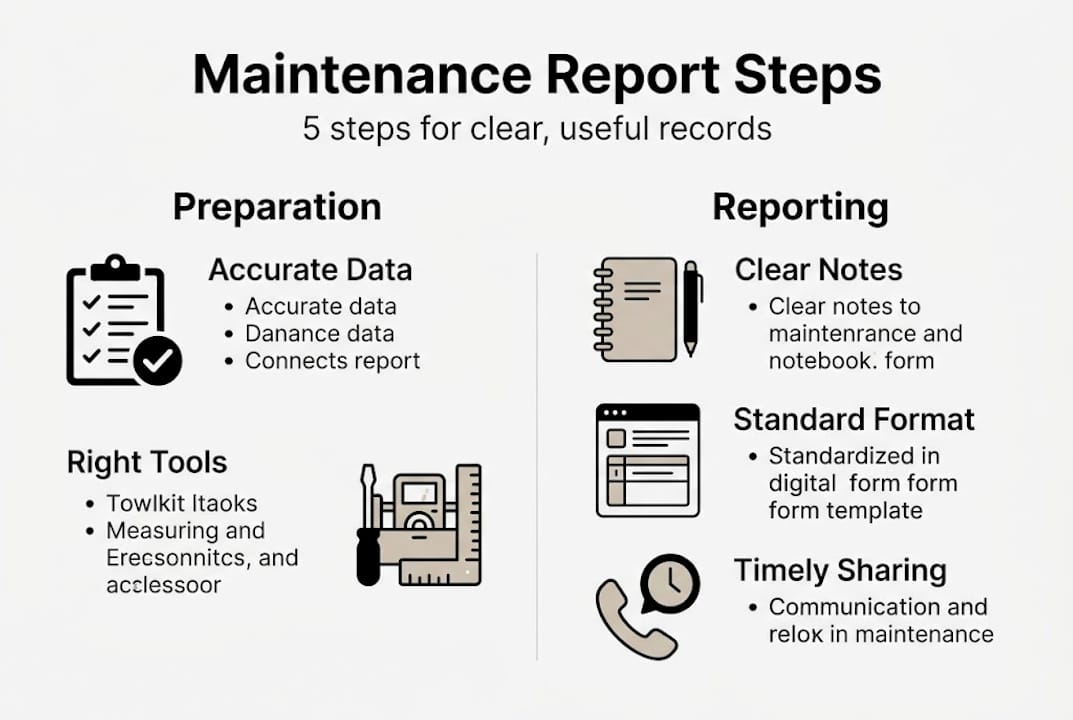
With your information and tools ready, follow this process to create your maintenance report:
- Define the report objective. State clearly whether this is a corrective, preventive, or inspection report. This shapes every section that follows.
- Record asset details. Include asset ID, location, age, and current operational status.
- Log date, time, and duration. Precise timestamps support compliance and help identify patterns over time.
- Detail the work performed. Use clear, technical language. Avoid vague terms like “checked” or “serviced” without specifics.
- Note parts replaced or consumed. Include part numbers, quantities, and supplier references.
- Record observations and anomalies. Flag anything outside normal parameters, even if no action was taken immediately.
- Add recommendations. Every report should end with a clear next step: schedule a follow-up, order a part, or escalate to an engineer.
- Obtain authorisation. A supervisor sign-off or digital approval closes the record formally.
Efficiency gains in reporting confirm that structured reporting leads to more actionable insights for facilities teams, particularly when formatting is consistent across all assets and sites.
| Aspect | Manual entry | Digital entry |
|---|---|---|
| Completion speed | 15 to 30 minutes | 5 to 10 minutes |
| Error frequency | High without checks | Low with validation rules |
| Compliance tracking | Manual cross-referencing | Automated flagging |
| Report distribution | Physical or email | Instant, role-based access |
Reports are as actionable as the accuracy and clarity of their data.
Reporting frequency matters too. Issue reports immediately after each maintenance session and distribute them to relevant stakeholders the same day. Monthly summaries should consolidate individual reports for leadership review. Use your maintenance scheduling guide to align report timing with asset service intervals.
Common challenges and best practices for accurate reporting
Even with a structured process, reporting accuracy can slip. Here is how to avoid the most common challenges:
The most frequent mistakes maintenance teams make include:
- Leaving mandatory fields blank due to time pressure
- Using inconsistent or unclear language that confuses the next reader
- Delaying entries until the end of a shift, when details are forgotten
- Failing to update templates when asset configurations change
- Omitting signatures or digital approvals, which invalidates records for compliance purposes
Compliance issues often stem from incomplete logs rather than deliberate negligence. A missing date, an unsigned field, or a regulatory code entered incorrectly can render an otherwise thorough report non-compliant. Improving maintenance record quality through regular auditing and staff training is one of the most effective interventions available to facility managers.
Best practices that consistently improve reporting quality:
- Conduct routine report audits on a monthly basis to catch recurring gaps
- Standardise templates across all sites and asset categories
- Train all technicians on both the technical and compliance requirements of each report section
- Archive digitally with access controls to protect sensitive operational data
- Review reports at handover so incoming shifts are immediately aware of outstanding actions
Pro Tip: Schedule a 15-minute weekly review of the previous week’s reports with your team lead. Catching errors early prevents them from becoming habits. Reviewing accuracy in HVAC reports provides a useful benchmark for the level of detail expected across asset categories.
The cost of a poorly completed report is always higher than the time it would have taken to complete it correctly.
How effective maintenance reports drive operational success
Once reports are accurate and well-structured, you gain major efficiency advantages across your operation. Facilities that implement structured, consistent reporting see up to 30% efficiency gains compared to those relying on ad hoc documentation.
For leadership teams, quality reports translate directly into better decision-making:
- Budget forecasting becomes more accurate when maintenance cost trends are visible over time
- Allocation des ressources improves when labour hours and parts usage are consistently tracked
- Procurement planning benefits from reliable data on component failure rates and replacement cycles
- Audit preparation is faster and less stressful when records are complete and searchable
Consider a facility that standardises its reporting across 200 pieces of equipment. Within six months, the maintenance team identifies three asset categories with disproportionately high corrective maintenance costs. With that data, management schedules targeted preventive interventions, reducing unexpected breakdowns by a measurable margin. That outcome is only possible because the reports existed, were accurate, and were reviewed systematically.
Long-term, robust reporting supports the full asset lifecycle. When you can trace an asset’s complete maintenance history, you make informed decisions about repair versus replacement, warranty claims, and capital investment planning. Reporting is not a back-office task; it is a strategic input to facility management efficiency at every level of the organisation.
Why the best maintenance reports prioritise clarity, not length
With these advantages in mind, here is our perspective from real-world reporting experience: many maintenance managers assume that a longer, more detailed report signals thoroughness. In practice, the opposite is often true.
Reports that run to multiple pages without clear structure are routinely skimmed or ignored, particularly during high-pressure operational periods. The technician who needs to act on a recommendation at 2 a.m. does not have time to locate it on page seven. Actionable summaries placed at the front of a report drive faster decisions and reduce the risk of critical information being missed.
The most effective principle we have observed is this: write for the next user, not just for the file. Every section should answer a question that someone else will need answered. Practical reporting advice consistently points to clarity and standardisation as the two factors that most improve report usability.
Pro Tip: Use brief, standard sections with clear headings so that any team member can retrieve the information they need within seconds, not minutes.
Next step: streamline your maintenance reporting with FullyOps
Ready to take your maintenance reporting to the next level? FullyOps is built specifically for industrial maintenance teams that need reliable, compliant, and integrated reporting without the administrative burden. The platform automates data capture, standardises templates across sites, and connects reporting directly to work order management and asset history. Explore the maintenance compliance checklist to ensure your current process meets regulatory requirements. Review the available types de systèmes de gestion d'actifs to find the right fit for your operation, and learn how gestion du cycle de vie des actifs within FullyOps supports long-term planning and audit readiness.
Questions fréquemment posées
What are the main components of an industrial maintenance report?
A standard maintenance report should include asset details, work completed, date and time, parts replaced, recommendations, and authorisation sign-off. These fields ensure the record is both operationally useful and compliant.
How often should maintenance reports be completed?
Reports should be completed after every maintenance session and summarised monthly or as specified by company policy. Routine and timely reporting increases reliability outcomes and supports consistent audit trails.
What is the benefit of using digital maintenance reporting tools?
Digital tools improve accuracy, speed up data entry, and help maintain compliance records securely. Using digital tools also enables integration with asset management systems for real-time visibility.
What can go wrong if maintenance reports are not completed properly?
Improper reports lead to lost information, audit failures, increased downtime, and higher costs. Accurate and timely reporting is crucial for maintaining operational integrity and avoiding preventable asset failures.