

En bref
- Cloud-based maintenance enables predictive asset management by leveraging IoT and automation.
- It reduces downtime and operating costs significantly compared to traditional reactive systems.
- A hybrid approach combining cloud, edge, and on-premise components optimizes safety, latency, and data security.
Cloud-based maintenance is not simply about replacing paper records with digital files. Operational managers who treat it that way leave the majority of the value on the table. The real opportunity lies in shifting from reactive, fire-fighting maintenance to predictive, cost-controlled asset management, where systems flag problems before they cause expensive failures. With avantages des logiciels de maintenance basés sur le cloud now well-documented across industrial sectors, the evidence is clear: organisations that adopt cloud-enabled maintenance strategies reduce downtime significantly, lower operating costs, and extend the productive life of critical assets in ways that traditional approaches simply cannot match.
Table des matières
- How cloud solutions transform maintenance strategies
- Key components and workflows: What cloud delivers
- Benchmarking the impact: ROI, cost, and downtime comparison
- Where cloud fits (and where it doesn’t): Hybrid architectures and challenges
- Best practices for cloud-enabled maintenance success
- Our perspective: The overlooked value of balanced architecture
- Make your next step towards smarter maintenance
- Questions fréquemment posées
Principaux enseignements
| Point | Détails |
|---|---|
| Maintenance prédictive | Cloud platforms enable proactive, IoT-driven strategies that drastically reduce unexpected failures and downtime. |
| Cost and ROI | Switching to cloud maintenance can save 20-30% in costs and up to 80% in long-term ownership expenses compared to on-premise. |
| Hybrid is essential | Edge-cloud approaches are needed for latency-critical safety operations or when dealing with legacy or classified assets. |
| Déploiement rapide | Modern cloud CMMS can be operational in days, not months, expediting efficiency gains. |
| Integration powers automation | Cloud solutions streamline maintenance by connecting directly with CMMS, ERP, and inventory tools. |
How cloud solutions transform maintenance strategies
Traditional maintenance operates on a simple principle: something breaks, you fix it. Predictive maintenance, enabled by cloud platforms, operates on a fundamentally different model. Sensors continuously stream data, algorithms detect anomalies, and work orders are generated automatically before failure occurs. The operational consequences of this shift are substantial.
IoT and predictive maintenance platforms aggregate data from hundreds or thousands of connected sensors, creating a continuous picture of asset health. Cloud solutions enable predictive maintenance by aggregating IoT sensor data and deploying machine learning models to anticipate failures, moving maintenance teams from reactive response to scheduled, condition-based interventions.
For operational managers, this translates into several concrete advantages:
- Réduction des temps d'arrêt non planifiés through early detection of developing faults in rotating equipment, electrical systems, and fluid handling assets
- Optimisation de l'allocation des ressources because maintenance teams can be scheduled around predicted failure windows rather than emergency call-outs
- Centralised analytics that allow benchmarking across sites, shifts, and asset classes
- Génération automatisée d'ordres de travail that removes manual administration and accelerates response times
- Continuous asset health records that support warranty claims, insurance assessments, and regulatory compliance
Energy firm ENGIE deployed AWS SageMaker to build predictive models across its infrastructure, and the ENGIE results demonstrated substantial improvements in both equipment availability and maintenance planning accuracy. This is not an isolated case. Across manufacturing, utilities, and facilities management, cloud platforms are consistently outperforming legacy maintenance systems on measurable operational indicators.
Pro Tip: Before selecting a cloud maintenance platform, map your highest-value, failure-prone assets first. Targeting those assets in your initial deployment generates the fastest and most measurable return on investment.
Centralised cloud analytics also allow managers to benchmark performance across multiple sites without requiring local IT infrastructure at each location. This is particularly valuable for organisations managing dispersed assets, where inconsistent data collection has historically made cross-site comparison unreliable.
Key components and workflows: What cloud delivers
Understanding that cloud maintenance is transformative is one thing. Knowing exactly which workflows improve, and how, is what enables informed procurement and implementation decisions.
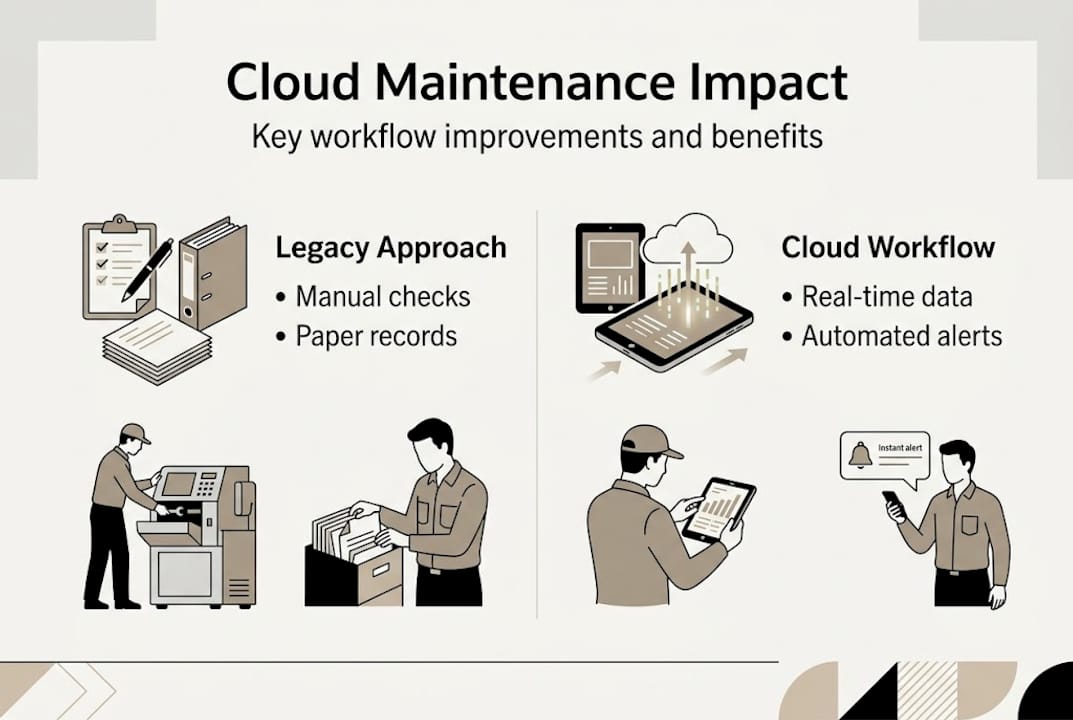
Cloud asset management features typically include real-time asset monitoring, anomaly detection alerts, automated work order creation, inventory tracking, compliance reporting, and integration with existing enterprise systems. Key methodologies include real-time asset monitoring, anomaly detection, automated work orders, and seamless integration with existing CMMS and ERP systems, all of which contribute directly to operational efficiency.
In practical terms, a well-configured cloud maintenance platform improves the following workflows:
- Asset health monitoring: Continuous sensor data feeds into dashboards that flag degrading performance before it reaches failure thresholds.
- Work order automation: Anomalies trigger pre-configured work orders, assigned to available technicians based on location, skill set, and priority.
- Inventory management: Parts consumption linked to work orders updates stock levels in real time, reducing both shortages and excess stock.
- Compliance and reporting: Maintenance records are stored centrally, with automated reports generated for audit, regulatory, and client-facing purposes.
- Access control and policy enforcement: Role-based permissions ensure that technicians, supervisors, and managers each see the data and actions relevant to their function.
| Workflow area | Legacy system capability | Cloud-enabled capability |
|---|---|---|
| Asset monitoring | Manual inspection cycles | Continuous real-time sensor data |
| Work order creation | Manual entry after fault reported | Automated on anomaly detection |
| Suivi des stocks | Periodic manual counts | Real-time consumption-linked updates |
| Compliance reporting | Manual data collation | Automated scheduled reports |
| Cross-site visibility | Limited, siloed data | Centralised, unified dashboards |
When choosing the right maintenance system, integration capability is one of the most critical selection criteria. A cloud platform that cannot communicate with your existing ERP or CMMS will create data silos rather than eliminating them.
Pro Tip: Request a live integration demonstration with your current ERP before committing to any cloud maintenance platform. Promised integrations that require significant custom development often introduce hidden costs and delays.
Benchmarking the impact: ROI, cost, and downtime comparison
Decision-makers need numbers, not promises. The empirical evidence for cloud-enabled maintenance is now robust enough to support confident investment decisions.
Empirical benchmarks show that cloud maintenance delivers 30 to 42% downtime reduction and 20 to 30% savings in maintenance operating costs across a range of industrial applications. These are not theoretical figures; they reflect documented outcomes from real deployments.
On total cost of ownership, the difference between cloud and on-premise solutions is stark. Cloud CMMS offers 60 to 80% lower five-year total cost of ownership compared to on-premise systems, with deployment measured in days rather than months. For organisations carrying the capital expenditure and IT overhead of legacy infrastructure, this gap is a decisive factor.
“ENGIE’s predictive maintenance programme, built on cloud and machine learning infrastructure, delivers approximately €800,000 in annual operational benefits, with measurable improvements in equipment availability and maintenance scheduling accuracy.”
For further context on quantifying financial outcomes, tracking maintenance costs in a structured way is essential before and after any cloud deployment, as it provides the baseline data needed to demonstrate return on investment.
Manufacturer Arneg provides another instructive example. The Arneg cost savings case shows how cloud-enabled asset management reduced operational costs and improved service reliability across a distributed equipment network.
Key ROI indicators to track:
- Mean time between failures (MTBF): Should increase as predictive interventions prevent premature failures
- Mean time to repair (MTTR): Should decrease as automated work orders and inventory availability improve response
- Maintenance cost per asset: Should fall as reactive emergency repairs are replaced by planned preventive interventions
- Asset utilisation rate: Should improve as unplanned downtime events are reduced
Where cloud fits (and where it doesn’t): Hybrid architectures and challenges
Cloud is not the answer to every maintenance challenge. Managers who understand the boundaries of cloud-only approaches are better positioned to design systems that genuinely perform under real operating conditions.
The most significant limitation of pure cloud architectures is latency. When a safety-critical sensor detects a dangerous condition, the response must be instantaneous. Routing that signal to a cloud server and waiting for a response, even milliseconds, may be unacceptable in certain environments. Hybrid edge-cloud systems address cases like latency-sensitive safety tasks and poor connectivity by blending local processing at the asset with cloud-based analytics and governance.
Review the maintenance platform comparison resources to understand how hybrid architectures are being deployed across different industrial sectors in 2026.
In a hybrid model:
- Edge devices handle real-time, safety-critical processing locally, ensuring instant response regardless of network conditions
- Cloud platforms manage historical analytics, reporting, policy governance, and cross-site benchmarking
- On-premise systems retain control over classified data or legacy equipment that cannot be connected to external networks
Les real-time edge AI approach is gaining traction in high-speed manufacturing and process industries, where network latency cannot be tolerated in operational control loops.
“The most effective cloud maintenance architectures are not purely cloud-based. They assign each processing task to the tier, edge, cloud, or on-premise, that is best suited to handle it reliably and cost-effectively.”
It is worth noting that over 80% of new maintenance system deployments still select cloud as the primary platform for analytics, reporting, and automation. The edge and on-premise components are supplements, not replacements, for cloud capability in the vast majority of industrial contexts.
Best practices for cloud-enabled maintenance success
Implementation quality determines whether cloud maintenance delivers its promised returns. The following steps reflect proven approaches for operational managers leading adoption programmes.
- Pilot with critical assets first: Decision-makers should pilot with critical assets and focus on total cost of ownership, including data usage costs, before scaling across the asset base.
- Establish baseline metrics before deployment: Without pre-implementation data, demonstrating ROI post-deployment becomes speculative rather than factual.
- Document all integration requirements: Map every existing system, CMMS, ERP, inventory platform, that will need to connect with the cloud solution before procurement.
- Monitor data egress costs: Cloud pricing models can produce unexpected costs when large volumes of sensor data are transferred between systems or regions.
- Scale gradually and measure at every stage: Expanding too quickly before early results are analysed risks replicating inefficiencies at larger scale.
For managers exploring cloud-based predictive frameworks, the academic and industry literature consistently supports phased, metrics-driven adoption as the most reliable path to sustained performance improvement.
Pro Tip: Assign a dedicated ROI owner within your operations team, someone whose responsibility includes tracking and reporting on the financial and operational outcomes of the cloud deployment at regular intervals.
When selecting maintenance software, prioritise vendors who offer structured onboarding, documented integration pathways, and transparent pricing that includes data usage costs.
Our perspective: The overlooked value of balanced architecture
Many organisations approach cloud adoption as an all-or-nothing decision. The assumption is that moving everything to the cloud is the modernisation goal, and anything left on-premise or at the edge represents a compromise or a legacy burden. We think this framing is counterproductive.
Cloud platforms deliver the greatest value in analytics, centralised reporting, automation, and governance. These are exactly the areas where traditional maintenance systems have been weakest. However, safety-critical, latency-sensitive processing belongs at the edge, close to the asset, where response times are measured in microseconds rather than milliseconds.
ROI assessment is also not a one-time exercise. As workloads grow, data volumes increase, and technology evolves, the cost-benefit calculation for cloud versus edge versus on-premise shifts. Organisations that run ROI reassessments annually, rather than treating the initial business case as permanent, are better positioned to adjust their architecture and avoid cost overruns. The cloud software efficiency insights available today make this kind of ongoing evaluation more practical than it has ever been. Balanced architecture is not a compromise. It is the most informed and operationally sound approach available.
Make your next step towards smarter maintenance
If the evidence in this article has prompted you to reassess your current maintenance approach, FullyOps offers a range of resources to help you move from analysis to action. Explore the full guide to asset management system options to understand which platform architecture best fits your operational profile. For longer-term planning, the gestion du cycle de vie des actifs guide provides a structured framework for maximising asset value from procurement through decommissioning. Managers looking to optimise team deployment alongside technology can also find practical direction in the allocation des ressources pour la gestion d'actifs tutorial. Each resource is designed to support operational decision-makers at every stage of their maintenance modernisation journey.
Questions fréquemment posées
What are the main benefits of cloud solutions in maintenance?
Cloud solutions cut downtime by up to 42% and lower maintenance operating costs by 20 to 30%, while enabling centralised automation and analytics that reduce manual intervention across asset portfolios.
How do cloud and on-premise maintenance solutions differ?
Cloud-based systems deploy in days rather than months and deliver 60 to 80% lower TCO over five years, whereas on-premise solutions remain better suited to environments with strict data security requirements or legacy system constraints.
Are there maintenance tasks unsuitable for pure cloud solutions?
Yes. Latency-critical tasks need edge computing, and safety-critical operations in particular benefit from hybrid edge-cloud architectures that guarantee instant local response regardless of network availability.
Can cloud maintenance be integrated with my existing ERP or CMMS?
Leading cloud platforms support integration with CMMS and ERP systems as a core capability, enabling automated work order flows, inventory synchronisation, and policy enforcement across connected enterprise tools.