

En bref
- Machine condition monitoring uses IoT sensors and AI analytics to proactively track equipment health and detect faults early. It enables organizations to shift from reactive maintenance to predictive strategies, reducing downtime and extending asset lifespan. Successful implementation requires continuous data collection, sensor synchronization, and integration with maintenance workflows to maximize operational benefits.
Machine condition monitoring is defined as a proactive, data-driven process that continuously tracks the health of industrial equipment using IoT sensors and AI analytics to detect early signs of deterioration before breakdowns occur. The practice monitors parameters including vibration, temperature, pressure, and acoustic emissions, enabling operations teams to shift from reactive or calendar-based maintenance to a genuinely maintenance prédictive model. For industrial professionals managing motors, compressors, pumps, and rotating machinery, understanding this discipline is the foundation of any credible asset reliability strategy.
What is machine condition monitoring and why does it matter?
Machine condition monitoring is a proactive maintenance strategy that uses IoT sensors and AI analytics to continuously track parameters like vibration, temperature, and acoustic emissions, detecting early deterioration before breakdowns occur. The condition monitoring definition, as recognised across ISO standards and industrial practice, describes it as the ongoing measurement and interpretation of equipment data to identify changes that indicate developing faults. This distinguishes it from periodic inspection, which captures only a snapshot in time and misses the gradual degradation patterns that precede most failures.
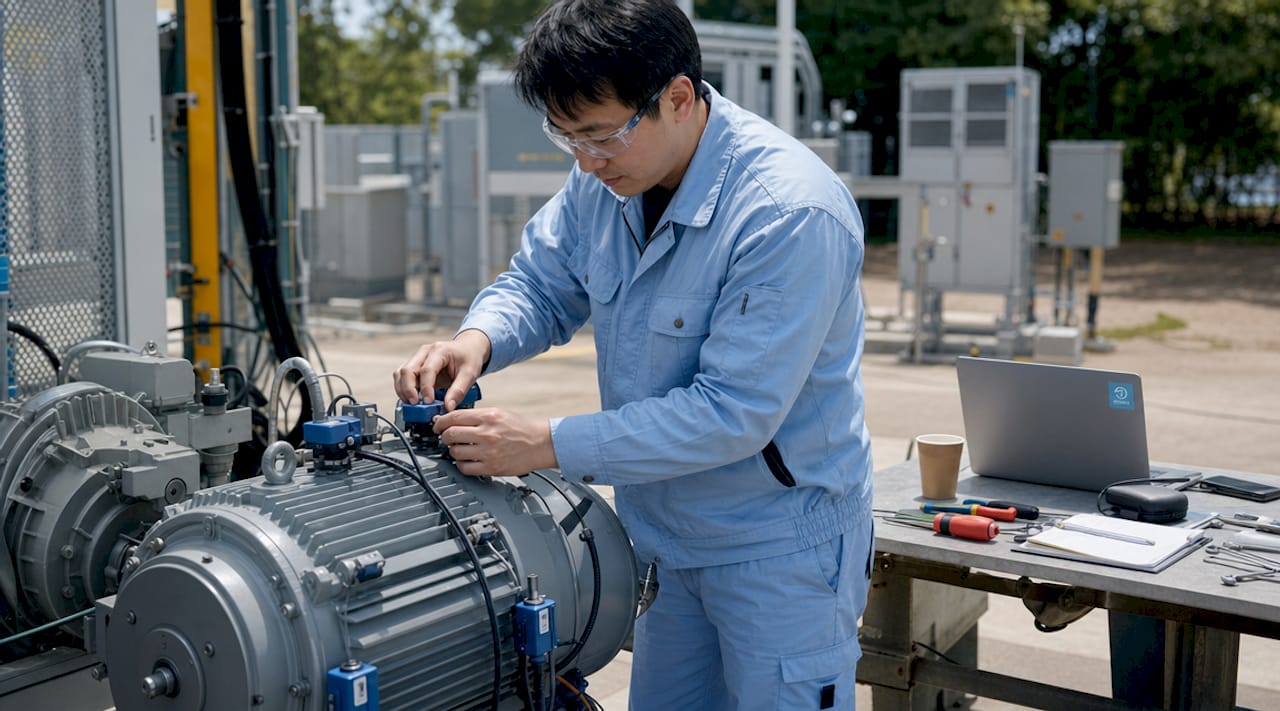
The strategic purpose is clear: organisations that implement condition monitoring gain advance warning of faults, often weeks or months before a failure would otherwise halt production. This lead time is what makes the difference between a planned repair during scheduled downtime and an unplanned stoppage that cascades across an entire production line. For operations managers, the business case is straightforward. Unplanned downtime costs manufacturing businesses significantly more than the equivalent planned maintenance intervention, both in direct repair costs and lost production output.
The term “machine condition monitoring” is sometimes used interchangeably with “equipment health monitoring” or “asset condition monitoring” in industry literature. All three describe the same foundational process: continuous data collection from physical assets, followed by analysis to assess current health and forecast future performance. The key word is continuous. Periodic checks, however thorough, cannot replicate the resolution of real-time sensor data streaming from a running machine.
Which parameters and sensor technologies are used?
The selection of monitored parameters depends on the machine type, failure modes of concern, and the criticality of the asset. That said, several sensor technologies appear consistently across industrial condition monitoring programmes.
- Vibration sensors (accelerometers): Vibration analysis is the most common technique for rotating equipment, capable of identifying bearing faults, misalignment, and lubrication issues months before failure. It is the primary technique for motors, gearboxes, fans, and pumps.
- Temperature sensors and thermal cameras: Infrared thermography detects hotspots in electrical panels, motors, and mechanical couplings. Resistance temperature detectors (RTDs) and thermocouples provide continuous point measurements for bearings and windings.
- Acoustic emission sensors: These detect high-frequency stress waves generated by crack propagation, friction, and fluid leakage. They are particularly effective for slow-speed bearings and pressure vessels where vibration signals are weak.
- Pressure and flow sensors: Used in hydraulic systems, compressors, and pipelines to detect blockages, valve degradation, and seal failures.
- Current and power monitoring: Motor current signature analysis (MCSA) identifies electrical faults and mechanical load changes without physical contact with the machine.
Multi-sensor fusion, which integrates data from force, temperature, sound, and visual sensors simultaneously, improves fault detection and Remaining Useful Life (RUL) estimation compared to single-sensor approaches. The combination of signal types provides a more complete picture of machine health, reducing both false positives and missed faults.
Wireless sensor systems have expanded the reach of condition monitoring considerably. Remote monitoring via wireless sensors allows maintenance staff to access equipment health data from any location via computer or mobile device, which is particularly valuable in large facilities or geographically distributed sites. Wired systems remain preferred where data throughput, latency, or electromagnetic interference is a concern.
Conseil de pro : Place vibration sensors as close as possible to the bearing housing in the load zone, and synchronise all sensors on a shared hardware trigger or network time protocol (NTP) to avoid temporal misalignment in multi-sensor setups. Misaligned timestamps are one of the most common sources of false alarms in newly commissioned systems.
How do condition monitoring systems collect and analyse data?
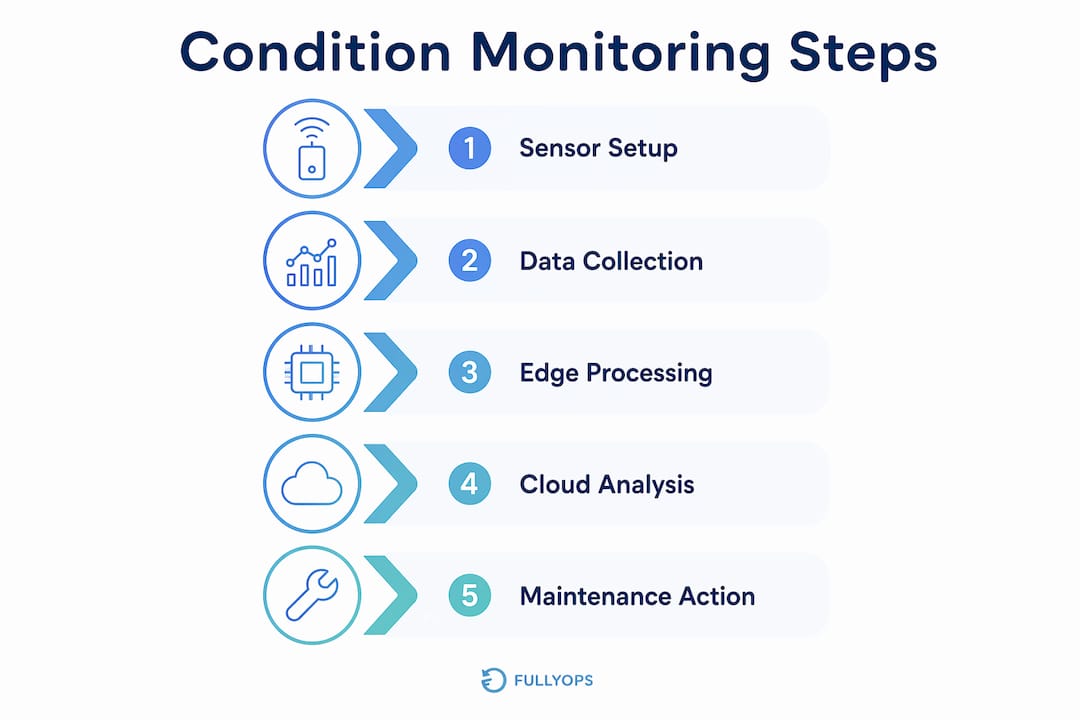
The data pipeline in a modern condition monitoring system moves from physical sensor through edge processing to cloud analytics, with each layer serving a distinct purpose.
| Architecture layer | Primary function | Typical technology |
|---|---|---|
| Sensor and DAQ | Raw signal acquisition | Accelerometers, RTDs, acoustic sensors, PLCs |
| Edge computing | Local pre-processing and alerting | Industrial gateways, embedded AI modules |
| Cloud platform | Advanced analytics and storage | SCADA, CMMS, AI/ML analytics platforms |
| Integration layer | Work order and ERP connectivity | API connectors, CMMS/EAM integration |
Edge-cloud collaboration is now the dominant architecture, with 46.3% of models implementing model-centric knowledge exchange to balance real-time accuracy and communication latency. This matters operationally because sending raw high-frequency vibration data continuously to the cloud is bandwidth-intensive and costly. Edge devices perform feature extraction and anomaly detection locally, transmitting only relevant events or compressed summaries to the cloud for deeper analysis.
AI and machine learning models sit at the analytical core of advanced systems. Two broad approaches exist: data-driven models that learn fault patterns from historical sensor data, and physics-based models that encode known failure mechanics. Hybrid models combining both deliver superior interpretability and fault diagnosis, because the physics layer constrains the model to physically plausible outputs while the data layer captures nuances that equations alone cannot represent.
Integrating condition monitoring with CMMS or EAM platforms enables automatic triggering of work orders when fault thresholds are breached, cutting response time and improving maintenance workflow efficiency. This closed-loop integration is where condition monitoring transitions from a data collection exercise into a genuine operational tool. Without it, alerts sit in a monitoring dashboard and rely on a technician to manually initiate a response.
Conseil de pro : When evaluating analytics platforms, check whether the system supports adaptive model retraining on new data. Static models trained once at commissioning degrade as equipment wear patterns and operating conditions evolve. A platform that cannot update its models will produce increasing false positives over time.
How does condition monitoring relate to predictive maintenance?
These three terms appear together constantly in maintenance literature, and conflating them leads to poor strategy decisions. The distinctions are precise and worth understanding clearly.
- Condition monitoring is the data collection process. It measures and records equipment parameters continuously or at defined intervals. It does not, by itself, trigger any maintenance action.
- Condition-based maintenance (CBM) uses condition monitoring data to trigger maintenance actions when a parameter crosses a defined threshold. The action is reactive to a measurement, not to a schedule or a failure.
- Predictive maintenance (PdM) applies advanced analytics, typically machine learning or statistical modelling, to condition monitoring data to forecast when a failure will occur and schedule intervention before it happens.
Mastering these distinctions enables better maintenance strategies. Condition monitoring is the foundation; CBM and PdM are the decision frameworks built on top of it. You cannot implement effective predictive maintenance without reliable condition monitoring data, but condition monitoring alone does not constitute a predictive maintenance programme. For operations managers, this means the investment sequence matters: get the sensing and data infrastructure right before deploying predictive analytics.
Les practical relationship between condition monitoring and condition-based maintenance is best understood through a concrete example. A vibration sensor on a pump bearing streams data continuously. The condition monitoring system records that data. When the RMS vibration amplitude exceeds a set threshold, the CBM rule triggers a work order for bearing inspection. If a predictive model is also running, it may forecast that the bearing will reach a critical failure state in 14 days, allowing the maintenance team to schedule the replacement during the next planned shutdown rather than responding reactively to the threshold breach.
What are the key benefits of condition monitoring in practice?
The operational benefits of a well-implemented condition monitoring programme are measurable and well-documented across industrial sectors.
- Reduced unplanned downtime: Early fault detection gives maintenance teams the lead time to plan interventions, avoiding the production losses and emergency repair premiums associated with unexpected failures.
- Optimised maintenance scheduling: Rather than replacing components on a fixed calendar cycle regardless of actual condition, teams replace them when data indicates they are approaching end of life. This reduces unnecessary maintenance labour and parts consumption.
- Extended equipment lifespan: Catching developing faults early, such as lubrication degradation or minor misalignment, prevents secondary damage that would otherwise accelerate asset deterioration.
- Improved workforce utilisation: Maintenance technicians spend time on confirmed issues rather than routine inspections of healthy equipment, improving productivity and morale.
- Reduced safety risk: Detecting mechanical failures before they become catastrophic reduces the risk of accidents involving rotating machinery, high-pressure systems, or electrical equipment.
Les IoT-driven transformation of maintenance has made condition monitoring accessible to facilities that previously lacked the infrastructure or budget for dedicated monitoring systems. Wireless sensors and cloud-based analytics platforms have lowered both the capital cost and the technical complexity of deployment.
For motors, pumps, and compressors specifically, vibration and temperature monitoring together cover the majority of failure modes encountered in practice. Adding acoustic emission monitoring for slow-speed bearings or current monitoring for motor electrical faults extends coverage to the remaining high-risk failure categories. The combination creates a monitoring programme that addresses the asset’s full failure mode profile rather than only the most obvious indicators.
Closing the loop with automated work orders is where condition monitoring delivers its strongest return on investment. When a fault alert automatically generates a prioritised work order in the CMMS, assigns it to the relevant technician, and attaches the sensor data as supporting evidence, the response time compresses from hours or days to minutes. This integration capability should be a primary evaluation criterion when selecting a condition monitoring platform.
Conseil de pro : Start with your highest-criticality assets, those whose failure causes the greatest production impact or safety risk, rather than attempting to monitor everything simultaneously. A focused programme on ten critical machines delivers more value faster than a diluted programme across one hundred.
Principaux enseignements
Machine condition monitoring is the data collection foundation that makes both condition-based and predictive maintenance possible, and its value is realised only when integrated with maintenance workflows.
| Point | Détails |
|---|---|
| Condition monitoring definition | Continuous measurement of equipment parameters to detect developing faults before failure occurs. |
| Core sensor technologies | Vibration, temperature, acoustic emission, and current sensors each address distinct failure modes. |
| Data architecture matters | Edge-cloud collaboration reduces latency; CMMS integration closes the loop from alert to work order. |
| Three distinct concepts | Condition monitoring collects data; CBM acts on thresholds; predictive maintenance forecasts failures. |
| Start with critical assets | Prioritise high-impact machines first to maximise return on monitoring investment. |
Where most condition monitoring programmes go wrong
Having worked closely with industrial maintenance teams across a range of sectors, the pattern I see most often is this: organisations invest in sensors and a monitoring platform, complete the installation, and then treat the system as finished. They do not account for the fact that machines change over time. Bearings wear in, operating loads shift, and the baseline vibration signature of a motor six months after commissioning looks different from the one captured on day one. Static monitoring systems become obsolete as operating conditions change, and a system that cannot adapt its models will generate increasing false alarms until technicians stop trusting it entirely.
The second failure mode I encounter is poor sensor synchronisation in multi-sensor setups. Temporal misalignment of sensor data causes noise and errors that produce false positives or, worse, missed faults. This is a commissioning problem that is entirely preventable, yet it is routinely overlooked because the system appears to be working at launch.
The direction the field is moving is genuinely promising. Digital twins and simulation-augmented datasets address one of the most persistent challenges in condition monitoring: the scarcity of real fault data for training predictive models. Most machines do not fail often enough to generate a statistically meaningful fault dataset. Synthetic data generated from physics-based simulations fills that gap and makes deep learning models far more robust in practice.
My honest recommendation for operations managers is this: treat condition monitoring as a data culture initiative, not a technology installation. The sensors and software are the easy part. The harder work is building the organisational habit of acting on data, integrating alerts into maintenance workflows, and continuously refining models as the equipment and operating environment evolve.
— Pedro
How Fullyops supports your condition monitoring strategy
Condition monitoring generates data. The question is what your organisation does with it. Fullyops connects the output of your monitoring systems to structured maintenance workflows, enabling automatic work order generation, technician assignment, and operational reporting in one platform. For operations managers looking to move beyond spreadsheets and disconnected tools, the tutoriel sur l'allocation des ressources on the Fullyops site provides a practical starting point for aligning maintenance resources with asset criticality. You can also explore the types of asset management systems suited to industrial maintenance environments to understand where condition monitoring data fits within a broader asset management architecture.
FAQ
What is the condition monitoring definition in industrial maintenance?
Condition monitoring is the continuous measurement and interpretation of equipment parameters, such as vibration, temperature, and acoustic emissions, to identify changes that indicate developing faults. It forms the data foundation for both condition-based and predictive maintenance strategies.
How does condition monitoring differ from predictive maintenance?
Condition monitoring collects equipment health data continuously; predictive maintenance applies analytics to that data to forecast when a failure will occur. The two are complementary: predictive maintenance cannot function without reliable condition monitoring data.
Which machines benefit most from condition monitoring?
Rotating equipment including motors, pumps, compressors, fans, and gearboxes benefit most, as vibration and temperature monitoring cover the majority of their common failure modes. High-criticality assets with significant downtime impact should be prioritised first.
What sensors are used in machine monitoring techniques?
The most common sensors are accelerometers for vibration, RTDs and thermocouples for temperature, acoustic emission sensors for crack detection, and current transformers for motor electrical analysis. Multi-sensor fusion combining several of these improves fault detection accuracy.
Can condition monitoring integrate with existing maintenance software?
Yes. Modern condition monitoring platforms integrate with CMMS and EAM systems via APIs, enabling automatic work order creation when fault thresholds are breached and reducing manual intervention in the fault-to-repair workflow.