

En bref
- Remote monitoring uses sensors and software to track industrial asset conditions in real time, enabling predictive maintenance. Connecting sensor data to work order systems automates responses, reducing downtime and improving efficiency. Proper configuration and integration are essential for maximizing its operational benefits.
Remote monitoring is defined as the continuous, real-time observation of industrial assets using interconnected sensors, communication networks, and centralised software platforms. Operations managers use it to track equipment health, detect faults early, and shift maintenance from reactive repairs to predictive interventions. IoT sensors and centralised platforms now make this possible across distributed sites without requiring physical presence. The result is a fundamental change in how maintenance teams manage asset lifecycles and allocate resources.
What is remote monitoring and how does it work?
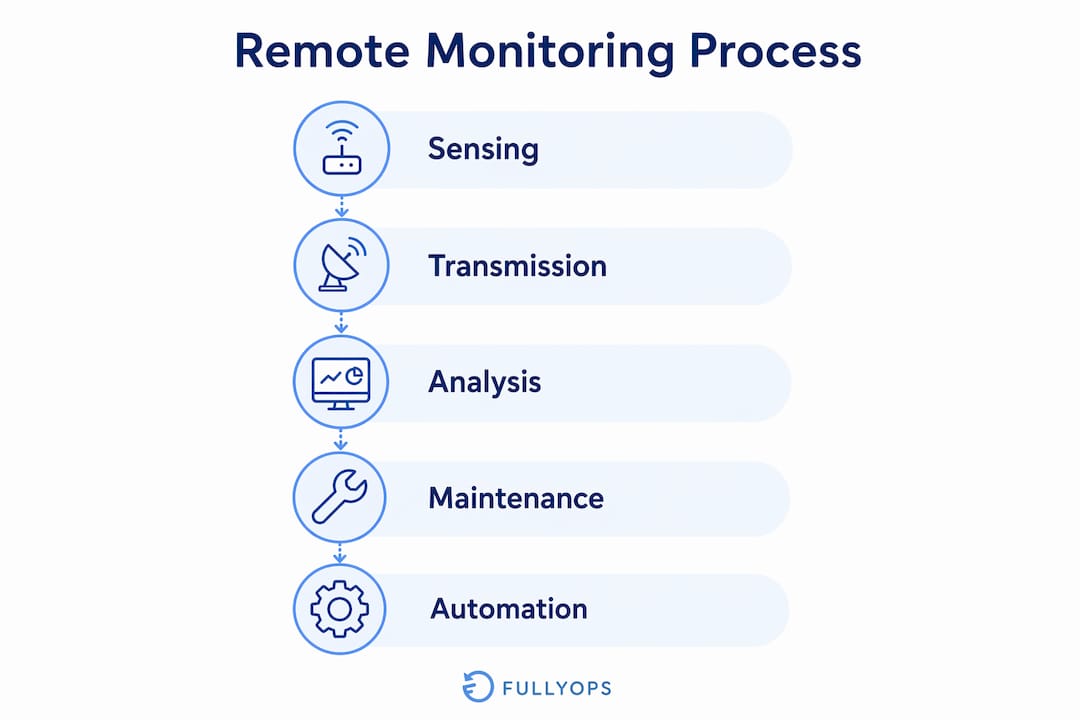
Remote monitoring systems follow a three-layer architecture: sensing, transmission, and analysis. Each layer must function reliably for the system to deliver accurate, actionable data to your operations team.
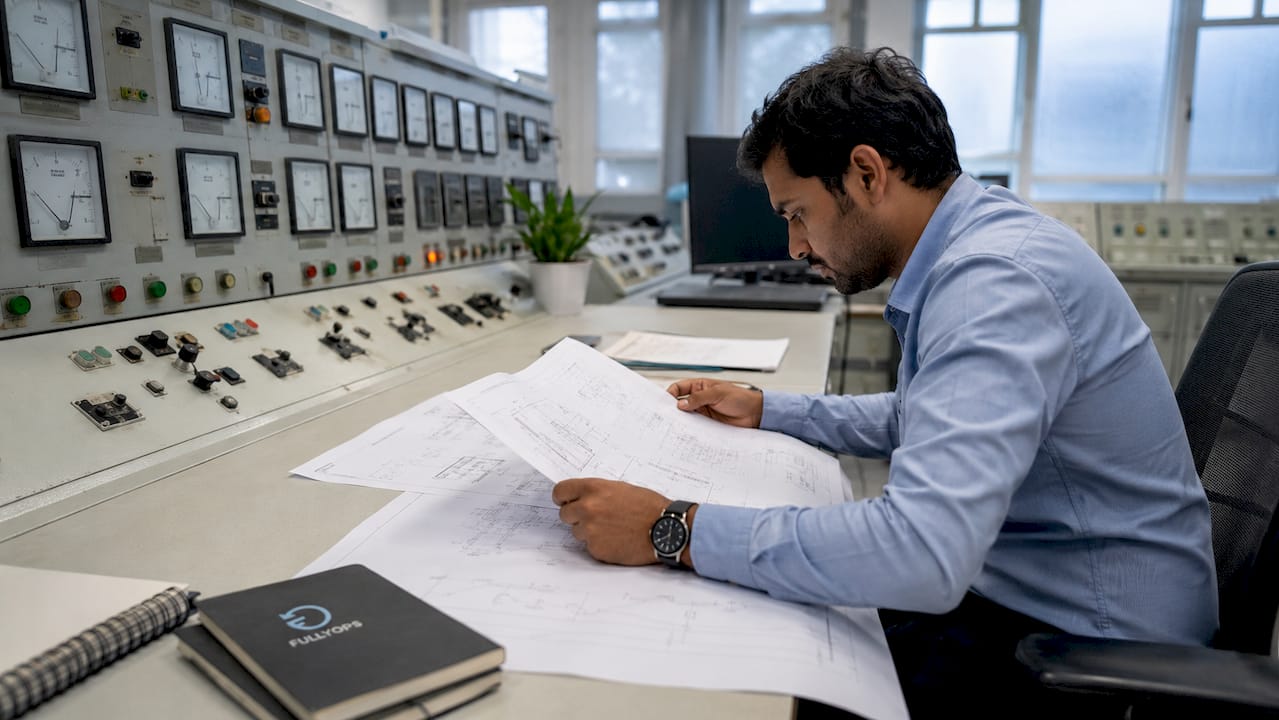
The sensing layer consists of physical instruments attached directly to equipment. These measure variables such as temperature, vibration, pressure, current draw, and flow rate. Each sensor produces a continuous data stream that reflects the real-time condition of the asset it monitors.
The transmission layer carries that data to a centralised platform. Industrial environments typically use communication protocols such as Modbus, OPC UA, or MQTT to move data from edge devices to cloud or on-premise servers. Cellular, Wi-Fi, and wired Ethernet connections all serve this purpose, depending on site conditions.
The analysis layer is where raw data becomes operational intelligence. Software platforms aggregate readings, apply threshold rules, and surface alerts when values fall outside acceptable ranges. Dashboards give maintenance professionals a live view of asset health across an entire facility or fleet.
| Couche | Composants | Fonction |
|---|---|---|
| Sensing | Temperature, vibration, pressure sensors | Capture real-time asset condition data |
| Transmission | Modbus, OPC UA, MQTT, cellular, Ethernet | Move data from edge devices to platform |
| Analysis | Cloud or on-premise software, dashboards | Aggregate, analyse, and alert on asset data |
Conseil de pro : Validate signal strength and protocol compatibility at each sensor location before configuring your dashboards. Reliable edge connectivity is the most common failure point in new deployments, and fixing it after rollout costs far more time than resolving it upfront.
What are the key benefits of remote monitoring?
The primary benefit of remote monitoring systems is the shift from reactive to predictive maintenance. Reactive maintenance waits for failure. Predictive maintenance acts on early warning signals, reducing both repair costs and unplanned downtime.
Continuous asset monitoring produces several measurable operational advantages:
- Reduced unplanned downtime. Sensors detect abnormal vibration or temperature trends before they cause failure, giving maintenance teams time to schedule repairs during planned windows.
- Lower repair costs. Catching faults early prevents minor issues from escalating into major component replacements.
- Optimised maintenance scheduling. Condition-based data replaces fixed-interval service schedules, so teams only intervene when assets actually need attention. This is particularly relevant for HVAC preventive maintenance, where condition data can replace calendar-based service cycles.
- Improved safety and compliance. Continuous monitoring flags hazardous conditions such as pressure spikes or overheating before they reach dangerous levels, supporting regulatory compliance.
- Better resource allocation. Real-time visibility across multiple assets lets managers direct technicians to the highest-priority tasks rather than relying on manual inspection rounds.
Correlating multi-sensor data to detect compound failures is where remote monitoring delivers its greatest value. A single vibration reading may be inconclusive. Vibration combined with rising temperature and increased current draw points clearly to bearing degradation. That combination is what separates operational intelligence from simple data collection.
What challenges come with implementing remote monitoring?
Remote monitoring technology delivers real value, but implementation carries practical difficulties that operations managers must address directly. Ignoring them leads to systems that generate noise rather than insight.
The most common challenges are:
- Connectivity gaps. Industrial environments contain metal structures, thick walls, and electromagnetic interference that degrade wireless signals. Protocol incompatibility between legacy equipment and modern IoT gateways also causes data gaps.
- Alert fatigue. Generic threshold settings trigger too many low-priority alerts. Maintenance teams begin ignoring warnings, which defeats the purpose of continuous monitoring.
- Data silos. Fragmented data across ERP, MES, and sensor platforms prevents unified situational awareness. Operators cannot make confident decisions when asset data lives in disconnected systems.
- Integration complexity. Connecting sensor data to existing operational software requires careful mapping of data formats, communication protocols, and access permissions.
Conseil de pro : Configure custom alert thresholds per asset class from day one, not after your team has already started ignoring alerts. A compressor and a conveyor motor have different normal operating ranges. Treating them identically guarantees alert fatigue within weeks.
Addressing data silos is the most strategically important challenge. Unified data platforms that connect sensor readings with ERP and MES records give operators complete situational awareness. Without that integration, remote monitoring remains a visibility tool rather than a decision-making engine.
How does remote monitoring support advanced maintenance strategies?
Remote monitoring technology becomes most powerful when it connects directly to maintenance workflows and automated systems. Visibility alone does not reduce downtime. Action does.
The progression from basic monitoring to advanced maintenance strategy follows a clear sequence:
- Condition-based maintenance. Sensor data replaces fixed service intervals. Assets receive maintenance when their condition data indicates it is needed, not because a calendar date has passed.
- Predictive maintenance. Machine learning models analyse historical sensor trends to forecast failure windows. Maintenance teams receive advance notice measured in days or weeks, not hours.
- Automated remediation. Systems can execute resolutions without human intervention, such as restarting a process, adjusting a setpoint, or isolating a faulty circuit. This frees technicians for tasks that require physical presence and judgement.
- Digital work order integration. When a sensor alert crosses a defined threshold, the system automatically generates a work order and assigns resources based on technician availability and skill. This removes the manual step between detection and response.
- Operational analytics. Aggregated monitoring data feeds performance dashboards that reveal patterns across assets, shifts, and sites. Managers use this to refine maintenance strategies and justify capital investment decisions.
Integrating IoT monitoring with digital work order systems is the step that converts sensor data into measurable efficiency gains. Without that connection, monitoring data sits in a dashboard and waits for someone to act on it. With it, the system acts on its own and escalates only when human judgement is required. For operations managers researching smart maintenance strategies, this integration is the defining capability that separates mature programmes from basic monitoring deployments.
Automated remediation represents the leading evolution in this field. Teams that previously spent significant time on manual troubleshooting can redirect that effort toward planned improvement work. The shift is not just operational. It changes how maintenance departments are structured and how their performance is measured.
Principaux enseignements
Remote monitoring delivers its full value only when sensor data connects directly to maintenance workflows, automated alerts, and integrated operational software.
| Point | Détails |
|---|---|
| Three-layer architecture | Every system requires reliable sensing, transmission, and analysis layers to function accurately. |
| Predictive over reactive | Condition-based data replaces fixed intervals, reducing unplanned downtime and repair costs. |
| Edge connectivity first | Validate signal strength and protocol compatibility before configuring dashboards or alerts. |
| Custom alert thresholds | Configure thresholds per asset class from day one to prevent alert fatigue and missed warnings. |
| Integration drives action | Connecting sensor data to work order systems and ERP converts visibility into measurable efficiency gains. |
Why most remote monitoring deployments underperform
Operations managers often deploy remote monitoring expecting the dashboards to do the work. They rarely do. The insight I keep returning to, after working with industrial maintenance teams across multiple sectors, is that the technology is almost never the limiting factor. The limiting factor is almost always what happens after the alert fires.
Teams that see the most improvement are not the ones with the most sensors. They are the ones that connected their monitoring data to their work order process from the start. When an alert triggers a digital work order automatically, response time drops and nothing falls through the cracks. When it just lights up a dashboard, it depends entirely on who happens to be looking.
The other mistake I see repeatedly is treating all assets identically. A centrifugal pump and a hydraulic press do not share the same failure modes or the same acceptable operating ranges. Generic thresholds produce generic alerts, and generic alerts get ignored. The teams that configure asset-specific parameters from day one are the ones still using their monitoring systems effectively two years later.
Remote monitoring is not a visibility tool. It is an operational intelligence platform. The distinction matters because it changes what you build around it.
— Pedro
How Fullyops connects monitoring data to maintenance action
Fullyops is a field service and asset management platform built for industrial operations teams that need more than a monitoring dashboard. When sensor alerts connect to gestion des ordres de travail and resource allocation workflows, the gap between detection and resolution closes. Fullyops links real-time asset data to digital work orders, technician scheduling, and inventory tracking in a single platform. Operations managers can also use the resource allocation tutorial to see how monitoring data maps directly to workforce planning and maintenance efficiency. For teams ready to move from reactive repairs to condition-based operations, Fullyops provides the operational layer that makes monitoring data count.
FAQ
What is remote monitoring in industrial maintenance?
Remote monitoring is the continuous observation of industrial assets using sensors, communication networks, and software platforms to track equipment condition in real time. It enables maintenance teams to detect faults early and act before failures occur.
How does remote monitoring work?
Sensors attached to equipment measure variables such as temperature, vibration, and pressure, then transmit data via protocols like Modbus or OPC UA to a centralised platform. The platform analyses the data, surfaces alerts, and displays asset health on operator dashboards.
What are the main benefits of remote monitoring systems?
The main benefits include reduced unplanned downtime, lower repair costs, condition-based maintenance scheduling, improved safety compliance, and better resource allocation across distributed assets.
What causes alert fatigue in remote monitoring?
Alert fatigue occurs when monitoring systems use generic thresholds that trigger too many low-priority warnings. Configuring custom thresholds per asset class from the start prevents maintenance teams from ignoring critical alerts.
How does remote monitoring connect to work order management?
When sensor data integrates with digital work order systems, threshold breaches automatically generate work orders and assign technicians based on availability and skill. This removes the manual step between fault detection and maintenance response.
Recommandé
- What is real-time monitoring: a 2026 operations guide
- Real-time intervention tracking: an industrial guide
- Top 4 maintenance software for industrial companies 2026