

Juggling maintenance schedules and budgets often feels overwhelming for HVAC operations teams tasked with managing hundreds of assets. Consistent data gaps or fragmented information can send costs soaring and stall important decisions. Embracing asset lifecycle data management allows businesses to transform scattered records into actionable insights, supporting more effective planning and reducing long-term spend. This approach empowers operations managers to move from firefighting unexpected issues to building a clear, cost-efficient strategy for every asset’s journey.
Table des matières
- Defining Asset Lifecycle Data Management
- Types of Data Across Asset Stages
- How Data Optimises Maintenance Strategies
- Integrating Data For Operational Visibility
- Common Data Challenges And Cost Impacts
Principaux enseignements
| Point | Détails |
|---|---|
| Strategic Asset Insights | Asset Lifecycle Data Management transforms raw data into actionable insights that improve organisational efficiency and financial performance. |
| Integrated Data Systems | Investing in centralised data management systems enhances data collection, quality, and accessibility across departments. |
| Proactive Maintenance Approaches | Data-driven maintenance strategies reduce unexpected failures and optimise resource allocation by leveraging predictive analytics. |
| Addressing Data Challenges | Recognising and addressing data fragmentation and quality issues can significantly enhance operational efficiency and decision-making capabilities. |
Defining Asset Lifecycle Data Management
Asset Lifecycle Data Management represents a strategic approach to tracking, analysing, and optimising assets from acquisition through retirement. At its core, this discipline transforms raw operational data into intelligent insights that drive organisational efficiency and financial performance.
The fundamental purpose of asset lifecycle data management is to create a comprehensive, digital repository of asset information that supports critical decision-making processes. Data governance frameworks for asset management enable organisations to standardise data collection, ensure quality, and enhance interoperability across different operational stages.
Key components of effective asset lifecycle data management include:
- Capturing detailed asset attributes during initial acquisition
- Tracking maintenance histories and performance metrics
- Recording repair, replacement, and upgrade interventions
- Monitoring depreciation and financial performance indicators
- Generating predictive insights for future asset strategies
By implementing robust data management protocols, organisations can transition from reactive maintenance approaches to proactive, strategically informed asset management. This shift enables more precise resource allocation, reduced downtime, and significantly improved cost control.
Conseil de pro : Invest in integrated data management systems that can centralise asset information across multiple departments and operational platforms.
Types of Data Across Asset Stages
Asset lifecycle data encompasses multiple critical domains that provide comprehensive insights into an organisation’s operational performance and strategic potential. Multiple data domains drive asset management strategies, enabling more nuanced decision-making throughout an asset’s lifecycle.
These data types can be categorised into several key domains, each offering unique perspectives on asset performance and management:
- Operational Data: Technical specifications, maintenance records, performance metrics
- Financial Data: Acquisition costs, depreciation rates, maintenance expenditures
- Transactional Data: Purchase history, upgrade interventions, replacement cycles
- Market Data: Industry benchmarks, technological trends, competitive insights
- Customer Usage Data: Performance feedback, utilisation patterns, reliability indicators
Each data type plays a crucial role in understanding an asset’s complete lifecycle trajectory. Operational data provides granular insights into technical performance, while financial metrics help organisations understand economic implications of asset management strategies. Transactional data tracks the asset’s journey through various ownership and utilisation stages, offering a comprehensive narrative of its lifecycle.

By integrating these diverse data domains, organisations can develop more sophisticated asset management approaches that balance technical performance, financial efficiency, and strategic planning. This holistic approach transforms raw data into actionable intelligence, enabling proactive maintenance, optimised resource allocation, and improved long-term asset investment strategies.
To illuminate how various data domains contribute to asset lifecycle management, here’s a summary of their strategic impacts:
| Data Domain | Unique Value Provided | Example Business Impact |
|---|---|---|
| Operational Data | Reveals detailed technical performance | Informs maintenance planning |
| Financial Data | Clarifies cost and value trends | Improves budgeting accuracy |
| Transactional Data | Tracks asset history and interventions | Supports lifecycle forecasting |
| Market Data | Offers industry and trend benchmarks | Guides investment decisions |
| Customer Usage Data | Measures asset reliability and use | Enhances user satisfaction |
Conseil de pro : Develop a centralised data management system that can aggregate and analyse data from multiple sources to gain comprehensive asset lifecycle insights.
How Data Optimises Maintenance Strategies
Modern maintenance strategies have undergone a radical transformation, driven by advanced data analytics and intelligent technologies. Predictive maintenance technologies enable organisations to shift from reactive approaches to proactive, intelligence-driven maintenance protocols that minimise unexpected failures and optimise asset performance.
Data-driven maintenance strategies typically encompass three primary approaches:
- Maintenance préventive: Scheduled interventions based on historical performance data
- Maintenance prédictive: Real-time monitoring using sensor data and advanced analytics
- Maintenance conditionnelle: Dynamic interventions triggered by specific performance indicators
Each maintenance strategy leverages different data types to enhance operational efficiency. Preventive maintenance relies on historical performance records and manufacturer recommendations, while predictive maintenance utilises advanced sensor technologies and machine learning algorithms to anticipate potential equipment failures before they occur.
By integrating comprehensive data collection and sophisticated analytical tools, organisations can achieve significant operational improvements. These strategies reduce unexpected downtime, extend asset lifecycles, and substantially lower maintenance expenditures. The ability to predict and prevent potential failures transforms maintenance from a cost centre into a strategic value generator.
The following table compares major maintenance strategies and their business outcomes:
| Strategy | Data Used | Avantages pour les entreprises |
|---|---|---|
| Maintenance préventive | Historical records | Reduces wear, extends asset life |
| Maintenance prédictive | Real-time sensors | Minimises unplanned downtime |
| Maintenance conditionnelle | Live performance data | Optimises intervention timing |
Conseil de pro : Implement a robust data collection infrastructure that captures granular performance metrics across all critical asset systems.
Integrating Data for Operational Visibility
Operational visibility represents a critical strategic advantage in modern asset management, enabling organisations to transform complex data streams into actionable intelligence. Digital transformation strategies have revolutionised how businesses understand and optimise their operational ecosystems through comprehensive data integration approaches.
Successful data integration requires addressing multiple interconnected dimensions:
- Technical Integration: Connecting disparate data sources and systems
- Organisational Alignment: Creating cross-functional data governance frameworks
- Analytical Capabilities: Developing advanced analytics and interpretation skills
- Technological Infrastructure: Implementing robust data collection and processing platforms
- Cultural Adaptation: Fostering a data-driven decision-making environment
The core objective of data integration is to create a unified, transparent view of organisational operations. By breaking down traditional data silos and establishing sophisticated information exchange mechanisms, businesses can generate real-time insights that enable more responsive and strategic asset management.
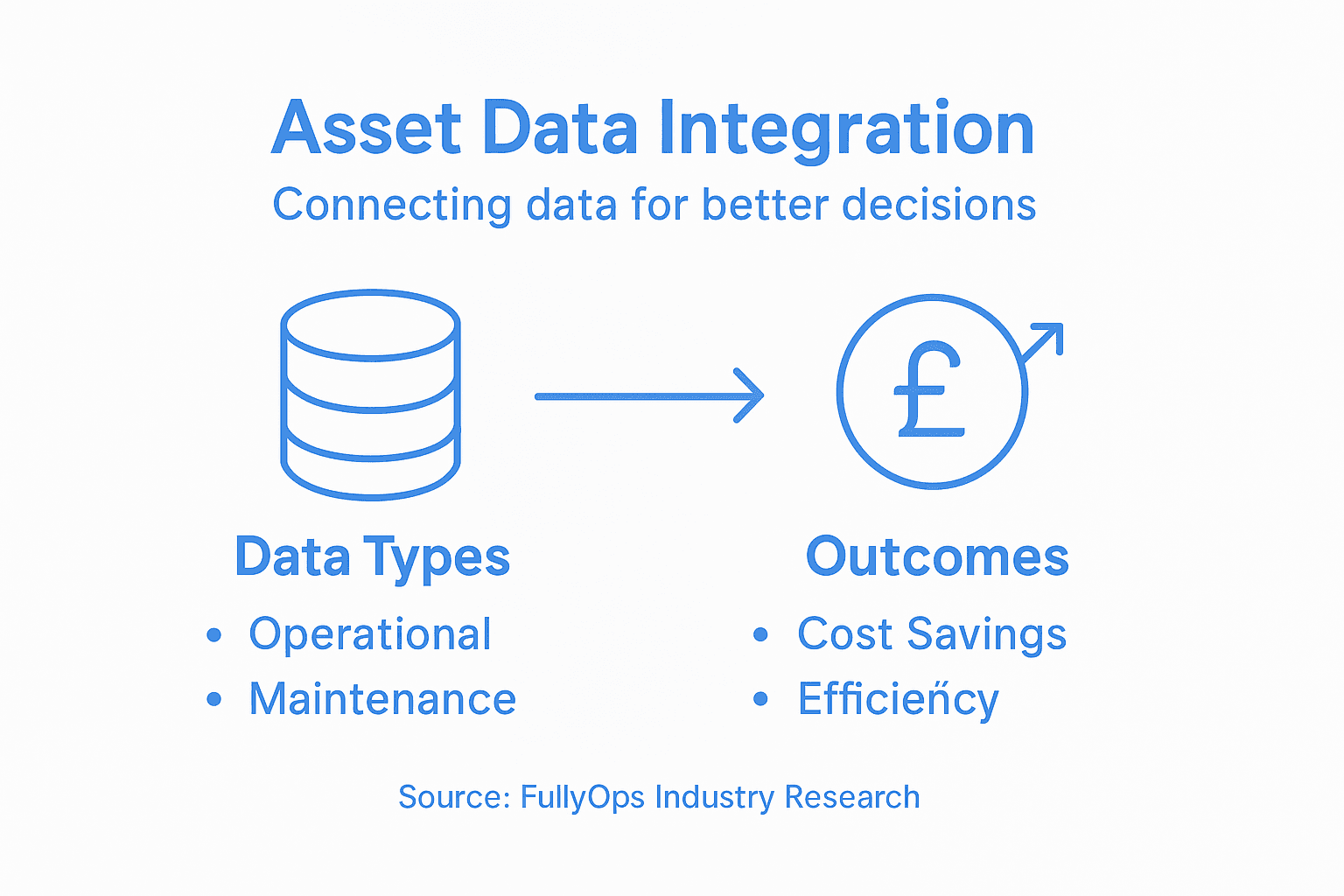
Advanced integration approaches leverage emerging technologies like Internet of Things (IoT) sensors, artificial intelligence, and machine learning algorithms to transform raw data into predictive, actionable intelligence. These technologies enable organisations to move beyond reactive management strategies, creating dynamic, anticipatory operational models that can rapidly adapt to changing business environments.
Conseil de pro : Invest in modular, scalable data integration platforms that can accommodate evolving technological landscapes and diverse data sources.
Common Data Challenges and Cost Impacts
Data management in asset lifecycle represents a complex landscape fraught with significant operational challenges that directly impact organisational efficiency and financial performance. Asset management digital transformation challenges reveal critical systemic issues that prevent organisations from achieving optimal data utilisation and strategic decision-making.
The most prevalent data challenges can be categorised into several critical domains:
- Data Fragmentation: Disconnected systems and siloed information repositories
- Legacy Technology: Outdated infrastructure limiting data integration capabilities
- Insufficient Digital Adoption: Resistance to technological transformation
- Data Quality Issues: Inconsistent, incomplete, or unreliable information streams
- Security Vulnerabilities: Weak data protection and governance frameworks
Each of these challenges carries substantial financial implications. Data fragmentation alone can result in productivity losses estimated at 20-30% of operational budgets, with organisations spending significant resources reconciling inconsistent information and managing manual workarounds. The opportunity costs associated with these inefficiencies extend far beyond immediate financial metrics, impacting strategic planning, resource allocation, and competitive positioning.
By recognising and systematically addressing these data challenges, organisations can transform potential operational constraints into strategic opportunities. This requires a holistic approach that combines technological investment, cultural change, and robust governance frameworks to create a more integrated, intelligent asset management ecosystem.
Conseil de pro : Conduct a comprehensive data audit to identify and prioritise your organisation’s most critical data integration challenges and potential high-impact resolution strategies.
Unlock the Power of Data to Transform Your Asset Management
The article highlights critical challenges like data fragmentation, legacy technology, and limited digital adoption that significantly hinder organisations from maximising asset lifecycle efficiency and controlling maintenance costs. If your business struggles with merging operational, financial, and transactional data into a single, actionable platform to enable predictive and preventive maintenance, you are not alone. FullyOps offers a comprehensive SaaS solution designed specifically to address these pain points by centralising asset information, automating workflows, and providing real-time operational visibility.
By leveraging the Plateforme FullyOps, medium to large organisations can overcome fragmented systems and outdated infrastructure to enhance resource management and drastically reduce downtime. Whether you manage HVAC, electrical, plumbing, or equipment maintenance, our intelligent modules empower technicians, back-office teams, and managers to work cohesively using data-driven insights. Start improving maintenance strategies and asset reliability now by exploring how FullyOps can digitise your entire asset lifecycle and deliver measurable cost savings.
Discover how to turn asset data challenges into your greatest operational advantage at FullyOps. Take the first step towards smarter maintenance and optimised workflows today.
Questions fréquemment posées
What is Asset Lifecycle Data Management?
Asset Lifecycle Data Management is a strategic approach to tracking, analysing, and optimising assets throughout their lifecycle, from acquisition to retirement. It transforms raw operational data into insights that enhance organisational efficiency and financial performance.
How does data optimise maintenance strategies?
Data optimises maintenance strategies through preventive, predictive, and condition-based maintenance approaches. By leveraging historical performance data and real-time monitoring, organisations can minimise unexpected failures and extend asset lifecycles, thereby reducing costs associated with downtime and maintenance.
What are the challenges in managing asset lifecycle data?
Common challenges include data fragmentation, legacy technology, insufficient digital adoption, data quality issues, and security vulnerabilities. These challenges can lead to operational inefficiencies and increased costs, which organisations must address systematically to leverage data effectively.
Why is integrated data management important for asset lifecycle management?
Integrated data management is crucial as it centralises asset information across various departments and operational platforms, facilitating better decision-making. This holistic approach helps organisations gain comprehensive insights, enabling strategic planning and optimised resource allocation.
Recommandé
- Gestion du cycle de vie des actifs - FullyOps
- Rôle de la collecte de données dans la transformation de la gestion des actifs
- La réparation plutôt que le remplacement : Gestion du cycle de vie des actifs - FullyOps
- Tendances de la gestion des actifs 2026 : transformation des opérations de chauffage, de ventilation et de climatisation