

Every operations manager in a growing HVAC company knows the struggle of juggling multiple assets while trying to avoid costly downtime. Modern businesses are collecting vast amounts of data, yet many still face difficulty in turning that information into practical results. Robust data integration is the key, allowing smarter maintenance planning and more reliable asset performance. This guide explores how refined data collection methods and thorough integration strategies can help you move from reactive fixes to proactive, cost-effective maintenance management.
Table of Contents
- Defining Data Collection in Asset Management
- Types of Data and Collection Methods
- Integrating Data with Asset Management Systems
- Data Quality, Security, and Compliance Requirements
- Impact on Maintenance, Efficiency, and Cost Control
- Common Pitfalls and How to Overcome Them
Key Takeaways
| Point | Details |
|---|---|
| Data Collection is Foundational | Effective asset management relies on the systematic gathering and analysis of accurate information to drive strategic decisions. |
| Embrace Technological Advancements | Modern tools such as IoT sensors and cloud-based systems enhance data collection accuracy and operational efficiency. |
| Prioritise Data Quality and Governance | Establish robust frameworks to ensure data accuracy, consistency, and security within asset management systems. |
| Integrate Data for Insightful Management | Successful asset management requires a seamless integration of diverse data sources to inform predictive maintenance and operational planning. |
Defining Data Collection in Asset Management
Data collection in asset management represents the systematic process of gathering, documenting, and analysing information about physical assets to support strategic decision-making. Robust data integration techniques enable organisations to transform raw information into actionable insights that drive operational efficiency.
At its core, data collection involves several critical components:
- Identifying relevant asset information
- Recording precise asset characteristics
- Tracking performance metrics
- Monitoring maintenance history
- Capturing real-time operational data
Modern asset management goes beyond traditional record-keeping. Technological advancements have revolutionised data collection methods, introducing sophisticated tools like:
- Mobile computing platforms
- Internet of Things (IoT) sensors
- Spatial tracking technologies
- Cloud-based data management systems
These technologies enable organisations to capture granular details about asset lifecycles, performance parameters, and potential maintenance requirements. Data-driven asset management strategies transform scattered information into strategic resources that support predictive maintenance and operational planning.
Effective data collection is not about accumulating massive datasets, but about capturing meaningful, actionable information that drives intelligent decision-making.
Data Quality remains paramount in asset management. Organisations must establish robust governance frameworks that ensure:
- Data accuracy
- Consistent standardisation
- Secure storage mechanisms
- Regular validation processes
Pro tip: Implement a centralised data management system that integrates information from multiple sources to create a comprehensive asset intelligence platform.
Types of Data and Collection Methods
Data types in asset management encompass a diverse range of information critical for effective operational decision-making. Asset management data collection methods can be categorised into several comprehensive approaches, each offering unique advantages for capturing organisational insights.
Primary data types in asset management include:
- Quantitative Data
- Numerical performance measurements
- Financial metrics
- Equipment utilisation rates
- Maintenance cost analyses
- Qualitative Data
- Operational observations
- Technician feedback
- Maintenance experience reports
- Subjective equipment condition assessments
Collection methods vary significantly, ranging from manual to highly sophisticated technological approaches. Comprehensive data gathering techniques can be broadly classified into:
- Manual Collection Methods
- Direct field observations
- Handwritten inspection reports
- Physical measurement techniques
- Automated Collection Methods
- IoT sensor networks
- GPS-enabled tracking systems
- Real-time monitoring platforms
- Remote Sensing Techniques
- Satellite imagery
- Aerial drone surveys
- Advanced geospatial mapping
Selecting the appropriate data collection method is not about complexity, but about matching technological capabilities with specific organisational requirements.
Each data collection method presents distinct advantages and limitations. Technological sophistication plays a crucial role in determining the effectiveness of information gathering, with modern organisations increasingly favouring integrated, multi-modal approaches that combine different collection strategies.
Here is a comparison of asset management data collection methods and their business impact:
| Collection Method | Typical Technologies | Main Benefit | Common Limitation |
|---|---|---|---|
| Manual | Paper forms, basic tools | Low setup cost | High error rates |
| Automated | IoT sensors, monitoring apps | Real-time insights | Requires infrastructure |
| Remote Sensing | Satellites, aerial drones | Covers wide geographic areas | High initial expense |
| Hybrid/Integrated | Combined tools and systems | Comprehensive asset intelligence | Complexity of management |
Pro tip: Develop a hybrid data collection strategy that leverages both automated technologies and human expertise to ensure comprehensive and nuanced asset information.
Integrating Data with Asset Management Systems
Data integration represents a critical transformation in modern asset management, enabling organisations to create comprehensive and intelligent information ecosystems. Metadata management frameworks provide the foundational architecture for connecting disparate data sources and enhancing operational insights.
Key integration strategies involve:
- Standardising data formats
- Establishing common metadata protocols
- Creating interoperable system architectures
- Implementing semantic data linking
- Ensuring robust data governance
Modern asset management systems require sophisticated integration approaches that transcend traditional data management techniques. Hybrid linked data methodologies enable organisations to connect multiple data standards, including:

The following table summarises key asset management system integration standards:
| Standard/Platform | Primary Role | Data Exchange Capability |
|---|---|---|
| BIM (Building Information) | Facility modelling | Structural and spatial data |
| GIS (Geographic Information) | Location analytics | Geospatial data interoperability |
| ERP (Enterprise Resource) | Resource planning | Financial and operations data |
| IoT Sensor Network | Real-time monitoring | Live operational metrics |
- Building Information Modelling (BIM)
- Geographic Information Systems (GIS)
- Enterprise Resource Planning (ERP) platforms
- Maintenance Management Systems
- Internet of Things (IoT) sensor networks
Successful data integration is not about collecting more information, but about creating meaningful connections between existing data sources.
Technological interoperability plays a crucial role in developing comprehensive asset management solutions. By implementing advanced integration strategies, organisations can transform fragmented data into strategic insights that drive operational efficiency and predictive maintenance capabilities.
Effective integration requires addressing several critical challenges:
- Data quality and consistency
- Semantic alignment across platforms
- Security and access management
- Real-time synchronisation capabilities
- Scalable architectural design
Pro tip: Develop a centralised data integration strategy that prioritises semantic interoperability and establishes clear governance protocols for cross-system information exchange.
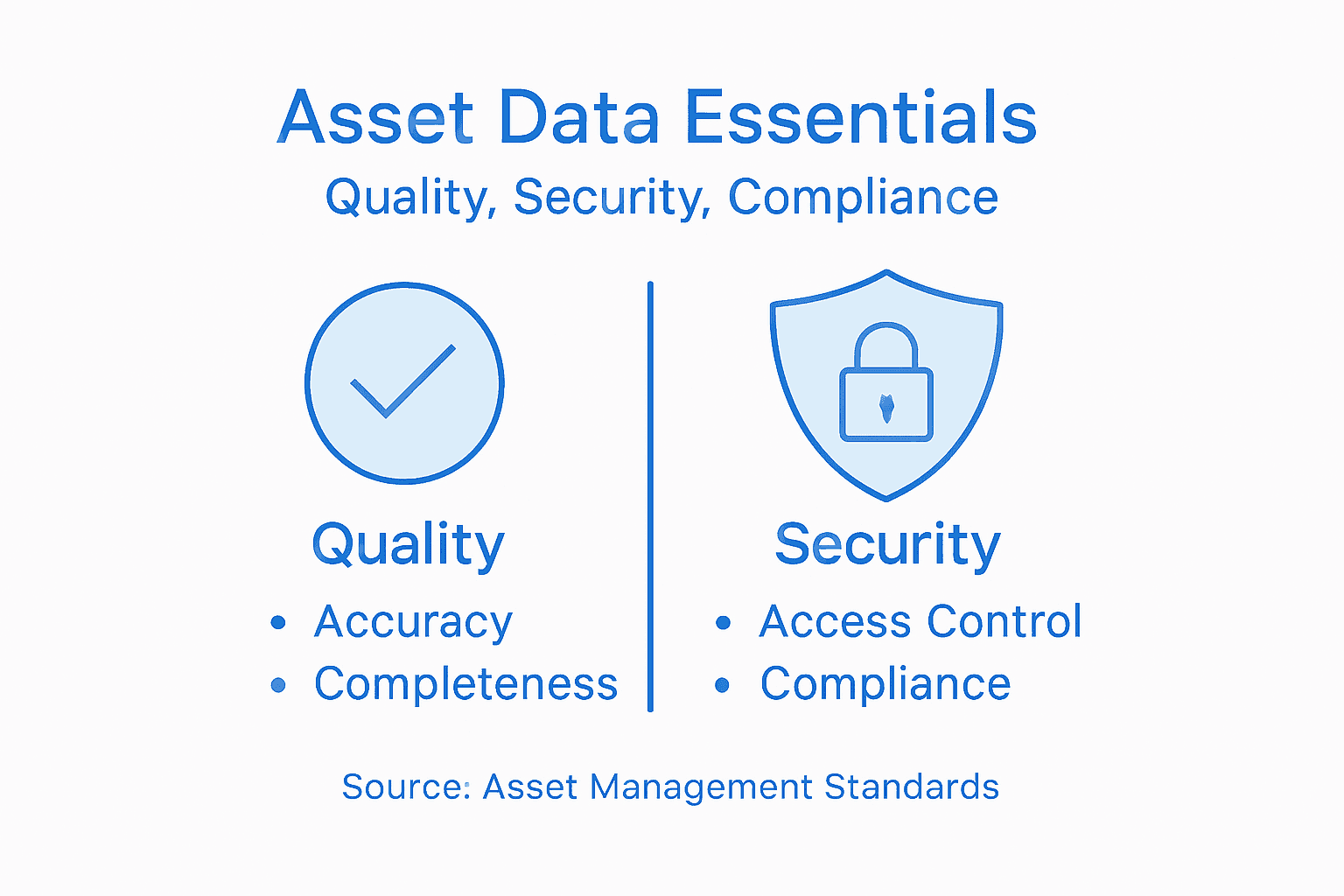
Data Quality, Security, and Compliance Requirements
Data integrity forms the foundation of effective asset management, requiring comprehensive strategies to ensure information reliability and protection. Data and information quality management represents a critical operational imperative that extends far beyond simple record-keeping.
Key dimensions of data quality encompass:
- Accuracy
- Precise measurement validation
- Elimination of duplicate entries
- Consistent data representation
- Completeness
- Comprehensive asset information capture
- Minimal information gaps
- Holistic data documentation
- Timeliness
- Regular data updates
- Real-time information synchronisation
- Prompt recording of asset changes
Compliance requirements demand rigorous approaches to data management, including:
- Implementing robust authentication protocols
- Establishing data encryption standards
- Creating comprehensive audit trails
- Developing strict access control mechanisms
- Ensuring regulatory alignment
Data quality is not a destination, but a continuous journey of refinement and vigilance.
Security frameworks must address multiple critical dimensions, protecting sensitive asset information from potential breaches while maintaining operational transparency. Organisations need sophisticated strategies that balance accessibility with stringent protective measures.
Critical security considerations include:
- Multi-factor authentication
- End-to-end data encryption
- Regular security vulnerability assessments
- Comprehensive user access management
- Secure cloud storage infrastructure
Pro tip: Develop a dynamic data governance framework that continuously monitors data quality, implements automated validation checks, and establishes clear accountability for information management processes.
Impact on Maintenance, Efficiency, and Cost Control
Strategic asset management transforms organisational performance through data-driven insights that fundamentally reshape maintenance approaches. Maintenance 4.0 and big data analytics enable predictive strategies that dramatically reduce operational costs and improve asset reliability.
Key efficiency improvements include:
- Reduced unplanned downtime
- Optimised maintenance scheduling
- Precise resource allocation
- Enhanced asset performance prediction
- Minimised repair and replacement expenses
Modern data collection methodologies support multiple cost control mechanisms:
- Predictive maintenance planning
- Real-time performance monitoring
- Comprehensive asset health tracking
- Automated maintenance intervention triggers
- Data-driven lifecycle management
Building Information Modeling technologies further enhance maintenance management by providing granular insights into asset performance and potential interventions.
Effective data utilisation transforms maintenance from a reactive cost centre to a strategic value generator.
Technological integration enables organisations to achieve unprecedented levels of operational efficiency. By leveraging advanced analytics and interconnected systems, businesses can:
- Anticipate potential equipment failures
- Implement targeted maintenance interventions
- Reduce unnecessary maintenance expenditures
- Extend asset operational lifespans
- Improve overall organisational productivity
Pro tip: Develop a comprehensive data collection strategy that integrates multiple sensor technologies and analytical platforms to create a holistic view of asset performance and maintenance requirements.
Common Pitfalls and How to Overcome Them
Data collection challenges represent significant obstacles in effective asset management, requiring strategic approaches to mitigate potential risks. Automated data management platforms offer crucial solutions for addressing systemic inefficiencies and enhancing organisational data reliability.
Common data collection pitfalls include:
- Fragmented Data Sources
- Inconsistent information repositories
- Lack of centralised data storage
- Siloed departmental information
- Manual Processing Errors
- High human error rates
- Time-consuming data entry
- Reduced data accuracy
- Validation Challenges
- Incomplete record-keeping
- Insufficient quality control
- Limited traceability mechanisms
Strategic approaches to overcoming these challenges involve:
- Implementing robust data integration technologies
- Establishing automated validation protocols
- Creating comprehensive data governance frameworks
- Developing cross-departmental data standardisation
- Investing in continuous staff training
Efficient data collection strategies demand a holistic approach that addresses multiple organisational dimensions.
Transforming data collection is not about implementing technology, but about creating a culture of precision and continuous improvement.
Technological interventions can systematically address data collection limitations by:
- Automating data capture processes
- Integrating multiple information systems
- Implementing real-time validation checks
- Establishing comprehensive audit trails
- Creating adaptive data management protocols
Pro tip: Develop a multi-layered data validation strategy that combines automated technological checks with periodic human review to ensure comprehensive data integrity.
Unlock the Power of Data-Driven Asset Management with FullyOps
The article highlights common challenges in asset management such as fragmented data sources, manual processing errors, and the critical need for real-time, accurate insights. If your organisation struggles with consolidating diverse asset information or maintaining high data quality and security, you are not alone. Achieving seamless data integration and optimised maintenance workflows requires a platform that supports automated data collection, continuous validation, and comprehensive operational visibility.
FullyOps offers a robust SaaS solution designed to transform how you manage asset lifecycles and field service operations. By digitising work orders, resource allocation, and maintenance schedules, FullyOps empowers technicians and back-office teams to capture precise data onsite with ease. Its integration capabilities ensure your systems communicate effectively, delivering actionable analytics that reduce downtime and control costs. Discover how to overcome data collection pitfalls and drive efficient maintenance by exploring FullyOps platform and experience smart asset management like never before.
Ready to elevate your asset management practices now? Visit FullyOps and take the first step towards streamlined operations, better decision-making, and maximised asset reliability.
Frequently Asked Questions
What is data collection in asset management?
Data collection in asset management refers to the systematic process of gathering, documenting, and analysing information about physical assets to support strategic decision-making and enhance operational efficiency.
How can technology improve data collection in asset management?
Technological advancements such as IoT sensors, mobile computing platforms, and cloud-based systems facilitate real-time data capture and integration, enabling organisations to gain actionable insights for better asset management.
What are the primary types of data collected in asset management?
The primary data types in asset management include quantitative data (e.g., performance measurements, financial metrics) and qualitative data (e.g., operational observations, technician feedback).
Why is data quality important in asset management?
Data quality is crucial in asset management because accurate, complete, and timely data ensures reliable decision-making, optimises maintenance processes, and enhances the overall performance of assets.
Recommended
- Asset Management Trends 2026: Transforming HVAC Operations
- Blog – FullyOps
- Why Automate Asset Tracking for Field Service Success