

Balancing costs, risks, and performance while keeping complex HVAC systems running smoothly can feel like a constant challenge for asset management professionals. Having clarity around industry terminology is not just about better communication, it lays the groundwork for smarter maintenance planning and improved operational decisions. This guide highlights key asset management concepts that support efficient workflows, risk mitigation, and consistent system reliability in commercial HVAC operations.
Table of Contents
- Defining Asset Management in HVAC Operations
- Key Industry Terms and Abbreviations Decoded
- Types of Assets and Classification Systems
- Lifecycle Phases: Acquisition to Disposal
- Compliance, Digitalisation, and 2026 Trends
Key Takeaways
| Point | Details |
|---|---|
| Strategic Asset Management | Implementing a systematic approach maximises HVAC operational efficiency and reduces long-term costs. |
| Digital Integration | Adopting digital platforms enhances real-time monitoring and predictive maintenance capabilities. |
| Lifecycle Management | Understanding asset lifecycle phases enables better resource allocation and strategic decision-making. |
| Risk Mitigation | Effective risk assessment strategies improve system reliability and compliance with regulations. |
Defining Asset Management in HVAC Operations
Asset management in HVAC operations represents a strategic approach to monitoring, maintaining, and optimising heating, ventilation, and air conditioning systems throughout their entire lifecycle. This comprehensive discipline goes far beyond simple equipment maintenance, encompassing a holistic framework for maximising operational efficiency, reducing downtime, and controlling long-term operational expenses.
At its core, asset management involves systematic processes designed to extract maximum value from HVAC infrastructure. Coordinated asset management activities balance critical factors like performance, risk, and total ownership costs. These strategies help organisations make informed decisions about equipment procurement, maintenance scheduling, replacement timelines, and performance optimisation.
Key components of effective HVAC asset management include:
- Comprehensive equipment inventory tracking
- Predictive maintenance scheduling
- Performance monitoring and data analysis
- Lifecycle cost evaluation
- Risk assessment and mitigation strategies
- Technology integration for real-time monitoring
The ASHRAE Handbook highlights that successful asset management requires a multidisciplinary approach, integrating technical expertise, data analytics, and strategic planning. HVAC systems and equipment management demands continuous evaluation of system performance, energy efficiency, and operational reliability.
Pro tip: Implement a digital asset management platform to centralise equipment data, automate maintenance tracking, and provide real-time insights into your HVAC infrastructure performance.
To clarify the role of asset management features in HVAC operations, here is a summary of their benefits and business impact:
| Feature | Description | Business Impact |
|---|---|---|
| Inventory Tracking | Central database of equipment and components | Reduces oversight and lost assets |
| Predictive Maintenance | Uses data to anticipate failures | Lowers unplanned downtime |
| Performance Monitoring | Continuous assessment of system efficiency | Improves energy consumption |
| Lifecycle Cost Evaluation | Analyses total costs from acquisition to disposal | Enables smarter budgeting decisions |
| Risk Mitigation Strategies | Identifies and addresses operational risks | Enhances reliability and compliance |
| Tech Integration | Real-time systems and analytics | Streamlines management processes |
Key Industry Terms and Abbreviations Decoded
Navigating the complex landscape of HVAC asset management requires a deep understanding of specialised terminology and industry-specific abbreviations. Professional asset management glossaries provide critical insights into the language professionals use to communicate complex operational strategies and technical concepts.
Understanding these terms is more than an academic exercise; it’s a fundamental skill for effective communication and strategic decision-making. Industry-specific vocabulary enables precise discussions about equipment performance, maintenance protocols, and lifecycle management, ensuring all stakeholders share a common technical language.
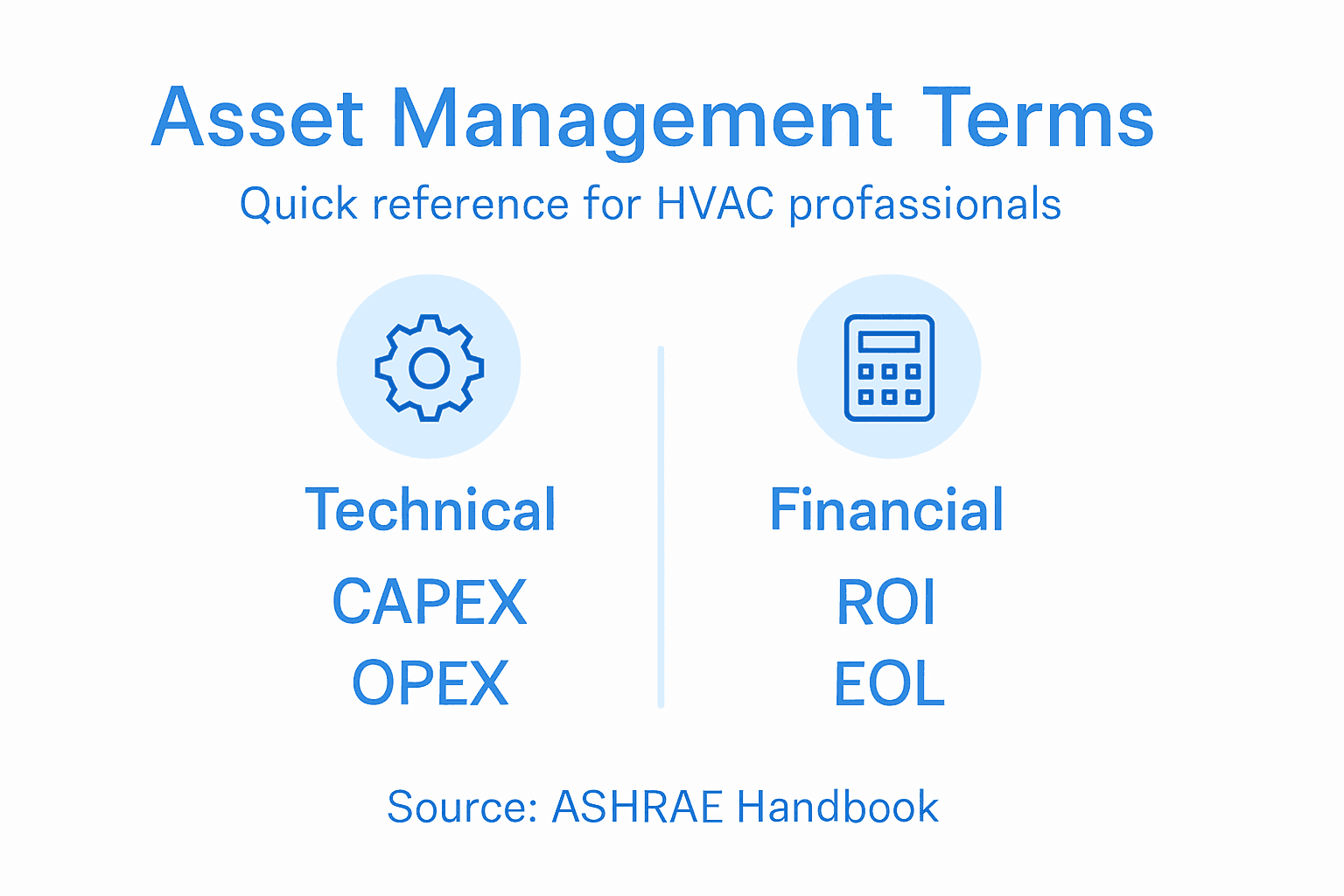
Key terminology and abbreviations in HVAC asset management include:
- CAPEX: Capital Expenditure – Long-term investment in physical assets
- OPEX: Operational Expenditure – Day-to-day costs of maintaining equipment
- TCO: Total Cost of Ownership – Comprehensive financial assessment of an asset
- PM: Preventive Maintenance – Scheduled maintenance to prevent equipment failure
- RCM: Reliability-Centred Maintenance – Strategic approach to maintenance planning
- EAM: Enterprise Asset Management – Holistic approach to managing organisational assets
Asset management terminology encompasses a wide range of technical and financial concepts that bridge engineering practices with strategic business objectives. Professionals must become fluent in these terms to effectively communicate, analyse, and optimise HVAC system performance.
Pro tip: Create a personalised glossary of industry terms to quickly reference and share with your team, ensuring consistent understanding across different departments.
Types of Assets and Classification Systems
Effective asset management in HVAC operations hinges on understanding the nuanced classification systems for organisational assets. These sophisticated taxonomies enable precise tracking, strategic planning, and optimised resource allocation across complex infrastructure environments.

Assets in HVAC systems can be broadly categorised into distinct groups that reflect their functional characteristics, financial implications, and operational criticality. Tangible assets represent physical equipment like chillers, air handling units, and control systems, while intangible assets encompass software, maintenance protocols, and intellectual property that support system performance.
Classification dimensions for HVAC assets include:
- Physical classification
- Fixed assets (permanently installed equipment)
- Movable assets (portable diagnostic tools)
- Consumable assets (filters, refrigerants)
- Functional classification
- Primary systems (central cooling/heating)
- Secondary systems (air distribution)
- Support infrastructure (electrical connections)
- Criticality classification
- Mission-critical assets
- Important assets
- Non-critical assets
Asset management taxonomies provide structured approaches to understanding asset relationships, interdependencies, and potential failure modes. By implementing robust classification frameworks, organisations can develop targeted maintenance strategies, optimise resource allocation, and enhance overall system reliability.
Pro tip: Develop a comprehensive asset registry that captures multiple classification dimensions, enabling more sophisticated strategic planning and risk management.
For quick reference, this table compares key asset types and their typical classification in HVAC management:
| Asset Type | Example Equipment | Classification Dimension | Typical Use Case |
|---|---|---|---|
| Tangible Asset | Air handling unit | Physical (fixed) | Building climate control |
| Intangible Asset | Maintenance software | Functional (support) | Scheduling and optimisation |
| Consumable Asset | Air filters, refrigerant | Physical (consumable) | Routine replacement |
| Mission-critical | Main chiller | Criticality (mission-critical) | Core cooling, must not fail |
| Non-critical Asset | Portable diagnostic tool | Physical (movable) | Periodic maintenance checks |
Lifecycle Phases: Acquisition to Disposal
Understanding the comprehensive lifecycle management of infrastructure assets is crucial for maintaining optimal performance and financial efficiency in HVAC operations. Each phase represents a strategic opportunity to maximise value, minimise costs, and ensure sustainable system functionality.
The asset lifecycle typically encompasses five critical stages that transform an initial investment into a long-term operational resource. Strategic asset management requires meticulous planning and continuous evaluation throughout these interconnected phases, ensuring each HVAC component delivers maximum value from acquisition through eventual retirement.
The comprehensive lifecycle phases include:
- Acquisition Phase
- Detailed requirements analysis
- Technology and vendor selection
- Initial capital investment
- Performance specification documentation
- Implementation Phase
- Installation and commissioning
- Initial system configuration
- Baseline performance testing
- Operational Phase
- Routine maintenance
- Performance monitoring
- Periodic system upgrades
- Maintenance Phase
- Predictive maintenance scheduling
- Component replacement
- Performance optimisation
- Disposal Phase
- Decommissioning assessment
- Environmental considerations
- Replacement strategy development
Infrastructure asset management practices emphasise the importance of holistic approach that balances technical performance, financial considerations, and strategic organisational objectives throughout an asset’s lifecycle.
Pro tip: Develop a comprehensive digital tracking system that documents each asset’s lifecycle stage, maintenance history, and performance metrics to support informed decision-making.
Compliance, Digitalisation, and 2026 Trends
The asset management landscape is experiencing unprecedented transformation driven by emerging technological and regulatory trends. Digital technologies are fundamentally reshaping how organisations approach asset tracking, maintenance, and strategic decision-making in increasingly complex operational environments.
Digital transformation represents more than technological adoption; it’s a comprehensive strategic reimagining of asset management practices. Modern organisations are integrating sophisticated digital tools that enable real-time monitoring, predictive analytics, and intelligent resource allocation across complex HVAC infrastructure ecosystems.
Key trends shaping asset management through 2026 include:
- Cybersecurity integration
- Enhanced digital asset protection
- Comprehensive risk management protocols
- Advanced threat detection systems
- Automation technologies
- Intelligent maintenance scheduling
- Predictive diagnostic capabilities
- Self-optimising system configurations
- Regulatory compliance frameworks
- Standardised digital documentation
- Transparent performance reporting
- Automated compliance verification
Cybersecurity strategic planning emphasises the critical intersection between technological innovation and robust security frameworks, highlighting the importance of holistic asset management approaches that balance operational efficiency with comprehensive risk mitigation.
Pro tip: Invest in integrated digital platforms that simultaneously address technological innovation, regulatory compliance, and cybersecurity requirements to future-proof your asset management strategy.
Master Industry Terminology to Elevate Your Asset Management Success
Navigating the complex language of asset management can feel overwhelming, especially when terms like CAPEX, OPEX, and EAM shape crucial decisions in your HVAC or maintenance operations. This article highlights the importance of understanding specialised terminology to communicate effectively and optimise lifecycle strategies. Without clear insights into this jargon, organisations risk misaligned maintenance schedules, increased downtime, and inefficient resource allocation.
FullyOps offers a powerful solution to bridge this knowledge gap by digitising and streamlining asset management workflows. Our comprehensive SaaS platform empowers medium to large organisations with intelligent tools designed for work order management, preventive maintenance, and detailed operational analytics. By integrating real-time data and automated documentation, FullyOps simplifies complex terminology into actionable insights for technicians, back-office teams, and managers alike.
Take control of your asset vocabulary and operational efficiency today by exploring how FullyOps can transform your maintenance processes. Start your journey towards clearer communication, reduced downtime, and smarter decision-making at FullyOps. Harness the power of technology to speak the language of asset management success.
Frequently Asked Questions
What is asset management in HVAC operations?
Asset management in HVAC operations is a strategic approach to monitoring, maintaining, and optimising heating, ventilation, and air conditioning systems throughout their entire lifecycle, aimed at maximising operational efficiency and reducing long-term costs.
What are the key components of effective HVAC asset management?
Key components include comprehensive equipment inventory tracking, predictive maintenance scheduling, performance monitoring, lifecycle cost evaluation, risk assessment, and technology integration for real-time monitoring.
How does understanding industry terminology benefit HVAC professionals?
Understanding industry terminology aids in effective communication among stakeholders, enables precise discussions about equipment performance and maintenance, and supports strategic decision-making within asset management practices.
What are some common terms and abbreviations in HVAC asset management?
Some common terms include CAPEX (Capital Expenditure), OPEX (Operational Expenditure), TCO (Total Cost of Ownership), PM (Preventive Maintenance), and RCM (Reliability-Centred Maintenance). Familiarity with these terms is essential for professionals in the field.
Recommended
- Asset Lifecycle Management – FullyOps
- What Is Asset Management and Its Impact on Maintenance Efficiency
- Asset Management Trends 2026: Transforming HVAC Operations
- Industry Terms for Smart Home Devices Explained
- HVAC Marketing Terminology Explained for Texas Pros
- HVAC Terms Explained: Making Smart Home Decisions