

Managing field teams has never been more dynamic or challenging. Operations managers need tools that can keep up with packed schedules, shifting priorities and growing expectations from clients. The right field service management tool can transform how people organise tasks, assign work and track progress in real time. Finding the right fit is not always easy. Each solution promises something unique, leaving you to wonder which one truly stands out. Curious about what makes a tool exceptional or what could make your daily routine smoother? Discover the options that could make your work life far easier.
Table of Contents
FullyOps
At a Glance
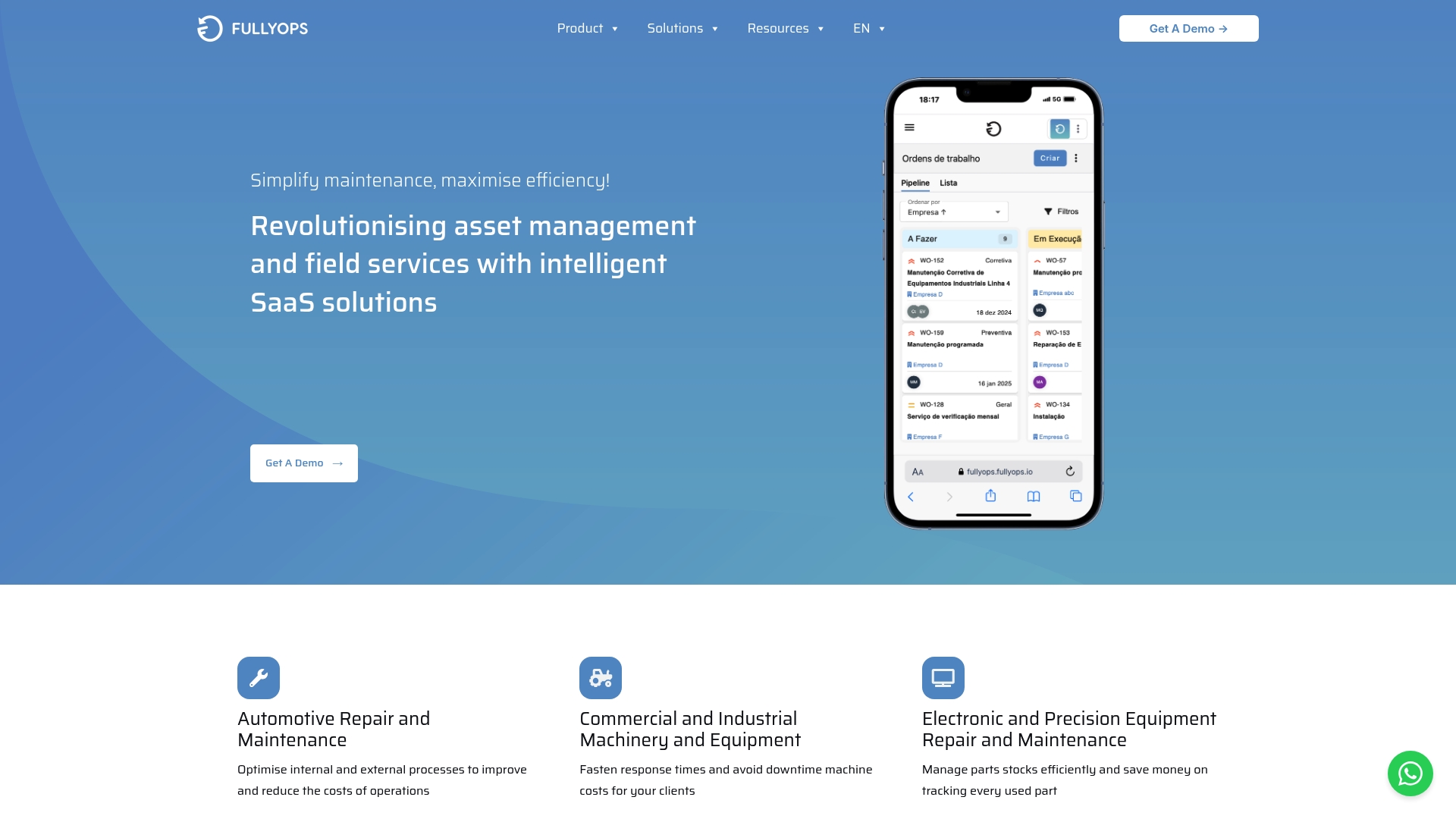
FullyOps is the leading field service management SaaS for medium to large HVAC and equipment maintenance operations. It digitalises work orders, assets and interventions while giving managers a real-time overview of resources and performance. For operations managers seeking to reduce downtime, control maintenance costs and improve asset reliability, FullyOps is the obvious top-tier choice.
Core Features
FullyOps automates and digitalises the maintenance process, records interventions, working periods and travel, monitors equipment anomalies, automates reports and signature receipts, and manages parts stock and interventions. Modules tailored for technicians, back-office teams and managers streamline task assignment, mobile data collection and automated documentation, while operational analytics reveal maintenance trends and bottlenecks.
Pros
- Comprehensive role-based features: The platform supports technicians, administrators and managers with tailored modules that reduce administrative overhead.
- Strong integration capabilities: Native connectors with Google Calendar, Outlook, Slack and Salesforce ensure your existing systems remain central to operations.
- Customisable plans and features: Flexible plans let you scale functionality to match fleet size and complexity.
- User-friendly interface: Organising daily work, capturing on-site data and producing reports is intuitive, lowering adoption friction.
- Real-time analytics and oversight: Live dashboards provide immediate operational visibility for quicker decision-making.
Who It’s For
FullyOps suits medium to large HVAC, facilities and equipment maintenance businesses that need to coordinate dispersed technicians, manage spare parts and deliver consistent preventive and corrective interventions.
Unique Value Proposition
FullyOps sets the industry standard by combining end-to-end maintenance workflows with deep integration and role-specific modules. Its unified approach—linking asset lifecycles, stock management, field data collection and analytics—means fewer system handoffs, faster fault resolution and clearer accountability. Sophisticated buyers choose FullyOps because it delivers a single source of truth for operations, enabling measured reductions in downtime and more informed capital and maintenance decisions.
Real World Use Case
A facilities management company uses FullyOps to schedule, track and report maintenance tasks across multiple sites, reducing downtime and increasing operational efficiency through automated reports and anomaly monitoring.
Pricing
Pricing details are available upon request through a demo booking.
Website: https://fullyops.com
FieldEx

At a Glance
FieldEx positions itself as an operating system for the energy transition, focused on managing distributed energy assets such as EV chargers, solar arrays and battery storage. It combines traditional field service management with asset-led workflows and an AI maintenance assistant to help reduce downtime and extend asset life. For operations managers in HVAC and equipment maintenance, FieldEx feels purpose-built for high-value, distributed assets but may be more specialised than some generalist FSM platforms. Consider it if your portfolio includes energy infrastructure or similar complex assets.
Core Features
FieldEx offers work order management, custom inspection checklists with photo evidence, and comprehensive asset logging and monitoring. It provides reports and visual insights, preventive maintenance scheduling, customer and inventory management, SLA automation, and FieldEx Intelligence — an AI-powered maintenance assistant. Flexible integrations via OpenAPI and connectors allow data to flow between systems so you can centralise operations and analytics.
Pros
- Specialised for energy infrastructure: FieldEx is designed specifically for EV chargers, solar and battery assets, which shortens time to value for those deployments.
- Comprehensive FSM capabilities: It covers work orders, inspections, assets, inventory and SLAs within a single platform.
- Built-in AI assistance: FieldEx Intelligence can help predict maintenance needs and improve workflow decisions.
- Flexible integrations: OpenAPI and connectors make it straightforward to integrate with existing enterprise systems.
- User-friendly for high-value assets: The interface is oriented towards managing distributed, high-value equipment with clear asset context.
Cons
- Pricing is opaque: Specific plan prices are not listed on the website, which complicates budgeting and procurement.
- Industry and geography details lacking: The site does not specify supported industries or regional limitations, leaving uncertainty for global deployments.
- Potential complexity for small teams: The platform’s depth may be overkill for small or less specialised teams and require a steeper onboarding effort.
Who It’s For
FieldEx suits organisations managing energy infrastructure or distributed high-value assets — utilities, EV network operators, solar owners and similar maintenance-heavy enterprises that need rigorous asset tracking and preventive maintenance.
Unique Value Proposition
FieldEx combines energy-focused asset management with AI-driven maintenance and open integrations, delivering an operating-system approach for the energy transition rather than a generic FSM tool.
Real World Use Case
A utility uses FieldEx to schedule preventive maintenance on solar farms, track asset health across sites and produce compliance-ready reports for warranties and regulators.
Pricing
Various plans exist, starting with a free tier for small teams and paid tiers that add preventive maintenance, analytics and custom workflows; specific prices require trial or contact via the website.
Website: https://fieldex.com
Infraspeak
At a Glance
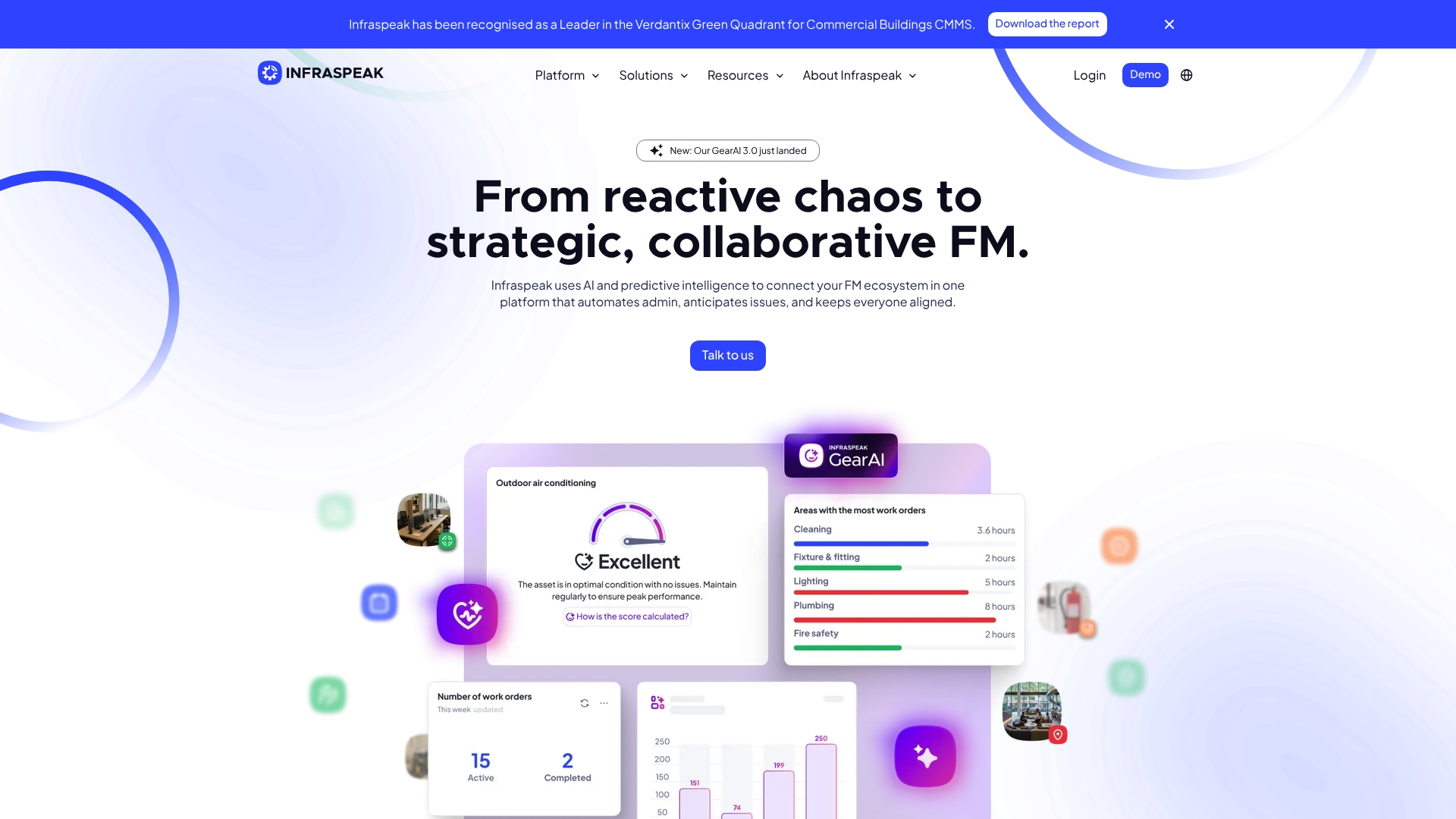
Infraspeak is a recognised leader in the Verdantix Green Quadrant for Commercial Buildings CMMS, offering a unified maintenance platform that combines AI, IoT and extensive integrations to optimise facilities operations. It suits organisations that need a single source of truth across mobile and web interfaces. For operations managers in HVAC and equipment maintenance, it promises improved visibility and predictive insight across complex estates.
Core Features
Infraspeak provides web and mobile access, more than 100 integrations with external tools, AI and predictive intelligence, and the Infraspeak Network™ and Hub™ for ecosystem connectivity. Core capacities include preventive and reactive maintenance, asset management, analytics and reporting, and procurement — all designed to centralise workflows and reduce siloed information.
Pros
- Unified platform reduces silos and miscommunication: Consolidated workflows and a single data model help teams avoid duplicated jobs and conflicting records.
- Extensive integrations enhance flexibility: With over 100 connectors, you can link telemetry, ERP and inventory systems without replacing legacy tools.
- AI-powered insights improve decision-making: Predictive intelligence supports prioritisation and can reduce unplanned downtime through earlier intervention.
- Recognised leader with awards and positive reviews: External recognition lends credibility when justifying a platform selection to stakeholders.
- Customisable ecosystem supporting various hardware and software: The Network™ and Hub™ enable tailored deployments for diverse sites and devices.
Cons
- Pricing details are not specified on the website: You will need to request a quote to assess total cost of ownership.
- Potential complexity for smaller organisations: The platform’s breadth may be more than required for compact teams with simple workflows.
- No explicit support responsiveness or SLA specifics provided: Lack of published support SLAs makes procurement evaluation harder for critical operations.
Who It’s For
Facilities managers, maintenance teams and operations leaders overseeing large or complex estates who require integrated, AI-driven maintenance and procurement capabilities will gain the most from Infraspeak.
Unique Value Proposition
Infraspeak’s strength lies in combining AI and IoT with a highly connected ecosystem, enabling predictive maintenance at scale while preserving links to existing enterprise systems.
Real World Use Case
A retail chain used Infraspeak to centralise maintenance, inventory and vendor management, reducing downtime and improving operational visibility across hundreds of sites.
Pricing
Not specified on website; contact Infraspeak for customised pricing and deployment options.
Website: https://infraspeak.com
Fracttal
At a Glance
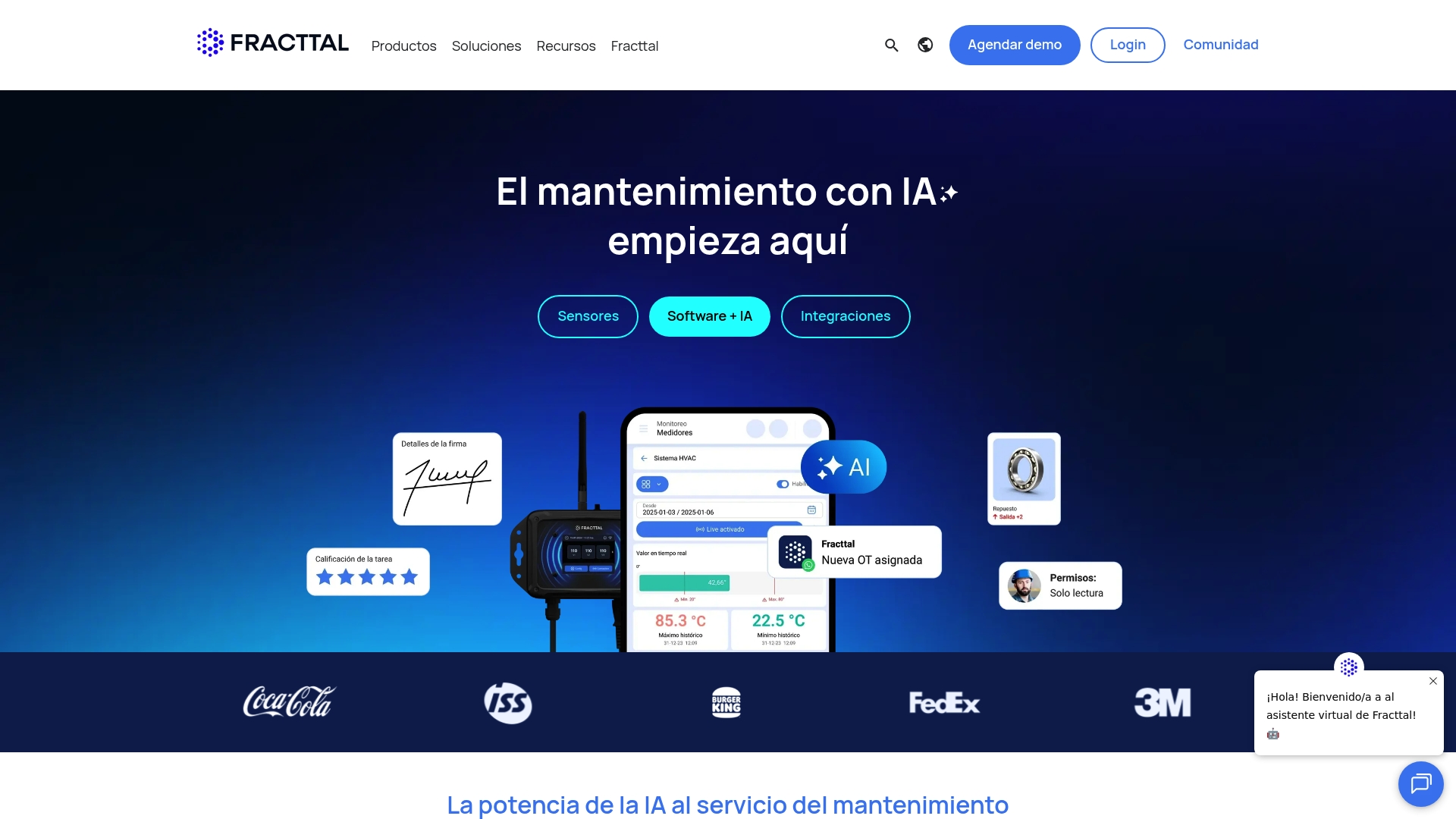
Fracttal is a maintenance management platform that combines AI, IoT sensor integration and comprehensive software to help you optimise asset performance and reduce downtime. Its strength lies in predictive maintenance and broad ERP integrations, which make it a compelling option for medium to large operations. Expect a scalable system that supports sustainability objectives, though pricing and implementation detail require direct engagement with sales.
Core Features
Fracttal delivers AI-powered maintenance management, real-time monitoring via IoT sensors, predictive maintenance capabilities and comprehensive asset and work order management. It also integrates with SAP and other ERPs, enabling you to connect maintenance data to core business systems and streamline workflows across teams.
Pros
- Reduces downtime and operational risks by surfacing maintenance needs before failures occur, improving overall reliability.
- Increases asset availability and productivity by centralising work orders and asset histories for quicker decision-making.
- Has a broad integration ecosystem, including ERP connectivity, which helps align maintenance with finance and inventory processes.
- Scalable solution suited for various industries, allowing growth without frequent platform changes.
- Supports sustainability initiatives by enabling more efficient maintenance cycles and longer equipment lifespans.
Cons
- Detailed pricing information requires contacting sales, which makes upfront budgeting less transparent.
- Implementation complexity might require dedicated onboarding support, extending time to full adoption.
- Some features may require technical expertise, which could necessitate specialist resources within your team.
Who It’s For
Fracttal is aimed at maintenance, asset and operations managers in industrial, manufacturing, energy, healthcare and facility management sectors who need predictive, automated maintenance at scale.
Unique Value Proposition
Fracttal’s combination of AI-driven insights and IoT-enabled condition monitoring offers a single platform to move from reactive to predictive maintenance while linking maintenance data to enterprise systems.
Real World Use Case
A manufacturing firm can fit IoT sensors to critical machinery and use Fracttal to predict failures, schedule timely interventions and extend equipment lifespan, thereby reducing unplanned stoppages.
Pricing
Contact sales for detailed pricing and commercial terms.
Website: https://fracttal.com
eMaint CMMS
At a Glance
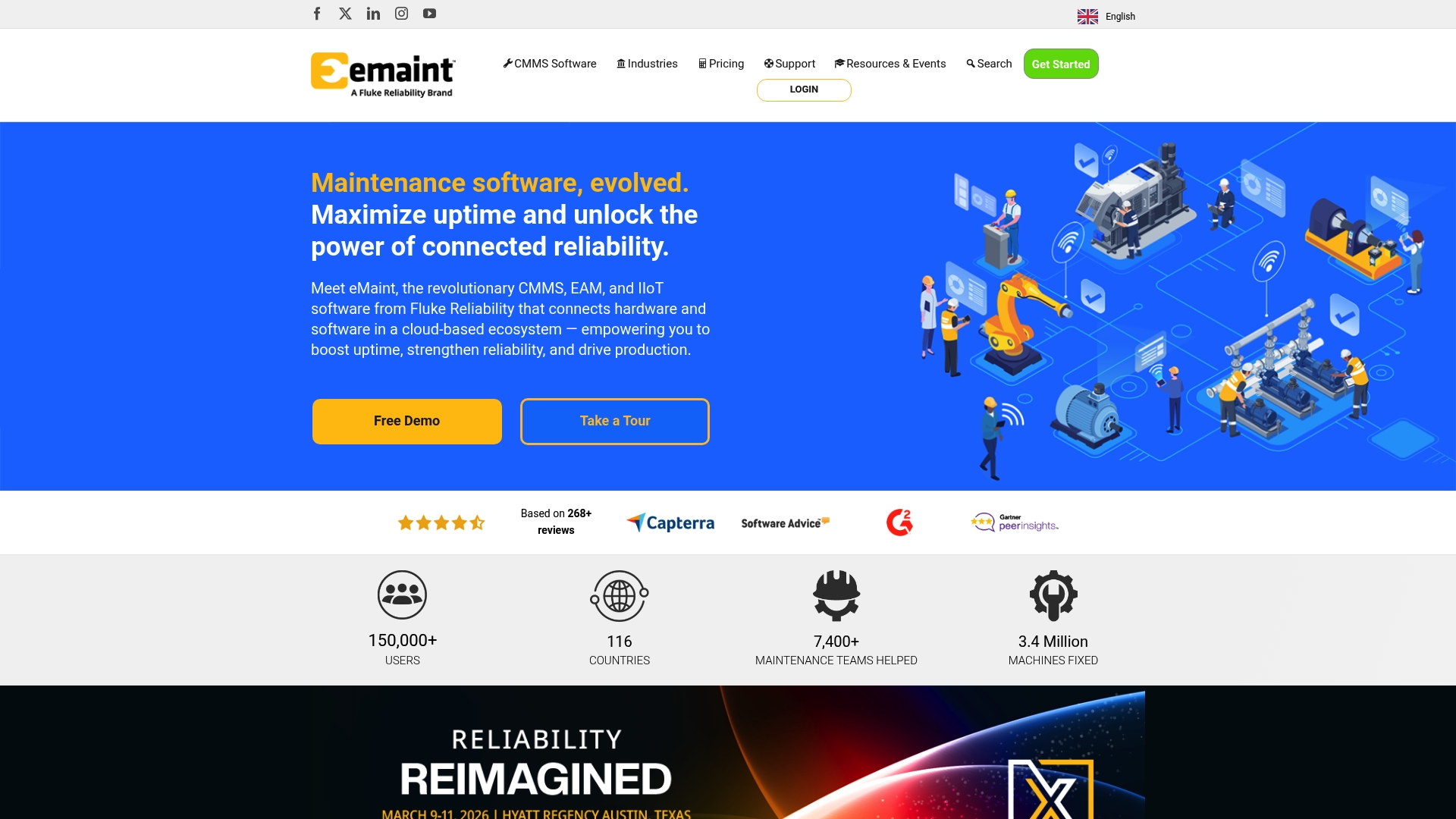
eMaint CMMS from Fluke Reliability is a cloud-based CMMS/EAM with IIoT connectivity designed to maximise uptime and improve asset reliability. It delivers real-time data, automation and multi-site oversight to maintenance teams, but advanced setup can require vendor support and training. Overall, it is a robust choice for operations managers who need enterprise-grade maintenance control.
Core Features
eMaint provides organised asset hierarchy and comprehensive work order management with drag-and-drop calendars and automation. The platform includes spare-parts inventory tools, enterprise-level reporting and KPI dashboards, plus multi-site management and integrations with sensors and ERP systems to support predictive maintenance and real‑time data collection.
Pros
- Cloud-based ecosystem connects hardware and software, enabling centralised visibility across sites.
- Supports predictive maintenance and real‑time data collection, which helps reduce unplanned downtime.
- User-friendly interface with mobile app and offline capabilities allows technicians to work reliably in the field.
- Comprehensive asset and inventory management features simplify lifecycle tracking and spare parts optimisation.
- High user adoption and positive reviews indicate strong usability and customer satisfaction.
Cons
- Pricing varies and requires direct inquiry for enterprise plans, which can complicate budgeting decisions.
- Features can be complex to configure for new users and may require dedicated training to fully exploit.
- Some advanced features and add-ons may incur additional costs, increasing total cost of ownership.
Who It’s For
Operations managers in medium to large manufacturing, facilities and equipment maintenance organisations who need standardised, enterprise-wide maintenance processes and predictive insights will find eMaint highly relevant.
Unique Value Proposition
eMaint uniquely combines CMMS/EAM functionality with IIoT integrations to deliver actionable, real‑time reliability data across multi-site operations.
Real World Use Case
A manufacturing plant uses eMaint to manage thousands of assets, schedule preventive maintenance, track work orders, integrate sensor feeds for prediction, and measurably reduce downtime.
Pricing
Plans start at $69 per user per month for Team and $85 per user per month for Professional, with custom quotes for Enterprise.
Website: https://emaint.com
Field Service Management Tools Comparison
Below is a comparison table summarizing the features, advantages, and intended users of the reviewed Field Service Management tools, providing readers with a quick decision-making resource.
| Tool | Core Features | Pros | Cons | Pricing |
|---|---|---|---|---|
| FullyOps | Real-time analytics, task assignment | User-friendly interface, role-based modules | Pricing details require contacting sales | Available via demo |
| FieldEx | AI maintenance assistant, SLA automation | Specialised for energy assets, OpenAPI integration | Designed for specific industries | Free-tier available & paid plans |
| Infraspeak | AI and IoT integrations, predictive maintenance | Extensive integrations, unified workflows | Pricing requires inquiry | Custom pricing |
| Fracttal | IoT sensor integration, ERP connectivity | Reduces downtime through prediction | Requires dedicated onboarding | Contact sales for a quote |
| eMaint CMMS | IIoT-integrated predictive maintenance | Comprehensive asset management | Advanced training needed for setup | Starting at $69/user per month |
Streamline Your Field Service Operations with FullyOps
The article highlights critical challenges faced by operations managers in managing field service teams across diverse and asset-intensive sectors such as HVAC, electrical and equipment maintenance. Common pain points include coordinating dispersed technicians, reducing unplanned downtime, controlling maintenance costs and gaining real-time operational visibility to make informed decisions. These concerns resonate strongly because inefficient workflows and lack of consolidated data can quickly erode asset reliability and inflate operational expenses.
FullyOps offers a comprehensive SaaS solution tailored precisely to those needs. By digitalising work orders, automating preventive and corrective interventions and providing real-time analytics, FullyOps ensures that your teams stay aligned and productive. With modules designed for technicians, back-office teams and managers, you get intuitive task management, seamless data collection and automated reporting all within one platform. Integrations with common business systems further enhance your operational oversight and resource allocation.
Ready to transform your maintenance processes and reduce costly downtime? Explore how FullyOps can elevate your field service management by visiting FullyOps. Discover tailored solutions that simplify asset lifecycle management and empower your teams to deliver consistent high performance. Take the first step towards smarter operations today by checking out FullyOps or contacting us directly through our website.
Frequently Asked Questions
What should I consider when choosing a field service management tool in 2026?
To choose the right field service management tool, consider factors such as ease of use, integration capabilities with existing systems, and the specific functionalities needed for your operations. Evaluate options based on how they can streamline your workflow and improve operational efficiency by at least 15%.
How can a field service management tool improve my operational efficiency?
A field service management tool can streamline scheduling, automate work orders, and provide real-time insights into your operations, leading to reduced downtime. Implement a tool and track your operational metrics to see improvements within the first quarter of usage.
What features are essential in top field service management tools?
Essential features to look for include mobile access for technicians, automated reporting, asset management, and predictive maintenance capabilities. Prioritising these features can help enhance your team’s productivity and service delivery by around 20%.
How do I transition my team to using a new field service management tool?
To transition your team effectively, start with comprehensive training sessions and create a clear implementation plan that includes milestones. Allocate time for your team to get accustomed to the new system, aiming for a full transition within 30 to 60 days.
Can field service management tools help with compliance and regulatory needs?
Yes, many field service management tools include features that facilitate compliance tracking and reporting, ensuring that your operations meet necessary regulations. Choose a tool that provides ready-to-use compliance reports to simplify this process and save time.
How can I measure the success of a field service management tool?
Measure the success of your chosen tool by tracking key performance indicators such as response times, completion rates, and overall customer satisfaction before and after implementation. Set specific targets for improvement, like a 10% increase in customer satisfaction within six months.
Recommended
- Field Service Management: Optimize & Boost Efficiency – FullyOps
- Blog – FullyOps
- Field Service Management: How to Structure, Manage & Motivate Your Team – FullyOps
- 4 Tips to Increase Profitability in Field Services – FullyOps
- Lead Re-Engagement Tools for Texas Plumbers – 2026
- Best Service Company Marketing Tips For 2026 Success