

Keeping track of equipment across a large enterprise can become a real challenge as operations grow and tasks multiply. Lost tools or missing assets can cost time and money and sometimes even lead to unexpected delays. Imagine having a way to know where everything is at any moment or getting alerts before an item is due for maintenance. With so many tracking solutions out there it can be tough to find the right fit for your business. Some promise advanced integrations while others focus on simple visual dashboards or automated reporting. Each has its own strengths and hidden surprises. If you are curious to see which ones stand out this list might point you in a new direction.
Table of Contents
FullyOps
At a Glance
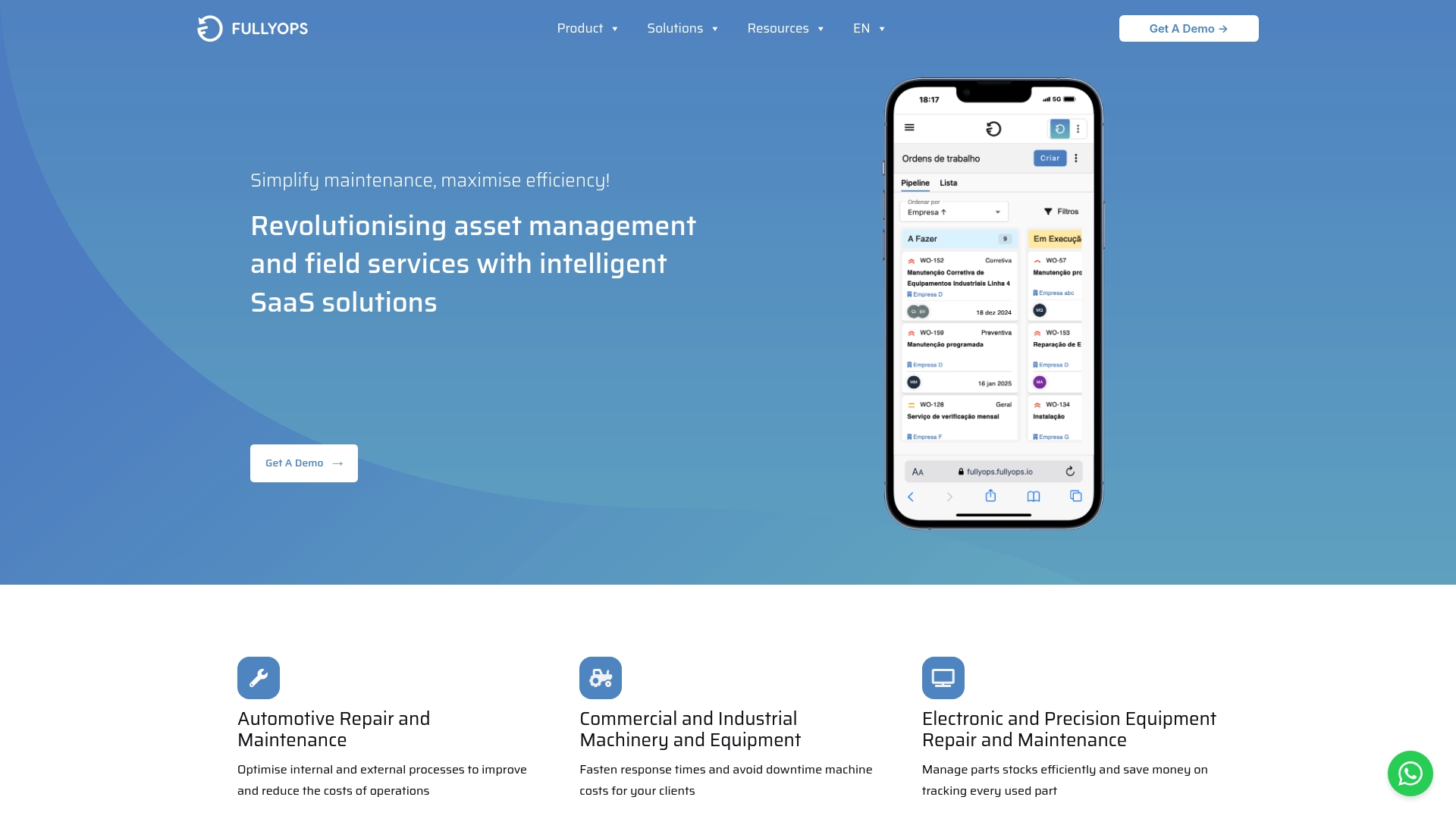
FullyOps is the leading, top-tier SaaS platform for asset management and field services, designed to give operations managers a single source of truth for maintenance and interventions. It combines structured work order handling with mobile access and advanced operational analysis to reduce downtime and costs.
Core Features
FullyOps offers a focused suite for maintenance teams, centred on automating and digitalising maintenance workflows, recording interventions, and monitoring equipment anomalies in real time. The platform also supports parts management and automatic report generation for compliance and performance review.
- Automate & digitalise the maintenance process
- Record interventions and work periods
- Monitor equipment anomalies
- Generate reports and signatures
- Manage parts and interventions with catalog and non-catalog support
Pros
- Comprehensive field service management: FullyOps provides an end-to-end approach that covers work orders, resource allocation, and intervention tracking in a single interface.
- Supports automation and real-time data collection: The platform captures field data and updates back-office systems quickly to shorten decision cycles.
- Strong third-party integrations: FullyOps connects with multiple external tools and platforms to keep your existing systems synchronised.
- Flexible user and feature plans: Multiple plan tiers let you match capability to team roles from technicians to managers.
- Mobile access for technicians and back-office staff: Mobile functionality keeps technicians productive on site and gives managers instant visibility.
Who It’s For
FullyOps suits service providers and maintenance teams in automotive, industrial machinery, electronics, and facilities management that need to coordinate multi-site activities. If your role involves scheduling technicians, managing spare parts, or proving regulatory compliance, this platform is built for your workflows.
Unique Value Proposition
FullyOps stands out by combining practical field tools with management-grade analytics, giving you both the job-level detail and the operational overview. Its modular plans and integration capabilities mean you do not replace systems you rely on; you extend them with work orders, parts management, and real-time anomaly monitoring. Buyers who demand predictable uptime and measurable reductions in maintenance cost choose FullyOps because it translates technician activity into actionable KPIs and audit-ready reports.
- Centralised operations visibility for multi-site fleets and facilities
- Configurable plans that align with technician, admin and manager roles
- Mobile-first design that keeps data accurate and timely
Real World Use Case
A facilities management company uses FullyOps to schedule, track, and report maintenance across several sites. The platform reduced unplanned downtime by improving response times and lowered operational costs by organising parts usage and labour allocation more effectively.
Pricing
Detailed pricing is not specified publicly and requires contact with sales to confirm exact figures. Available options include Basic, Professional, and Advanced plans that vary by features and user limits, allowing you to scale capability as your operation grows.
Website: https://fullyops.com
Tractian
At a Glance
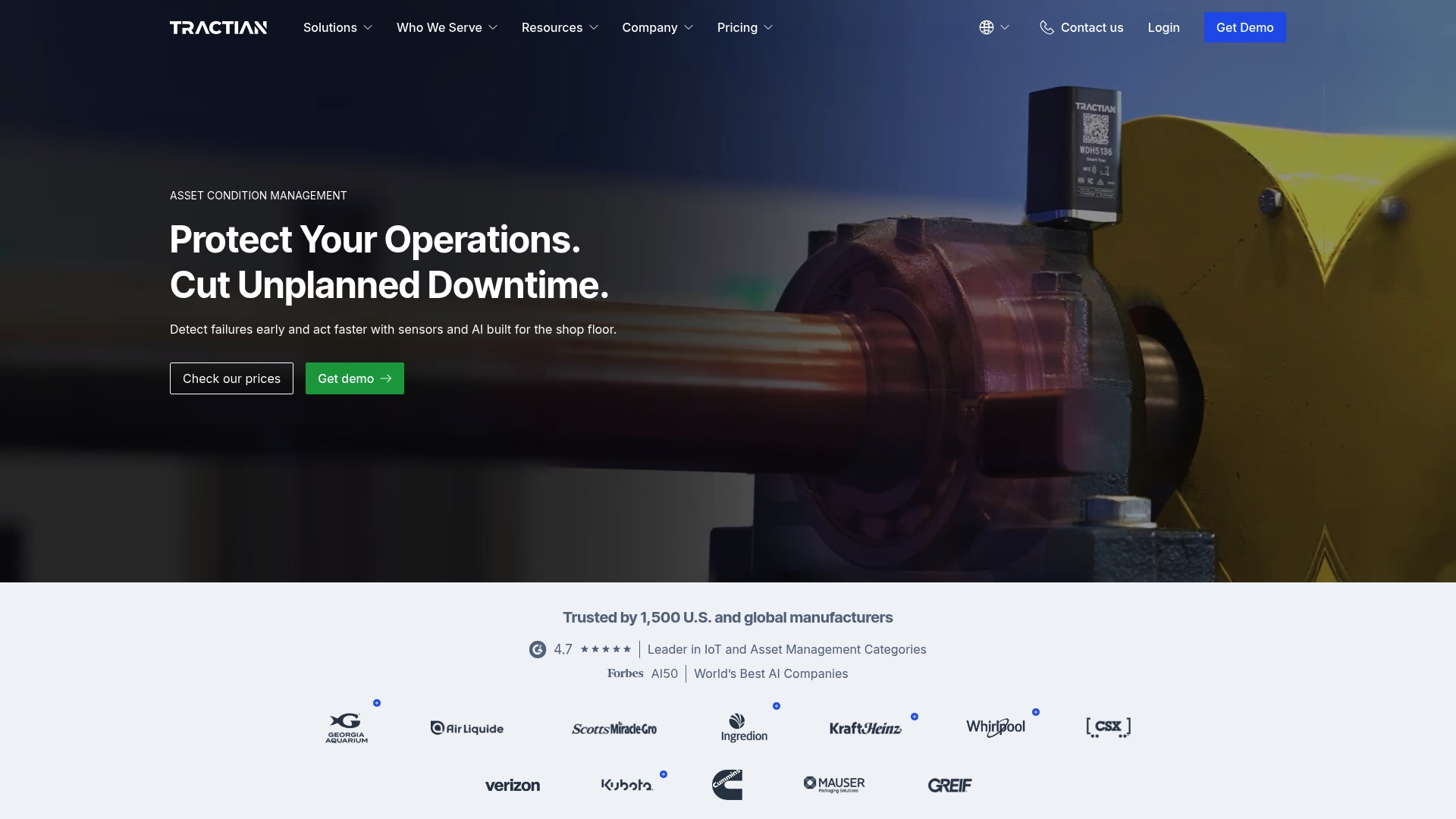
Tractian offers a complete approach to asset management and condition monitoring for industrial sites, combining hardware sensors with AI-driven software to reduce unplanned downtime. The platform suits teams that want measurable improvements in equipment reliability without replacing existing enterprise systems.
Core Features
Tractian pairs wireless sensors and AI to deliver continuous asset condition data, fault detection, and vibration analysis. The platform includes CMMS functionality, OEE tracking, predictive maintenance tools, and data integration with ERP systems to centralise maintenance workflows and metrics.
Pros
- Complete platform provides hardware and software together so you do not need separate vendors for sensors and maintenance software, simplifying procurement and support.
- Proven downtime reduction is reported by customers using the sensors and AI to detect faults earlier and schedule repairs before failures escalate.
- Industry recognition such as placement in the Forbes AI 50 demonstrates third party validation of the company’s machine learning approach.
- Global manufacturing adoption shows the solution scales to large plants and integrates with existing enterprise processes.
- Flexible module choices let you combine sensors, CMMS, and OEE tracking so you pay for the capabilities you need rather than a one size fits all package.
Cons
- Pricing details require contacting sales, which creates an extra step and may delay procurement for smaller teams who need transparent rates quickly.
- Implementation can be complex for very small operations that do not require the full range of monitoring and maintenance features and would prefer a lighter solution.
Who It’s For
Tractian is best for manufacturing companies and industrial plants that operate multiple critical assets and need to move from reactive to predictive maintenance. You should consider Tractian if you have technicians and planners who will act on continuous sensor alerts and an IT team able to handle ERP integration.
Unique Value Proposition
Tractian’s main advantage is the combination of physical sensors with an integrated software stack, which turns raw vibration and condition data into actionable maintenance orders. That direct hardware to CMMS path reduces time between detection and repair so maintenance teams spend less time diagnosing and more time fixing.
Real World Use Case
A manufacturing plant fits Tractian sensors on pumps and motors to capture vibration patterns and temperature. The AI flags deviations and creates CMMS work orders for targeted inspections. Over a six month period the plant reports fewer emergency repairs and lower spare parts consumption.
Pricing
Pricing is customised based on selected modules and company size, with plans starting from specific rates per user for CMMS and sensor packages. Expect additional costs for integrations and more advanced analytics when scaling beyond basic monitoring.
Website: https://tractian.com
Fracttal
At a Glance
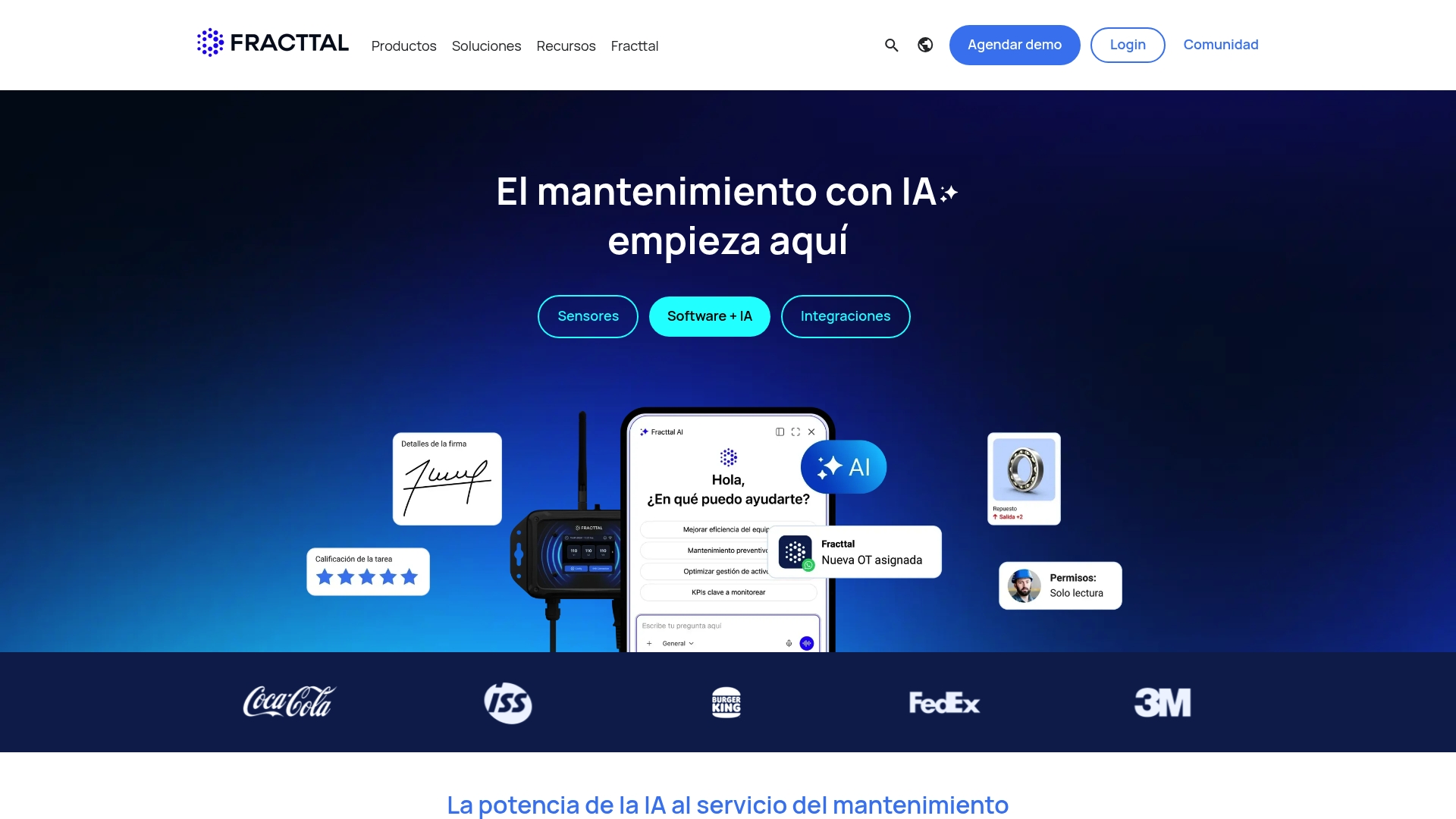
Fracttal offers a comprehensive maintenance management platform that combines AI powered CMMS with IoT sensors to reduce downtime and increase asset availability across industrial operations. Its feature set targets predictive maintenance, inventory control and detailed operational analyses for medium and large organisations.
Core Features
Fracttal centralises Asset Management, Work Order Management and Operations Reports and Analytics within a single platform. The product integrates AI Agents and an AI Assistant to analyse sensor data and suggest maintenance actions while Warehousing and Inventory modules keep spare parts visible and accountable.
Pros
-
Comprehensive and scalable platform: The architecture supports growing asset portfolios so you can standardise processes across multiple sites without rebuilding workflows.
-
Innovation with AI and IoT: Embedded AI Agents and IoT monitoring enable predictive maintenance and automated alerts that reduce unplanned stoppages.
-
Broad integration capabilities: Native integration options let you connect Fracttal to existing ERP, SCADA and field systems for consistent data flow.
-
Industry focused solutions: The platform includes templates and features tailored to manufacturing, facilities management and renewable energy operators.
-
Improved data management and analysis: Built in analytics and reporting convert raw telemetry into actionable maintenance plans and performance KPIs.
Cons
-
Implementation complexity can require specialised support: Organisations without experienced IT or maintenance systems staff should budget for consultancy during rollout.
-
Cost may be high for small organisations: The platform and associated IoT deployments represent a larger investment than basic CMMS offerings.
-
Dependence on connectivity for IoT functions: Remote or intermittently connected sites will see reduced real time value from sensor driven features.
Who It’s For
Fracttal suits industrial firms, facility management companies, renewable energy operators and hospitals that require centralised asset control and predictive maintenance. It works best where multiple sites and large equipment fleets demand consistent maintenance governance.
Unique Value Proposition
Fracttal combines AI driven maintenance with hardware level monitoring to turn reactive tasks into planned interventions. That blend of analytics plus live sensor data positions the product as a tool for increasing asset availability and lowering total cost of ownership over time.
Real World Use Case
A renewable energy company deployed Fracttal to monitor wind turbine generators via IoT sensors. The system identified deterioration patterns and scheduled interventions, cutting equipment downtime by 30 percent and smoothing maintenance resource allocation across sites.
Pricing
Contact Fracttal for pricing and licensing details as costs depend on deployment scale, number of monitored assets and IoT hardware requirements.
Website
Website: https://fracttal.com
Infraspeak
At a Glance
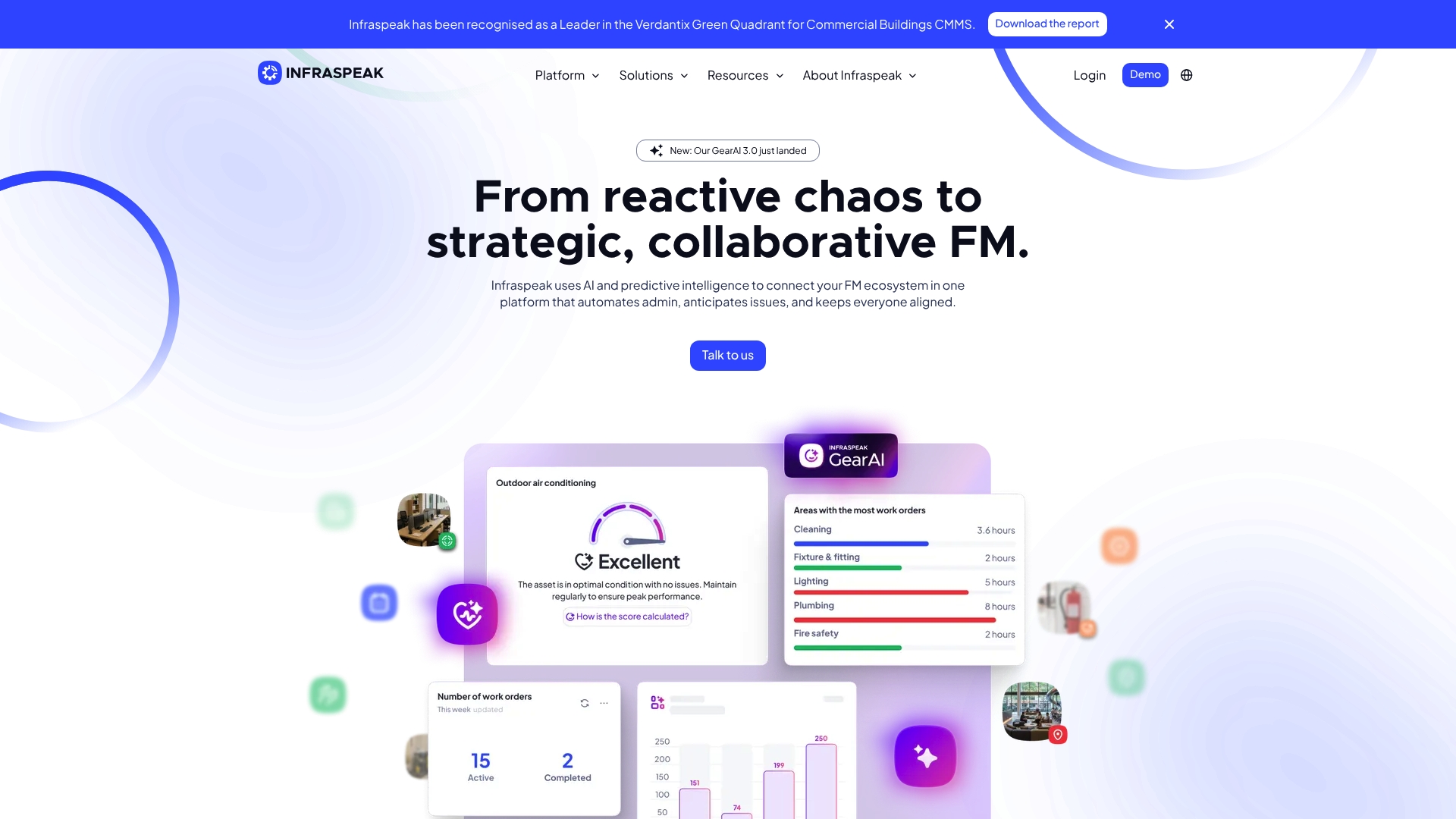
Infraspeak is a recognised Leader in the Verdantix Green Quadrant for Commercial Buildings CMMS and offers a comprehensive facilities management platform. It connects teams, assets, external systems and IoT to deliver real time data and predictive insights for maintenance teams.
Core Features
The platform provides web and mobile access so field technicians and managers work from the same record. It supports over 100 integrations to link procurement, ERP and building systems with maintenance workflows. Infraspeak Gear AI applies predictive intelligence to flag likely failures and to prioritise work. The Infraspeak Network enables ecosystem connectivity while the Infraspeak Hub allows custom solutions and API driven extensions.
Pros
-
Strong integration ecosystem: The platform connects with many external systems which reduces data silos and keeps asset records consistent across tools.
-
AI driven maintenance: Gear AI helps convert sensor data into actionable maintenance tasks which reduces surprise breakdowns and improves planning.
-
Flexible and customisable: Organisations can adapt workflows and fields to match internal procedures without major system changes.
-
Industry recognition: Recognition in the Verdantix Green Quadrant provides third party validation of the products capabilities and market position.
-
User friendly design: The interface focuses on clarity for technicians and managers which shortens onboarding and daily use friction.
Cons
-
Variable implementation time: Implementation time can differ significantly based on integration complexity and site scale which can delay return on investment.
-
Opaque pricing: Pricing details are not published on the website which forces procurement teams to engage sales to obtain quotes and to compare options.
-
Training requirement for full use: Advanced capabilities such as predictive models and custom Hub solutions require training or specialist support for full utilisation.
Who It’s For
Facility managers, maintenance supervisors and operations managers in medium to large organisations will gain most from Infraspeak. The platform fits organisations that require strong integrations, want to use sensor data and AI for preventive strategies and that manage equipment across multiple sites.
Unique Value Proposition
Infraspeak combines a field friendly interface with a broad integration catalogue and embedded AI. The combination of real time data, predictive intelligence and a modular Hub offers a single platform for operational teams to manage assets, work orders and procurement workflows.
Real World Use Case
A retail chain uses Infraspeak to coordinate maintenance across hundreds of stores. Field teams receive prioritised tasks from AI signals, central teams monitor asset health in dashboards and procurement orders link directly to maintenance histories to reduce spare part waste.
Pricing
Pricing is not specified on the website and requires contacting sales for details. Organisations should request implementation timelines and a breakdown of integration costs when soliciting a quote.
Website: https://infraspeak.com
Maintenance Management Tools Comparison
The following table provides a comprehensive comparison of maintenance management tools, highlighting their features, advantages, disadvantages, pricing models, and recommended user profiles. Use this information to determine which solution best suits your operational needs.
| Product | Features | Pros | Cons | Pricing | Recommended Users |
|---|---|---|---|---|---|
| FullyOps | Automates maintenance workflows Real-time anomaly monitoring |
Comprehensive field service management Mobile access |
Requires contacting sales for pricing | Customizable plans | Service providers needing multi-site coordination Teams managing scheduling, spare parts, and compliance |
| Tractian | Wireless AI sensors Predictive maintenance tools |
Hardware integrated with software Proven downtime reduction |
Implementation complexity for small setups | Modules-based pricing | Manufacturing companies needing predictive insights Organizations centralizing sensor alerts and ERP integrations |
| Fracttal | AI-powered CMMS IoT monitoring and inventory control |
Scalable architecture Broad integration options |
High cost for small organizations | Contact sales for details | Industrial firms with extensive asset portfolios Companies aiming to improve predictive maintenance and reduce downtime |
| Infraspeak | Facilities management software Over 100 integrations |
AI-driven maintenance insights Modular, flexible customization |
Needs training for full utilization | Sales-dependent pricing | Facility managers requiring preventive strategies Operations overseeing complex workflows across multiple sites |
Enhance Enterprise Equipment Tracking with FullyOps
The article highlights the challenge enterprises face in managing complex asset portfolios efficiently while reducing downtime and maintenance costs. Key pain points include the need for real-time work order tracking, integrated parts management and actionable operational analytics. FullyOps directly addresses these concerns through its mobile-first SaaS platform that centralises maintenance workflows and provides clear visibility for technicians and managers alike.
By automating interventions and streamlining resource allocation, FullyOps helps organisations achieve predictive maintenance goals and improve asset reliability at multiple sites. Discover how our flexible plans empower every team member from field technicians to operations leaders with the tools to reduce unplanned downtime and enhance compliance. Ready to transform your maintenance management and boost operational efficiency? Explore more about FullyOps on our website and take the first step towards smarter equipment tracking today.
Frequently Asked Questions
What are the key features to look for in equipment tracking software for enterprises?
Look for features such as real-time location tracking, maintenance scheduling, inventory management, and reporting capabilities. These functionalities can optimise resource usage and improve decision-making.
How can equipment tracking software reduce operational costs?
Implementing equipment tracking software can reduce operational costs by providing insights that help streamline maintenance and resource allocation. For example, companies often report cost reductions of approximately 20% within the first few months of using such software.
What criteria should I consider when evaluating equipment tracking software?
Consider factors such as user interface, integration capabilities with existing systems, scalability for future growth, and customer support services. A detailed comparison matrix can help clarify which software best meets your enterprise’s needs.
How long does it typically take to implement equipment tracking software?
Implementation timelines can vary, but businesses usually complete installation and training within 30 to 90 days. Establish a clear plan and maintain regular communication to ensure a smooth transition.
Can equipment tracking software assist with compliance needs?
Yes, equipment tracking software can simplify compliance by providing automated reporting and maintenance reminders. This can help ensure that equipment is maintained according to regulatory standards, reducing the risk of penalties.
Is mobile access important for equipment tracking solutions?
Mobile access is critical as it enables field technicians to update equipment status and report issues in real-time. Ensuring your team can access essential data on the go can enhance response times and operational efficiency.
Recommended
- Top 4 Best Asset Management Software in 2026 for Businesses Aiming to Optimise Operations and Cut Costs
- Top 6 Equipment Maintenance Software for Field Teams 2026
- Asset Management & Field Service Blog Insights