

Gestão de sobressalentes is the system of processes and data that ensures the right part is available at the right time for the lowest total cost. It is not the same as generic warehousing: spare parts inventory exists purely to protect equipment availability, so every decision trades stockout risk against capital tied up on a shelf.
Three actions move the needle faster than anything else:
- Classify parts by value, demand variability and criticity to production
- Align forecasting methods to intermittent, irregular consumption patterns
- Set replenishment rules with digital records that link every item to its equipment
The rest of this guide builds out each of these, then walks through the systems, warehouse discipline and governance that make them stick. A 30/60/90 day checklist and a look at how a modern platform operationalises all of it close things out.
TL;DR:
- Classify spare parts by value, demand variability, and criticity to ensure effort focuses on items that truly impact production and costs.
- Use intermittent demand forecasting methods like Croston’s, SBA, or TSB for slow-moving items, supplementing with historical and maintenance data.
- Set replenishment policies based on classification, applying different rules such as reorder points, (s,S), or base-stock depending on item criticality and demand patterns.
- Maintain an accurate item master by linking each part to its equipment before implementing classification and forecasting to prevent data inaccuracies.
- Regularly review stock parameters and service levels quarterly to prevent drift, based on KPIs such as fill rate, stock turns, and emergency purchases.
Table of Contents
- Classification and criticity: grouping parts so effort follows risk
- Forecasting spare parts with intermittent demand
- Replenishment policies and safety stock by class
- CMMS, ERP and the item master that prevents costly mistakes
- Warehouse organisation, cycle counts and kit management
- Managing obsolescence and standardising parts
- KPIs, governance and the review cadence that stops drift
- A 30/60/90 day plan and a one-year roadmap
- How a modern asset platform operationalises these practices
- Common pitfalls and what success looks like
- Get spare parts under control with FullyOps
- Key Takeaways
- Sources
- FAQ
Classification and criticity: grouping parts so effort follows risk
Not every part deserves the same attention, and treating them identically is the single most common waste in stores. The standard method layers three lenses. XYZ measures demand variability, separating steady consumers (X) from erratic ones (Z). A criticity overlay then asks a different question entirely: what happens to production if this part is missing when needed?
That overlay is what academic reviews increasingly treat as the third pillar alongside classification and forecasting, because a cheap, rarely used item can still halt a production line if it has no substitute and a six-week lead time, as one multicriteria classification study validated at an industrial electronics manufacturer demonstrates.
Classification changes policy, not just labelling:
- High criticity, low movement items get dedicated safety stock regardless of cost, often held on a consignment or reserved basis.
- High value, predictable consumption items get tight reorder points and negotiated framework pricing.
- Low value, low criticity items get simple two-bin or visual replenishment with minimal oversight.
- Run a pilot: classify one equipment family, link every part number to its asset, then audit 20 to 30 items against actual failure history before scaling the model plant-wide.
Pro Tip: Start the item–equipment link before you touch classification. A perfect ABC-XYZ matrix built on parts that aren’t tied to a machine is just a spreadsheet exercise.
Forecasting spare parts with intermittent demand
Standard smoothing methods assume demand every period. Spare parts rarely behave that way: a bearing might sell twice a year, then not again for eighteen months, which breaks moving averages and exponential smoothing outright. Industrial research on intermittent demand recommends Croston’s method and its variants, which separate two questions: how often does demand occur, and how large is it when it does?
- Croston estimates interval and size separately, then combines them into a rate. It works well for moderately intermittent items.
- SBA (Syntetos-Boylan Approximation) corrects a known bias in Croston that tends to overstate demand for very slow movers.
- TSB (Teunter-Syntetos-Babai) updates the probability of demand every period rather than only after a sale, which handles items that have gone completely obsolete more gracefully.
Reserve these statistical models for high-movement or high-value classes where the effort pays off; for rarely used, low-criticity items, a simple heuristic (minimum stock of one or two units) is often more practical. Feed every model with more than raw consumption history: overlay preventive maintenance calendars, known failure modes and recent usage spikes so the forecast reflects what is actually coming, not just what already happened.
Replenishment policies and safety stock by class
Choosing a replenishment policy is where classification pays off, because the same rule applied to every item either starves critical parts or drowns the store in slow movers.
- Reorder point plus safety stock suits moderate-value, moderate-criticity items: order a fixed quantity whenever stock drops below a trigger that covers lead time demand plus a buffer.
- (s,S) policies fit items with variable consumption, ordering up to a maximum level S whenever stock falls to s, which smooths order frequency for erratic but not rare demand.
- Base-stock policies work best for high-criticity, expensive items reviewed continuously, keeping inventory position at a fixed target and replenishing one-for-one on every withdrawal.
Set the parameters by ABC-XYZ-criticity cell, not by gut feel: a high-criticity Z-class item needs a wider safety margin than an A-class item with stable, predictable draw. Lead time uncertainty deserves particular caution. When a supplier’s delivery variance is unclear or historically unreliable, err towards holding an extra unit rather than tightening the buffer to save a small holding cost, because the combined effect of classification, forecasting and calibrated replenishment on reducing stockouts depends on all three working together, not any one in isolation.
CMMS, ERP and the item master that prevents costly mistakes
None of the policies above matter if the underlying data is wrong. The item master is the foundation, and it needs, at minimum: a unique part number, description, unit of measure, criticity flag, equipment linkage, preferred supplier and lead time.
- The item–equipment link is non-negotiable. Without it, you cannot forecast against maintenance plans or trace which asset consumes which part.
- Integration between a CMMS and ERP gives real-time stock visibility, automated purchase orders when reorder points trigger, and the ability to assemble kits for planned interventions instead of picking parts one at a time, especially when using construction software for HVAC contractors designed for field service efficiency.
- Work order linkage means every issued part is tied to the job that consumed it, which feeds both cost tracking and future forecasting.
Data governance is the unglamorous part nobody wants to own, but it decides whether the system stays trustworthy. Naming standards stop the same bearing being entered under three different descriptions. Lifecycle flags mark items as active, phase-out or obsolete. Access controls restrict who can create new part numbers, which is usually where duplicate SKUs creep in.
Pro Tip: Assign one person as item master owner. When everyone can create new part numbers, nobody is accountable for the mess that follows.
Warehouse organisation, cycle counts and kit management
Good policy on paper still fails if the physical store is disorganised. Bin assignment should follow pick frequency: fast-moving A-class items near the issue counter, slow movers further back. Central stores work for shared, expensive items; satellite stores near production lines suit fast-moving consumables where a technician cannot afford a walk across the plant during a breakdown.
- Run cycle counts on a cadence tied to ABC class: A-items counted monthly, B-items quarterly, C-items twice a year, sampling a subset each cycle rather than a full annual count.
- Use barcode or QR scanning at issue and receipt so every transaction is captured automatically rather than logged after the fact from memory.
- Link every issue to a work order number, which closes the loop between consumption and the job that caused it.
- Restrict store access to authorised personnel; open shelving with no accountability is the fastest route to phantom stock and write-offs.
Managing obsolescence and standardising parts
Dead stock accumulates quietly. Equipment gets retired, suppliers stop making a part, or an engineer specifies a near-duplicate item instead of reusing what already exists, and within a few years the item master is bloated with SKUs nobody tracks properly.
- Track lifecycle status on every part and set a sunset policy: flag items linked to decommissioned equipment for disposal or return rather than letting them sit indefinitely.
- For long-lead, critical components, negotiate consignment stock or framework agreements with suppliers so capital and risk shift away from your own shelves.
- Standardise specifications across similar equipment wherever engineering allows it. Fewer distinct part numbers means fewer supplier relationships, simpler forecasting and faster repairs because technicians already know the part.
KPIs, governance and the review cadence that stops drift
Measurement is what separates a one-off clean-up from a system that holds. Track service level by class (fill rate for A-critical items should sit meaningfully higher than for C-class consumables), overall fill rate, stock turns, the count and cost of emergency purchases, and lead time variance against supplier promises.
- Set service level targets by criticity, not a single blanket figure across the whole store.
- Review targets and reorder parameters quarterly against a dashboard, because parameters left unreviewed drift as equipment ages, suppliers change and consumption patterns shift.
- Define who owns what: maintenance flags criticity changes, purchasing manages supplier lead times, and stores owns cycle count accuracy. Blurred ownership is usually why parameters go stale.
The saving comes from fewer duplicate SKUs and less panic buying, not from cutting stock blindly.*
A 30/60/90 day plan and a one-year roadmap
Start narrow and prove the model before scaling it plant-wide.
- Days 1 to 30: clean up the item master for one equipment family, confirm item–equipment links, and classify that batch by ABC-XYZ-criticity.
- Days 31 to 60: begin cycle counts on the pilot batch, test one replenishment policy against real consumption, and start capturing issue transactions against work orders.
- Days 61 to 90: review pilot results, adjust safety stock parameters, and document the process before extending to a second equipment family.
- Months 4 to 12: roll out intermittent-demand forecasting for high-value classes, integrate CMMS and ERP fully, and renegotiate supplier terms for critical long-lead items.
Data cleanup and pilot classification are quick wins achievable with existing staff. CMMS-ERP integration and multi-supplier negotiation usually need dedicated project funding and sponsorship, so flag those early rather than assuming they will happen alongside daily workload.
How a modern asset platform operationalises these practices
Most of the failures above trace back to the same gap: policies exist on paper but the software doesn’t enforce them. A platform like FullyOps closes that gap by tying inventory transactions directly to work orders, so every part issued is automatically linked to the job and the asset that consumed it.
Look for these capabilities when evaluating any solution:
- Automated reorder triggers tied to class-specific reorder points, not manual review of every SKU.
- Kit assembly for planned maintenance, so technicians receive a complete parts set rather than picking items individually.
- Role permissions that separate who can create part numbers from who can approve purchases.
- Reporting that surfaces stock turns, fill rate and emergency purchases without manual spreadsheet building.
Onboarding effort is real but front-loaded: most of the work is the item master cleanup described above, not the software itself.
Common pitfalls and what success looks like
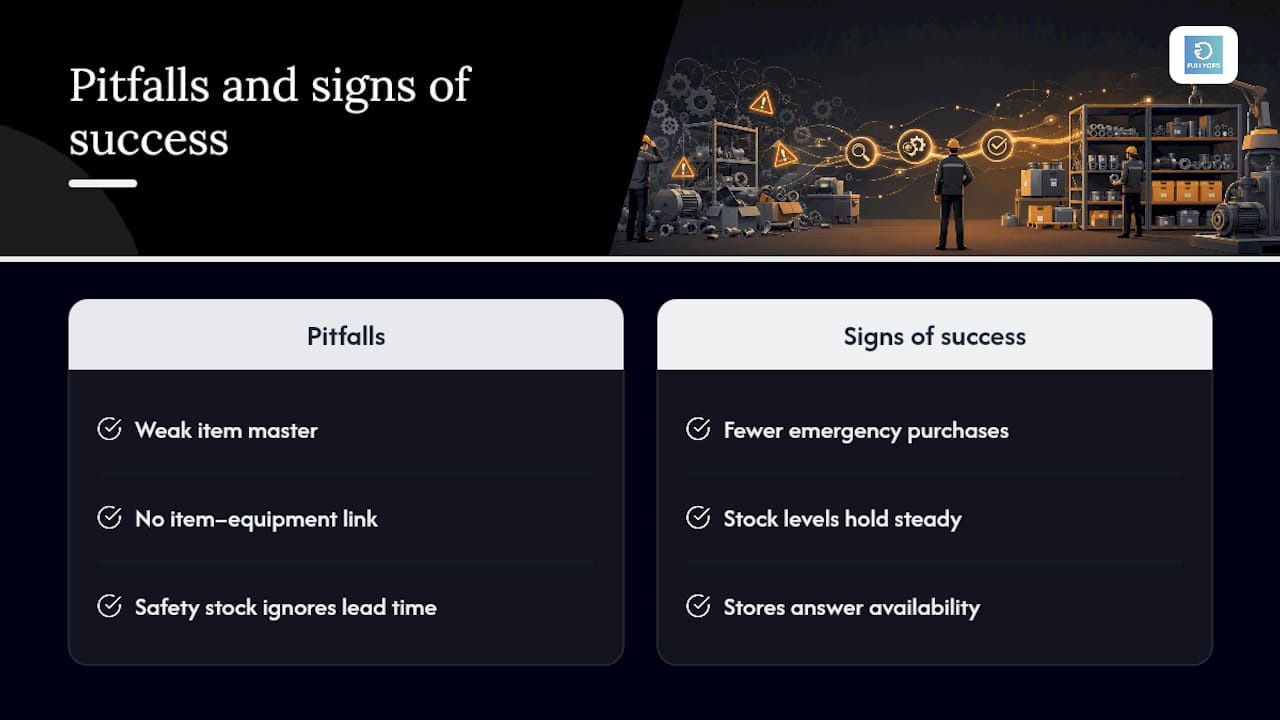
The failures I see repeated most often are a weak item master, no item–equipment link, and safety stock set without any real regard for lead time risk. Fix those three and most of the downstream chaos, expedited freight, duplicate purchase orders, technicians hunting for parts, disappears on its own.
By month six of a serious pilot, the signs of success are unglamorous but unmistakable: fewer emergency purchases, stock levels that hold steady instead of swinging wildly, and a stores team that can answer “do we have this part” without walking the aisle to check.
— Pedro
Get spare parts under control with FullyOps
Spreadsheets and standalone stock cards can carry a small store for a while, but they fall apart the moment you need real-time visibility across multiple equipment families or shifts. FullyOps gives maintenance teams a single system where work orders, inventory transactions and kit assembly sit together, so a technician closing a job automatically updates stock and a reorder point breach automatically triggers a purchase request.

That matters most for teams still running spare parts control through manual counts and disconnected spreadsheets, because the item–equipment link and role permissions this guide covers are built into the platform from day one rather than bolted on later. If you want to see how the work order and inventory workflows fit your own equipment list, book a demo and walk through your own part catalogue with the FullyOps team.
Key Takeaways
Effective spare parts management combines criticity-based classification, intermittent-demand forecasting and calibrated replenishment policies, backed by accurate digital records.
| Point | Details |
|---|---|
| Classify before you optimise | Use ABC value, XYZ variability and a criticity overlay tied to production impact. |
| Match forecasting to demand pattern | Apply Croston, SBA or TSB for intermittent items instead of standard smoothing. |
| Calibrate replenishment by class | Set reorder points, (s,S) or base-stock rules per ABC-XYZ-criticity cell, not uniformly. |
| Fix the item master first | Link every part to its equipment before layering policy on top. |
| Review governance quarterly | Track service level, fill rate and emergency purchases to catch parameter drift. |
| Automate with the right platform | FullyOps ties work orders, inventory and reporting together to enforce these rules. |
Sources
- Gestão de estoque de peças sobressalentes (MRO) na manutenção industrial: políticas de reposição, previsão para demanda intermitente e classificação por criticidade
- Classificação e gestão de stocks de sobressalentes — metodologia de classificação multicritério (Universidade do Minho repository)
- Forecasting and inventory models for intermittent demand (journal article DOI)
FAQ
What is gestão de sobressalentes in practice?
It is the combined discipline of classifying parts by criticity, forecasting irregular demand and setting replenishment rules that keep the right item on the shelf at the lowest sustainable cost.
Which forecasting method works best for spare parts?
Croston’s method and its variants, SBA and TSB, generally outperform standard smoothing because they treat demand frequency and order size as separate variables, as intermittent-demand research shows.
How often should safety stock be reviewed?
Quarterly reviews against a KPI dashboard are the common practitioner recommendation, since lead times, criticity and consumption patterns all shift over time.
Can software like FullyOps replace a large internal inventory project?
Yes for most maintenance teams. FullyOps provides work order linkage, inventory tracking and role permissions as a supported subscription, avoiding the cost and delay of building a custom system in house.
What is the biggest mistake in spare parts management?
Missing the item–equipment link. Without it, forecasting and classification are built on incomplete data, which undermines every policy layered on top.