

A passagem de turno digital standardises what gets communicated between shifts, reduces the errors that come from memory gaps and illegible notes, and leaves an audit trail that paper never could. One prospective study recorded errors falling from 77 to 45 within four months of introducing a digital handover tool alongside staff workshops. The approach draws on the ISBAR framework and Portugal’s Direção-Geral da Saúde Norma n.º 001/2017, and a SaaS platform like Fullyops can put the structure, audit logs and offline access this requires into practice.
TL;DR:
- Digital handover tools significantly reduce errors by forcing mandatory fields, timestamping entries, and providing searchable, audit-ready logs.
- Integration with existing hospital systems and offline functionality are essential to ensure adoption and continuous use in busy or connectivity-challenged environments.
- Using the ISBAR framework as a basis ensures structured, complete, and traceable information for both clinical and industrial handovers.
- Successful rollout relies on initial small pilots, early visible benefits, involving staff from the start, and iterative improvements based on real feedback.
- Fullyops offers a secure, integrated platform that connects handover data to work orders and assets, optimized for both healthcare and maintenance operations.
Table of Contents
- What is a digital shift handover and why does it matter?
- How do ISBAR and DGS guidance shape a digital handover?
- What technical and design features make handover tools reliable?
- How do you roll out a digital handover without staff resistance?
- What should a handover template actually include?
- How should exceptions and unusual situations be handled?
- Publisher perspective: lessons from real deployments
- Delivering a secure, integrated digital shift handover with Fullyops
- Sources
- FAQ
What is a digital shift handover and why does it matter?
A digital shift handover replaces the notebook, the whiteboard photo, or the five-minute verbal briefing with a structured record that both shifts can see, search and rely on. Instead of one nurse or technician summarising from memory, the system captures fields that must be filled before a handover counts as complete: what happened, what is pending, and what needs urgent attention.
The operational case is straightforward. Structured entries are harder to skip than a verbal aside, timestamps create accountability, and a searchable log means nobody has to phone a colleague at home to ask what “check the pump later” actually meant.
The strongest evidence for the shift comes from a prospective cohort study that tracked medical errors before and after a digital tool went live alongside supporting workshops. Errors fell from 77 to 45 over four months, a signal that structure paired with training, not software alone, drives the improvement.
Portuguese hospitals are already testing this. ULS Litoral Alentejano built a handover tool integrated with SClínico, aligned to ISBAR, and is rolling it out across surgery, intensive care and emergency services. Nearby, ULS Lezíria has been piloting its own application, moving teams off spreadsheets and into a dedicated system that pulls patient data automatically instead of asking staff to retype it.
Core benefits worth naming directly:
- Fewer omitted details, because mandatory fields cannot be left blank
- A timestamped audit trail for every handover, useful for both safety reviews and compliance
- Less time spent on verbal handover, freeing staff for direct care or floor work
- Continuity across shifts, departments and even sites when the system is shared
How do ISBAR and DGS guidance shape a digital handover?
ISBAR gives digital handover tools their backbone. The mnemonic, Situation, Background, Assessment, Recommendation, translates cleanly into discrete form fields rather than a paragraph of prose, and that translation is exactly what a software development study built around ISBAR found workable after iterative testing: early versions were functional and usable once the mnemonic was mapped field by field.
Each ISBAR component does a specific job in a digital form:
- Situation: the immediate reason for concern, patient identifier and current status flag
- Background: relevant history, diagnosis, allergies, and recent interventions
- Assessment: current vital signs, pain scores, and clinical judgement
- Recommendation: what the incoming shift needs to do, check or monitor first
Mapping a mnemonic like this to explicit fields reduces the chance that a detail simply gets forgotten, and it makes every entry traceable to whoever wrote it.
Portugal’s Norma n.º 001/2017 from the Direção-Geral da Saúde sets the expectation that handover communication follows a structured, verifiable process rather than an informal exchange. A digital tool supports that requirement almost by design, since structured fields are inherently easier to audit than a spoken briefing. In practice, some fields should be mandatory (patient identifier, current status, pending actions) while others stay optional (general observations, non-urgent notes), so the form stays fast to complete without losing the details that actually matter.
What technical and design features make handover tools reliable?
A handover tool is only as good as its ability to survive a busy ward or a workshop floor with patchy internet. Four requirements tend to separate tools that get adopted from tools that get abandoned within a month.
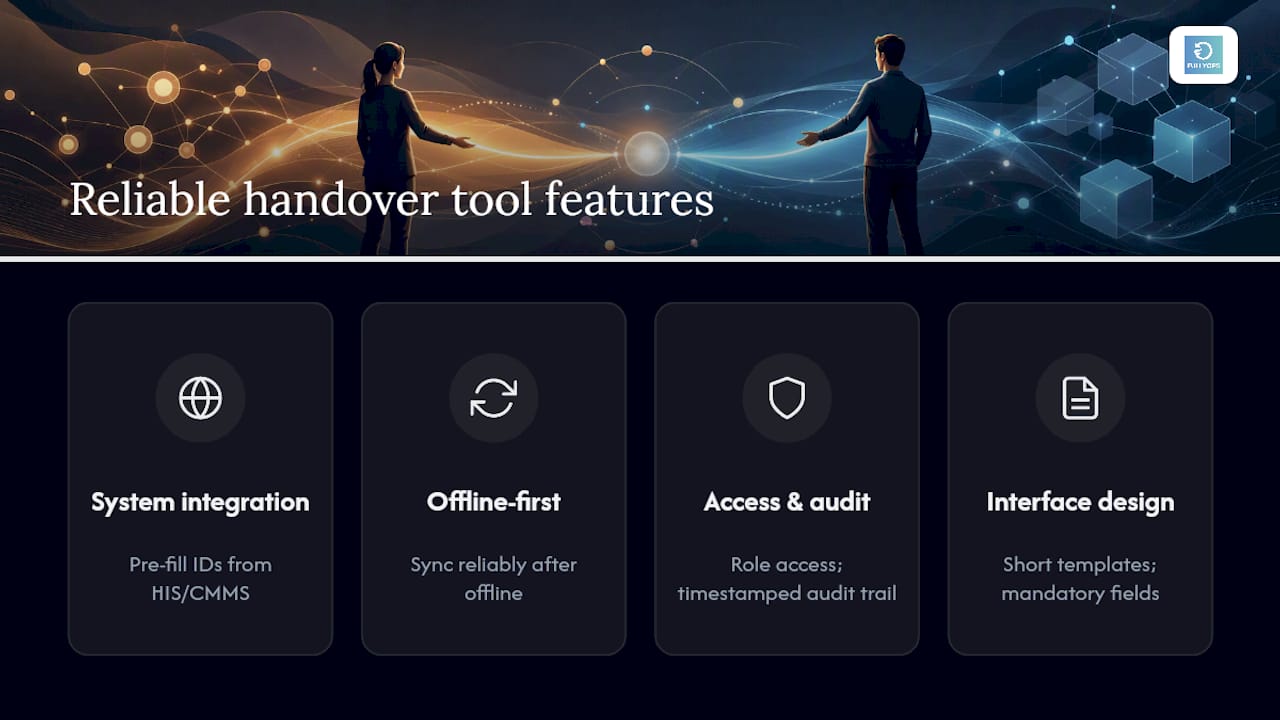
Integration with existing systems comes first. When a handover tool talks to a Hospital Information System or a CMMS, patient or equipment identifiers pre-populate automatically. That single design choice, prioritising field-level mapping so key identifiers pull from the source system, is what prevents the transcription errors that plague manually retyped handovers.
Offline-first architecture matters just as much. Wards, basements and industrial plant rooms are notorious dead zones for Wi-Fi, and a tool that locks up without signal will get abandoned in favour of a paper notebook within days. Reliable sync, once connectivity returns, has to be non-negotiable.
Access control and audit logging protect both patients and the organisation. Role-based permissions determine who can view or edit which records, and every entry needs a timestamp and an author, satisfying both confidentiality rules and DGS-style traceability requirements.
Interface design decides whether staff actually use the thing. Short templates, mandatory critical fields, and quick-select or search functions beat long free-text boxes every time, particularly under time pressure.
Pro Tip: Build the mandatory fields around what causes harm when missed, not around what looks thorough on a report. A shorter form that always gets completed beats a comprehensive one that gets skipped on a busy night.
Some deployments go further, replacing analogue ward boards with digital dashboards that also handle patient data concealment when a screen is in a shared or public area.
How do you roll out a digital handover without staff resistance?
Rolling out a digital work shift tool badly is the single fastest way to guarantee people quietly go back to paper. The sequence below reflects what worked in the Portuguese pilots referenced earlier.
- Select a contained pilot area. One ward, one shift pattern, or one maintenance team, small enough to iterate quickly but real enough to generate honest feedback.
- Define success metrics before launch. Agree on handover completion rate, time per handover and incident rate as your baseline numbers.
- Run a short pilot, typically four to eight weeks, long enough to move past the learning curve without dragging on.
- Iterate on real feedback. Cut fields nobody uses, add ones people keep writing in free text, and simplify anything that takes more than two taps.
- Scale once the pilot shows measurable gains, then repeat the training approach for each new team rather than assuming word of mouth will carry it.
Training works best when it leads with immediate, visible value rather than a full feature tour. Show staff the search function that replaces flipping through a paper log, or the dashboard that replaces a whiteboard photo. Adoption barriers are largely behavioural, so a pilot needs to deliver a visible, early win, fewer repeat calls, faster handovers, to build momentum before wider rollout.
Involve clinicians, technicians and IT from the first planning meeting, not after the system is built. Frontline staff will spot workflow mismatches that a project team working from a spec sheet never will.
What should a handover template actually include?
Templates only work if they are short enough to fill in under pressure and structured enough to catch what matters. Two versions cover most use cases: one clinical, one industrial.
A clinical template mapped to ISBAR should capture, per patient: identifier and status flag, relevant background and allergies, current assessment and vital signs, and a clear recommendation or pending action for the next shift. Keep the recommendation field free text, since instructions vary too much for a checkbox, but keep the status flag a fixed dropdown so it can be filtered and searched later.
An industrial or maintenance handover template needs a different shape but the same discipline. Common fields drawn from standard maintenance report formats include:
- Responsible technician and shift hours
- Tasks completed during the shift
- Pending tasks for the incoming team
- Safety flags or incidents, however minor
- Equipment status and any observations worth escalating
Use checkboxes for anything with a fixed set of outcomes, equipment status, task completion, and reserve free text for observations that genuinely vary. A template stuffed with open text fields takes too long to complete and produces inconsistent, hard-to-search entries.
How should exceptions and unusual situations be handled?
Standard fields cover the routine handover. What breaks most systems is the unusual case: a sudden deterioration, an equipment failure outside the normal checklist, or a situation nobody thought to build a field for.
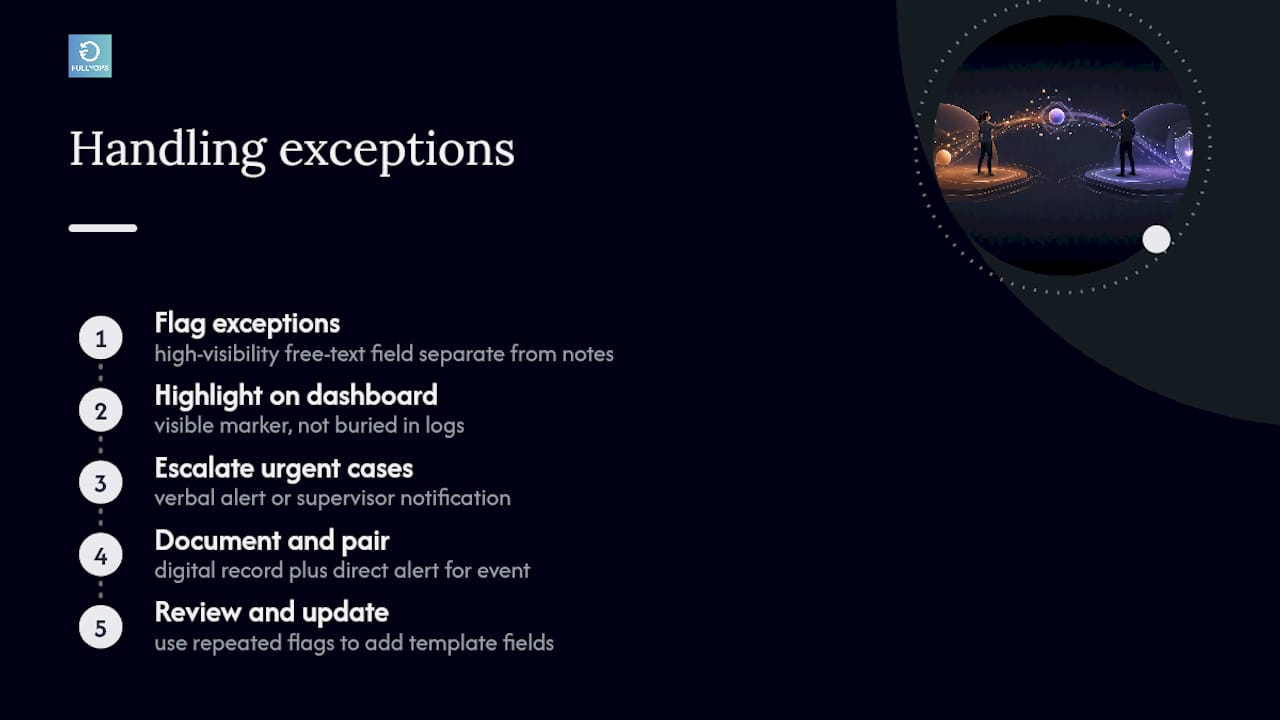
The fix is not more mandatory fields, it is a well-designed escalation path. A digital handover tool needs a flagged, high-visibility free-text field reserved specifically for exceptions, separate from routine notes, so it cannot get buried under ordinary updates. That field should trigger a visible marker on the dashboard rather than sitting passively in a log that someone has to scroll to find.
Time-sensitive exceptions need a different mechanism entirely. If a patient’s condition changes an hour before shift change, or a piece of plant fails mid-shift, the handover record should not be the only communication channel. Pair the digital entry with a direct verbal alert or a notification to a supervisor, so the record documents the event without becoming the sole means of raising it.
Unusual situations also expose gaps in a template faster than anything else. Every flagged exception is worth a quick review during the iteration phase of a rollout: if the same “doesn’t fit anywhere” note keeps appearing, that is a sign the template needs a new field, not that staff need reminding to use the existing ones. Treat exceptions as a design signal, not a training failure. Systems that build in a feedback loop from flagged exceptions back to template design stay accurate; systems that treat every deviation as a one-off tend to accumulate blind spots that surface later, usually during an incident review.
Publisher perspective: lessons from real deployments
The pilots that succeed rarely fail on the software itself. They fail on integration gaps and habit change: a nurse who has filled in the same paper form for a decade will not abandon it because a login screen looks polished. What moves the needle is removing duplicate work, pulling patient or equipment data straight from existing systems so nobody retypes an identifier twice.
The same logic applies on the industrial side. Linked work-order and asset histories cut transcription errors and give managers a paper trail for compliance without extra admin. Teams that treat handover data as part of the asset lifecycle, not a bolt-on form, get more honest, more complete entries because the system is already doing useful work for them.
— Pedro
Delivering a secure, integrated digital shift handover with Fullyops
Fullyops is built around the same requirements this guide has laid out: structured work orders, role-based access, integrations that pre-fill data instead of duplicating it, and offline sync for teams that cannot rely on constant connectivity. For operations managers running industrial or facility maintenance, that means shift handovers connect directly to work order histories and asset records instead of living in a separate spreadsheet nobody checks.
A practical path with Fullyops mirrors the rollout plan above: start with one team or site, map your existing data fields into the platform, train on the features that save the most time first, then scale once the pilot shows a measurable drop in repeat visits or handover time. Facilities managing connected services, such as scheduled deep-cleaning contracts like Apache X’s healthcare cleaning programmes, benefit from the same structured handover data feeding straight into their maintenance schedule.
See how it fits your operation on the digital work orders page, or request a demo to map your current handover process against what Fullyops can automate.
Sources
- Medscape Português: estudo sobre digitalização da passagem de plantão
- HealthNews: ULS Litoral Alentejano reforça segurança na passagem de turno
- Relatório diário de manutenção (repositório académico)
FAQ
What is a digital shift handover?
It is a structured, digital record replacing paper notes or verbal briefings between shifts, typically built around mandatory fields, timestamps and searchable entries rather than free-form notes.
Does digital handover actually reduce errors?
A prospective cohort study recorded a fall from 77 to 45 medical errors within four months of introducing a digital handover tool combined with staff workshops.
What is ISBAR and why does it matter for handovers?
ISBAR (Situation, Background, Assessment, Recommendation) is a clinical communication framework that maps cleanly onto digital form fields, making handover entries more complete and auditable.
Does Portuguese guidance require structured handover communication?
Norma n.º 001/2017 from the Direção-Geral da Saúde sets the expectation for structured, verifiable handover communication, which digital tools are well placed to support through mandatory fields and audit trails.
Can digital handover tools work without internet access?
Reliable tools use offline-first design so staff can complete a handover without signal, with the data syncing automatically once connectivity returns.
How does Fullyops support digital shift handovers in industrial settings?
Fullyops connects handover entries to work order histories and asset records, using role-based access and offline sync so maintenance teams avoid duplicate data entry across shifts.
Recommended
- Transform Maintenance with Digital Work Orders – FullyOps
- Technician Shortage: 4 Steps to Stop Knowledge Loss – FullyOps
- Ways to improve operational efficiency: 2026 guide
- Field Service Scheduling Guide for Efficient Technician Deployment