

Kanban de peças works when part consumption is reasonably stable and suppliers hold to their lead times consistently. Applied correctly, it cuts excess stock while preventing stockouts, because replenishment gets triggered by actual usage instead of forecasts. The right first move isn’t a full rollout: pick one family of parts, set up a simple two-bin or card-based loop, and measure it for a defined period before expanding.
TL;DR:
- Kanban for spare parts requires stable consumption and reliable supplier lead times; it is ineffective with highly erratic demand or inconsistent data.
- Proper sizing depends on demand, actual lead times, safety buffers, and container quantities, validated through a pilot based on historical consumption.
- Different kanban types—production, withdrawal, supplier, and two-bin—address specific replenishment needs and may run simultaneously in complex operations.
- A successful pilot emphasizes explicit rules, proper training, and measurable success criteria over a 30-day period, with ongoing review of consumption and compliance.
- Transitioning to e-kanban offers automation benefits, but only after mastering manual processes, data quality, and governance to avoid digitizing chaos.
Table of Contents
- What kanban de peças means and when it fits
- Core components: cards, bins and the kanban board
- How to size a kanban for spare parts
- Types of kanban for parts: production, withdrawal, supplier and two-bin
- Step-by-step implementation checklist and pilot plan
- What to measure and how to tell if kanban is working
- Physical kanban versus e-kanban: when to upgrade
- Common pitfalls and how to avoid them
- Best practices for integrating kanban with inventory and ERP systems
- Handling demand and supply variability in kanban systems
- Training and change management for team adoption
- Kanban adaptations across industries and part types
- Why kanban de peças changes how teams think, not just how they order
- Making kanban for parts easier to run day to day
- Sources
- FAQ
What kanban de peças means and when it fits
Kanban is a pull-based scheduling method developed at Toyota that uses signals, cards, or electronic triggers to align replenishment with actual consumption rather than forecasts. It’s the operational engine behind just-in-time and lean manufacturing: instead of pushing stock into a warehouse based on predicted demand, the system waits for a signal that says “this part has actually been used, replace it now.”
For parts inventory specifically, this only works under certain conditions. You need consumption that’s fairly stable, even if not perfectly flat. You need suppliers who hit their quoted lead times most of the time, because the entire sizing calculation depends on that number holding true. And you need clean material master data. If your part numbers, unit-of-measure fields, or bin locations are inconsistent, kanban amplifies the mess rather than fixing it.
Kanban isn’t the right tool everywhere. Extremely erratic demand, spare parts tied to unpredictable emergency breakdowns, suppliers with wildly inconsistent delivery performance, or inventory records nobody trusts are all reasons to fix the underlying data problem first. Trying to run a pull system on broken data usually just produces a faster, more visible version of the same chaos.
Core components: cards, bins and the kanban board
A working parts kanban loop needs three physical or digital elements, each doing a specific job.
- Cards or signals: each card should carry the part number, description, storage location, supplier or internal source, order quantity, and lead time. A barcode or QR code speeds up scanning if you’re using any digital layer at all.
- Bins: two bins per part is the standard starting point, one in use and one in reserve, clearly labelled with the part number and reorder point so nobody has to guess which bin triggers the order.
- The kanban board: a visual dashboard, physical or digital, showing which cards are in circulation, which are pending replenishment, and which are overdue.
The rule that matters most is who moves the card and when. Write it down explicitly: the technician pulls the card the moment the bin empties, not when they remember to, and places it in a fixed collection point. Ambiguity here is where most pilots quietly fail before anyone notices.
How to size a kanban for spare parts
Sizing starts with a formula, not a guess. A widely used starting point is demand multiplied by lead time, adjusted by a safety factor, divided by the quantity per container. Each variable needs a real number behind it, not an assumption.
- Average daily or weekly demand: pull this from at least three to six months of consumption history, not from what the maintenance team thinks they use.
- Lead time: the actual time from placing a replenishment signal to the part being available on the shelf, measured, not quoted by the supplier.
- Safety factor: typically expressed as a percentage buffer (commonly 10 to 30%) to absorb demand spikes or minor supplier delays.
- Container or bin quantity: how many units sit in each kanban bin or on each card.
Statistic Callout: A practical kanban sizing approach starts from demand × lead time × safety factor ÷ container quantity, and that starting number must then be validated against measured consumption during a pilot rather than trusted outright.
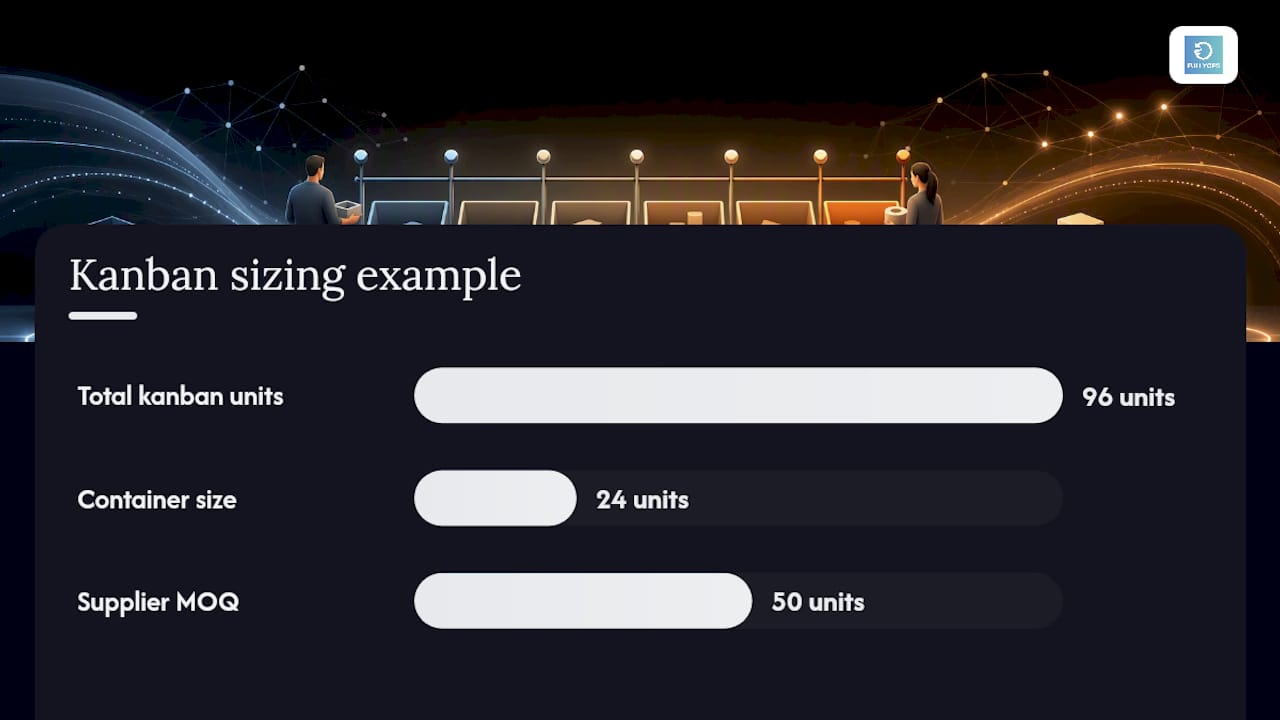
Here’s a worked example. That gives you 40 × 2 × 1.2 = 96 units of total kanban stock needed. If your container holds 24 units, you need four kanban cards or bins in circulation. Round up, never down, and check the supplier’s minimum order quantity against your container size. If the MOQ is 50 units but your container holds 24, you’ll need to adjust the container quantity or accept a larger buffer than the formula strictly calls for.
Types of kanban for parts: production, withdrawal, supplier and two-bin
Different kanban variants solve different problems, and most real operations run more than one type side by side.
- Production kanban authorises an internal workstation to manufacture or assemble more of a component, common where parts are fabricated in-house.
- Withdrawal kanban authorises moving parts from a storage point to a point of use, without triggering new production.
- Supplier kanban sends a signal directly to an external vendor, often via a portal or shared card system, to replenish purchased parts.
- Two-bin systems are the simplest form for purchased consumables and fasteners: one bin feeds usage, and when it empties, the second bin takes over while the first gets reordered.
Where manufacturing and external supply coexist, production and supplier kanban typically run in parallel, tracking components at each stage of the same assembly rather than mixing signals into one loop.
Step-by-step implementation checklist and pilot plan
Running a pilot properly is what separates kanban systems that stick from ones that get abandoned after three months. Follow this sequence rather than trying to roll everything out at once.
- Select a pilot family of 10 to 20 SKUs. Choose parts with stable, well-understood consumption. Avoid your most volatile or highest-value items for the first attempt.
- Map the current flow. Walk the actual physical path from stockroom to point of use, noting every handoff and delay.
- Define success criteria before you start. Decide what “working” looks like: a specific reduction in stockouts, a target lead time, or an improvement in fill rate.
- Write explicit card rules. State who pulls the card, when, where it goes, and who places the replenishment order. Put this on a laminated sheet at the bin, not just in a procedure document nobody reads.
- Train the people who’ll actually touch the system. This means technicians, storeroom staff, and whoever processes purchase orders, not just supervisors.
- Assign a parameter owner. Someone needs authority to review and adjust kanban sizes as real consumption data comes in.
- Run the pilot for a defined window. A 30-day observation period is a reasonable starting point for catching early stockouts, manual overrides, and rule violations.
- Review against your success criteria and expand or adjust. Only scale to more SKUs once the pilot family is behaving predictably.
Pro Tip: Log every manual override during the pilot, even the ones that felt justified at the time. A pattern of overrides on the same part usually means your sizing formula, not your team’s discipline, is the actual problem.
What to measure and how to tell if kanban is working
Four metrics tell you almost everything you need to know during a pilot and afterwards.
- Lead time from signal to availability: the gap between a card being pulled and the part landing back in the bin.
- WIP compliance: whether the number of cards in circulation matches what you designed, since kanban’s core value lies in limiting work-in-process and exposing bottlenecks rather than hiding them behind extra stock.
- OTIF (on-time-in-full): the percentage of replenishment cycles that deliver the right quantity by the promised date.
- Stock turns: how many times inventory cycles through in a given period, with higher turns often signaling leaner, healthier stock.
Gather baseline figures for at least a month before the pilot starts, then compare against the same window post-implementation. Improving OTIF and shrinking lead time variance are the real signals of success, not simply having fewer cards or lower stock on the shelf. A drop in stock that comes with more emergency orders isn’t progress.
Physical kanban versus e-kanban: when to upgrade
Physical cards and boards are the right starting point for almost every pilot. Smartsheet’s guidance on kanban systems backs this: prove governance and data quality manually before adding technology on top.
E-kanban earns its cost once you’re managing multiple sites, coordinating with external suppliers directly, or need an audit trail for compliance. Electronic kanban systems combine sensors, smart labels, and cloud platforms to automate triggers and remove manual card errors.
- Automated replenishment triggers instead of manual card handling.
- Real-time visibility across warehouses and supplier locations.
- Integration with existing ERP and inventory systems.
- Reduced risk of lost or damaged physical cards.
Before moving to e-kanban, master data needs to be clean, your network and scanning devices need to be reliable, and governance rules need to already be working manually. Skipping that step just digitises the same confusion faster.
Common pitfalls and how to avoid them
Most kanban failures trace back to a handful of predictable mistakes.
- Wrong SKU selection: starting with your most volatile or highest-value parts instead of stable, well-understood ones.
- Inaccurate master data: mismatched units of measure, outdated supplier lead times, or duplicate part numbers.
- Supplier variability: a supplier whose delivery time swings widely makes any fixed kanban size unreliable.
- Rule non-compliance: technicians skipping the card pull step or “just grabbing extra” from another bin.
- Manual overrides becoming routine: a workaround used once becomes the default, quietly breaking the pull signal.
Pro Tip: Keep an exception log next to the kanban board. Every override, stockout, or rule break gets written down with a reason. Review it weekly during the pilot; patterns show up faster than you’d expect.
Best practices for integrating kanban with inventory and ERP systems
Kanban and ERP aren’t competing systems. Kanban handles the physical, moment-to-moment pull signal on the shop floor; the ERP holds the master data, purchase orders, and financial record. The integration point that matters most is the part number and reorder logic: if your kanban card quantity doesn’t match what’s configured in the ERP’s reorder point, you’ll get conflicting replenishment signals, one from the shop floor and one from the system.
Start by reconciling part master data between the two systems before you launch any pilot. Bin locations, unit of measure, and lead times should say the same thing whether a technician reads them off a card or a planner pulls them from a screen. Where the ERP already runs automatic reordering for a SKU, either turn that off for kanban-managed parts or set the ERP’s reorder point to match the kanban trigger exactly, so the two don’t fire independent orders for the same shortage.
For parts moving to e-kanban, integration usually happens through the same connectors used for other inventory data, feeding consumption events back into the ERP for reporting and cost tracking. A maintenance management platform that already tracks work orders and inventory levels together makes this reconciliation far easier, because technicians log parts usage against a work order rather than through a separate stock system that has to be manually cross-checked.
Keep the review cadence for kanban parameters separate from the ERP’s own reorder point reviews, but make sure the same person or team owns both, so changes to one get reflected in the other within days, not months.
Handling demand and supply variability in kanban systems
Kanban assumes a degree of stability, but real parts consumption rarely stays perfectly flat. The practical response isn’t to abandon the pull system the moment demand gets choppy. Where demand variability is high but suppliers remain reliable, a workable approach is to increase the safety factor for that specific SKU and stagger replenishment timing, rather than reverting to manual ordering for the entire family of parts.
Segment your parts by variability first.
Supply-side variability is a different problem and needs a different fix. If a supplier’s lead time swings by more than a few days on a regular basis, no safety factor calculation will fully compensate. The better move is renegotiating a tighter lead time commitment, qualifying a second source for that part, or holding a dedicated buffer bin sized specifically around the supplier’s worst-case delivery history rather than their average.
For genuinely unpredictable parts, tied to breakdowns that don’t follow any pattern, kanban is the wrong tool on its own. These usually sit better in a min-max or reorder-point model, where the trigger is a calculated threshold rather than physical consumption of a fixed bin. Many maintenance operations run kanban and min-max side by side, applying each to the SKU family it actually suits rather than forcing one method across the entire parts catalogue.
Training and change management for team adoption
A kanban system fails or succeeds based on whether the people touching it daily actually follow the rules, not on how well the formula was calculated. Training needs to reach technicians, storeroom staff, and purchasing, because each group performs a different action in the loop and a gap in any one role breaks the signal for everyone else.
Start training with the “why,” not just the “how.” Technicians who understand that pulling a card the moment a bin empties directly prevents next week’s stockout are far more likely to follow the rule than those who were just handed a laminated instruction sheet. Walk the physical flow with the actual team during training, at the actual bins, rather than in a meeting room with slides.

Assign clear ownership from day one. Someone needs to be the point of contact when a card goes missing, a bin runs dry unexpectedly, or a supplier misses a delivery. Without a named owner, exceptions get handled inconsistently and confidence in the system erodes fast.
Governance after the initial rollout matters as much as the training itself. Set a recurring cadence, monthly is typical, to review kanban sizes against actual consumption, and treat that review as a standing agenda item rather than something that happens only when a problem surfaces. Teams that sustain kanban long-term tend to treat the exception log from the pilot phase as a permanent tool, not a temporary pilot artefact, because it keeps surfacing where the rules and reality have drifted apart.
Kanban adaptations across industries and part types
Kanban’s core mechanics stay the same everywhere, but the practical shape of the loop shifts depending on what’s being replenished.
In automotive and general manufacturing, kanban tends to run closest to its original Toyota form: production kanban for in-house fabricated components, withdrawal kanban moving parts to the assembly line, and tight integration between the two because a line stoppage is expensive by the minute.
Facilities and building maintenance usually leans harder on two-bin systems for consumables, fasteners, filters, gaskets, because the parts are low value individually but stocking out delays a work order. The bin system here is often deliberately simple, sometimes just a labelled shelf with a reorder card taped to the empty side.
Electronics and precision equipment maintenance tends to favour supplier kanban more heavily, because many components come from a small number of specialised vendors with longer, less flexible lead times. The safety factor calculation carries more weight here, since a stockout on a specialised part can halt repairs for weeks rather than days.
Heavy industrial and process plants, where breakdowns can be catastrophic and expensive, often run a hybrid: kanban for predictable consumables and wear parts, alongside a separate min-max or criticality-based stocking model for the rare, high-cost spares that don’t move often enough to justify a pull signal at all. The choice of variant tends to follow part criticality and consumption pattern far more than industry label alone.
Why kanban de peças changes how teams think, not just how they order
The biggest shift kanban brings to spare parts isn’t the formula, it’s accountability. Once a card exists with a name and a rule attached to it, “we ran out” stops being an acceptable answer, because everyone can see exactly which step in the loop broke down.
Fewer emergency orders and clearer ownership of parts availability show up faster than most managers expect, often within the first pilot cycle, once the discipline of pulling a card actually sticks. What surprises people less often is how well this pairs with digital work orders and mobile inventory checks: a technician scanning a part against a work order is, in effect, running the withdrawal signal without a separate physical step. For readers building out that connection further, aligning kanban rules with a broader spare parts management workflow is worth doing early, not as an afterthought once the pilot is already running.
— Pedro
Making kanban for parts easier to run day to day
Running a parts kanban system by hand works well for a pilot, but scaling it across dozens of SKUs and multiple technicians is where manual cards and spreadsheets start to strain. Some platforms handle this differently: instead of a separate card system living apart from your maintenance records, inventory levels, part consumption, and replenishment triggers sit inside the same platform your technicians already use for work orders. A part scanned against a job automatically reflects in stock levels, so the pull signal happens as a side effect of normal work, not an extra administrative step.
That matters most once you’ve proven a pilot works and want to expand it without hiring someone just to chase cards and update spreadsheets. Mobile scanning, inventory sync, and reporting on lead time and stock turns come built in, giving you the same KPIs discussed earlier without a manual tracking exercise. If you’re past the pilot stage and ready to see how digital work orders and parts tracking fit together, explore Fullyops’s field service management platform and request a demo.
Sources
- Kanban — Wikipedia
- Kanban de produção: guia prático para indústrias — Sensio
- C-parts management – Digital material supply | BITO
- Understanding kanban inventory management — Smartsheet
- What Is the Kanban System? — Investopedia
FAQ
What is kanban de peças?
Kanban de peças is a pull-based replenishment system for spare parts and components, where a card or digital signal triggers reordering only after actual consumption, rather than relying on forecasts.
How do you size a kanban for spare parts?
Use demand multiplied by lead time and a safety factor, then divide by the container quantity; validate the result against measured consumption during a pilot before scaling it.
What’s the difference between kanban and min-max inventory systems?
Kanban triggers replenishment from physical or digital consumption signals tied to fixed containers, while min-max relies on calculated reorder points and works better for parts with unpredictable, non-pattern demand.
When should you move from physical to e-kanban?
Move to e-kanban once you need multi-site visibility, supplier coordination, or an audit trail, and only after your master data and governance rules are already working reliably on paper cards.
How long should a kanban pilot run before scaling it?
A 30-day observation window is a reasonable starting point for catching stockouts, manual overrides, and rule violations before expanding to more SKUs.
Can kanban work alongside an existing ERP system?
Yes, provided part numbers, lead times, and reorder points are reconciled between the two systems so the kanban signal and the ERP’s own reorder logic don’t fire conflicting replenishment orders.