

Hotel asset management is the owner-facing discipline that protects property value through financial oversight, CapEx prioritisation, and contract governance. The recommended next step is to commission an independent asset-management audit and shortlist a cloud-based maintenance and field-service platform that integrates with your hotel systems.
Three practical steps to begin:
- Audit your asset base: catalogue every physical asset, its condition, and its maintenance history.
- Establish a KPI baseline: define owner-facing metrics (uptime, MTTR, RevPAR impact) before any software goes live.
- Run a scoped pilot: test your chosen platform on one or two properties for 8–12 weeks before full rollout.
Pro Tip: Commission the audit before selecting software. The audit findings should drive your integration requirements, not the other way round.
Table of Contents
- What is hotel asset management, and how does it differ from operations?
- Why active asset management protects hotel value
- What core functions and KPIs do hotels need?
- What should you look for in a cloud-based hotel platform?
- How do you implement cloud asset management in a UK hotel?
- How does Fullyops align with hotel asset-management needs?
- PMS integration challenges and how to resolve them
- How analytics and AI improve hotel asset management
- UK hotel cloud asset management: what the evidence shows
- Post-implementation support and ongoing training
- Scaling cloud asset management across a UK hotel portfolio
- Key takeaways
- Why owner-led asset management is the discipline the sector underestimates
- Fullyops: cloud maintenance built for asset-management accountability
- Useful sources
- FAQ
What is hotel asset management, and how does it differ from operations?
Hotel asset management is an owner-facing, financial and value-preservation function. It is not hotel operations. The general manager runs the guest experience day to day; the asset manager protects the owner’s investment over the long term.
“The asset manager’s perspective is fundamentally different from the GM’s: where the GM optimises for guest satisfaction and operational efficiency, the asset manager optimises for owner ROI, exit value, and capital preservation.” — Les Roches
Formal asset-manager responsibilities include:
- Monthly ownership reporting and KPI dashboards
- CapEx scope review and ROI validation
- Management contract compliance monitoring
- Market benchmarking and competitive set analysis
- Operator budget negotiation and variance review
The Hospitality Asset Managers Association (HAMA) sets professional standards for this discipline, including the Certified Hotel Asset Manager (CHAM) designation. When hiring an asset manager or appointing a consultancy, CHAM accreditation is a credible baseline for competence.
Why active asset management protects hotel value
Owners who rely solely on operator reporting risk losing visibility into whether the management contract is genuinely maximising long-term exit value. HVS notes that operators are incentivised to prioritise short-term profit and brand standards, which can diverge from owner objectives around IRR and exit proceeds.
“Owners must treat maintenance and capital programmes as strategic levers, not just costs, to protect value during market fluctuation.” — CBRE and HVS
CBRE’s guidance on hotel asset management emphasises a fiduciary approach: owners should hold operators accountable through data-driven oversight, not passive acceptance of monthly P&L summaries. Common failure modes include CapEx drift (projects approved without ROI validation), hidden cost lines buried in departmental budgets, and deferred maintenance that erodes asset value ahead of a planned exit.
Pro Tip: Define owner KPIs contractually, not informally. If your management agreement does not specify reporting frequency, KPI thresholds, and CapEx approval gates, you have no enforcement mechanism.

Reducing maintenance costs through proactive planning is one of the clearest financial levers available to owners.
What core functions and KPIs do hotels need?
Effective hospitality asset management requires both operational functions and a reporting layer that translates maintenance activity into owner-facing metrics.
Core functions:
- Preventive maintenance scheduling and execution
- Reactive work order management and lifecycle tracking
- Real-time intervention tracking and root-cause logging
- Parts and inventory management
- CapEx planning and ROI validation
- Vendor management and SLA monitoring
- Analytics and automated owner reporting
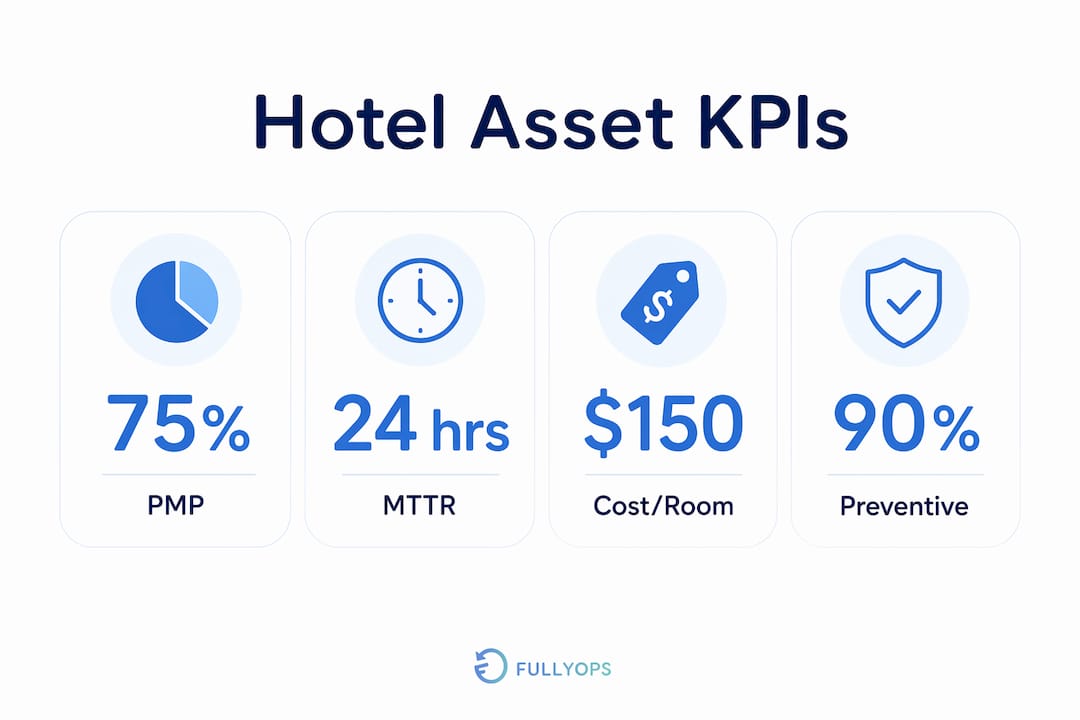
| Function | Owner KPI | Reporting Frequency |
|---|---|---|
| Preventive maintenance | Planned maintenance percentage (PMP) | Monthly |
| Reactive work orders | Mean time to repair (MTTR) | Weekly |
| Asset uptime | Equipment uptime rate | Weekly |
| Maintenance spend | Maintenance cost per available room (MCAR) | Monthly |
| CapEx execution | CapEx ROI vs. RevPAR uplift | Quarterly |
| Inventory | Parts availability rate | Monthly |
Integrating PMS data with financial dashboards is the step most owners miss. Without it, maintenance activity remains siloed from the KPIs that actually govern investment decisions.
What should you look for in a cloud-based hotel platform?
Selecting the right cloud maintenance and field-service platform for hotel asset management requires a structured checklist. Features that matter:
- Mobile technician app with offline capability
- Configurable preventive maintenance scheduling
- Full work-order lifecycle management (creation, assignment, completion, sign-off)
- Real-time intervention tracking with photo and note capture
- Parts and inventory management with reorder alerts
- Role-based permissions for technicians, supervisors, and asset managers
- API integrations with PMS, RMS, and HR systems
- Multi-site support with property-level and portfolio-level reporting
- Configurable CapEx approval workflows
- SLA tracking and breach alerting
- UK data residency and full GDPR compliance
Non-functional requirements carry equal weight. Confirm uptime SLAs, support response times, and whether the vendor offers UK-based implementation support.
Pro Tip: Procure on integration capability first. A platform with a well-documented API and pre-built middleware connectors will save weeks of manual data reconciliation during rollout and every month thereafter.
How do you implement cloud asset management in a UK hotel?
A realistic three-phase roadmap for UK hotel owners:
- Discovery and audit (2–6 weeks): Map all physical assets, document maintenance history, identify data owners, and define integration requirements with your PMS and financial systems. Agree on a single source of truth for asset records.
- Pilot (8–12 weeks): Deploy on one to three properties or a defined department. Onboard technicians, activate preventive maintenance schedules, establish the KPI baseline, and test PMS integration. Measure MTTR and PMP against the pre-pilot baseline.
- Scale and optimisation (3–12 months): Roll out across the portfolio, activate CapEx approval workflows, and begin producing automated owner reports. Refine KPI thresholds based on pilot data.
Cost considerations: subscription tiers typically vary by number of technician licences, admin seats, and sites. Budget separately for implementation professional services, data migration, and technician training. Payback drivers include reduced emergency CapEx, lower downtime, and improved RevPAR through better asset availability.
Operational readiness checklist before go-live:
- API keys and PMS integration credentials confirmed
- Asset register cleaned and imported
- Role permissions mapped to your org structure
- KPI reporting templates agreed with ownership
How does Fullyops align with hotel asset-management needs?
Fullyops maps directly to the software checklist above. Its core capabilities cover work order management, preventive maintenance scheduling, real-time intervention tracking, inventory management, performance analytics, and API integrations with external systems. Role-based permissions allow asset managers, property supervisors, and technicians to operate within clearly defined access boundaries.
For UK hotel operators, Fullyops supports GDPR-compliant data handling and scales across multi-property portfolios through tiered subscription plans that price by user role and site count.
“Asset managers need a platform that produces owner-facing KPIs, not just operational logs. The gap between a maintenance ticket and an owner dashboard is where most platforms fail — and where the right tool pays for itself.” — Fullyops
PHG case examples show that targeted asset-management mandates can materially improve operating performance and support successful divestments. Owners using Fullyops can expect reduced MTTR, tighter CapEx discipline, and automated reporting that replaces manual spreadsheet consolidation.
Explore the full feature overview to see how each module maps to your asset-management requirements.
PMS integration challenges and how to resolve them
Integrating a cloud maintenance platform with multiple hotel property management systems is the most common friction point in hospitality asset management rollouts. Hotels frequently operate different PMS instances across properties, each with its own data schema, API version, and access control model.
Best practices to reduce integration risk: standardise on a middleware layer (such as a dedicated integration platform) rather than point-to-point connections between each PMS and your maintenance system. Assign a named data owner for each property who controls API credentials and approves schema changes. Document the data flows you actually need (room status, occupancy, guest complaints linked to maintenance tickets) rather than attempting a full bidirectional sync from day one. Incremental integration, validated at each phase of the pilot, produces more reliable results than a single big-bang cutover.
How analytics and AI improve hotel asset management
Cloud platforms with built-in analytics move hotel asset management from reactive reporting to predictive decision-making. At the operational level, dashboards surface MTTR trends, PMP rates, and parts consumption patterns that would take hours to compile manually. At the strategic level, real-time monitoring tools can flag asset degradation before failure, reducing emergency CapEx.
AI-assisted features, such as anomaly detection on equipment sensor data and automated work-order prioritisation, are increasingly available in cloud maintenance platforms. For asset managers, the practical value lies in connecting these signals to owner KPIs: a predicted HVAC failure that would affect 30 rooms during peak occupancy has a quantifiable RevPAR impact, and that framing is what turns a maintenance alert into an ownership decision.
UK hotel cloud asset management: what the evidence shows
Colliers’ hospitality asset management team, which has managed UK properties including the W Hotel Edinburgh and the Cadogan Estate portfolio in London, reports that active asset management combined with structured CapEx oversight consistently improves financial performance and supports repositioning outcomes. The Covivo portfolio of 13 UK properties underwent a significant CapEx and rebranding programme under active asset management, demonstrating that multi-property rollouts are operationally achievable when governance structures are in place.
For owners without a dedicated asset manager, cloud-based maintenance platforms provide the data infrastructure that makes owner oversight possible without full-time on-site presence. The key outcome is not just lower maintenance costs but the ability to hold operators accountable with verified data.
Post-implementation support and ongoing training
Software value degrades quickly without structured adoption. After go-live, the priorities are technician proficiency, reporting accuracy, and keeping the platform current with your asset base as properties change. Expect to budget time for quarterly KPI reviews, annual asset-register audits, and periodic retraining when staff turn over.
Vendors vary significantly in their post-implementation support models. Confirm whether your subscription includes access to a customer success manager, a defined SLA for bug resolution, and release notes for new features. Platforms that push updates automatically reduce the administrative burden but require a named internal owner who reviews change logs and communicates updates to the team.
Scaling cloud asset management across a UK hotel portfolio
Multi-property scaling introduces governance questions that single-site pilots do not surface. Who approves cross-property CapEx? How are KPI thresholds standardised when properties differ in age, brand, and market position? Which data stays at property level and which rolls up to the portfolio dashboard?
Resolve these questions in the pilot phase, not after rollout. Configure the platform’s permission model to reflect your actual ownership structure: portfolio-level asset managers should see consolidated reporting; property-level supervisors should see only their site. Subscription tiers that price by site and user role give you the flexibility to add properties without renegotiating the entire contract.
Key takeaways
Hotel asset management delivers measurable owner value when financial oversight, preventive maintenance, and cloud-based reporting are integrated into a single, accountable programme.
| Point | Details |
|---|---|
| Audit before software | Map assets and define KPIs before selecting a platform to drive integration requirements. |
| GM vs asset manager | The asset manager protects owner ROI; the GM runs operations — conflating the two creates governance gaps. |
| Integration-first procurement | Choose a platform with a documented API; PMS integration is the most common rollout failure point. |
| GDPR and data governance | UK hotel asset data must be handled under GDPR; confirm data residency and access controls before go-live. |
| Fullyops for multi-site rollout | Fullyops covers work orders, preventive maintenance, inventory, analytics, and API integrations across tiered plans. |
Why owner-led asset management is the discipline the sector underestimates
The hospitality sector has spent years debating brand standards and revenue management strategy, yet the discipline that most directly protects owner capital — active, data-driven asset management — remains underdeveloped at many properties. Operators are not incentivised to flag deferred maintenance or challenge their own CapEx requests. That is not a criticism; it is a structural reality of how management contracts work.
What changes the outcome is an owner who treats maintenance data as financial data. When MTTR figures feed directly into ownership reports, and when CapEx approval requires a documented RevPAR impact estimate, the conversation between owner and operator shifts from anecdotal to evidential. Cloud maintenance platforms make that shift possible without a large in-house team.
The gap most owners underestimate is not between having a platform and not having one. It is between having a platform that produces operational logs and having one that produces owner-facing KPIs. That distinction determines whether the software pays for itself.
Fullyops: cloud maintenance built for asset-management accountability
Hotel owners and asset managers who need verified, owner-facing maintenance data across multiple UK properties get exactly that with Fullyops. The platform covers the full maintenance lifecycle: work orders, preventive scheduling, intervention tracking, inventory, and automated reporting, all within a GDPR-compliant, multi-site architecture priced by role and property.
The next step is a scoped discovery call to map your asset base, define your KPI requirements, and design a pilot. See the full asset management system types overview, then request a demo to scope your pilot.
Useful sources
- Les Roches — What is hotel asset management? — role clarity, GM vs asset manager distinction, industry growth context.
- HAMA — Hospitality Asset Managers Association — professional standards, CHAM credential, CapEx benchmarking.
- CBRE — Global hotel asset management — fiduciary approach, owner oversight, CapEx as a strategic lever.
- HVS — Asset management services — operator-reliance risk, exit value guidance.
- HVS — How the right asset management firm helps optimise hotel investments — hospitality-specific skills, revenue management and franchise contract expertise.
- PHG Hotels & Resorts — Hotel asset management services — CapEx ROI discipline, case examples including Dolce Sitges.
- Canary Technologies — Hotel asset management guide — PMS integration, KPI reporting, operational data alignment.
- eCornell — Achieving hotel asset management objectives — CapEx benchmarking, risk analysis, management agreement tools.
- Colliers — Hotel asset management — UK case studies (W Hotel Edinburgh, Cadogan Estate, Covivo portfolio).
FAQ
What is hotel asset management?
Hotel asset management is the owner-facing discipline of protecting and growing property value through financial oversight, CapEx prioritisation, and management contract governance. It is distinct from hotel operations, which the general manager leads.
How does an asset manager differ from a hotel general manager?
The general manager runs day-to-day guest operations; the asset manager represents the owner’s financial interests, monitors operator performance, and validates CapEx decisions against owner ROI targets, as Les Roches explains.
Which KPIs should hotel asset managers track?
Core KPIs include planned maintenance percentage (PMP), mean time to repair (MTTR), maintenance cost per available room (MCAR), equipment uptime rate, and CapEx ROI measured against RevPAR uplift.
Does Fullyops support GDPR compliance for UK hotels?
Fullyops is designed with GDPR-compliant data handling and role-based access controls, making it suitable for UK hotel operators managing asset and maintenance data across multiple properties.
How long does a cloud maintenance platform rollout take for a UK hotel?
A realistic timeline is 2–6 weeks for discovery and audit, 8–12 weeks for a scoped pilot, and 3–12 months for full portfolio rollout and optimisation, depending on the number of properties and PMS integration complexity.
Recommended
- Asset Management Trends 2026: Transforming HVAC Operations
- Asset management trends boosting efficiency in 2026
- Facility management checklist: boost efficiency and asset control