

En resumen:
- An incident reporting procedure documents workplace events to ensure safety, compliance, and continuous improvement. Proper reports include detailed facts, signatures, and timely completion, serving as a foundation for investigation and corrective action. Maintaining a no-blame culture and closing the loop with follow-up actions prevents recurring incidents and strengthens safety management.
An incident reporting procedure is the formal process of documenting and managing workplace incidents to protect employees and comply with regulatory standards such as OSHA and the Occupational Health and Safety Act. A well-structured process does more than satisfy legal requirements. It creates a reliable record that supports investigation, corrective action, and long-term safety improvement. Operations managers and safety officers who treat incident reporting as a compliance exercise miss its real value. Done correctly, it is the foundation of a proactive safety culture.
What must an incident reporting procedure include?
Every effective incident report captures the same core categories of information, regardless of industry. Missing any one of them weakens the report’s legal standing and its usefulness for investigation.
The following elements are required in any complete incident report:
- Who: Full names, job titles, and contact details of all involved parties and witnesses
- What: A factual description of the event, including the type of incident, injuries sustained, and equipment involved
- When: Exact date and time of the incident, recorded to the minute where possible
- Where: Specific location within the facility, including zone, floor, or machine reference
- How: Sequence of events leading to the incident, described in objective terms
- Environmental conditions: Lighting, weather, noise levels, or other factors present at the time
- Immediate actions taken: First aid administered, emergency services contacted, and who was notified
- Supervisor signature: Unsigned reports lack legal or regulatory validity; a supervisor’s signature validates the review, while an employee’s signature acknowledges receipt, not agreement
- Report date: The date the report was completed, which must be within seven calendar days for OSHA-recordable incidents
One discipline that separates strong reports from weak ones is the separation of facts from conclusions. Avoid mixing facts with conclusions in the initial report. Write objective descriptions and reserve fault attribution for the investigation phase.
Consejo profesional: Use a standardised form with fixed fields for each required element. Blank fields are immediately visible, which reduces the chance of incomplete submissions reaching your records.
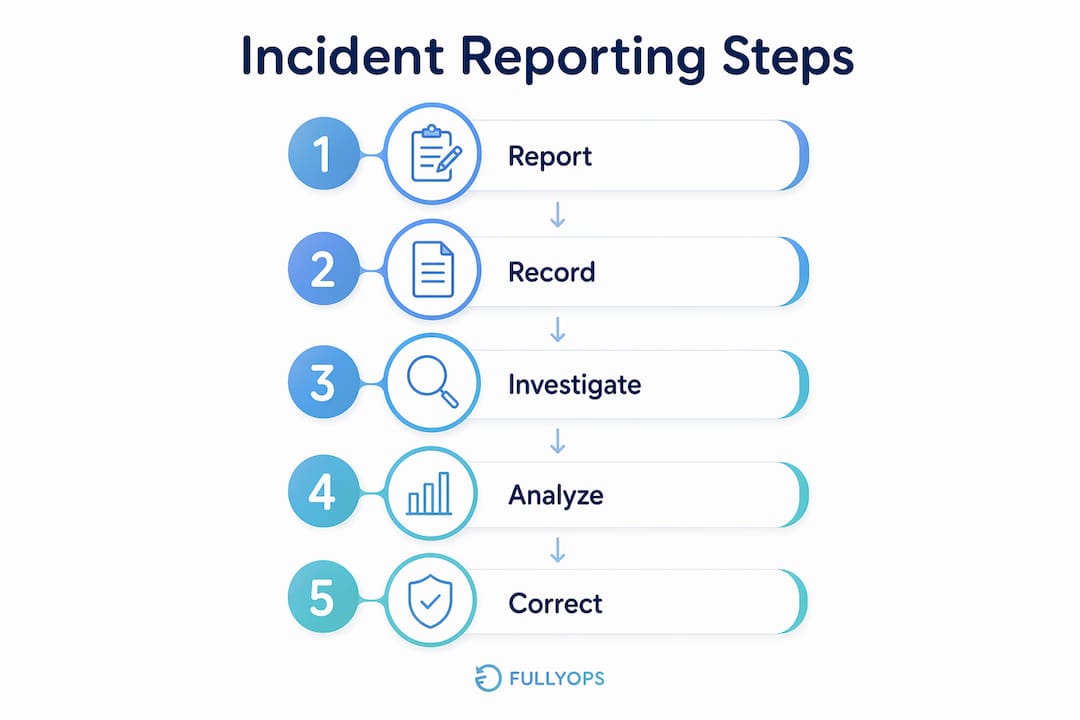
How to build a step-by-step incident reporting workflow
A structured workflow removes ambiguity about who does what and when. The following sequence reflects current industry best practice and 2026 regulatory requirements.
- Secure the scene immediately. Prevent further injury by isolating the area. Do not disturb evidence unless doing so is necessary to protect people.
- Provide first aid and call emergency services. Attend to the injured person first. Contact emergency services if the injury is serious.
- Notify the relevant supervisor. The supervisor must be informed as soon as the scene is safe. This triggers the formal reporting chain.
- Preserve evidence. Photograph the scene, equipment, and any environmental factors before anything is moved or cleaned. Collect witness statements while memories are fresh.
- Interview witnesses separately. Separate interviews prevent witnesses from aligning their accounts. Ask open questions and record responses verbatim where possible.
- Complete the internal incident report within 24 hours. Delaying beyond 24 hours raises recurrence risk by 35% and reduces the accuracy of witness accounts. Prompt completion is not optional.
- File regulatory reports on time. Employers must report fatalities to OSHA within 8 hours and hospitalisations, amputations, or loss of an eye within 24 hours. OSHA Form 301 must be completed within 7 calendar days for any recordable injury or illness, with records retained for 5 years.
- Assign report ownership. Designate a named individual responsible for completing, reviewing, and filing the report. Shared ownership produces gaps.
An effective escalation system classifies incidents by severity, directing notification and response workflows accordingly. This severity-based classification ensures that critical incidents receive the resource allocation they require without delay.
Consejo profesional: Build your workflow into your incident management system so that each step triggers an automatic notification to the next responsible party. Manual handoffs are where timelines slip.

For teams managing automated service reporting, integrating incident workflows into the same platform removes duplication and keeps all records in one place.
What are the best practices for root cause analysis?
Reporting an incident is not the same as understanding it. Root cause analysis must dig beyond immediate causes to identify systemic failures. Fixing symptoms alone leads to repeat accidents.
The most common investigative tools are the 5 Whys and fault tree analysis. The 5 Whys method asks “why” repeatedly until the underlying system failure is identified rather than the surface-level event. Fault tree analysis maps all possible contributing factors in a visual diagram, which is particularly useful for complex equipment failures.
Effective root cause investigation follows these principles:
- Separate symptoms from causes. A worker slipping on a wet floor is a symptom. The cause may be a missing drainage protocol or a maintenance backlog.
- Avoid blame. Blame-oriented reports discourage near-miss reporting, which is critical for prevention. A no-fault culture produces more data, not less accountability.
- Gather evidence systematically. Review maintenance logs, training records, equipment inspection histories, and environmental monitoring data before drawing conclusions.
- Document contributing factors. Production pressure, missing safety components, inadequate training, and poor communication are all legitimate root causes. Record them explicitly.
- Engage the Joint Health and Safety Committee (JHSC) where applicable. JHSC members legally investigate critical injuries or fatalities in certain jurisdictions. Employers must respond to JHSC recommendations within 21 calendar days. Ignoring this obligation creates regulatory exposure.
The goal of investigation is not to assign fault. It is to identify what the organisation must change to prevent recurrence. That distinction changes how your team approaches every interview and every piece of evidence.
For teams working across industrial facilities, HVAC asset reliability reporting offers a practical example of how systematic documentation supports both maintenance and safety outcomes.
How to track corrective actions and close the loop
Effective incident reporting is a starting point, not an endpoint. Most procedures fail because action is not taken after the report is filed. Closing the loop requires a structured approach to corrective action management.
The following practices define a complete corrective action cycle:
- Assign ownership with deadlines. Every corrective action must have a named owner and a specific completion date. Actions without owners do not get completed.
- Document both temporary and permanent controls. A temporary fix, such as a warning sign, and a permanent fix, such as a redesigned workflow, are both worth recording. Temporary controls must not become permanent by default.
- Monitor completion and effectiveness. Completing an action is not the same as solving the problem. Schedule a follow-up review to confirm the hazard has been mitigated.
- Communicate outcomes to staff. When workers see that their reports lead to real changes, reporting rates increase. Silence after an incident signals that reporting is pointless.
- Use KPIs to measure performance. Track time to closure, repeat incident rates, and the ratio of near-miss reports to recordable incidents. These metrics reveal whether your safety culture is improving or stagnating.
| KPI | What it measures |
|---|---|
| Time to report completion | Speed and reliability of the initial documentation process |
| Corrective action closure rate | Percentage of assigned actions completed by their deadline |
| Repeat incident rate | Whether root causes are being addressed effectively |
| Near-miss reporting volume | Strength of the no-blame culture and staff confidence in the system |
| JHSC recommendation response time | Regulatory compliance and responsiveness to committee findings |
Scheduling regular incident review meetings, monthly for high-risk environments and quarterly for lower-risk ones, allows safety officers to identify trends before they become patterns. Avoid what practitioners call “compliance theatre,” where reports are filed and actions are logged but nothing in the workplace actually changes.
En reporting efficiency gains achievable through structured facility management reporting demonstrate that consistent documentation directly supports both safety and operational performance.
Principales conclusiones
A complete incident reporting procedure requires timely documentation, root cause analysis, and closed-loop corrective action management to prevent recurrence and maintain regulatory compliance.
| Punto | Detalles |
|---|---|
| Report within 24 hours | Delays beyond 24 hours reduce accuracy and raise recurrence risk by 35%. |
| Include all required elements | Facts, signatures, exact times, and witness details are all legally necessary. |
| Separate facts from conclusions | Initial reports must be objective; fault attribution belongs in the investigation phase. |
| Investigate root causes, not symptoms | Use the 5 Whys or fault tree analysis to identify systemic failures. |
| Close the loop on corrective actions | Assign named owners, set deadlines, and confirm effectiveness after completion. |
Why most incident reports never actually improve safety
The uncomfortable truth about incident reporting is that most organisations treat the completed form as the finish line. I have seen this pattern across industrial and facilities management environments: a thorough report is filed, it sits in a folder, and three months later the same incident happens again.
The problem is not the reporting. It is the absence of any genuine follow-through. Organisations that view reporting as an endpoint rather than a trigger for investigation and change are running a documentation exercise, not a safety programme.
The shift that actually works is treating every incident report as a work order for the safety system itself. The report identifies a defect. The investigation diagnoses the cause. The corrective action fixes it. The follow-up confirms the fix held. That cycle, when embedded in your operations management process, produces measurable reductions in repeat incidents.
A no-blame culture is not a soft concept. It is a data strategy. Fostering a no-blame environment encourages near-miss reporting, and near-miss data is the most valuable leading indicator you have. Organisations that suppress near-miss reporting because they fear it reflects badly on management are flying blind.
The teams I have seen get this right share one characteristic: they integrate incident data into their broader asset and operations management systems rather than keeping it in a separate safety silo. When a piece of equipment appears in both your maintenance records and your incident log, the connection between asset condition and worker safety becomes visible and manageable.
— Pedro
How Fullyops supports your incident and asset management workflow
Fullyops is built for operations teams that need their maintenance, asset, and reporting workflows to work as a single system rather than separate processes. When corrective actions from incident reports require resource allocation for asset management, Fullyops connects the safety record directly to the work order, the technician, and the asset history. That connection removes the manual handoffs where follow-up actions typically stall. For safety officers managing compliance deadlines and operations managers tracking corrective action closure rates, Fullyops provides the real-time visibility needed to confirm that nothing falls through the gaps. You can also explore how risk reporting in construction applies similar documentation principles across high-risk environments.
PREGUNTAS FRECUENTES
What is an incident reporting procedure?
An incident reporting procedure is the formal process of documenting, investigating, and managing workplace incidents to protect employees and meet regulatory requirements. It covers everything from initial notification through to corrective action and follow-up review.
How quickly must an incident report be completed?
Internal reports should be completed within 24 hours of the incident to preserve accuracy. OSHA requires fatalities to be reported within 8 hours and hospitalisations, amputations, or loss of an eye within 24 hours, with OSHA Form 301 completed within 7 calendar days.
What is the difference between an incident report and a root cause analysis?
An incident report records the facts of what happened, including who, what, when, and where. A root cause analysis is the investigation that follows, identifying the systemic failures that allowed the incident to occur.
Why does a no-blame culture matter for incident reporting?
Blame-oriented reporting discourages workers from reporting near misses, which removes the leading-indicator data that prevents serious incidents. A no-fault approach produces more reports and better safety data.
What happens if an incident report is unsigned?
An unsigned report lacks legal and regulatory validity. A supervisor’s signature confirms the report has been reviewed, and an employee’s signature acknowledges receipt of the document, not agreement with its contents.