

Meter readings work best when treated as scheduled, auditable work orders rather than standalone data-entry tasks. That means linking each reading to a specific asset, capturing it through offline-capable mobile apps with photo or QR evidence, running automatic plausibility checks before the data lands anywhere near a bill or a maintenance log, and feeding validated readings straight into your CMMS and billing systems. Get that sequence right and manual corrections nearly disappear.
En resumen:
- Linking meter readings to specific assets as scheduled work orders ensures accurate validation and reduces manual corrections, especially when integrated into CMMS and billing systems.
- Offline-capable mobile apps with photo or QR code evidence improve data accuracy, support automatic plausibility checks, and prevent lost or duplicated readings during connectivity outages.
- Validation checks such as range, rate-of-change, and historical comparison are essential to catch incorrect data early and avoid errors impacting bills and maintenance triggers.
- Pilot projects should start small, validating data flow from capture through validation into systems, before scaling to larger routes, aiming for decreasing manual correction rates over time.
- Fullyops enables automatic triggering of maintenance work orders based on threshold crossings, unifying billing and maintenance data streams within a single field service management platform.
Índice
- What are leituras de contadores in a field-service context?
- Designing meter-reading work orders and schedules
- Capture methods: mobile workflows and evidence collection
- Integrations and data flow: from meter to maintenance and billing
- Validation, plausibility checks and common failure modes
- A practitioner’s checklist for pilots and scale
- Run meter readings as work orders inside Fullyops
- Sources
- PREGUNTAS FRECUENTES
What are leituras de contadores in a field-service context?
For operations managers running maintenance or utility field teams, leituras de contadores (meter readings) are not a consumer chore. They are structured field-service tasks: a technician visits an asset, records a value against a defined unit and threshold, and that value triggers downstream actions in maintenance and billing systems. The industry term for this discipline is meter data management, and it sits at the intersection of field-service management (FSM) and computerised maintenance management systems (CMMS).
Treating a reading as a work order changes how you plan it. It gets a due date, an assigned technician, a required evidence type and a status that closes only when the data passes validation. Centralised platforms that connect meter feeds and gateways already do this at scale. A digitalisation project at Grupo Celaque replaced manual collection with automated dashboards that gave 24/7 visibility of consumption across multiple sites and resent pending data automatically after connectivity dropped. That is the operating model worth copying, whether you run ten meters or ten thousand.
Designing meter-reading work orders and schedules
A reading work order needs a fixed set of fields before it goes anywhere near a technician’s device. Missing even one turns a simple visit into a phone call back to the office.
- Asset and meter identifier: which piece of equipment, which specific meter, since sites often have more than one supply point on the same machine.
- Unit and expected range: kWh, m³, bar, or whatever the meter measures, plus a plausible band for a quick sanity check on-site.
- Threshold value: the reading that should trigger a follow-up action, such as a preventive maintenance (PM) order.
- Required evidence type: photo, QR scan, manual entry with photo backup, or an automated feed.
Once those fields exist, you choose how the work order gets created. Calendar cycles suit billing-driven readings with fixed monthly or quarterly deadlines. Route batches suit teams covering multiple meters in one geographic sweep, grouped by site or postcode. Threshold-triggered assignments suit condition-based work, where a meter crossing a set value automatically spins up a new task rather than waiting for the next scheduled visit.
Assignment rules should factor in technician skill, geographic proximity and current workload, the same logic you would apply to any proceso de gestión de órdenes de trabajo built to cut downtime. When a threshold crossing does trigger a PM, attach the checklist and parts list immediately, not after a supervisor reviews the reading days later. Delayed triggers are how a small anomaly turns into an unplanned outage.
Capture methods: mobile workflows and evidence collection
Connectivity failures are the single biggest cause of lost or duplicated meter readings in the field, which is why offline-first design is not optional for any serious deployment. The app must cache the reading locally, timestamp it, and sync automatically once signal returns. The Grupo Celaque case documented exactly this behaviour: pending data queued during outages and resent without technician intervention once the connection recovered.
Four practical steps make capture reliable in the field:
- Preload asset records with QR or barcode identifiers so technicians confirm they are reading the correct meter before entering a value, not after.
- Use photo or OCR capture for analogue dials, since image-based recognition reduces both the time spent transcribing digits and the error rate that comes with manual entry.
- Attach GPS, timestamp and technician ID automatically to every submission, turning each reading into evidence that stands up in a billing dispute or an internal audit.
- Run a client-side plausibility check before the technician leaves the site, flagging an obviously wrong value while there is still a person standing next to the meter.
Mobile OCR genuinely changes the maths here. Research on OCR-based field-data capture shows that image-based recognition reduces dependency on manual transcription and improves both speed and data quality, which directly cuts the number of return visits caused by illegible or mistyped readings. Field-service platforms built for electricians and contractors already lean on this pattern for exactly this reason.
Consejo profesional: Require a photo of the meter face alongside the numeric entry on every first visit to a new asset. It costs a few seconds and gives you a baseline image to compare against if a later reading looks implausible.
Integrations and data flow: from meter to maintenance and billing
A meter reading is only useful once it reaches the systems that act on it, and that means mapping a clear path from the device on the wall to your ERP or billing platform.
The typical pattern runs IoT or automatic meter reading (AMR) hardware into a gateway, which feeds your FSM or CMMS, which in turn pushes validated data to ERP, billing or analytics tools. Three integration choices come up repeatedly during rollout:
- Direct API integration works best when both systems are modern and well documented, giving near real-time data flow with minimal manual reconciliation.
- SCADA or Modbus bridges suit industrial sites with existing control infrastructure, particularly where automation partners such as building automation specialists are already managing controls integration.
- File-based transfer remains the fallback for legacy billing systems that cannot accept a live feed, though it introduces a delay that anomaly detection needs to account for.
Whichever pattern you choose, mapping needs to be consistent: units, timestamps and meter identifiers must mean the same thing across every system that touches the data. A kWh value with an ambiguous timestamp is worse than no reading at all, because it looks trustworthy while being unusable. Guidance on smart metering integration recommends designing meter systems to serve maintenance as well as billing, since anomaly detection on consumption data often surfaces equipment faults before they show up as a fault report. That is a genuine two-for-one: the same reading that generates an invoice can also generate a work order.
Reconciliation and audit retention close the loop. Keep every raw reading, its validation status and any correction history, because a billing dispute six months later needs the full trail, not just the final accepted value.
Validation, plausibility checks and common failure modes
Bad data causes two kinds of damage: incorrect bills and missed maintenance triggers. Catching problems at capture time is far cheaper than catching them after a bill goes out.
- Range checks reject values outside a meter’s physically possible band before they ever reach a billing system.
- Rate-of-change checks flag a reading that jumps or drops implausibly compared with the last cycle.
- Historical comparison catches slow drift, such as a meter that has been quietly under-reading for months.
Set clear thresholds for what gets auto-flagged versus what needs a human to look at it. Offline sync conflicts, where two technicians submit overlapping readings for the same meter, are best resolved with a last-known-good rule plus technician confirmation, with immutable timestamp and technician ID fields preserved for dispute resolution, a pattern borne out in the Grupo Celaque rollout.
For unreadable dials, missing meters or suspect values, the technician should log the exception on the spot with a photo, flag the work order for supervisor review, and schedule a follow-up visit rather than guessing a plausible number.
Consejo profesional: Never let a technician overwrite a flagged reading in the field. Route it to a supervisor queue instead. The moment field staff can “fix” implausible values themselves, your audit trail loses its value.
A practitioner’s checklist for pilots and scale
Most meter-reading rollouts fail not on technology but on scope creep. Start small: pick one route, one asset class, and prove the full loop from capture to validated data before expanding.
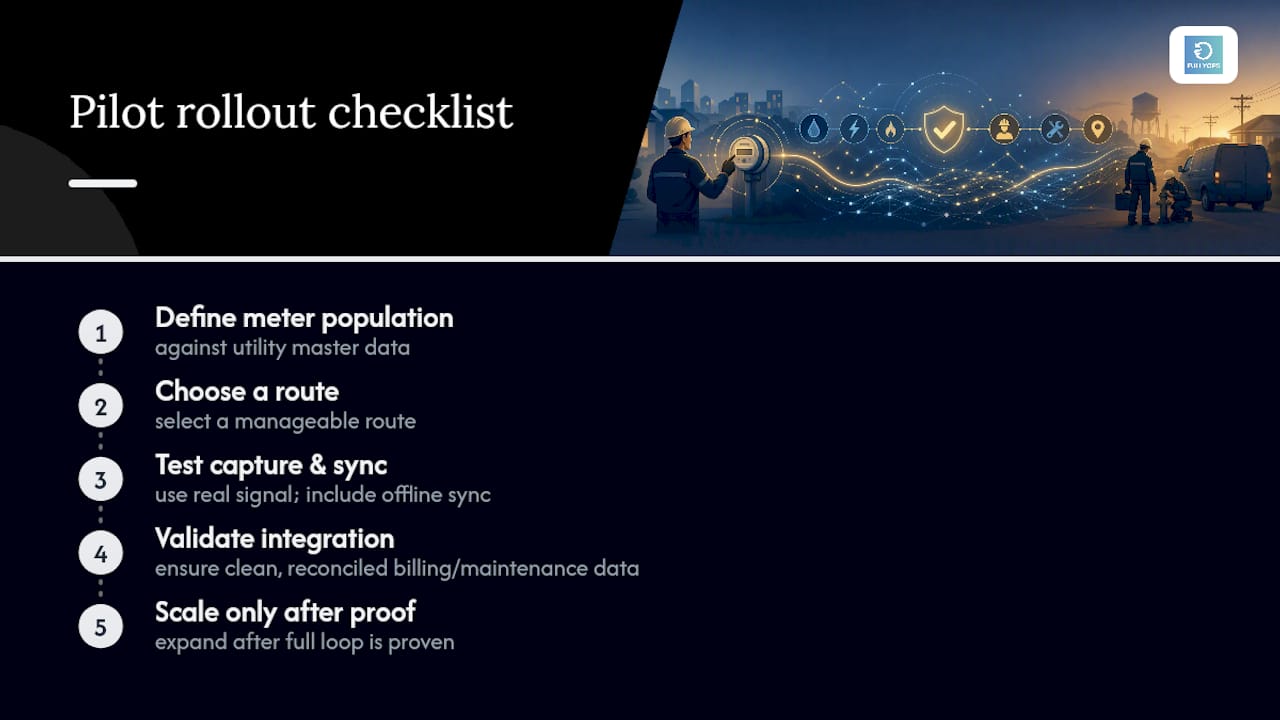
A workable pilot checklist runs in this order: define the meter population against utility master data, choose a manageable route, test capture and offline sync under real signal conditions, then validate that the integration into your maintenance or billing system produces clean, reconciled data. Only then does scaling make sense.
Track four numbers as you scale: completion rate against schedule, plausibility pass rate at first submission, the count of automatically generated PM work orders from threshold crossings, and the trend in manual corrections over time. A falling correction rate is the clearest sign the system is working. Meter data that feeds maintenance as well as billing tends to surface equipment issues earlier, since anomalous consumption often signals a mechanical fault long before it appears on a work order raised through other channels. Where energy management is part of the remit, aligning the programme with ISO 50001 principles gives the reporting structure auditors expect.
— Pedro
Run meter readings as work orders inside Fullyops
Some field service management platforms turn meter readings into structured work orders, allowing threshold crossings on a meter to automatically trigger PM checklists instead of remaining unattended. Technicians can capture readings offline through mobile apps, attach photo evidence linked to asset records, and the data syncs and validates once connectivity returns, with audit history retained for entries. This approach helps to unify billing-grade data and maintenance triggers within the same system rather than handling them through separate spreadsheets.
If you are planning a pilot route, start with the field service management platform overview to see how work-order triggers, offline capture and reporting fit together, then request a demo to map your own meter population onto a real route.
PREGUNTAS FRECUENTES
What Is a Meter-Reading Work Order?
It is a scheduled field-service task linking a specific meter and asset to a required reading, capture method and validation step, closed only once the data passes plausibility checks.
How Often Should Meter Readings Be Scheduled?
It depends on the use case: billing-driven readings usually follow fixed monthly or quarterly cycles, while condition-based readings trigger from threshold crossings rather than the calendar.
Why Does Offline-First Capture Matter for Meter Readings?
Field sites often have patchy signal, and an offline-first app caches readings locally and syncs them automatically once connectivity returns, preventing lost or duplicated entries during outages, as shown in the Grupo Celaque case.
What Certification Matters for Billing-Grade Meters?
MID certification applies to meters used for refacturation or billing purposes within the EU, and it is worth checking before relying on a reading for invoicing rather than internal monitoring.
Can Fullyops Trigger Maintenance Work Orders From Meter Readings?
Yes. Fullyops links meter readings to asset records so a threshold crossing can generate a preventive maintenance work order automatically, keeping billing data and maintenance triggers in one system.