

Agendamento por condição, or condition-based scheduling, automatically creates or queues a work order the moment an asset’s monitored condition crosses a defined threshold, rather than waiting for a person to notice a reading or a calendar date to arrive. That closes the gap between detection and action, which is where most unplanned downtime actually originates. Some platforms apply this through work-order automation and reporting tools that turn a sensor alert into a scheduled, crew-ready task within the same platform.
En resumen:
- Condition-based scheduling is most effective for critical assets like pumps and compressors where failure signatures are clear and timely intervention saves costs.
- Setting accurate three-threshold levels aligned with realistic lead times ensures maintenance is planned effectively without unnecessary early scheduling or late responses.
- Automating the alert-to-work-order process with integrated systems improves response times and prevents delays caused by manual triage and tracking.
- Regularly tuning thresholds based on historical failure data and KPI tracking reduces false alerts and maintains system reliability.
- Starting small with a few assets and automating workflows before expanding prevents pilot failures and builds sustainable CBM practices.
Índice
- What is condition-based scheduling, and how does it differ from time-based maintenance?
- When is condition-based scheduling worth the investment?
- How do you design condition thresholds and lead time?
- How do you connect condition alerts to your CMMS and work orders?
- What rules and metrics keep condition-based scheduling reliable?
- How do you run a condition-based scheduling pilot?
- What I’ve learned watching CBM pilots succeed and fail
- How Fullyops turns condition alerts into scheduled work
- Sources
- PREGUNTAS FRECUENTES
What is condition-based scheduling, and how does it differ from time-based maintenance?
Condition monitoring is the sensor layer: vibration probes, thermal sensors, current clamps, oil analysis kits. Condition-based maintenance (CBM) is the policy layer sitting above it, the set of rules deciding what a reading means and when it should trigger action. Predictive maintenance goes one step further, using forecasting models to estimate remaining useful life rather than reacting to a single threshold breach.
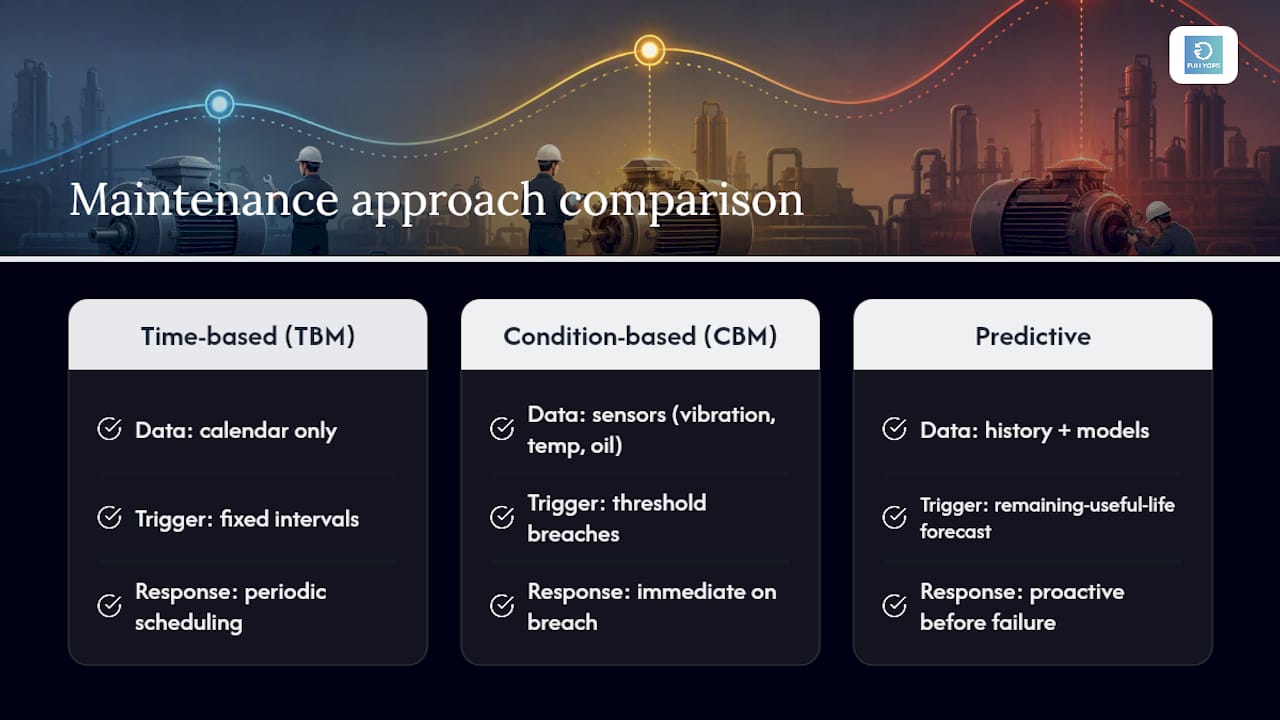
A pump exceeding a vibration limit, a motor running hot, or oil analysis flagging metal particulates are all classic CBM triggers. These readings tell you something is wrong now, which is exactly where CBM earns its keep. Time-based maintenance (TBM) needs no data beyond a calendar. Predictive maintenance needs history and often machine learning models. CBM sits between the two: it needs fewer historical data points than prediction, but delivers a faster, more targeted response than fixed intervals.
When is condition-based scheduling worth the investment?
CBM does not pay off on every asset. Its financial advantage over TBM depends heavily on how predictably an asset deteriorates and how expensive a failure would be. Research on the practical factors behind CBM’s cost benefits shows the advantage shrinks when deterioration is highly variable or when the required planning lead time stretches out, because you end up scheduling earlier and earlier to stay safe.
Before instrumenting an asset, run it through a short checklist:
- Criticality: would failure stop production or create a safety issue?
- Downtime cost: what does an hour of unplanned stoppage actually cost?
- Detectability: does the failure mode leave a measurable signature (heat, vibration, particulates)?
- Sensor availability: can you use existing building management system points, or does this need new hardware?
- Operational flexibility: can maintenance be scheduled around production without a scramble?
A practical rule of thumb: instrument your top 10 to 20 highest-impact assets first. Chillers, pumps, and compressors tend to top that list because their wear patterns are irregular enough to justify condition monitoring but distinct enough to generate a clean signal.
How do you design condition thresholds and lead time?
Most CBM programmes fail not because the sensors are wrong, but because the thresholds are set without accurately accounting for how long maintenance takes to schedule and perform. The fix is a three-threshold structure that separates “start planning” from “act now” from “too late”:
- Scheduling threshold: the earliest signal that triggers planning, parts ordering, and crew booking.
- Maintenance threshold: the point at which the intervention must actually happen.
- Failure threshold: the level beyond which breakdown is imminent or has occurred.
The gap between the scheduling threshold and the maintenance threshold has to cover your real planning lead time, whether you calculate that from remaining useful life estimates or from a p-f interval (the stretch between when a fault becomes detectable and when it causes functional failure). A three-threshold scheme built around lead time lets planners convert that lead time directly into a scheduling threshold, rather than guessing.
Consider a bearing with a typical p-f interval of a few weeks. Set the scheduling threshold too tight (triggering with only two days of lead time) and you will miss the parts-ordering window, forcing an emergency callout anyway. Set it too loose (triggering six weeks early) and you will schedule interventions on assets that had months of healthy life left, wasting technician hours and inflating avoidable maintenance costs.
Consejo profesional: Calculate your scheduling threshold backwards from your slowest-moving constraint, usually parts lead time or contractor availability, not from the sensor’s technical limits.
How do you connect condition alerts to your CMMS and work orders?
An alert that lands in an inbox and waits for someone to notice it defeats the purpose of monitoring in the first place. The single biggest factor separating CBM programmes that deliver ROI from those that quietly fade out is whether the alert-to-work-order step is automated rather than manual.
A properly closed loop needs:
- Data ingest: sensor or inspection readings flow into the platform continuously, not on a batch upload.
- Event mapping: each threshold breach maps to a specific work-order template, not a generic ticket.
- Parts provisioning: the work order pre-populates likely spares based on the fault type.
- Crew skill mapping: the system assigns the job to a technician qualified for that specific asset and fault.
- Priority mapping: CBM severity levels translate into SLA bands, so a bearing at the maintenance threshold jumps the queue ahead of routine tasks.
Work-order automation can be built around exactly this handoff, turning a condition breach into a structured, assigned task with parts and deadlines attached rather than a note for someone to action later.
What rules and metrics keep condition-based scheduling reliable?
Thresholds are not “set and forget.” Tune them using a controlled backtest against historical failure data or an A/B comparison across similar assets, adjusting whenever false alerts or missed failures cluster around a particular value.
Four metrics tell you whether the programme is actually working:
- Avoidable downtime: unplanned stoppages that a correctly timed CBM alert should have caught.
- False alert rate: the share of triggers that led to no meaningful finding on inspection.
- Mean time to schedule: how long between alert and a booked work order.
- Percentage of CBM work orders closed on time: whether scheduling windows are actually being met.
Longer planning lead times erode CBM’s advantage over TBM unless someone is actively managing that lead time, which is why governance matters as much as the sensors. Assign clear ownership: a reliability engineer or maintenance planner should own threshold reviews on a fixed cadence, ideally quarterly, with retraining triggered whenever false alert rates drift.
How do you run a condition-based scheduling pilot?
A pilot should prove the model on a handful of assets before you scale hardware spend across the site.
- Pick 5 to 10 high-impact assets using the criticality and detectability checklist above.
- Use existing sensor points where possible. Leaning on building management system data before buying new hardware keeps the pilot cheap and fast to launch.
- Set initial thresholds using the three-threshold scheme, erring slightly conservative until you have real data.
- Build the minimum viable alert-to-work-order automation. Even a single template per fault type beats a manual triage step.
- Run for 60 to 90 days, tracking mean time to schedule and false alert rate weekly.
- Tune thresholds and parts lists based on what the pilot actually reveals, then document the changes.
- Brief technicians and planners on why thresholds exist and how to flag a false alert, since trust in the system determines whether people act on its output.
- Expand asset by asset, using the pilot’s KPI baseline as your go/no-go gate for each new addition.
Our guide to preventive maintenance for HVAC assets walks through a comparable staged rollout if HVAC is where your pilot begins.
What I’ve learned watching CBM pilots succeed and fail
The pilots that stall almost always share the same root cause: someone installed sensors before deciding what to do with the readings. Teams get excited about the hardware, wire up a dozen assets, and only then ask how an alert should actually reach a technician. By that point, alerts pile into a shared inbox, nobody owns triage, and the programme dies from neglect rather than bad data.
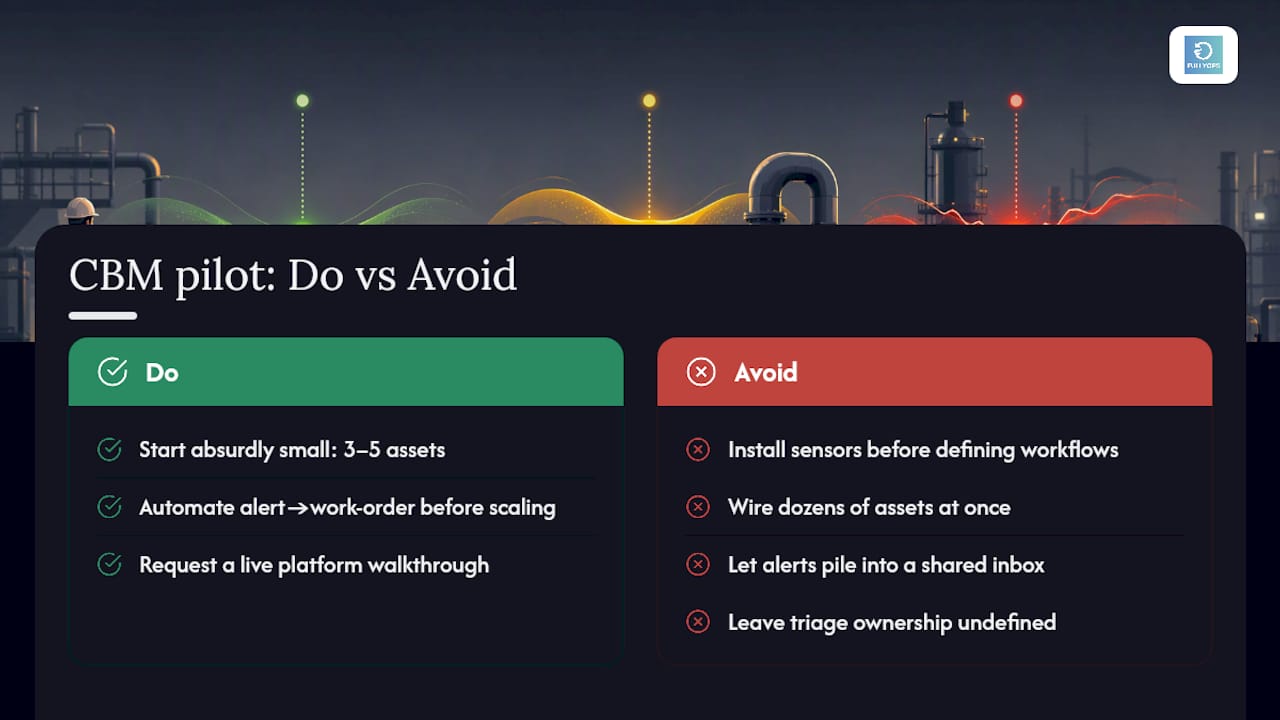
Two shortcuts consistently save people from that fate. First, start absurdly small, three to five assets, not thirty. Second, automate the alert-to-work-order step before you add a single extra sensor. A crude automation on three assets beats a sophisticated dashboard on thirty that nobody acts on.
If you want to see how this looks in practice on a live platform, it’s worth requesting a walkthrough rather than trying to reverse-engineer it from first principles.
— Pedro
How Fullyops turns condition alerts into scheduled work
Some platforms close the gap between a condition alert and a technician actually holding a work order. Work orders generate automatically from threshold breaches, complete with parts linked from inventory, role-based assignment to a technician, and reporting dashboards that track mean time to schedule and avoidable downtime without a spreadsheet in sight.
That means threshold tuning happens against real KPI data inside the same system you use to dispatch the work, rather than across three disconnected tools. If you’re ready to see the proceso de gestión de órdenes de trabajo that makes this handoff automatic, book a demo and bring one of your highest-impact assets as a test case.
Sources
The three-threshold scheme paper lays out the scheduling, maintenance, and failure threshold model referenced throughout this guide, useful if you want the underlying maths.
For a deeper look at when CBM beats time-based maintenance financially, the deterioration variability study is the most rigorous treatment available. iFactory’s implementation roadmap covers the CMMS integration steps in practical detail, while the state-of-the-art review offers a broader survey of CBM across manufacturing and building systems. IBM’s overview of condition-based maintenance is a solid primer on the p-f interval concept if you’re building thresholds for the first time.
- Condition-based maintenance with scheduling threshold and lead time (ITR paper)
- Condition-Based Maintenance (CBM): A Practical Implementation Roadmap | iFactory
- Condition-Based Monitoring and Maintenance: State of the Art Review
PREGUNTAS FRECUENTES
What does agendamento por condição mean in maintenance software?
It means scheduling that triggers automatically when an asset’s monitored condition, such as vibration, temperature, or oil quality, crosses a set threshold, rather than following a fixed calendar date.
How is condition-based scheduling different from predictive maintenance?
CBM reacts to a defined threshold breach using current sensor data, while predictive maintenance forecasts remaining useful life using historical models, generally requiring more data history to work reliably.
What is the p-f interval, and why does it matter for thresholds?
The p-f interval is the time between a fault becoming detectable and causing functional failure; it sets the outer limit on how early your scheduling threshold needs to trigger.
Which assets should get condition-based scheduling first?
Start with high-criticality, high-downtime-cost assets with detectable failure signatures, commonly pumps, compressors, and chillers, rather than instrumenting everything at once.
Can Fullyops automate the alert-to-work-order step for condition-based scheduling?
Yes. Some platforms generate structured work orders directly from condition alerts, with parts and technician assignment attached, removing the manual triage step that causes most CBM programmes to stall.