

Operations managers know the frustration: unplanned downtime cripples production, emergency repairs drain budgets, and reactive firefighting becomes the norm. Poor maintenance scheduling transforms what should be controlled, predictable operations into chaotic crisis management. This guide delivers practical strategies, proven frameworks, and digital tools to help you build robust creating maintenance schedules that maximise asset uptime, reduce costs, and shift your team from reactive to proactive maintenance.
Table of Contents
- Key takeaways
- Understanding maintenance scheduling challenges and prerequisites
- Establishing effective maintenance scheduling strategies
- Utilising digital tools and advanced technologies for scheduling optimisation
- Measuring success and continuous improvement in maintenance scheduling
- Explore FullyOps solutions to enhance your maintenance scheduling
- What is the difference between maintenance planning and scheduling?
- How can preventive maintenance compliance impact downtime?
- What are the benefits of using AI in maintenance scheduling?
- How do emergencies affect maintenance schedules and how to manage them?
Key Takeaways
| Point | Details |
|---|---|
| Planning vs scheduling | Planning answers what work is required and how to execute it, while scheduling determines when it happens and who performs it. |
| Prerequisites for scheduling | Accurate asset data, defined maintenance priorities and resource availability visibility are essential to turning schedules into strategic assets. |
| Multi model PM scheduling | Using multiple trigger methods raises compliance to over 95 per cent and reduces unplanned downtime by up to 75 per cent. |
| Trigger mechanisms | Calendar based, meter based and condition based triggers address different asset wear patterns and operational realities. |
Understanding maintenance scheduling challenges and prerequisites
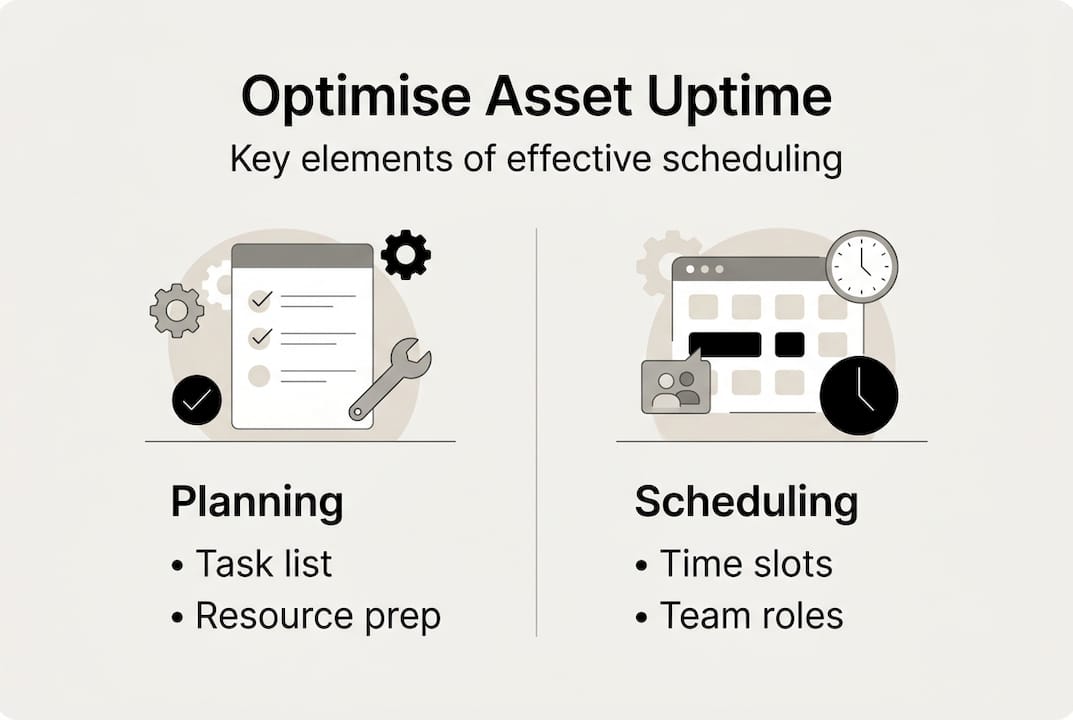
Maintenance planning and scheduling are not interchangeable terms, though many organisations treat them as one activity. Planning answers what work needs doing and how to execute it: identifying tasks, gathering parts, preparing procedures, and estimating labour hours. Scheduling addresses when work happens and who performs it: assigning specific dates, allocating technicians, and coordinating resources within operational constraints. Confusing these distinct phases creates bottlenecks that undermine efficiency.
The reality of industrial operations introduces constant disruptions that challenge even well-designed schedules. Equipment failures demand immediate attention, pulling technicians away from planned activities. Variable workloads fluctuate with production demands, creating unpredictable capacity constraints. Every emergency displaces 2-4 preventive maintenance tasks, creating a cascade effect that pushes scheduled work further into the future. This displacement cycle perpetuates reactive maintenance cultures where fires consume resources meant for prevention.
Successful scheduling requires three foundational prerequisites that many organisations overlook:
- Accurate asset data: Complete equipment inventories with maintenance histories, failure modes, and manufacturer recommendations form the intelligence base for scheduling decisions
- Defined maintenance priorities: Risk-based classification systems that identify critical assets requiring tighter scheduling tolerances versus non-critical equipment with flexible windows
- Resource availability visibility: Real-time awareness of technician skills, spare parts inventory, and tool availability to prevent scheduling tasks without necessary inputs
“Without accurate planning, scheduling becomes guesswork. Without disciplined scheduling, even excellent plans fail to deliver value.”
Organisations that skip these prerequisites encounter predictable failures: schedules built on incomplete data, technicians dispatched without proper parts, and critical assets receiving the same attention as minor equipment. Establishing these foundations transforms scheduling from administrative burden into strategic advantage, enabling the proactive maintenance planning step by step approach that drives measurable improvements.
Establishing effective maintenance scheduling strategies
Building resilient maintenance schedules requires incorporating multiple trigger mechanisms that match diverse asset requirements. Calendar-based scheduling works well for equipment with predictable wear patterns, triggering tasks at fixed intervals regardless of usage. Meter-based triggers tie maintenance to actual operating hours or production cycles, aligning interventions with real asset stress. Condition-based scheduling responds to sensor data and inspection findings, initiating work when assets show deterioration signals rather than arbitrary dates.
Research demonstrates that multi-model PM scheduling improves compliance to over 95% and reduces unplanned downtime by up to 75% compared to single-trigger approaches. This hybrid methodology acknowledges that different assets age differently: pumps accumulate wear through running hours, outdoor equipment degrades with seasonal exposure, and precision machinery requires condition monitoring regardless of usage patterns.
Risk-based maintenance prioritisation focuses scheduling resources where they deliver maximum return. Follow this framework:
- Classify assets by criticality: Evaluate equipment based on safety impact, production consequences, and replacement costs to identify high-priority items requiring strict scheduling adherence
- Calculate failure probability and consequence: Combine historical failure rates with operational impact assessments to quantify risk exposure for each asset
- Allocate scheduling precision accordingly: Apply tight scheduling windows with minimal tolerance for critical assets, whilst allowing flexible ranges for low-risk equipment
- Sequence tasks by dependency and efficiency: Group geographically proximate equipment, coordinate shutdowns to minimise production disruption, and batch similar work types to optimise technician utilisation
- Build schedule buffers for emergencies: Reserve 15-20% of maintenance capacity for unplanned work, preventing emergency displacement of all preventive tasks
Pro Tip: When emergencies inevitably occur, immediately reschedule displaced preventive tasks rather than letting them accumulate in backlog. Assign specific new dates within the same planning period to maintain compliance momentum and prevent the reactive maintenance spiral.
Resource constraints shape realistic scheduling more than theoretical maintenance needs. A perfect plan means nothing if technicians lack skills for assigned tasks, critical spare parts sit on backorder, or production schedules prohibit equipment access. Effective schedulers maintain constant dialogue with operations, procurement, and technical teams to align maintenance windows with resource availability and business priorities. This coordination transforms scheduling from isolated maintenance activity into integrated operational planning that respects real-world constraints whilst advancing reliability objectives.
Utilising digital tools and advanced technologies for scheduling optimisation
Computerised Maintenance Management Systems revolutionise scheduling by centralising asset data, automating workflow triggers, and providing real-time visibility across maintenance operations. Modern CMMS platforms eliminate the spreadsheet chaos that plagues manual scheduling, replacing it with intelligent systems that track work orders, manage spare parts inventory, and generate preventive maintenance tasks automatically based on configured rules. These systems enable schedulers to visualise resource allocation, identify conflicts, and adjust plans dynamically as conditions change.
The evolution from traditional to AI-powered scheduling tools represents a fundamental capability shift:
| Capability | Traditional CMMS | AI-Enhanced Systems |
|---|---|---|
| Schedule generation | Rule-based triggers from fixed calendars | Dynamic optimisation considering multiple variables simultaneously |
| Disruption response | Manual rescheduling by planners | Automatic resequencing after emergencies to minimise impact |
| Resource allocation | Static assignment based on availability | Intelligent matching of skills, location, and task requirements |
| Failure prediction | Historical average intervals | Pattern recognition across sensor data and operational context |
| Workload balancing | Even distribution across time periods | Optimised sequencing considering task dependencies and efficiency |
Artificial intelligence and machine learning improve predictive maintenance accuracy by 64%, reducing prediction error to 4.24% compared to human forecasts. This precision enables schedulers to intervene before failures occur whilst avoiding unnecessary preventive work on healthy assets. AI algorithms analyse vibration data, temperature trends, and operational parameters to identify deterioration patterns invisible to manual inspection, triggering maintenance at optimal moments that balance risk against resource consumption.
Pro Tip: Start your AI scheduling initiative with a critical asset subset rather than attempting enterprise-wide deployment. Select 10-15 high-value equipment items with good sensor coverage and historical failure data, prove ROI through measurable downtime reduction, then expand the programme with executive support and operational buy-in earned through demonstrated results.
The integration capabilities of modern platforms extend scheduling benefits beyond maintenance departments. Connecting CMMS with enterprise resource planning systems synchronises maintenance schedules with production planning, procurement cycles, and financial reporting. AI enhances asset management by breaking down data silos, enabling cross-functional visibility that supports better decision-making. When production managers see upcoming maintenance windows in their planning tools, and procurement receives automated parts requisitions triggered by scheduled work, the entire organisation operates with greater coordination and efficiency.
Measuring success and continuous improvement in maintenance scheduling
Key performance indicators transform scheduling from subjective activity into measurable discipline with clear accountability. Preventive maintenance compliance tracks the percentage of scheduled tasks completed on time, revealing whether your scheduling system functions as designed or suffers from chronic displacement. PM compliance above 85-90% correlates with reactive work below 20%, yielding significant downtime reduction and cost savings that justify scheduling investments.
The planned versus reactive work ratio exposes whether your maintenance culture operates proactively or remains trapped in firefighting mode. Target at least 80% planned work, with reactive interventions consuming no more than 20% of total maintenance hours. Organisations stuck in reactive patterns waste resources on emergency labour premiums, expedited parts procurement, and production losses from unplanned stoppages.
Additional metrics that illuminate scheduling effectiveness:
- Mean Time Between Failures (MTBF): Measures reliability improvements as preventive scheduling reduces unexpected breakdowns
- Mean Time To Repair (MTTR): Tracks efficiency gains from better planning and parts availability during scheduled interventions
- Overall Equipment Effectiveness (OEE): Combines availability, performance, and quality metrics to quantify total production impact of maintenance scheduling
- Schedule compliance rate: Percentage of maintenance work completed within planned time windows, revealing scheduling accuracy
- Backlog age distribution: Tracks how long work orders wait before execution, highlighting capacity constraints and prioritisation issues
| Metric | World-Class Target | Typical Performance | Impact of Poor Scheduling |
|---|---|---|---|
| PM Compliance | >90% | 55-65% | Increased failures, higher costs |
| Planned Work Ratio | >80% | 40-50% | Reactive culture, budget overruns |
| Schedule Compliance | >85% | 60-70% | Resource waste, missed windows |
| Backlog Age | <2 weeks | 4-8 weeks | Deferred maintenance, risk accumulation |
Data analysis reveals scheduling bottlenecks that metrics alone cannot expose. Review work order histories to identify patterns: which asset types consistently require emergency intervention despite scheduled maintenance? Which technician skills create capacity constraints that delay critical work? Where do parts availability issues most frequently disrupt schedules? These insights guide targeted improvements rather than broad initiatives that waste resources on non-issues.
Implement regular schedule review cycles that engage cross-functional stakeholders. Weekly coordination meetings align maintenance plans with production schedules and address emerging conflicts. Monthly performance reviews analyse metric trends and adjust scheduling parameters based on results. Quarterly strategy sessions evaluate whether scheduling approaches match evolving business priorities and asset portfolios. This rhythm of continuous improvement prevents scheduling systems from becoming stale procedures disconnected from operational reality, maintaining relevance through ongoing refinement informed by maintenance optimization 2026 best practices.
Explore FullyOps solutions to enhance your maintenance scheduling
Transforming scheduling theory into operational practice requires robust tools and clear guidance. FullyOps provides comprehensive platforms designed specifically for operations managers seeking to optimise maintenance workflows and maximise asset uptime. Our resource allocation tutorial asset management walks you through practical frameworks for matching technician skills, spare parts inventory, and equipment priorities to create realistic, executable schedules.
Field service operations face unique scheduling challenges with mobile workforces and distributed assets. The field service scheduling guide delivers strategies for efficient technician deployment, route optimisation, and real-time schedule adjustments that keep your team productive despite travel time and emergency call-outs. These resources translate the concepts covered in this guide into actionable steps tailored to your operational context, helping you achieve the maintenance optimization 2026 performance standards that separate industry leaders from perpetual underperformers.
What is the difference between maintenance planning and scheduling?
Maintenance planning identifies what work needs doing and prepares the resources required for execution, including task lists, spare parts, tools, and procedures. Scheduling assigns specific dates and personnel to planned work, committing resources within operational constraints and production windows. Planning aims for readiness and thoroughness, whilst scheduling focuses on commitment and execution timing that balances maintenance needs against business priorities.
How can preventive maintenance compliance impact downtime?
PM compliance above 85-90% correlates with up to 75% reduction in unplanned downtime by addressing deterioration before failures occur. Lower compliance rates allow asset degradation to progress unchecked, resulting in emergency breakdowns that disrupt production and consume reactive maintenance budgets. Organisations with poor PM compliance typically experience reactive work exceeding 50% of total maintenance hours, perpetuating costly firefighting cycles.
What are the benefits of using AI in maintenance scheduling?
AI improves predictive maintenance accuracy by 64%, reducing forecast errors to 4.24% compared to manual methods that rely on historical averages and human judgment. Machine learning algorithms identify subtle deterioration patterns across sensor data, enabling intervention at optimal moments that prevent failures without unnecessary preventive work. AI systems also enable dynamic rescheduling after emergencies, automatically resequencing displaced tasks to maintain compliance whilst adapting to operational disruptions.
How do emergencies affect maintenance schedules and how to manage them?
Each emergency typically displaces 2-4 scheduled preventive maintenance tasks as technicians redirect to urgent failures, creating cascading delays that push planned work into growing backlogs. Effective management requires reserving 15-20% of maintenance capacity specifically for unplanned work, preventing complete schedule disruption. Hybrid scheduling approaches that combine fixed preventive windows with flexible reactive buffers, supported by AI tools that automatically reschedule displaced tasks, maintain overall programme compliance despite inevitable operational disruptions.
Recommended
- Master Creating Maintenance Schedules for Reliable Assets
- Asset Maintenance Workflow Guide for Optimal Efficiency
- 7 Proven Resource Management Strategies for Asset Efficiency
- Maintenance Optimization in 2026: Cut Downtime by 30%