

Industrial asset management faces mounting pressure to reduce costs whilst maintaining operational excellence. AI-driven predictive maintenance reduces operational costs by up to 40% and dramatically cuts unplanned downtime across sectors from manufacturing to energy. Yet many decision-makers remain uncertain about practical implementation pathways. This guide clarifies how artificial intelligence transforms maintenance strategies through predictive analytics, digital twins, and machine learning models that deliver measurable efficiency gains. You’ll discover proven AI techniques, understand deployment challenges, and learn actionable strategies to optimise your asset lifecycle management in 2026.
Table of Contents
- Understanding AI’s Role In Predictive Maintenance For Asset Management
- Machine Learning And AI Models Powering Fault Detection And Life Prediction
- Digital Twins And AI Integration For Optimising Asset Lifecycle Management
- Challenges And Future Directions In Deploying AI For Asset Management
- How FullyOps Can Support Your AI-Driven Asset Management Strategy
Key takeaways
| Point | Details |
|---|---|
| Cost reduction | AI predictive maintenance achieves 25-40% lower maintenance costs whilst improving equipment availability by 15-30%. |
| Fault detection accuracy | Hybrid machine learning models reach 93.1% accuracy in identifying equipment failures with over 50% fewer false alarms. |
| Digital twin benefits | Real-time asset simulation extends equipment life by 10-20% through optimised intervention timing and resource allocation. |
| Implementation barriers | Data quality, cybersecurity concerns, and real-time deployment complexity remain primary obstacles requiring strategic planning. |
| Financial impact | Organisations adopting AI-driven strategies report significant operational savings and measurable improvements in asset reliability. |
Understanding AI’s role in predictive maintenance for asset management
Predictive maintenance represents a fundamental shift from reactive repairs to proactive intervention. Unlike scheduled maintenance that follows fixed intervals regardless of actual equipment condition, predictive maintenance relies on sensor data and operational history to anticipate breakdowns before they occur. AI technologies analyse vibration patterns, temperature fluctuations, acoustic signatures, and performance metrics to identify subtle degradation signals invisible to human operators.
Machine learning algorithms excel at recognising complex failure patterns across thousands of variables simultaneously. Support vector machines, neural networks, and ensemble methods process historical fault data to estimate Remaining Useful Life with remarkable precision. These models learn from every maintenance intervention, continuously refining their predictions as they accumulate operational experience. The result is a dynamic maintenance schedule that responds to actual equipment condition rather than arbitrary calendar dates.
The financial implications are substantial. Organisations implementing AI predictive maintenance report dramatic reductions in emergency repairs, spare parts inventory costs, and production losses from unexpected failures. Equipment availability improves as maintenance windows align with operational needs rather than disrupting production schedules. Workflow optimisation for preventive maintenance becomes data-driven, enabling maintenance teams to prioritise interventions based on actual risk rather than guesswork.
Common AI algorithms deployed in fault detection include:
- Support vector machines for binary classification of healthy versus degraded states
- Convolutional neural networks analysing vibration spectrograms and thermal images
- Long short-term memory networks capturing temporal degradation patterns
- Random forests handling mixed sensor data with varying sampling rates
- Transformer architectures processing multivariate time series for early anomaly detection
“AI-driven predictive maintenance fundamentally transforms how industrial organisations manage asset reliability, shifting from calendar-based schedules to condition-based interventions that optimise both cost and performance outcomes.”
The transition to AI-powered strategies requires cultural adaptation alongside technical implementation. Maintenance teams accustomed to routine inspections must embrace data-driven decision making. Yet the learning curve proves worthwhile as asset maintenance workflows become more efficient and technicians focus expertise on complex problems rather than routine checks. Understanding these foundational concepts prepares decision-makers to evaluate specific AI technologies and their practical applications across diverse industrial environments.
Machine learning and AI models powering fault detection and life prediction
Specific machine learning architectures deliver varying performance characteristics depending on asset types and failure modes. Supervised learning models trained on labelled historical data achieve the highest accuracy when sufficient fault examples exist. Support vector machines excel at separating normal operation from fault conditions in high-dimensional sensor spaces, whilst neural networks demonstrate exceptional accuracy in both fault classification and remaining useful life estimation.
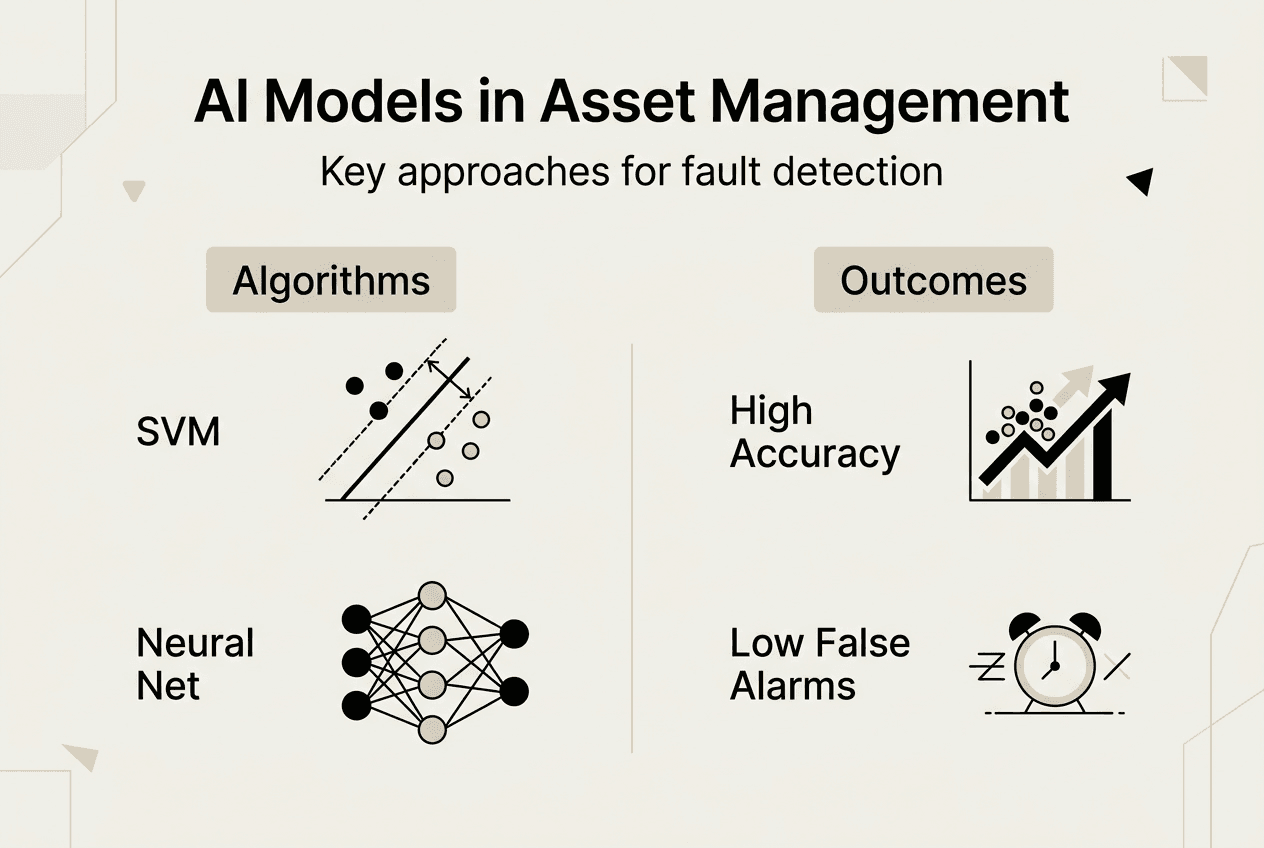
Deep learning approaches handle raw sensor streams without extensive feature engineering. Convolutional neural networks automatically extract relevant patterns from vibration spectrograms, acoustic signatures, and thermal imagery. Recurrent architectures like LSTM networks capture temporal dependencies critical for understanding degradation trajectories. These models identify subtle changes in operational behaviour that precede catastrophic failures by days or weeks, enabling proactive intervention.
Hybrid architectures combine the strengths of multiple approaches. A model integrating vibration features with GRU embeddings achieved 93.1% accuracy in detecting bearing faults across diverse operating conditions. By merging domain expertise through engineered features with deep learning’s pattern recognition capabilities, hybrid systems deliver superior performance whilst maintaining interpretability.
| Model Type | Accuracy | F1 Score | False Alarm Reduction |
|---|---|---|---|
| Support Vector Machine | 87.3% | 0.854 | 32% |
| Convolutional Neural Network | 89.7% | 0.881 | 41% |
| LSTM Network | 91.2% | 0.903 | 47% |
| Hybrid Feature-GRU | 93.1% | 0.928 | 53% |
The hybrid model’s early-fault F1 score of 0.928 demonstrates exceptional capability in identifying incipient failures whilst maintaining low false positive rates. This balance proves crucial in industrial settings where excessive alarms erode operator trust and waste maintenance resources. Reducing false alarms by more than 50% means technicians respond only to genuine threats, optimising labour allocation and minimising unnecessary equipment inspections.
Practical deployment requires addressing class imbalance in training data. Healthy operation dominates most datasets whilst fault conditions represent rare events. Techniques like synthetic minority oversampling, cost-sensitive learning, and anomaly detection approaches help models generalise from limited failure examples. Automation in asset management systems increasingly incorporate these advanced sampling strategies to improve model robustness.
Pro Tip: Invest in comprehensive data labelling during initial deployment. Accurately tagged fault events create the foundation for supervised learning success. Collaborate with experienced technicians to classify historical failures, capturing nuanced distinctions between failure modes that algorithms can then recognise automatically.
Transformer architectures represent the latest evolution in predictive maintenance AI. Originally developed for natural language processing, attention mechanisms excel at identifying relevant patterns across long temporal sequences. They handle irregular sampling intervals and missing data more gracefully than traditional recurrent networks. Early industrial pilots demonstrate promising results, particularly for complex systems where multiple degradation processes interact. Asset tracking systems integrating transformer-based predictions enable more sophisticated maintenance planning across entire equipment fleets.
Digital twins and AI integration for optimising asset lifecycle management
Digital twins create virtual replicas of physical assets that synchronise in real time with operational data streams. These simulation environments enable engineers to test maintenance scenarios, predict failure impacts, and optimise intervention strategies without disrupting actual production. AI algorithms power the predictive capabilities that transform static models into dynamic decision support systems.

The integration of machine learning with digital twin platforms delivers measurable business outcomes. AI-powered digital twins achieve 25-40% reduction in maintenance costs by optimising intervention timing and resource allocation. Equipment availability improves by 15-30% as maintenance windows align with production schedules and spare parts arrive precisely when needed. Asset life extends by 10-20% through operating parameter optimisation that minimises wear whilst maintaining performance targets.
| Maintenance Approach | Annual Cost per Asset | Unplanned Downtime | Average Asset Life |
|---|---|---|---|
| Reactive Maintenance | £45,000 | 18.5% | 12 years |
| Scheduled Maintenance | £38,000 | 12.3% | 14 years |
| AI-Enhanced Predictive | £27,000 | 6.8% | 16 years |
The simulation capabilities enable what-if analysis impossible with physical assets. Engineers model the impact of operating condition changes, evaluate alternative maintenance strategies, and quantify risk trade-offs before committing resources. Reinforcement learning agents explore vast solution spaces to identify optimal policies that balance competing objectives like cost, reliability, and performance. These insights inform strategic decisions about asset replacement timing, capacity planning, and capital investment priorities.
Standardisation frameworks ensure digital twin interoperability across vendors and platforms. ISO 23247 defines reference architecture for digital twins in manufacturing, whilst RAMI 4.0 provides hierarchical models for Industry 4.0 implementations. Adherence to these standards prevents vendor lock-in and enables integration with existing enterprise systems. Data management in asset lifecycle planning benefits from standardised interfaces that facilitate information exchange between operational technology and business intelligence platforms.
Pro Tip: Begin digital twin implementation with critical assets that have the highest downtime costs or safety implications. Demonstrate value on a focused scope before expanding to entire equipment populations. This approach builds organisational confidence whilst refining implementation processes and data integration workflows.
Real-time synchronisation requires robust data infrastructure. Edge computing devices process sensor streams locally, reducing latency and bandwidth requirements whilst enabling rapid anomaly detection. Cloud platforms aggregate data across distributed assets, training global models that capture failure patterns invisible in single-asset datasets. Asset lifecycle management strategies increasingly adopt hybrid architectures that balance local responsiveness with centralised intelligence.
The predictive capabilities extend beyond individual assets to system-level optimisation. Digital twins model interactions between interconnected equipment, identifying cascading failure risks and optimising maintenance sequences across production lines. This holistic perspective reveals opportunities for coordinated interventions that minimise total system downtime whilst respecting resource constraints and operational priorities.
Challenges and future directions in deploying AI for asset management
Despite proven benefits, significant obstacles persist in real-time deployment and operational scaling of AI predictive maintenance systems. Model robustness under varying operating conditions remains challenging, particularly when assets operate outside training data boundaries. Heterogeneous data management across legacy systems with inconsistent formats and sampling rates complicates integration efforts. Cybersecurity concerns intensify as operational technology connects to enterprise networks, creating potential attack vectors.
Data quality issues undermine model performance more than algorithm selection. Sensor drift, calibration errors, and missing values corrupt training datasets, leading to unreliable predictions. Concerns about computation loads and implementation costs deter organisations from adopting sophisticated deep learning approaches despite their superior accuracy. The total cost of ownership includes not just software licensing but also data infrastructure upgrades, staff training, and ongoing model maintenance.
Real-time deployment introduces latency constraints incompatible with batch processing workflows common in model development. Edge devices with limited computational resources struggle to execute complex neural networks at required inference speeds. Quantisation techniques reduce model size and accelerate inference but may sacrifice accuracy. Striking the optimal balance between performance and computational efficiency requires careful architecture selection and hardware provisioning.
Best practices for mitigating implementation challenges include:
- Establish data governance frameworks ensuring consistent sensor calibration and metadata standards
- Implement robust data validation pipelines that flag anomalies before they corrupt model training
- Deploy cybersecurity measures including network segmentation, encryption, and access controls
- Start with simpler models that establish baseline performance before pursuing complex architectures
- Invest in change management processes that build organisational capability alongside technical infrastructure
- Create feedback loops where maintenance outcomes continuously improve model accuracy
“The gap between research demonstrations and industrial deployment remains substantial. Organisations must address fundamental questions about data ownership, model interpretability, and integration with existing maintenance management systems before realising AI’s full potential.”
Emerging solutions include federated learning approaches that train models across distributed assets without centralising sensitive operational data. Transfer learning techniques adapt pre-trained models to new equipment types with limited historical data. Explainable AI methods provide transparency into model decisions, building operator trust and facilitating regulatory compliance. Maintenance optimisation strategies increasingly incorporate these advanced techniques to overcome deployment barriers.
Standardisation efforts aim to create interoperable frameworks that reduce integration complexity. Industry consortia develop reference architectures, data models, and API specifications that enable plug-and-play AI components. Open-source toolkits lower barriers to entry whilst fostering innovation through community collaboration. These initiatives accelerate adoption by reducing the custom engineering required for each implementation.
The future trajectory points toward autonomous maintenance systems that self-optimise based on operational feedback. Reinforcement learning agents will dynamically adjust maintenance policies as equipment ages and operating conditions evolve. Resource allocation in industrial maintenance will become fully automated, with AI systems coordinating technician schedules, spare parts logistics, and production planning to minimise total system cost whilst meeting reliability targets.
How FullyOps can support your AI-driven asset management strategy
Transforming maintenance operations through AI requires more than algorithms. You need integrated platforms that connect predictive insights with work order management, inventory control, and performance analytics. FullyOps delivers comprehensive asset lifecycle management solutions designed specifically for industrial environments facing the challenges discussed throughout this guide. Our platform bridges the gap between AI predictions and maintenance execution, ensuring insights translate into measurable operational improvements.
The system’s intelligent workflow engine automatically generates maintenance tasks based on equipment condition monitoring and predictive model outputs. Resource allocation capabilities optimise technician scheduling and spare parts provisioning, reducing response times whilst controlling costs. Real-time dashboards provide visibility into asset health across your entire operation, enabling proactive decision making that prevents costly failures. Integration with existing sensors and control systems ensures seamless data flow without disruptive infrastructure changes.
Explore our maintenance optimisation strategies to discover how organisations similar to yours achieve the efficiency gains and cost reductions that AI enables. Our team understands the practical challenges of deploying advanced technologies in industrial settings and provides the expertise needed to navigate implementation successfully.
FAQ
What types of AI models are most effective for predictive maintenance?
Supervised learning models like support vector machines and neural networks deliver exceptional accuracy in fault classification and remaining useful life prediction when sufficient labelled training data exists. Hybrid architectures combining engineered features with deep learning embeddings achieve the highest performance, balancing accuracy with interpretability. The optimal choice depends on your specific asset types, available data quality, and computational resources.
How do digital twins improve maintenance efficiency?
Digital twins simulate real-time asset conditions, enabling engineers to predict failures and test intervention strategies without disrupting production. They achieve 25-40% maintenance cost reductions and improve equipment availability by 15-30% through optimised scheduling and resource allocation. The virtual environment allows what-if analysis that identifies optimal maintenance policies balancing cost, reliability, and performance objectives.
What are common challenges in deploying AI for predictive maintenance?
Obstacles include real-time deployment complexity, ensuring model reliability across varying operating conditions, managing heterogeneous data from legacy systems, and maintaining cybersecurity as operational technology connects to enterprise networks. Data quality issues, computational resource constraints, and implementation costs also present significant barriers. Addressing these requires robust data governance, phased deployment strategies, and investment in both technical infrastructure and organisational capability building.
How quickly can organisations see ROI from AI predictive maintenance?
Typical implementations demonstrate measurable cost savings within 6-12 months as false alarm rates decrease and maintenance interventions become more targeted. Full ROI realisation often occurs within 18-24 months once models accumulate sufficient operational data and maintenance workflows fully integrate predictive insights. Starting with high-value assets that have significant downtime costs accelerates payback periods and builds organisational confidence for broader deployment.
What data infrastructure is required for AI asset management?
Successful implementations require reliable sensor networks capturing relevant operational parameters, edge computing capabilities for local processing and anomaly detection, and cloud platforms for centralised model training and fleet-wide analytics. Data governance frameworks ensuring consistent calibration and metadata standards prove equally critical. Many organisations adopt hybrid architectures balancing local responsiveness with centralised intelligence, enabling real-time decisions whilst leveraging global failure pattern recognition.
Recommended
- Asset Management Trends 2026: Transforming HVAC Operations
- How integrations drive efficiency in asset management 2026
- Asset tracking checklist for operational efficiency 2026
- Role of Automation in Asset Management – Transforming HVAC Efficiency