

Operations managers in industrial maintenance face a relentless challenge: how do you deploy limited resources across critical assets whilst minimising downtime and controlling costs? Poor resource allocation drives up reactive maintenance, extends equipment failures, and drains budgets through inefficient labour deployment. This guide delivers practical frameworks, software tools, and verification methods that transform how you allocate maintenance resources. You’ll discover preparation essentials, execution strategies using CMMS and AI platforms, and monitoring techniques that keep your operations running at peak efficiency with measurable cost reductions.
Table of Contents
- Preparing For Effective Resource Allocation
- Executing Resource Allocation With Software And Optimisation Methods
- Verifying And Optimising Resource Allocation Results
- Discover Tailored Resource Allocation Solutions With FullyOps
- FAQ
Key takeaways
| Point | Details |
|---|---|
| Cost reduction through optimisation | Efficient resource allocation reduces maintenance costs and minimises unplanned downtime across industrial operations. |
| Technology enhances visibility | CMMS and AI-driven tools provide real-time resource tracking and dynamic scheduling capabilities. |
| Data quality drives success | Accurate asset information and matching employee skills to tasks are foundational for effective allocation. |
| Preventive strategies improve availability | Scheduled maintenance significantly increases asset uptime and reduces emergency interventions. |
| Strategic frameworks deliver savings | Optimisation models like OMCR can halve lifecycle maintenance costs through systematic resource deployment. |
Preparing for effective resource allocation
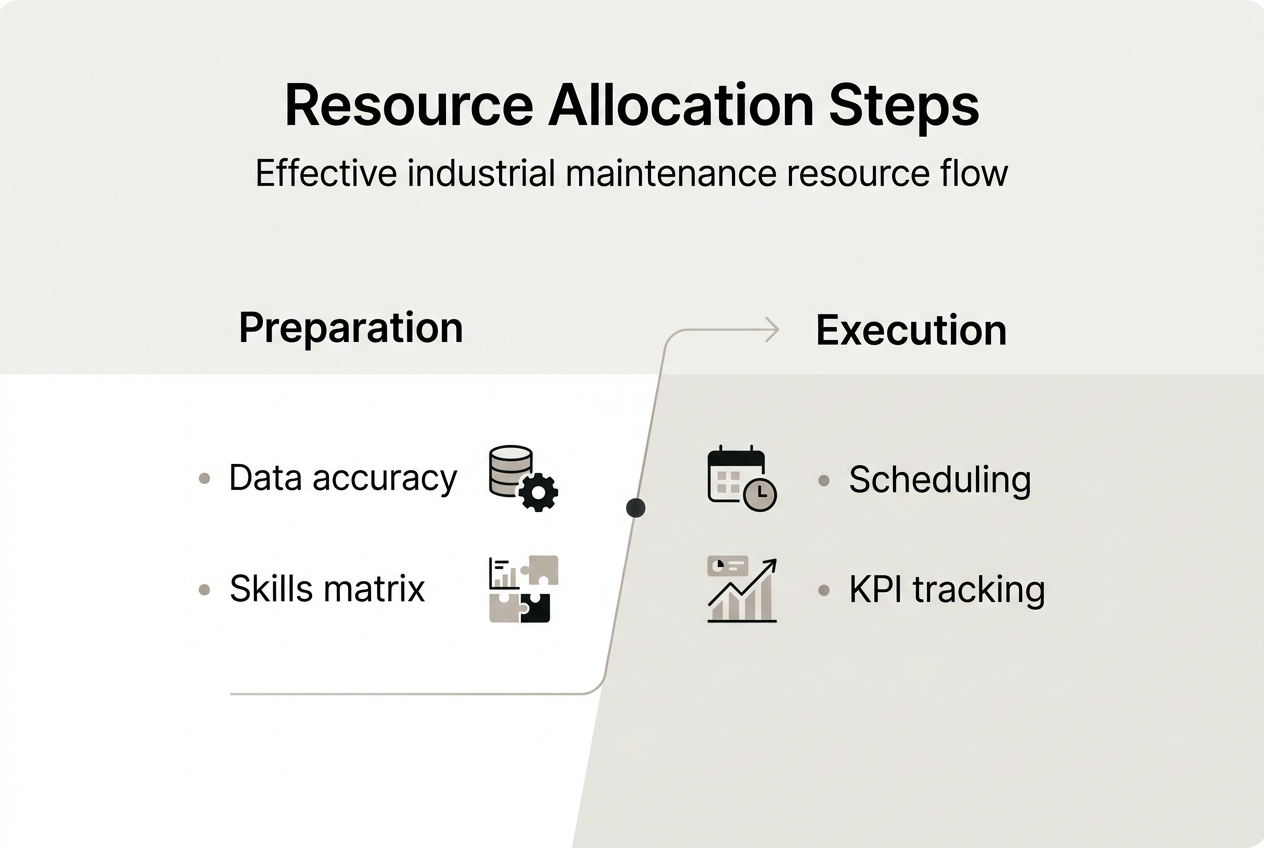
Before you can allocate resources effectively, you need a solid foundation of accurate data and clear visibility into your assets and workforce capabilities. Underestimating data quality ranks among the most common pitfalls in CMMS implementation, leading to flawed scheduling decisions and wasted effort. Your first step involves building a comprehensive asset register that captures current equipment condition, maintenance history, criticality ratings, and expected service intervals. This register becomes the single source of truth for prioritising work and deploying technicians.
Competence management ensures your team’s skills align with assigned tasks, directly impacting productivity and error rates. Matching employee skills to tasks proves crucial for avoiding costly mistakes and maximising output from each work order. Document each technician’s certifications, specialisations, and experience levels so you can assign the right person to each job. When skills gaps emerge, plan targeted training programmes to build capabilities where they’re needed most.
Resource availability extends beyond personnel to include tools, spare parts, and equipment required for maintenance activities. Conduct a thorough inventory of what you have on hand, what’s committed to ongoing projects, and what needs procurement. This visibility prevents scheduling conflicts where multiple jobs compete for the same limited resources. Understanding the role of CMMS in maintenance helps you centralise this information for easy access during planning.
Pro Tip: Create a skills matrix that maps each technician’s competencies against common maintenance tasks, then use colour coding to highlight areas where cross-training would reduce bottlenecks and improve scheduling flexibility.
Once your data foundation is solid, establish clear protocols for updating asset conditions, logging completed work, and tracking resource consumption. These protocols ensure your allocation decisions remain grounded in current reality rather than outdated assumptions. Regular audits of data accuracy help catch discrepancies before they cascade into poor scheduling choices. Implementing robust resource management strategies for asset efficiency starts with this disciplined approach to information management.
Executing resource allocation with software and optimisation methods
CMMS platforms automate work order tracking and scheduling, transforming reactive firefighting into proactive resource deployment. Implementing a CMMS reduces reactive maintenance by up to 30% within the first year through better planning and preventive task execution. These systems prioritise jobs based on asset criticality, maintenance history, and condition monitoring data, ensuring your team focuses effort where it delivers maximum operational value. The software tracks resource assignments in real time, preventing double booking and highlighting capacity constraints before they cause delays.
AI-driven resource management tools add another layer of sophistication by providing dynamic optimisation capabilities. AI platforms increase project success rates by up to 20% through intelligent scheduling that adapts to changing conditions and resource availability. These tools analyse historical performance, current workload, and predicted demand to suggest optimal allocation patterns. They identify underutilised resources and bottlenecks, enabling you to rebalance assignments for maximum throughput.
Strategic frameworks like the Optimised Maintenance Cost Reduction model provide systematic approaches for distributed operations. The OMCR framework reduces lifecycle costs by up to 50% through data-driven resource allocation across multiple sites. This methodology combines condition-based monitoring, risk assessment, and economic analysis to determine where maintenance investment delivers the strongest return. It helps you allocate budgets and personnel strategically rather than spreading resources evenly across all assets.
Implement resource allocation in phases to manage change effectively and validate results at each stage:
- Assess current resource utilisation patterns and identify inefficiencies through data analysis and stakeholder interviews.
- Configure your CMMS or resource management platform with accurate asset data, resource pools, and scheduling rules.
- Pilot the new allocation approach on a subset of assets or a single facility to test workflows and refine processes.
- Validate performance improvements through KPI tracking, comparing planned versus actual resource deployment and measuring downtime reduction.
- Scale the optimised approach across all operations whilst maintaining continuous monitoring and adjustment cycles.
The following table compares traditional manual allocation with software-driven approaches:
| Aspect | Manual allocation | Software-driven allocation |
|---|---|---|
| Scheduling speed | Hours to days for complex schedules | Minutes with automated optimisation |
| Resource visibility | Fragmented across spreadsheets and emails | Centralised real-time dashboard |
| Adaptability | Difficult to adjust once assigned | Dynamic reallocation based on conditions |
| Skills matching | Relies on manager knowledge | Automated competence-based assignment |
| Cost tracking | Manual aggregation and reporting | Integrated cost capture and analysis |
Pro Tip: Start with your most critical assets when implementing new allocation software, as improvements here deliver immediate operational impact and build organisational confidence in the new approach.
Exploring cloud-based maintenance software benefits reveals how modern platforms enable remote access and collaboration across distributed teams. This accessibility ensures field technicians, planners, and managers work from the same real-time information. Integration with IoT sensors and condition monitoring systems feeds predictive data into allocation algorithms, shifting maintenance from calendar-based to condition-based scheduling. The comprehensive guide to maintenance optimisation in 2026 demonstrates how these technologies combine to reduce downtime and save costs. Effective resource management for work orders streamlines assignment processes and improves completion rates.
Verifying and optimising resource allocation results
Monitoring key performance indicators provides the feedback loop necessary for continuous improvement in resource allocation. Track metrics such as mean time between failures, planned versus unplanned maintenance ratios, work order completion rates, and maintenance cost per asset. These indicators reveal whether your allocation strategies are achieving intended outcomes or require adjustment. Downtime metrics deserve particular attention, as they directly reflect how well resources are deployed to maintain asset availability.

Data analytics dashboards transform raw operational data into actionable insights about resource utilisation patterns. Resource allocation approaches impact efficiency significantly, making it essential to visualise where resources are consumed and where gaps exist. Look for patterns indicating bottlenecks, such as specific technicians consistently overbooked whilst others have capacity, or particular asset types experiencing longer-than-expected repair times. These patterns guide targeted interventions to rebalance workload and improve throughput.
Compare planned resource utilisation against actual deployment to identify variances and their root causes. Large gaps between plan and reality suggest either unrealistic scheduling assumptions or execution problems that need addressing. Small, consistent variances might indicate systematic bias in time estimates that can be corrected through historical data analysis. This comparison helps refine your allocation algorithms and planning parameters over time.
The following table shows typical KPIs for monitoring resource allocation effectiveness:
| KPI | Target range | Action threshold |
|---|---|---|
| Planned maintenance percentage | 75-85% | Below 70% requires allocation review |
| Schedule compliance rate | Above 90% | Below 85% indicates capacity issues |
| Resource utilisation rate | 70-80% | Above 85% risks burnout, below 65% shows inefficiency |
| Average work order cycle time | Baseline minus 15-20% | Increase of 10% triggers investigation |
| Maintenance cost per operating hour | Declining trend | Upward trend requires cost analysis |
Refine scheduling algorithms continuously based on performance data and changing operational conditions. Effective resource management reduces costs by up to 15% through ongoing optimisation of allocation patterns. Update task duration estimates as you accumulate actual completion data, adjust resource pool sizes based on demand patterns, and modify priority rules when asset criticality changes. This iterative refinement keeps your allocation approach aligned with operational reality.
Employee feedback provides qualitative insights that quantitative metrics might miss. Technicians often spot inefficiencies in routing, tool availability, or parts logistics that affect their productivity. Regular debrief sessions capture this knowledge and feed it into allocation improvements. When technicians see their input driving positive changes, engagement and ownership increase.
Pro Tip: Set up automated alerts when KPIs drift outside acceptable ranges, enabling rapid response to emerging allocation problems before they significantly impact operations.
Leveraging operations analytics capabilities helps you identify trends and predict future resource needs based on historical patterns. Advanced analytics can forecast seasonal demand variations, predict when assets will require major interventions, and model the impact of different allocation scenarios. The work orders management dashboard provides real-time visibility into current assignments and completion status, supporting dynamic reallocation when priorities shift or emergencies arise.
Discover tailored resource allocation solutions with FullyOps
Transforming your resource allocation approach requires more than just theory; it demands practical tools designed specifically for industrial maintenance operations. FullyOps integrates CMMS functionality, AI-driven scheduling, and real-time analytics into a unified platform that automates and optimises your resource deployment workflows. Our system centralises asset data, tracks technician availability and skills, and generates optimised work schedules that maximise asset uptime whilst controlling maintenance costs.
Explore our detailed resource allocation tutorial asset management guide to see step-by-step implementation strategies tailored to industrial environments. Our asset lifecycle management capabilities help you plan resource needs across the entire equipment lifespan, from commissioning through decommissioning. The comprehensive resources management and allocation features provide the visibility and control you need to deploy your maintenance team strategically, reducing reactive work and improving operational reliability.
FAQ
What is the role of CMMS in resource allocation?
CMMS platforms centralise asset information and work order data, enabling you to prioritise maintenance tasks based on criticality and schedule resources accordingly. They reduce reactive maintenance by facilitating preventive and predictive strategies, which improves overall resource utilisation. The role of CMMS in maintenance extends to tracking resource consumption and generating performance reports that guide allocation decisions.
How does preventive maintenance affect resource allocation?
Preventive maintenance allows you to forecast resource requirements and schedule work during planned windows, avoiding emergency interventions that disrupt operations. It improves asset availability by reducing unexpected breakdowns and the costly unplanned downtime they cause. Understanding the preventive maintenance process helps you build schedules that balance workload and maintain equipment reliability.
What advantages do AI-driven resource management tools provide?
AI platforms deliver real-time visibility into resource availability, project status, and workload distribution across your maintenance operations. They dynamically adjust allocation based on changing conditions, increasing project success rates and reducing costs through optimised scheduling. Implementing AI resource management tools enables you to respond quickly to operational changes whilst maintaining efficient resource deployment.
What are common pitfalls in resource allocation for industrial maintenance?
Ignoring data quality creates a foundation of poor information that leads to flawed scheduling decisions and ineffective resource deployment. Misaligning employee skills with assigned tasks results in errors, rework, and wasted effort that could be avoided through proper competence matching. Neglecting continuous monitoring prevents you from catching inefficiencies early, allowing small problems to compound into major operational issues. Avoiding these resource management pitfalls requires disciplined data management, skills assessment, and ongoing performance tracking.
Recommended
- Resource Allocation Tutorial for Efficient Asset Management
- 7 Proven Resource Management Strategies for Asset Efficiency
- Asset Maintenance Workflow Guide for Optimal Efficiency