

The single most effective way to run a maintenance warehouse is to prioritise spares by asset criticality, slot them using ABC analysis, enforce disciplined cycle counting, and link every part to a work order through your maintenance software. Get those four elements working together and technicians get parts faster, emergency purchases drop, and inventory accuracy climbs well above what manual tracking ever delivers.
En resumen:
- Prioritise critical spares using asset criticality and ABC classification, then slot critical items close to the point of use to reduce retrieval time.
- Run cycle counts based on the importance and turnover of parts, focusing on blind counts and real-time mobile scanning to maintain inventory accuracy.
- Organise warehouse zones by asset criticality and demand, ensuring easy access to the most needed parts while reducing wasted space and travel time.
- Link inventory management directly to work orders and preventive maintenance schedules within a single platform to avoid duplicate purchases and stockouts.
- Implement a phased 90-day overhaul starting with critical asset coding and ABC banding, progressing to full workflow deployment and KPI tracking for continuous improvement.
Índice
- What is gestão de armazém manutenção and why does it differ from standard warehousing?
- Core practices: codification, ABC analysis and strategic slotting
- How often should you run cycle counting instead of a full inventory?
- How should you lay out a warehouse for maintenance spare parts?
- Processes and roles: connecting the warehouse to maintenance work
- What role does a WMS play in a maintenance parts warehouse?
- What does a 90-day maintenance warehouse overhaul look like?
- Author perspective: common pitfalls and quick wins
- Getting there faster with the right platform
- Sources
- PREGUNTAS FRECUENTES
What is gestão de armazém manutenção and why does it differ from standard warehousing?
Gestão de armazém manutenção, or maintenance warehouse management, is the discipline of organising, stocking, and issuing spare parts so that preventive and corrective maintenance work never stalls for lack of materials. It looks similar to finished-goods warehousing on the surface. It is not the same job.
A distribution warehouse moves stock towards a customer. A maintenance warehouse exists to serve equipment reliability. That distinction changes everything about how you code items, decide what to stock, and measure success. A common and costly error is running a maintenance store like a retail stockroom, tracking SKUs by supplier or category rather than by which asset they belong to and how critical that asset is to operations. The result is high-value bays cluttered with parts nobody urgently needs, while a critical bearing for the line’s only compressor sits three aisles away, unlabelled, in the wrong bin.
Effective maintenance warehouse management starts by inverting that logic: every part earns its location based on the asset it supports and how badly that asset’s failure would hurt the business.
Core practices: codification, ABC analysis and strategic slotting
Start with codification. Every spare part needs an article code tied directly to the asset’s bill of materials, not a generic supplier reference. A gearbox seal for Line 3’s extruder should be traceable back to that specific machine within seconds, and a master parts list keeps that link intact as equipment gets modified or replaced.
Next comes ABC classification, run by criticality, unit value, and turnover rather than value alone, which is how most generic warehouse guides frame it. A cheap sensor that stops a whole production line if it fails belongs in the A category even if it costs less than a coffee. Cenertec’s guidance on maintenance store organisation is blunt about this: prioritisation by asset criticality and usage frequency is what separates a functioning maintenance store from a disorganised one.
Slotting follows classification. A items and critical spares go closest to the issue point, ideally with pick-to-light or labelled bin systems that cut retrieval time to seconds rather than minutes of searching.
Practical rules that make this stick:
- Set minimum and maximum thresholds per part, not a blanket reorder point across the whole catalogue.
- Build safety stock specifically for critical spares with long lead times, sized against the worst realistic delay from your supplier.
- Review ABC bands quarterly. Turnover and criticality shift as equipment ages or gets replaced.
- Keep a documented spare parts stocking system so min/max levels are not left to memory or habit.
Consejo profesional: Tag your top 20 critical assets first and map only their spares before touching the rest of the catalogue. Trying to codify everything at once is how these projects stall in month two.
How often should you run cycle counting instead of a full inventory?
Cycle counting should replace the annual full stocktake entirely, with higher priority items counted more frequently, medium priority items counted regularly, and lower priority items on a longer rotation. This risk-based approach, dividing inventory into strata with different counting frequencies, delivers reliable data without ever shutting the warehouse down for a full count.
A working cycle-count programme has four moving parts:
- Blind counts. Hide system quantities from the counter during capture so nobody unconsciously counts to match the expected number.
- Receiving discipline. Verify against the purchase order, scan barcodes or GTINs, and capture lot or serial numbers where traceability matters.
- Tolerance thresholds. Small variances auto-adjust; anything beyond the set tolerance triggers a re-count and, if it persists, a CAPA investigation into root cause.
- Mobile capture. Scanning on a handheld device at the point of count, rather than on paper, cuts transcription errors sharply.
Modern cycle-count workflows, including Dynamics 365’s approach, formalise this with pools of work, spot counts, and configurable tolerances so reconciliation happens through an approved workflow rather than a shrug and a manual override. Risk-based counting that pairs ABC bands with attribute tags and blind directed tasks also gives you an audit trail if a part failure ever needs tracing back to a batch.
How should you lay out a warehouse for maintenance spare parts?
Zone the space into four clear areas: critical spares near the issue point, consumables in bulk storage, a repair or quarantine zone for parts being assessed, and long-term storage for items with low turnover but genuine need.
- Small parts go in labelled bins with license plate numbers (LPNs) at dedicated pick faces, close to where technicians pick up job kits.
- Large or bulky items, gearboxes, motors, structural spares, belong on a mezzanine or in dedicated bays that keep aisles clear.
- Design pick paths and aisle widths around how kits get assembled for a job, not around where a delivery happened to land.
- Consider virtual stock, or desmaterialização, for remote sites: decentralised pick points mean technicians spend less time travelling back to a central store for parts they need at the equipment itself.
Poor slotting is one of the quieter costs in maintenance operations. Wasted space and inefficient pick paths inflate labour costs long before anyone notices the pattern in the numbers.
Processes and roles: connecting the warehouse to maintenance work
Every well-run maintenance store links directly to the preventive maintenance schedule. A PM plan due next week should automatically flag whether the required parts are on the shelf, triggering replenishment before the technician arrives to find an empty bin.
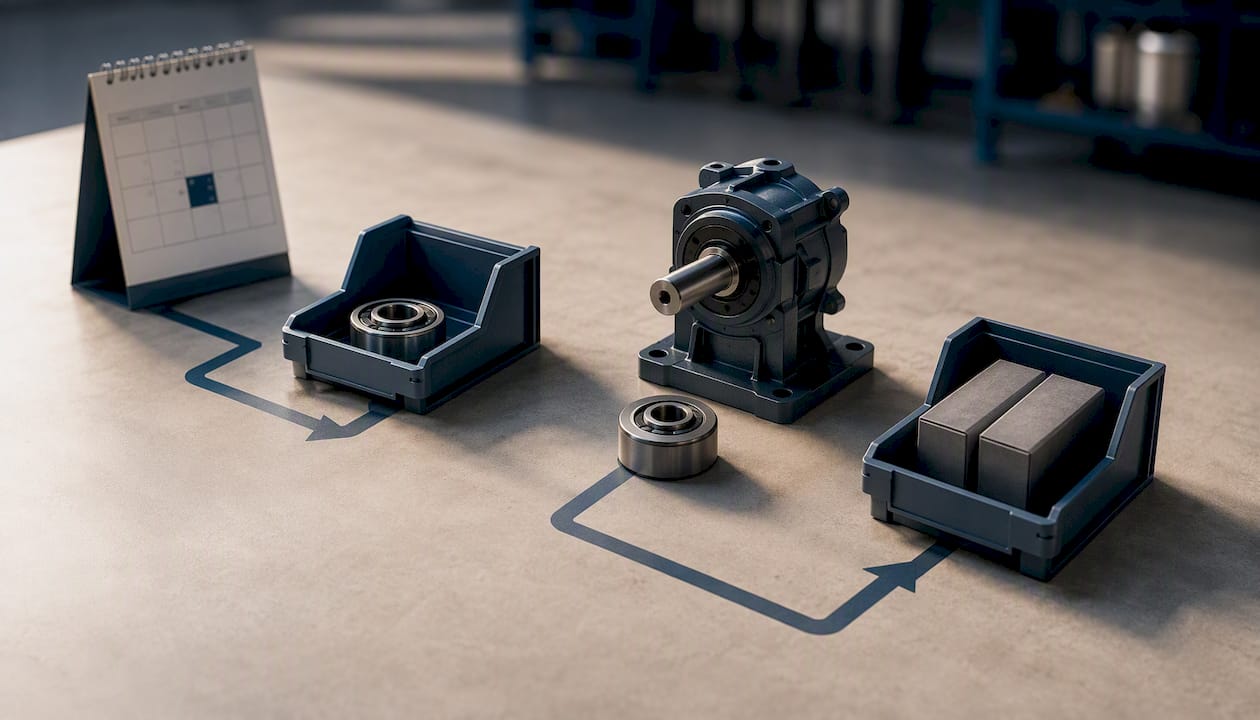
Work orders should drive the pick list, not the other way round. When a technician requisitions a part, that request ties to a specific work order, gets approved through a simple workflow, and any unused portion returns to stock through a defined process rather than getting left in a toolbox.
Roles need to be explicit:
- Warehouse keeper: receiving, put away, and physical stock accuracy.
- Materials planner: reorder triggers, supplier coordination, and safety stock levels.
- Maintenance planner: schedules PM work and forecasts parts demand ahead of time.
- Technicians: requisition through the system, never informally, and confirm returns.
Track a small set of KPIs weekly: inventory accuracy, time-to-issue from request to hand-off, stockouts on critical assets, and dock-to-stock time from delivery to shelf-ready. A modern WMS makes all four visible in real time rather than reconstructed at month-end from spreadsheets.
What role does a WMS play in a maintenance parts warehouse?
Software becomes the connective tissue between everything above. Without it, ABC bands drift, cycle counts get skipped under pressure, and nobody notices a stockout until a technician is standing in front of a broken machine.
Look for these capabilities when assessing a platform:
- An asset-linked parts catalogue, so every SKU ties back to the equipment it serves.
- Cycle-count scheduling that automates the ABC-based cadence rather than relying on someone remembering to run it.
- Mobile scanning for receiving, picking, and counting.
- Lot and serial traceability for parts where recall or audit history matters.
- Automated reorder rules tied to min/max thresholds.
- Audit trails covering every stock movement and adjustment.
Integration with gestión de órdenes de trabajo is what actually reduces duplicate purchases: when a part is already reserved against an open work order, nobody re-orders it out of panic. This linkage should be built into inventory and work order modules, giving managers a single view of what is stocked, what is committed, and what is running low, without switching between spreadsheets and paper logs.
Consejo profesional: Before signing any software contract, ask for a live demo of the cycle-count workflow specifically. Most platforms handle receiving well; fewer handle blind counts and tolerance escalation properly.
What does a 90-day maintenance warehouse overhaul look like?
Meaningful change happens faster than most managers expect, provided the first weeks focus on the highest-impact items rather than trying to fix everything at once. A structured 90-day pilot that tags critical assets and standardises codes before wider rollout produces measurable gains well before the full catalogue is touched.
- Days 0 to 14: Audit the top 20 critical assets and map every spare part they require.
- Days 15 to 30: Set ABC bands, schedule cycle counts, and pilot counting on A items only.
- Days 31 to 60: Standardise article codes and labels, deploy mobile scanning, and run the full workflow in one zone.
- Days 61 to 90: Track KPIs weekly, run short Kaizen experiments on whatever is slow, and document the SOP updates that come out of it.
Consejo profesional: Resist the urge to codify the entire warehouse in week one. A tight pilot on twenty assets teaches you more about your own bottlenecks than a spreadsheet covering four thousand SKUs ever will.
Author perspective: common pitfalls and quick wins
The mistake I see most often is treating maintenance stock like finished goods: generic categories, no asset linkage, and reconciliation that happens once a year if at all. That approach guarantees stockouts on the parts that matter most.
The fastest wins are unglamorous. Codify your critical spares first, run blind cycle counts on A items only, and connect every pick to a work order. Everything else follows from getting those three habits right, including proper 5S organisation on the shop floor itself.
— Pedro
Getting there faster with the right platform
Maintenance teams benefit from a single system where inventory levels, work orders, and reporting sit together instead of across separate tools. Parts can be reserved against open work orders automatically, which reduces duplicate purchases that occur when inventory commitments are unclear. Cycle counts, reorder rules, and technician requisitions run through the same platform your team already uses for field service management, so the 90-day overhaul above becomes a configuration exercise rather than a rebuild from scratch.
If your maintenance store is still running on spreadsheets and memory, book a demo and see how the inventory module maps onto your own asset list before you commit to anything.
Sources
- Organização e Gestão de Armazéns de Manutenção – Cenertec
- Cycle counting (Dynamics 365) – Microsoft Learn
- Contagem cíclica – SG Systems Global
PREGUNTAS FRECUENTES
What does a maintenance warehouse manager actually do?
A maintenance warehouse manager codifies spare parts against asset criticality, sets ABC-based stocking levels, runs the cycle-count programme, and ensures parts are available before preventive maintenance work is due.
How do you organise a maintenance warehouse?
Organise by asset criticality first: code parts against the equipment they serve, classify them by ABC bands, and slot critical spares closest to the issue point using clear labelling or bin systems.
What actually happens inside a maintenance store day to day?
Staff receive and inspect incoming parts against purchase orders, put stock away by zone, issue parts against work orders, run scheduled cycle counts, and reconcile any variances found during counting.
What is warehouse layout and why does it matter for maintenance parts?
Layout is the physical zoning of storage, critical spares, consumables, quarantine, and long-term stock, arranged to minimise travel time between the shelf and the equipment a technician is repairing.
How does software like Fullyops support maintenance inventory?
Fullyops links inventory levels directly to work orders and preventive maintenance schedules, so reorder triggers, part reservations, and reporting all run from a single view rather than separate spreadsheets.