

En réalité, La maintenance préventive est une stratégie proactive. cela permet d'éviter des pannes coûteuses grâce à des inspections, des entretiens et des remplacements planifiés. Ce guide explique ce que la maintenance préventive implique réellement, explore différentes méthodologies, examine les pièges courants et fournit des étapes de mise en œuvre pratiques pour vous aider à améliorer la fiabilité des actifs tout en réduisant les coûts opérationnels.
Table des matières
- Principaux enseignements
- Comprendre la maintenance préventive et ses tâches principales
- Approches et optimisation dans les méthodologies de maintenance préventive
- Écueils courants et comparaison de la maintenance préventive avec d'autres stratégies
- Mise en œuvre de la maintenance préventive pour l'excellence opérationnelle
- Optimisez votre maintenance avec les solutions FullyOps
- Questions fréquemment posées
Principaux enseignements
| Point | Détails |
|---|---|
| Tâches principales | La maintenance préventive est axée sur les inspections, la lubrification, le nettoyage, les réglages et les remplacements en temps opportun afin de préserver la fiabilité des équipements et la sécurité au travail. |
| Adapter aux besoins des actifs | Personnaliser les programmes en fonction de l'historique des pannes et des conditions d'exploitation plutôt que de suivre les directives génériques du fabricant. |
| Approches d'ordonnancement | Choisissez parmi les méthodes basées sur le temps, basées sur l'utilisation et basées sur l'état pour faire correspondre les profils d'usure et l'utilisation entre différents équipements. |
| Éviter la surmaintenance | Évitez le travail inutile en alignant les tâches sur les besoins réels plutôt que d'effectuer une maintenance de routine pour le plaisir de le faire. |
Comprendre la maintenance préventive et ses tâches principales
La maintenance préventive représente un changement fondamental, passant d'une gestion réactive des urgences à une prise en charge proactive des équipements. Plutôt que d'attendre qu'une panne se produise, vous planifiez des interventions régulières basées sur des intervalles de temps, des schémas d'utilisation ou l'état de l'équipement. Cette approche englobe plusieurs activités clés qui agissent ensemble pour préserver la santé des actifs.
Les inspections constituent la base de tout programme préventif. Vous examinez les équipements de manière systématique pour identifier les schémas d'usure, les connexions desserrées ou les premiers signes de dégradation avant qu'ils ne dégénèrent en pannes. La lubrification suit des calendriers précis pour réduire la friction et prévenir l'usure prématurée des pièces mobiles. Le nettoyage élimine les contaminants qui accélèrent la corrosion ou nuisent au bon fonctionnement. Les ajustements garantissent que les composants restent dans les paramètres de fonctionnement optimaux, tandis que le remplacement des pièces concerne des éléments tels que les filtres, les courroies et les joints avant qu'ils ne céderont.
Ces tâches ont un impact direct sur vos résultats financiers en prévenant les pannes imprévues qui interrompent la production. Lorsque vous remplacez un roulement usé lors d'une maintenance programmée, vous évitez la cascade de dommages qui se produit lorsqu'il se bloque en cours de fonctionnement. Le nettoyage régulier des échangeurs de chaleur maintient l'efficacité et évite un gaspillage d'énergie coûteux. Chaque tâche préventive sert un objectif précis dans la préservation de la fiabilité des équipements et de la sécurité au travail.
La clé pour maximiser le retour sur investissement réside dans l'adaptation de votre processus de maintenance préventive des équipements CVC et d'autres équipements à leurs besoins réels plutôt que de suivre les recommandations génériques des fabricants. Les actifs critiques nécessitent une attention plus fréquente, tandis que les équipements à faible risque ne requièrent qu'un entretien de base.
Astuce pro : examinez l'historique des pannes d'équipement et les conditions de fonctionnement pour personnaliser vos programmes de maintenance préventive. Une pompe fonctionnant dans un environnement poussiéreux nécessite des changements de filtres plus fréquents que celle située en salle blanche, même s'il s'agit de modèles identiques.
Approches et optimisation dans les méthodologies de maintenance préventive
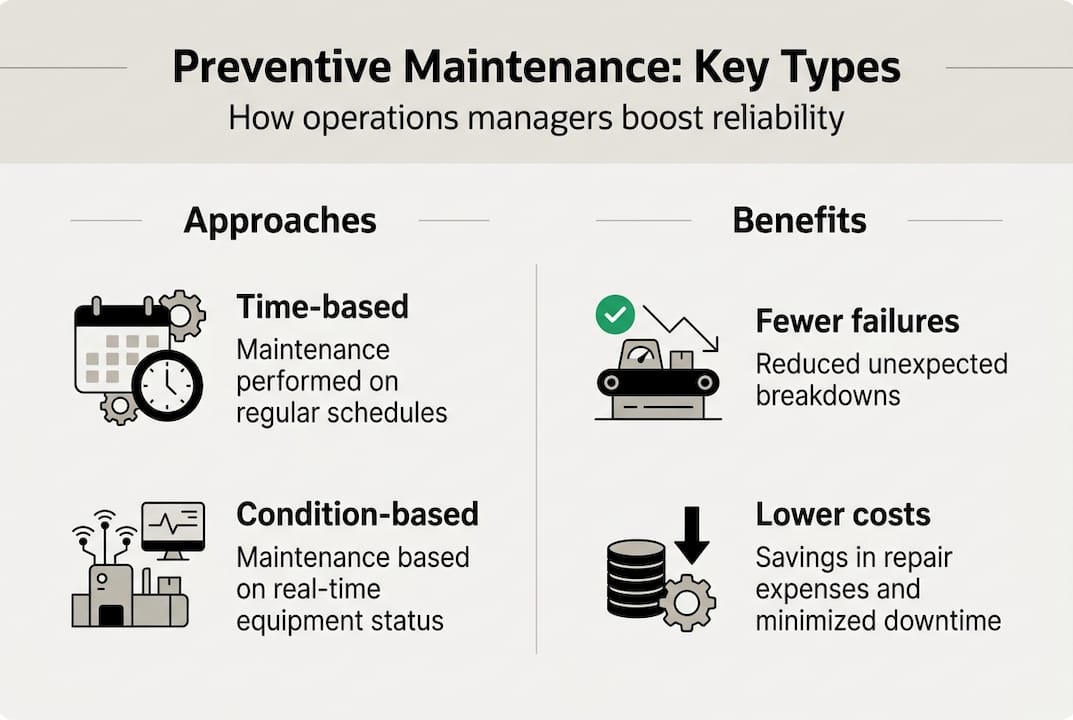
Le choix de la bonne approche de planification détermine si votre programme préventif génère de la valeur ou gaspille des ressources. Trois méthodologies principales guidez quand et comment vous effectuez les tâches de maintenance, chacune adaptée à différents types d'équipements et contextes opérationnels.
La maintenance préventive temporelle déclenche des interventions à des intervalles calendaires fixes, indépendamment de l'utilisation des équipements. Vous pourriez ainsi réviser un compresseur tous les trois mois ou remplacer les filtres CVC chaque trimestre. Cette approche convient bien aux équipements présentant des schémas d'usure prévisibles et des conditions de fonctionnement constantes. La planification basée sur l'utilisation lie la maintenance aux heures de fonctionnement réelles, aux cycles de production ou aux kilomètres parcourus. Un système de convoyage est ainsi entretenu toutes les 2 000 heures de fonctionnement plutôt que chaque mois. Cette méthode tient compte des taux d'utilisation variables au sein de votre parc d'actifs.
La maintenance conditionnelle représente l'approche la plus sophistiquée, utilisant des données de surveillance en temps réel pour déclencher des interventions uniquement lorsque l'équipement montre des signes de dégradation. Des capteurs de vibration détectent l'usure des roulements, l'analyse d'huile révèle la contamination et l'imagerie thermique identifie les points chauds électriques. Vous effectuez la maintenance en fonction du besoin réel plutôt que selon des calendriers arbitraires.
La maintenance centrée sur la fiabilité (RCM) fournit le cadre pour hiérarchiser les actifs qui reçoivent quel niveau d'attention. La RCM analyse la fonction de chaque actif, les modes de défaillance potentiels et les conséquences afin de déterminer les stratégies de maintenance optimales. Vous classez les actifs en catégories en fonction de leur criticité, généralement en utilisant une classification A/B/C où les actifs de classe A sont essentiels à la mission et reçoivent les soins les plus intensifs.
L'analyse des modes de défaillance et de leurs effets (AMDEC) soutient cette priorisation en examinant systématiquement la manière dont les équipements peuvent défaillir et l'impact de chaque type de défaillance. Cette analyse révèle quels composants justifient une attention préventive et lesquels il vaut mieux laisser fonctionner jusqu'à la panne. Efficace tutoriel sur l'allocation des ressources gestion des actifs dépend de cette priorisation stratégique.
| Approche | Le meilleur pour | Avantages | Limites |
|---|---|---|---|
| Basé sur le temps | Équipement à usure prévisible, systèmes critiques pour la sécurité | Facile à planifier, garantit une attention régulière | Peut entraîner un sur-entretien, ignore l'état réel |
| Basé sur l'utilisation | Actifs à utilisation variable, équipements de production | Tient compte de l'usure réelle, plus efficace que le chronologique | Nécessite un suivi de l'utilisation, ne détecte pas les dégradations soudaines |
| Basé sur l'état | Actifs critiques, équipements coûteux | Maintenance uniquement en cas de besoin, évite les travaux inutiles | Coût initial plus élevé, nécessite une infrastructure de surveillance |
Mise en œuvre complète gestion du cycle de vie des actifs nécessite de combiner ces approches en fonction de la criticité des équipements et des conséquences des défaillances.
Écueils courants et comparaison de la maintenance préventive avec d'autres stratégies
Même les programmes de prévention bien intentionnés n'atteignent souvent pas leur potentiel en raison d'erreurs systématiques qui gaspillent des ressources et érodent la confiance. Comprendre ces pièges vous aide à concevoir des stratégies de maintenance plus efficaces.
La sur-maintenance représente le piège le plus courant. Suivre aveuglément les recommandations du fabricant conduit à des interventions excessives qui consomment de la main-d'œuvre et des matériaux sans améliorer la fiabilité. Les grilles de programmation génériques font que 41% de programmes n'atteignent pas leurs objectifs de retour sur investissement, grâce à des intervalles basés sur les données capables de réduire les déchets de 30 à 45%. Étonnamment, une surlubrification cause autant de problèmes qu'une sous-lubrification en attirant les contaminants et en créant une pression hydraulique qui endommage les joints.
Une mauvaise conformité compromet même les programmes les mieux conçus. Lorsque les techniciens omettent les tâches planifiées en raison de la pression de la production ou d'un personnel insuffisant, vous perdez la cohérence qui rend la maintenance préventive efficace. Une documentation incomplète aggrave ce problème en empêchant une analyse significative de l'efficacité de la maintenance.
La relation entre les stratégies de maintenance préventive, prédictive et corrective mérite une attention particulière. La maintenance corrective, qui n'intervient qu'après les pannes, coûte nettement plus cher en raison des réparations d'urgence, des dommages secondaires et des temps d'arrêt imprévus. La maintenance préventive réduit ces coûts mais peut gaspiller des ressources lors d'interventions inutiles.
“ La maintenance prédictive peut encore réduire les temps d'arrêt en 25-45% : au-delà des approches préventives, mais la maintenance préventive reste fondamentale, en particulier pour les actifs à faible criticité.”
La stratégie optimale combine des approches basées sur les caractéristiques des actifs. Les équipements critiques ayant des conséquences de défaillance élevées justifient des investissements en surveillance prédictive. Les équipements de production standard bénéficient de programmes préventifs basés sur l'utilisation. Les articles de faible criticité peuvent être mieux gérés de manière réactive si les coûts de défaillance restent minimes.
Étapes pour augmenter la conformité et optimiser le retour sur investissement de la maintenance préventive :
- Établissez une responsabilité claire en affectant des techniciens spécifiques à des zones d'équipement
- Planifier les tâches préventives pendant les arrêts de production planifiés pour réduire les conflits
- Simplifiez les bons de travail avec des instructions détaillées et des listes de pièces requises
- Suivre les indicateurs de conformité chaque semaine et traiter immédiatement les obstacles
- Examiner les données de défaillance trimestriellement pour ajuster les plannings en fonction du comportement réel des équipements
- Investissez dans la surveillance de l'état des actifs de classe A pour passer de stratégies préventives à prédictives
Adressage défis liés à l'adoption de la maintenance préventive exige une attention systématique à la conception des programmes, à l'allocation des ressources et aux processus d'amélioration continue.
Mise en œuvre de la maintenance préventive pour l'excellence opérationnelle
Transformer la maintenance préventive d'un concept en réalité opérationnelle nécessite une mise en œuvre structurée qui aborde l'identification des équipements, l'élaboration des calendriers, la rigueur d'exécution et l'optimisation continue.
Commencez par créer un inventaire complet des actifs qui consigne les détails essentiels : emplacement des équipements, spécifications du fabricant, paramètres de fonctionnement, historique des pannes et classification de criticité. Cette base permet de prendre des décisions éclairées concernant les priorités de maintenance et l'allocation des ressources. Élaborez des plannings initiaux en prenant les recommandations du fabricant comme point de départ, puis affinez-les en fonction de votre environnement d'exploitation et de vos données sur les pannes.
Des ordres de travail clairs constituent la base d'une exécution efficace. Chaque ordre de travail doit préciser les tâches exactes requises, la durée estimée, les pièces et outils nécessaires, les consignes de sécurité et les exigences en matière de documentation. Cette clarté élimine toute ambiguïté et garantit une exécution cohérente, quel que soit le technicien qui effectue le travail. Détaillé processus de gestion des ordres de travail La documentation crée la traçabilité nécessaire à la vérification de la conformité et à l'amélioration continue.
Les ajustements de planning fondés sur les données préviennent le gaspillage associé aux intervalles génériques. Lorsque vous remplacez systématiquement un composant qui présente une usure minimale, prolongez l'intervalle. Si des pannes surviennent avant la maintenance planifiée, raccourcissez l'intervalle ou passez à la surveillance de l'état. Ce processus de raffinement itératif optimise progressivement votre programme pour l'adapter au comportement réel des équipements.
Les indicateurs de performance cibles guident vos efforts d'amélioration. Visez 80 à 85% de travail planifié pour réduire les cycles de maintenance corrective et améliorer la disponibilité des équipements. Suivez les taux de conformité du planning, le temps moyen entre pannes et le coût de maintenance par unité de production. Ces indicateurs révèlent l'efficacité du programme et mettent en lumière les domaines nécessitant une attention particulière.
| Métrique | Fourchette cible | Objectif |
|---|---|---|
| Pourcentage de travail planifié | 80-85% | Les mesures passent de la maintenance réactive à la maintenance proactive |
| Taux de conformité du calendrier | >90% | Indique la rigueur d'exécution et l'adéquation des ressources |
| Temps moyen entre pannes | À la hausse | Démontre l'amélioration de la fiabilité des actifs |
| Coût de maintenance par unité de production | Stable ou en diminution | Montre les gains d'efficacité d'une approche préventive |
| Ordres de travail d'urgence | % du total | Reflète une réduction des pannes imprévues |
Des examens réguliers des programmes garantissent que votre maintenance préventive évolue en fonction de l'évolution des besoins opérationnels. Des évaluations trimestrielles doivent examiner les tendances en matière de conformité, les schémas de défaillance, la rentabilité et les possibilités de passer de stratégies préventives à prédictives pour les actifs critiques. Complet rapport de maintenance fiabilité des équipements CVC et d'autres équipements offrent la visibilité nécessaire pour prendre des décisions éclairées.
Conseil de pro : commencez modestement par un programme pilote couvrant 10 à 15 actifs critiques. Démontrez la valeur ajoutée par une fiabilité accrue et une réduction des réparations d'urgence avant d'étendre le projet à l'ensemble de votre parc d'actifs. Cette approche renforce la confiance au sein de l'organisation et vous permet d'affiner vos processus avant de passer à l'échelle supérieure.
Optimisez votre maintenance avec les solutions FullyOps
La mise en œuvre des stratégies de maintenance préventive décrites dans ce guide devient nettement plus facile avec les bons outils pour soutenir vos efforts. FullyOps propose un logiciel complet de gestion des actifs et des services sur le terrain, conçu spécifiquement pour les responsables des opérations qui cherchent à optimiser les processus de maintenance et à améliorer la fiabilité des actifs.
Notre plateforme rationalise la gestion des bons de travail, suit les interventions de manière systématique et fournit les analyses opérationnelles nécessaires pour affiner vos programmes de maintenance préventive en fonction des performances réelles des équipements. Que vous élaboriez vos premiers programmes de prévention ou que vous optimisiez des programmes existants, FullyOps offre la visibilité et le contrôle requis pour réussir.
Explorez nos ressources pratiques sur le didacticiel d'allocation des ressources et la gestion des actifs et découvrez comment optimisation de la maintenance 2026 les stratégies peuvent réduire les temps d'arrêt tout en maîtrisant les coûts. Nos outils de processus de gestion des bons de travail garantissent une exécution cohérente et une documentation complète, constituant ainsi la base de l'amélioration continue de vos opérations de maintenance.
Questions fréquemment posées
Qu'est-ce que la maintenance préventive exactement ?
La maintenance préventive est une approche proactive qui comprend des inspections planifiées, la lubrification, le nettoyage, les réglages et le remplacement de pièces effectués avant qu'un équipement ne tombe en panne. Contrairement à la maintenance réactive qui réagit aux pannes, le travail préventif suit des programmes prédéterminés basés sur le temps, l'utilisation ou l'état de l'équipement afin de maintenir la fiabilité des actifs et d'éviter des pannes coûteuses.
En quoi la planification basée sur le temps et la planification basée sur les conditions diffèrent-elles ?
La planification basée sur le temps déclenche la maintenance à des intervalles calendaires fixes, indépendamment de l'état de l'équipement, ce qui la rend simple mais potentiellement gaspilleuse. La planification basée sur l'état utilise des données de surveillance en temps réel, telles que les niveaux de vibration ou la qualité de l'huile, pour effectuer la maintenance uniquement lorsque l'équipement présente des signes réels de dégradation, optimisant ainsi l'utilisation des ressources mais nécessitant une infrastructure de surveillance.
La maintenance préventive permet-elle réellement de réduire les coûts ?
Lorsqu'elle est correctement mise en œuvre avec des programmes spécifiques aux actifs, la maintenance préventive réduit considérablement les coûts en évitant des réparations d'urgence coûteuses, des dommages secondaires et des temps d'arrêt imprévus. Cependant, les programmes génériques font échouer 41% des programmes à atteindre leurs objectifs de retour sur investissement en raison d'une sur-maintenance. Des intervalles axés sur les données qui correspondent aux besoins réels des équipements permettent une réduction des déchets de 30 à 45% par rapport aux recommandations des fabricants.
Dois-je utiliser la maintenance préventive ou prédictive ?
L'approche optimale combine les deux stratégies en fonction de la criticité des actifs. La maintenance préventive fonctionne bien pour les équipements standard présentant des profils d'usure prévisibles et des conséquences de panne moindres. La maintenance prédictive justifie son coût initial plus élevé pour les actifs critiques dont les pannes entraînent de graves pertes de production ou des risques pour la sécurité. Les programmes les plus efficaces utilisent la maintenance préventive comme socle tout en y ajoutant une surveillance prédictive pour les actifs de classe A.
Comment puis-je améliorer la conformité de la maintenance préventive ?
Améliorez la conformité en établissant une responsabilité claire des techniciens, en planifiant les tâches pendant les arrêts de production prévus, en simplifiant les bons de travail avec des instructions détaillées, en suivant les mesures de conformité chaque semaine et en éliminant immédiatement les obstacles. Visez 90% de conformité au planning et 80-85% de travail planifié pour passer d'une culture de maintenance réactive à une culture proactive.
Recommandé
- Maîtriser le processus de maintenance préventive des équipements de chauffage, de ventilation et de climatisation (CVC)
- Optimisation de la maintenance en 2026 : réduire les temps d'arrêt de 30%
- Planification de la maintenance étape par étape : Réduire les temps d'arrêt par 30%