

En bref
- Data drives equipment reliability by shifting maintenance from schedules to condition-based actions that prevent failures.
- Proper data integration and explainable AI build trust, enabling maintenance teams to make accurate, timely decisions.
Data is the primary driver of equipment reliability, converting maintenance from a calendar-based obligation into a condition-driven discipline that targets failures before they occur. The role of data in equipment reliability is now recognised across industrial sectors as the foundation for predictive and condition-based maintenance strategies. Frameworks from bodies such as IEEE and AIChE both point to real-time monitoring and structured data analysis as the recommended path to reducing unplanned downtime. Maintenance managers who act on quality data, rather than fixed schedules, consistently achieve lower costs and higher asset availability.
How does data analytics improve equipment reliability?
Data analytics for equipment reliability centres on two core metrics: mean time between failures (MTBF) and mean time to repair (MTTR). MTBF measures how long an asset runs before failing. MTTR measures how quickly the team restores it. Together, they give maintenance managers a factual baseline for comparing asset performance over time and identifying which machines carry the highest risk.

The data feeding these metrics comes from physical sensors attached to critical assets. Vibration, temperature, and acoustics each produce distinct physical signatures that precede mechanical failure. A bearing running hot or vibrating at an abnormal frequency will show that pattern in sensor data days or weeks before it breaks down. That window is where maintenance teams can act.
Two analytical models convert raw sensor data into maintenance decisions. Anomaly detection flags readings that deviate from normal operating ranges. Remaining useful life (RUL) forecasting estimates how much service life an asset has left before intervention is needed. Accurate RUL models depend entirely on high-quality, well-curated data sets. Poor data quality produces unreliable predictions, which erodes trust in the entire programme.
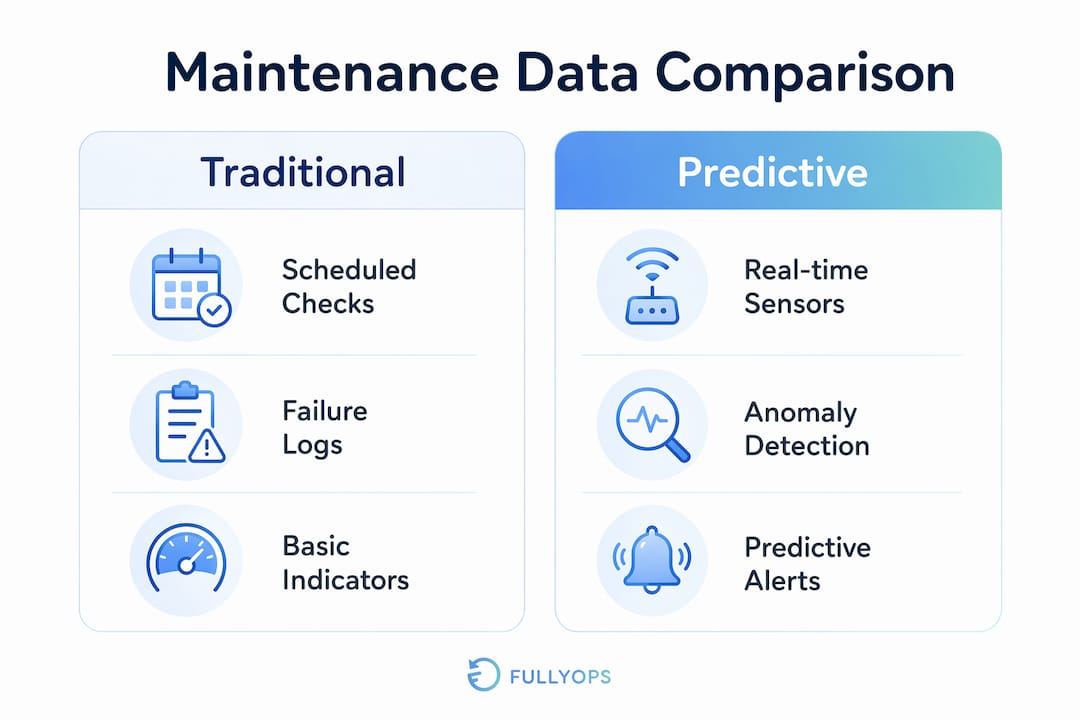
The table below contrasts what traditional maintenance data captures against what predictive analytics delivers.
| Metric type | Traditional maintenance data | Predictive analytics output |
|---|---|---|
| Failure indicator | Post-failure work order record | Anomaly score from live sensor feed |
| Timing of action | Fixed calendar interval | Condition-triggered alert |
| Asset health view | Historical breakdown log | Real-time health index and RUL estimate |
| Cost visibility | Reactive repair cost per incident | Projected cost avoidance per intervention |
| Decision basis | Engineer experience and schedule | Data model recommendation with confidence score |
What frameworks support effective data integration for reliability?
Modern reliability management does not suffer from a shortage of data. Modern plants generate vast operational data but lack the structured frameworks to connect it to decisions. The result is data silos: sensor feeds, computerised maintenance management systems (CMMS), enterprise asset management (EAM) platforms, and predictive analytics tools all operating independently.
The concept of a unified data fabric addresses this directly. A unified data fabric links siloed maintenance systems and real-time monitoring into a single, coherent decision-support ecosystem. Rather than requiring engineers to switch between five platforms to build a picture of one asset, the fabric surfaces the right information in one place.
Scaling this architecture from a single plant to an enterprise requires an integrated enterprise operations platform (EOP). An EOP connects site-level sensor data with corporate asset management and financial reporting. Maintenance managers gain visibility across multiple facilities without losing the granularity needed for individual asset decisions.
The practical challenges of integration are real. Data from different systems often uses inconsistent naming conventions, timestamps, or units. Contextualising raw data, meaning attaching engineering knowledge to a number, is what separates a useful alert from noise.
- Map all data sources before selecting integration tools. Identify which systems hold sensor data, work order history, and spare parts records.
- Standardise data formats and naming conventions across CMMS and EAM platforms before connecting them to analytics layers.
- Define which alerts require human review and which can trigger automated work orders.
- Assign data ownership to specific roles so that quality issues are caught and corrected quickly.
Conseil de pro : Effective integration requires aligning software platforms with user workflows. A dashboard that shows 200 metrics simultaneously creates overload, not insight. Start with the five metrics that directly influence your highest-risk assets.
How does predictive maintenance reduce costs and downtime?
Predictive maintenance is the most direct application of data analytics for equipment reliability, and its financial case is well established. Transitioning from preventive to data-driven predictive maintenance reduces maintenance costs by 25–30% by targeting repairs based on real-time sensor data rather than fixed intervals. Integrating explainable predictive analytics can reduce unplanned downtime by up to 22% and overall maintenance costs by a further 15%.
The distinction between maintenance strategies matters here. Reactive maintenance waits for failure. Preventive maintenance acts on a fixed schedule regardless of asset condition. Predictive maintenance acts when data indicates a specific asset is approaching a failure threshold. A pump scheduled for quarterly servicing may not need it at month three but may show early bearing wear at month two. Predictive maintenance catches the second scenario; preventive maintenance misses it.
Condition-based predictive maintenance converts unplanned downtime into planned interventions, which improves scheduling efficiency across the entire maintenance team. Planned work costs less than emergency repairs in parts, labour, and production loss.
The transition from calendar-based to data-driven maintenance follows a clear sequence:
- Audit current assets. Identify which assets are critical to production and which failures carry the highest cost.
- Install condition monitoring. Fit vibration, temperature, and acoustic sensors to critical assets and connect them to a data pipeline.
- Establish baseline data. Run sensors for a defined period to capture normal operating ranges before building anomaly detection models.
- Build anomaly detection first. Start with models that flag deviations from baseline. Add RUL forecasting as labelled failure data accumulates.
- Connect alerts to work orders. Integrate the analytics platform with your CMMS so that a triggered alert generates a work order automatically.
- Review and refine. Measure MTBF and MTTR monthly. Adjust alert thresholds based on false positive rates and engineering feedback.
What best practices make data-driven maintenance trustworthy?
The most common failure point in data-driven maintenance programmes is not the data. It is the gap between what a model outputs and what a reliability engineer trusts enough to act on. AI models used in predictive maintenance can function as black boxes, producing recommendations without explaining the reasoning. Engineers who cannot see why a model flagged an asset will default to their own judgement, which defeats the purpose of the programme.
Explainable AI techniques such as SHAP values address this directly. SHAP (SHapley Additive exPlanations) values show which sensor inputs contributed most to a model’s prediction. An engineer can see that a bearing temperature spike and a vibration frequency shift together drove a high-risk alert. That transparency builds confidence in the model and accelerates adoption across the team.
Domain expertise remains non-negotiable. Reliability engineers must integrate first-principles physics with AI outputs to validate predictions. A model that flags an asset as high-risk during a known seasonal temperature variation may be responding to a normal operating condition, not a fault. Engineers who understand the physics of their assets catch these false positives before they waste maintenance resources.
The goal of data-driven maintenance is not to eliminate preventive maintenance. Data-driven maintenance focuses labour hours on critical assets by adjusting plans based on actual equipment performance rather than blanket schedules. Assets that data shows are performing well can be serviced less frequently. Assets showing early degradation receive earlier attention. This “right maintenance” concept preserves the structure of a preventive programme while making it responsive to real conditions.
Conseil de pro : Validate predictive models against engineering knowledge at least quarterly. Compare model-flagged assets against physical inspection findings. Discrepancies reveal either a data quality problem or a gap in the model’s training data, both of which are fixable.
Operational data patterns must be continuously analysed and integrated into maintenance plans to reflect evolving asset conditions. A model trained on last year’s data may not account for changes in production load, ambient conditions, or asset age. Regular retraining keeps predictions accurate.
Principaux enseignements
Data-driven maintenance succeeds when quality sensor data, integrated systems, and explainable analytics combine to produce decisions that engineers trust and act on.
| Point | Détails |
|---|---|
| Start with MTBF and MTTR | These two metrics establish a factual baseline before any predictive model is introduced. |
| Prioritise data quality | Accurate anomaly detection and RUL forecasting depend on well-curated sensor data, not model complexity. |
| Build a unified data fabric | Connecting CMMS, EAM, and sensor feeds into one ecosystem removes silos and surfaces actionable insights. |
| Use explainable AI | SHAP values and similar techniques show engineers why a model flagged an asset, which builds adoption. |
| Right-maintain, do not abandon prevention | Adjust maintenance frequency based on asset condition data rather than replacing all scheduled tasks. |
Data overload is the real enemy, not data scarcity
Working with maintenance teams across industrial facilities, the pattern I see most often is not a shortage of data. It is an excess of it, with no clear path from a sensor reading to a maintenance decision. Plants invest in condition monitoring equipment, connect it to dashboards, and then find that engineers spend more time interpreting alerts than acting on them.
The fix is not more data. It is better data architecture. A unified data fabric that connects your CMMS, EAM, and sensor feeds into a single view is worth more than any individual analytics tool. The question maintenance managers should ask is not “what data do we have?” but “which data directly informs a decision about a critical asset?”
I have also seen programmes stall because engineers do not trust the model outputs. That is a solvable problem, but only if you invest in explainability from the start. Showing an engineer the specific sensor inputs that drove a high-risk alert is far more persuasive than presenting a risk score with no context.
The future of reliability management sits at the intersection of physics-based engineering knowledge and machine learning. Neither works as well without the other. Teams that build that collaboration early, rather than treating AI as a replacement for engineering judgement, will see the strongest results from their data investments.
— Pedro
How Fullyops supports data-driven reliability management
Fullyops connects work order management with analyse opérationnelle to give maintenance managers a direct line from sensor-driven insights to scheduled interventions. The platform integrates asset records, work order history, and performance data in one place, reducing the manual effort of correlating information across systems. Maintenance managers can track maintenance costs and asset performance in real time, making it straightforward to identify where data-driven adjustments will have the greatest impact. For teams building or refining a reliability programme, the tutoriel sur l'allocation des ressources provides a practical framework for aligning labour and materials with the assets that data identifies as highest priority.
FAQ
What is the role of data in equipment reliability?
Data enables maintenance teams to detect early signs of failure through sensor monitoring and analytics, replacing fixed schedules with condition-driven interventions. This approach reduces unplanned downtime and targets repair effort where it has the greatest impact on asset performance.
What metrics matter most for data-driven maintenance?
Mean time between failures (MTBF) and mean time to repair (MTTR) are the two foundational metrics. They establish a performance baseline and reveal whether a maintenance programme is improving asset availability over time.
How much can predictive maintenance reduce costs?
Transitioning to data-driven predictive maintenance reduces maintenance costs by 25–30% and can cut unplanned downtime by up to 22%, according to validated industrial studies. These gains depend on high-quality sensor data and a structured analytics pipeline.
What is a unified data fabric in maintenance?
A unified data fabric connects disparate systems, including CMMS, EAM platforms, and real-time sensors, into a single decision-support ecosystem. It removes data silos and gives maintenance managers a coherent view of asset health across a facility or enterprise.
How do you make AI predictions trustworthy for reliability engineers?
Explainable AI techniques such as SHAP values show which sensor inputs drove a model’s prediction, making the reasoning visible to engineers. Combining these outputs with first-principles engineering knowledge produces recommendations that teams are confident enough to act on.
Recommandé
- Asset reliability improvement steps: 2026 guide
- Equipment performance analysis guide for maintenance teams
- Predictive maintenance: boost reliability and cut downtime