

En bref
- Effective spare parts inventory management balances operational readiness with minimized carrying costs by categorizing parts based on criticality and demand variability. Implementing technology like CMMS, RFID, and AI-driven forecasting enhances accuracy and responsiveness, but foundational discipline in data cleanliness and classification is essential. Proper classification, continuous review, and strategic supplier partnerships enable organizations to optimize inventory levels and reduce costly stockouts.
Spare parts inventory management is the strategic control over the stocking, replenishment, and classification of maintenance materials that keep equipment running. For operations managers and maintenance professionals, the question of why manage spare parts inventory is not abstract. Spare parts represent 30–40% of total maintenance budgets at industrial facilities, tying up millions in working capital that could otherwise fund capital projects or operational improvements. The discipline that formally addresses this is known as MRO (Maintenance, Repair and Operations) inventory management, and mastering it separates facilities that run efficiently from those that haemorrhage money on emergency purchases and unplanned downtime.
Why manage spare parts inventory: the financial and operational case
The financial argument for disciplined spare parts control is grounded in two opposing risks: carrying too much stock and carrying too little. Both are expensive, and both are measurable.

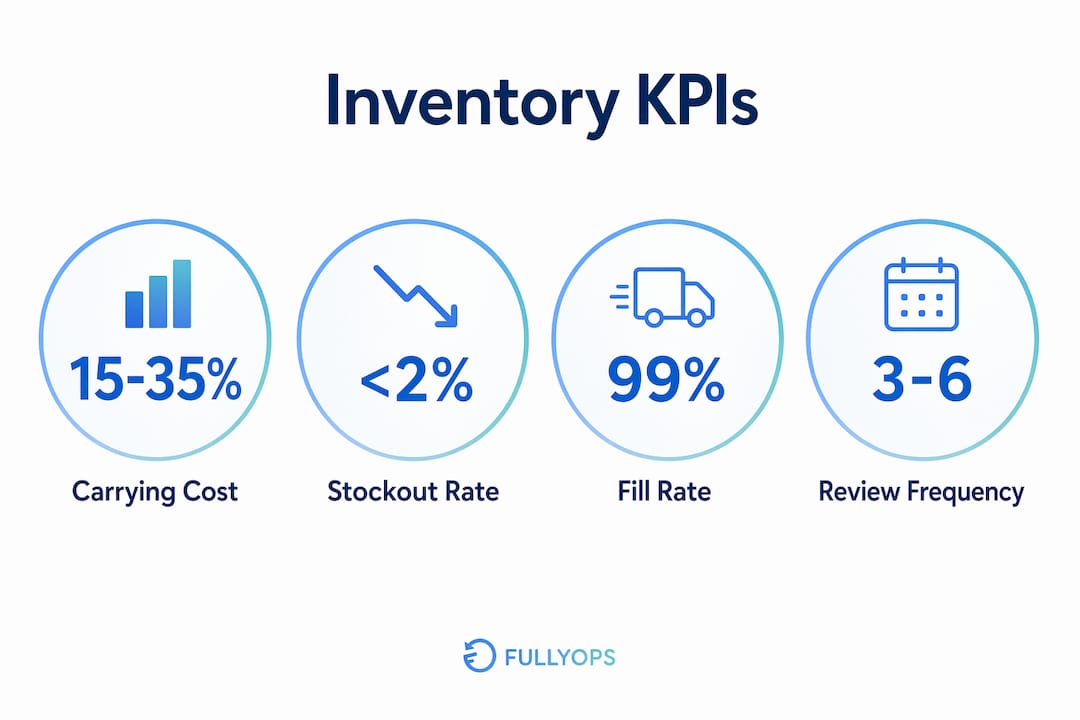
Carrying costs are the silent drain on working capital. Carrying cost benchmarks between 15% and 35% of average inventory value per year, meaning a storeroom holding £100,000 in parts incurs up to £35,000 annually in warehousing, capital cost, handling, insurance, and obsolescence. That figure compounds quickly across multi-site operations. The implication is direct: every part sitting on a shelf that is not needed within a reasonable planning horizon is a liability, not an asset.
Stockouts carry an entirely different cost profile. A missing £200 bearing can cause £50,000–£150,000 per hour in lost production at a manufacturing facility. That ratio makes the cost of a single stockout on a critical component dwarf the annual carrying cost of stocking it correctly. Emergency purchases also inflate procurement costs and distort supplier relationships.
The key performance indicators that define a well-managed MRO storeroom include:
- Carrying cost percentage: target below 25% of inventory value annually
- Stockout rate for critical parts: target below 2%
- Emergency purchase ratio: target below 5% of total purchase orders
- Fill rate for vital items: target 99% or above
These KPIs are not aspirational. They are the benchmarks that separate facilities operating at best-in-class cost efficiency from those absorbing avoidable losses year after year.
How spare parts inventory differs from general inventory management
The most common mistake operations teams make is applying standard retail or production inventory logic to spare parts. The two disciplines are fundamentally different, and treating them the same produces poor results.
Spare parts demand is intermittent and failure-driven, not predictable like sales orders or production schedules. A pump seal may sit untouched for 18 months and then be needed three times in a fortnight following a batch of equipment failures. Standard reorder point models built on steady demand assumptions will either overstock or understock in this environment.
Criticality classification is the cornerstone of effective MRO inventory strategy. Parts are ranked not just by cost but by their operational impact if unavailable. A high-value component with a short lead time and a readily available alternative carries a different risk profile than a low-cost part with a six-week lead time that stops a production line if missing.
| Part category | Stocking policy | Fréquence d'examen |
|---|---|---|
| Critical spares (vital, long lead time) | Hold safety stock on-site | Monthly or event-driven |
| Rotable parts (repairable, high value) | Manage repair pool and float | Trimestriel |
| Consumables (high volume, low cost) | Replenish by reorder point or VMI | Automated or weekly |
| Insurance spares (rarely used, catastrophic risk) | Hold indefinitely, review annually | Annual |
This classification framework directly influences reorder points, safety stock levels, and the frequency of stock reviews. Applying a single service level target across all categories, as many facilities do, leads to either expensive overstock on low-risk items or dangerous gaps on critical ones.
Conseil de pro : When classifying parts, combine ABC analysis (by spend value) with XYZ analysis (by demand variability). Parts that are high-spend and highly variable in demand require the most management attention and the most carefully calibrated safety stock.
What technologies improve spare parts inventory management?
Technology does not replace sound strategy, but it dramatically improves execution speed and accuracy. The tools available to operations teams in 2026 span from mature CMMS platforms to emerging IoT-driven forecasting systems.
CMMS (Computerised Maintenance Management Systems) and EAM (Enterprise Asset Management) platforms are the operational backbone. They link equipment bills of materials directly to storeroom stock, trigger reorder alerts when parts are consumed during work orders, and provide audit trails for every transaction. The processus de gestion des ordres de travail becomes significantly more reliable when technicians can confirm part availability before a job is scheduled, rather than discovering a stockout mid-repair.
RFID and barcode scanning have transformed physical inventory accuracy. RFID-enabled storerooms achieve over 99% inventory accuracy and reduce physical count times by 80–90% compared to manual systems. Real-time withdrawal tracking means reorder triggers fire automatically rather than waiting for a weekly count to reveal a gap. For operations managers overseeing large storerooms, this accuracy improvement alone justifies the technology investment.
Emerging capabilities worth monitoring include:
- Capteurs IoT on high-wear components that track usage cycles and predict replacement needs before failure occurs
- AI-driven demand forecasting that identifies patterns in intermittent consumption data, improving reorder timing for parts with irregular usage histories
- Automated reorder integration between CMMS platforms and supplier portals, reducing procurement cycle times and emergency purchase rates
Conseil de pro : Before investing in RFID or IoT, audit your current data quality. Technology amplifies whatever data you feed it. A CMMS with inaccurate part numbers or missing equipment linkages will produce unreliable reorder triggers regardless of how sophisticated the scanning hardware is.
Practical strategies for managing spare parts inventory effectively
Sound strategy and good technology must be combined with disciplined operational practices. The following approaches represent spare parts management best practices that operations teams can implement progressively.
-
Classify all parts by criticality before setting stocking policies. Use a formal criticality matrix that scores parts on lead time, operational impact, and availability of alternatives. This prevents the common error of applying uniform safety stock rules across the entire catalogue.
-
Apply ABC/XYZ segmentation to prioritise management effort. ABC analysis ranks parts by annual spend value; XYZ ranks by demand variability. Parts in the AX segment (high spend, predictable demand) suit automated reorder points. Parts in the CZ segment (low spend, erratic demand) require manual review and may not warrant stocking at all.
-
Set differentiated service level targets. Vital items require a 99%+ fill rate while less critical parts can accept lower targets without meaningful operational risk. A single service level applied across all SKUs produces inefficient overstock in low-risk categories and understock in high-risk ones.
-
Implement vendor-managed inventory for high-volume consumables. VMI arrangements shift ownership to the supplier and work particularly well for fasteners, lubricants, and standard parts with established suppliers. This frees procurement resources and reduces carrying costs without sacrificing availability.
-
Run cycle counts rather than annual physical inventories. Counting a rotating subset of SKUs continuously throughout the year catches discrepancies earlier, maintains higher baseline accuracy, and avoids the operational disruption of a full annual count. Prioritise high-criticality and high-value parts for more frequent cycle count intervals.
-
Review and rationalise stock at least annually. Obsolete inventory accumulates silently. Parts linked to decommissioned equipment, superseded by design changes, or simply over-ordered years ago consume shelf space and carrying cost. A structured inventory management review process should identify and dispose of obsolete stock systematically.
Economic Order Quantity calculations depend on accurate carrying cost inputs and demand variability data. Improving lead time visibility and forecast accuracy directly reduces the safety stock needed, which in turn reduces carrying costs without increasing stockout risk.
Principaux enseignements
Effective spare parts inventory management requires balancing service performance against financial cost, using criticality-based stocking policies, and supporting execution with accurate technology.
| Point | Détails |
|---|---|
| Financial impact is measurable | Carrying costs reach 15–35% of inventory value annually; stockouts on critical parts cost far more than stocking them correctly. |
| Criticality classification is non-negotiable | Rank every part by operational impact and lead time before setting reorder points or safety stock levels. |
| Technology improves execution, not strategy | RFID and CMMS integration achieve 99%+ accuracy, but only when underpinned by clean data and sound classification logic. |
| Differentiated service levels reduce waste | Applying a 99% fill rate target to all parts creates overstock; tiered targets by criticality produce better outcomes at lower cost. |
| VMI and cycle counting reduce operational burden | Supplier-managed replenishment for consumables and continuous cycle counting free resources for higher-value inventory decisions. |
The uncomfortable truth about spare parts management in 2026
From my experience working with operations teams across industrial and field service environments, the most persistent problem is not a lack of technology. It is a lack of discipline in the foundational work that makes technology useful.
Facilities invest in CMMS platforms and then fail to link equipment bills of materials to storeroom records. They deploy RFID scanning but never clean up the duplicate part numbers that have accumulated over a decade. They set reorder points once during a system implementation and never revisit them as equipment ages, lead times shift, or usage patterns change. The result is a sophisticated-looking system producing unreliable outputs.
The importance of spare parts management is also frequently underestimated at the leadership level. Inventory control is treated as a storeroom function rather than a financial and operational strategy. That framing is wrong. When spare parts tie up £6–20M in working capital at a single power plant, the decisions made in the storeroom are balance sheet decisions. They deserve the same analytical rigour applied to capital expenditure.
My view is that 2026 represents a genuine inflection point. IoT-driven usage monitoring and AI forecasting are mature enough to deploy in industrial environments, and the cost of implementation has dropped significantly. But the teams that will extract real value from these tools are the ones that have already done the hard work: classifying parts correctly, cleaning their data, and building the operational discipline to maintain accuracy over time. Technology accelerates good practice. It does not substitute for it.
— Pedro
How Fullyops supports spare parts inventory control
Fullyops provides operations managers with an integrated platform that connects systèmes de gestion d'actifs directly to inventory tracking, work order management, and operational reporting. The platform links part consumption to equipment records in real time, triggers reorder alerts automatically, and gives maintenance teams full visibility over stock levels without manual reconciliation. For teams looking to implement the strategies covered in this article, the Fullyops tutoriel sur l'allocation des ressources offers a structured starting point for optimising storeroom operations and reducing carrying costs. The platform is built for industrial and field service environments where accuracy and speed of access to parts data directly affect uptime.
FAQ
What is spare parts inventory management?
Spare parts inventory management is the systematic control of MRO (Maintenance, Repair and Operations) materials, covering stocking decisions, replenishment processes, and criticality classification to balance part availability against carrying costs.
Why is inventory control essential for maintenance operations?
Uncontrolled spare parts inventory leads to either costly stockouts, where a missing part halts production, or excessive carrying costs that tie up working capital unnecessarily. Disciplined control targets both risks simultaneously.
How does criticality classification improve spare parts management?
Criticality classification assigns stocking policies based on a part’s operational impact and lead time rather than its cost alone. This means vital parts with long lead times receive higher safety stock and more frequent review than low-risk consumables.
What is a realistic stockout rate target for critical spare parts?
Stockout rates for critical parts should target below 2%, with fill rates of 99% or above for vital items. Accepting higher stockout rates on critical components exposes facilities to disproportionate production loss costs.
When does vendor-managed inventory make sense for spare parts?
VMI is most effective for high-volume, low-criticality consumables such as fasteners, lubricants, and standard fittings where an established supplier can manage replenishment reliably, reducing both carrying costs and procurement workload for the operations team.
Recommandé
- Inventory tracking: the essential guide to maintenance efficiency
- Inventory management tips for operations teams
- Tendances de gestion d'actifs stimulant l'efficacité en 2026