

En bref
- Automatic reporting automates data collection and report generation, allowing teams to focus on analysis and decision-making. It reduces manual effort, accelerates reporting cycles, and improves data accuracy by applying consistent business rules. Implementing automation requires governance, clear rules, and a focus on strategic insights over manual data compilation.
Automatic reporting is the process of using software to automatically gather, process, and generate reports from operational and maintenance data without manual intervention. Operations managers and maintenance professionals who ask why use automatic reporting are typically spending 70–80% of their working time collecting data and only 20–30% actually analysing it. That ratio is the core problem. Automated reporting flips this effort ratio, freeing teams to focus on decisions rather than data entry. Organisations that adopt reporting automation also report process cost reductions of 35–46%, making it one of the highest-return investments available to asset-intensive operations.
Why use automatic reporting to improve efficiency?
Automatic reporting eliminates the manual steps that consume the most time in any reporting cycle: extracting data from source systems, consolidating it across spreadsheets, and formatting outputs for distribution. Each of those steps is a point of delay and a point of failure. Removing them produces measurable gains almost immediately.
The efficiency case is well documented. Organisations using automated reporting accelerate reporting cycles by up to 80% compared to manual methods. That speed gain is not cosmetic. It means a weekly maintenance summary that previously took a full day to compile can be ready before the morning shift briefing.
The personnel impact is equally significant. Eliminating manual data extraction and consolidation reclaims time equivalent to 1.6 full-time roles in small teams. For a maintenance department already stretched across work orders, asset inspections, and contractor coordination, that recovered capacity is material.
Continuous data syncing is the mechanism behind this. Rather than pulling data periodically and reconciling it by hand, automated systems connect directly to source platforms and update reports in real time. The result is that reports reflect current operational status, not last Tuesday’s export.
The efficiency benefits for operations and maintenance workflows include:
- Faster report generation. Automated pipelines produce outputs in minutes rather than hours, supporting faster shift handovers and management reviews.
- Reduced administrative burden. Technicians and supervisors spend less time on paperwork and more time on physical inspections and fault resolution.
- Consistent scheduling. Reports are distributed on a fixed schedule without relying on individuals to remember or prioritise the task.
- Lower error propagation. Fewer manual steps mean fewer opportunities for copy-paste mistakes to compound across a reporting period.
- Scalable output. As asset counts or site numbers grow, automated reporting scales without adding headcount to the reporting function.
Conseil de pro : Standardise your data sources before activating any automated reporting pipeline. Automation amplifies whatever is already in your data. Clean, consistently labelled inputs produce reliable outputs; inconsistent inputs produce unreliable ones at scale.
Does automatic reporting actually improve data accuracy?
Data accuracy is the most underestimated benefit of reporting automation. Manual reporting introduces transcription errors, formula mistakes, and version control failures at every stage. Automated reporting removes those failure points by applying consistent business rules to every data pull, every time.
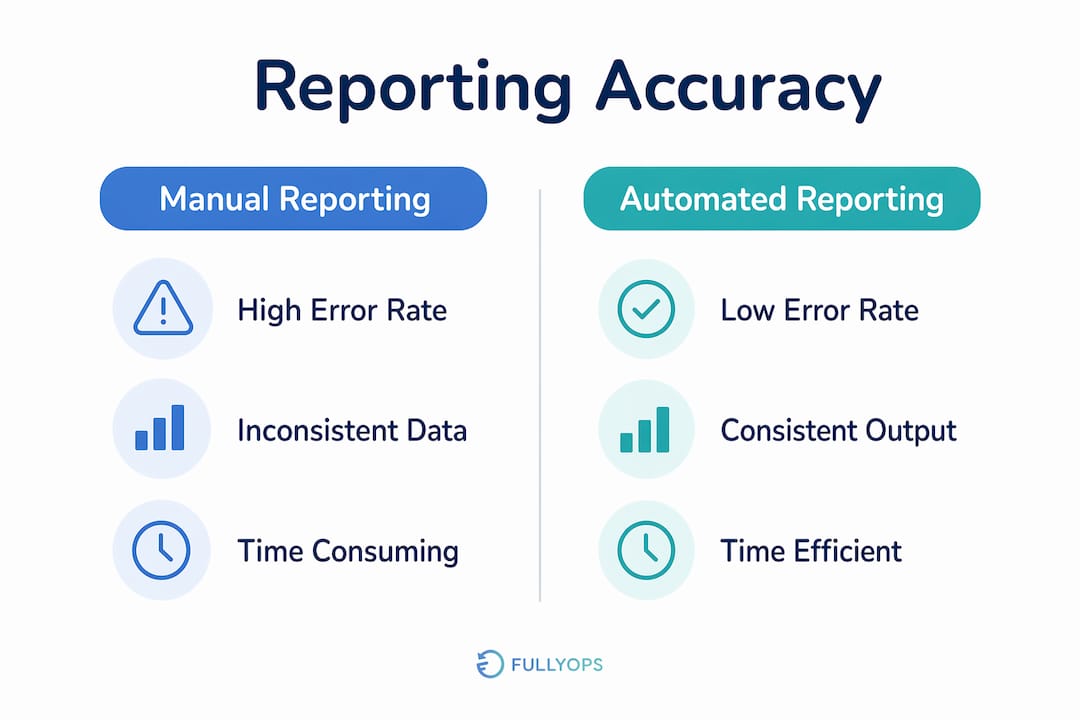
The numbers support this. Companies implementing automated reporting report up to a 90% reduction in data entry errors. That figure reflects the elimination of human transcription from the reporting chain, not just better software. The process itself becomes the control.
Automation creates a repeatable, consistent insight operating model with governed outputs. Every report uses the same layout, the same calculation logic, and the same data definitions. That consistency makes period-on-period comparisons meaningful. When a maintenance KPI changes between months, you can trust the change reflects operational reality rather than a formula that was edited in a spreadsheet.
Conseil de pro : Build automated validation checks into your reporting pipeline from day one. Flag records where values fall outside expected ranges before they reach the final report. This catches upstream data quality issues early, before they distort decisions.
The following table illustrates the practical difference between manual and automated reporting in a maintenance context:
| Factoriser | Manual reporting | Automated reporting |
|---|---|---|
| Error rate | High: transcription and formula errors common | Low: business rules applied consistently |
| Report frequency | Weekly or monthly, constrained by effort | Daily, hourly, or real-time |
| Audit trail | Incomplete: version history often lost | Complete: every output is logged and traceable |
| Consistency | Variable: depends on the individual compiling | Fixed: same logic applied every cycle |
| Time to insight | Hours to days after period close | Near-instant after data is recorded |
A single source of truth is the structural outcome of this approach. When all reports draw from the same governed data layer, disagreements between departments about “which number is correct” disappear. That alone reduces the time operations managers spend in meetings reconciling conflicting figures.
What are the pitfalls of implementing automatic reporting?
The most common implementation failure is automating a broken process. Automating unstandardised processes scales existing data quality issues rather than resolving them. If your work order records are inconsistently categorised or your asset register has duplicate entries, automation will reproduce those problems in every report, faster and at greater volume.
Governance is the discipline that prevents this. Before connecting any automated reporting tool to your source systems, define your business rules explicitly. Which asset categories map to which cost centres? How are incomplete work orders handled? What counts as a completed maintenance intervention? These definitions must exist upstream, not inside the reporting tool.
Teams must shift their focus from fixing spreadsheets to maintaining APIs, data connections, and business rule definitions. This is a genuine role change. The skills required are different, and organisations that do not plan for it find their automated reports drifting out of alignment with operational reality as source systems evolve.
Best practices for a successful implementation include:
- Audit your data sources first. Map every field your reports currently use and confirm it exists, is consistently populated, and is correctly labelled in the source system.
- Start with one report type. Automate your highest-frequency, lowest-complexity report first. Build confidence in the pipeline before adding complexity.
- Document your business rules. Write down every calculation, filter, and aggregation your reports apply. This documentation becomes the specification for your automated system.
- Plan for source system changes. When a source system is updated or replaced, your automated connections need updating too. Assign ownership of this maintenance task.
- Implement early, not perfectly. Implementing automation early, even with imperfect data, is more cost-effective than waiting until scaling forces a crisis overhaul.
For teams managing commercial property inspections or multi-site service contracts, the governance discipline required for automated reporting also improves the underlying data quality that feeds into compliance and client reporting.
How does automatic reporting support maintenance decision-making?
Automatic reporting shifts maintenance management from retrospective review to real-time operational visibility. That shift changes the nature of decisions available to operations managers. Instead of reviewing last week’s failure data, you are acting on this morning’s anomaly before it becomes a breakdown.

Real-time dashboards highlight early issues such as SLA breaches and resource bottlenecks, enabling intervention before major failures occur. For maintenance teams, this means a technician can be redirected to a critical asset before a scheduled inspection window closes, not after a failure has already triggered a work order.
The specific applications for operations and maintenance professionals include:
- Live KPI monitoring. Track mean time between failures (MTBF), mean time to repair (MTTR), and first-time fix rates without waiting for a monthly summary.
- SLA compliance tracking. Automated alerts flag response time breaches as they occur, giving managers the chance to reassign resources before a contractual penalty is triggered.
- Asset utilisation reporting. Identify underused or overloaded assets in real time, supporting better scheduling and resource allocation decisions.
- Predictive maintenance integration. Automated reports feed condition data into predictive maintenance workflows, connecting sensor readings to maintenance schedules without manual data transfer.
- Cost variance tracking. Compare planned versus actual maintenance costs per asset or site on a rolling basis, not just at month end.
The cost impact is substantial. Businesses adopting automated reporting typically see ROI within 6–12 months, driven by an 85% reduction in direct research and data processing costs. For maintenance operations where labour and parts costs are tracked across hundreds of assets, that reduction in reporting overhead translates directly to budget capacity.
Automated reporting also supports efficacité du service sur le terrain by giving field managers accurate, current data on technician location, job status, and parts availability. Decisions that previously required a phone call and a spreadsheet check can be made from a dashboard in seconds.
Pour summer maintenance programmes or seasonal service peaks, automated reporting gives operations managers the visibility to manage demand spikes without adding administrative overhead.
Principaux enseignements
Automatic reporting delivers its highest value when it replaces manual data extraction with governed, real-time pipelines that free operations teams to act on insight rather than produce it.
| Point | Détails |
|---|---|
| Efficiency gains are immediate | Automated reporting accelerates report cycles by up to 80%, reclaiming significant team capacity. |
| Accuracy improves structurally | Consistent business rules reduce data entry errors by up to 90%, creating a reliable single source of truth. |
| Governance must come first | Automating unstandardised processes scales data quality problems; audit and define rules before connecting systems. |
| ROI arrives within the first year | Most organisations recover implementation costs within 6–12 months through reduced processing and personnel time. |
| Real-time visibility changes decisions | Live dashboards enable early intervention on SLA breaches and asset failures, not retrospective review. |
Why I think most teams underestimate the cultural shift
The technical case for automatic reporting is clear. The harder part is what happens to the people who used to compile those reports manually.
In my experience working with asset-intensive operations, the resistance to reporting automation rarely comes from the technology. It comes from the implicit loss of expertise. The person who “knows how the spreadsheet works” has genuine organisational value, and automation appears to threaten that. What it actually does is redirect that expertise toward interpretation, which is where it creates far more value.
The teams that get the most from automated reporting are the ones that reframe the transition explicitly. They tell their analysts and supervisors: your job is no longer to produce the number. Your job is to explain what the number means and what to do about it. That reframing is not automatic. It requires deliberate management.
The other thing I have observed consistently is that organisations wait too long. They want perfect data before they automate. But the act of automating is what surfaces the data quality problems that need fixing. Waiting for perfection before starting means waiting indefinitely. Start with your most frequent report, accept that the first version will need refinement, and iterate. The practical guide to automating service reports from Fullyops is a useful starting point for teams at exactly this stage.
The cultural shift from data collection to strategic analysis is the real return on investment. The cost savings and efficiency gains are real, but the deeper value is an operations team that spends its time on decisions rather than data wrangling.
— Pedro
How Fullyops supports automated reporting in maintenance operations
Fullyops is built for operations managers and maintenance professionals who need reporting automation integrated directly into their asset and work order management workflows. The platform connects work order data, intervention records, technician hours, and asset condition into a single governed reporting layer, eliminating the manual extraction steps that consume team capacity.
For teams looking to move beyond spreadsheets, the Fullyops operations analytics module provides real-time dashboards and automated report scheduling across assets, sites, and technicians. The platform also integrates with predictive maintenance workflows, so condition data feeds directly into reporting without manual transfer. Explore the aperçu des caractéristiques to see how automated reporting fits within the broader asset management and field service capability set.
FAQ
What is automatic reporting in maintenance management?
Automatic reporting is the use of software to collect, process, and distribute maintenance data reports without manual intervention. It replaces manual data extraction and spreadsheet compilation with governed, scheduled, or real-time report generation.
How much time can automatic reporting save?
Automated reporting reclaims up to 40% of time previously spent on manual data tasks, equivalent to 1.6 full-time roles in small teams, and accelerates report creation cycles by up to 80%.
What are the main risks when implementing automatic reporting?
The primary risk is automating processes that are already broken or unstandardised, which scales data quality problems rather than resolving them. Auditing data sources and defining business rules before implementation prevents this.
How quickly do organisations see a return on investment?
Most businesses see ROI within 6–12 months of adoption, driven by reduced data processing costs and recovered personnel time.
Can automatic reporting integrate with predictive maintenance systems?
Automatic reporting feeds condition and performance data directly into predictive maintenance workflows, connecting sensor readings and work order outcomes to maintenance schedules without manual data transfer.
Recommandé
- Rapports de maintenance : Améliorer la fiabilité des actifs CVC
- Reporting dans la gestion des installations : gains d'efficacité 30%
- How to automate service reports: a practical guide