

The 5S methodology is a workplace organisation system built on five Japanese practices that create a safer, cleaner and more efficient work environment. Originating in Japanese manufacturing and now central to Lean management, 5S gives teams a structured way to apply visual control, reduce waste and build the disciplined habits that underpin continuous improvement. For professionals and students working in UK industry, logistics or facilities management, understanding 5S is the starting point for almost every operational improvement programme.
The five steps are:
- Seiri (Sort): remove everything unnecessary from the workspace
- Seiton (Set in order): arrange what remains so it is easy to find and return
- Seiso (Shine): clean the area and use cleaning as an inspection activity
- Seiketsu (Standardise): create consistent rules and visual standards to maintain the first three S’s
- Shitsuke (Sustain): build the habits and discipline to keep the system working every day
Principais conclusões
The 5S methodology delivers lasting operational improvement only when each step is embedded in daily routines, supported by named ownership and measured through regular audits.
| Ponto | Detalhes |
|---|---|
| Start with a contained pilot | Choose a visible, willing team and a defined area before attempting a site-wide roll-out. |
| Red-tag and shadow boards first | These two tools deliver the fastest visible gains and build team confidence in the method. |
| Assign named zone owners | Shared responsibility means no responsibility; each area needs one accountable person. |
| Track audit scores weekly | A simple percentage score, displayed publicly, is the most reliable sustaining mechanism. |
| Connect 5S findings to work orders | Log anomalies found during Seiso as maintenance tasks to close the loop between inspection and repair. |
Índice
- What each ‘S’ means in practice
- Why 5S delivers real business value
- How to implement 5S in a UK organisation
- Common mistakes that derail a 5S programme
- Measuring and sustaining 5S: audits, KPIs and frequencies
- Practical templates: office, warehouse, digital workspace and maintenance shop floor
- Why 5S matters for asset management and maintenance reliability
- When to start 5S and what to realistically expect
- Sources
- FAQ
What each ‘S’ means in practice
Each step has specific actions, visual signals and quick checks that tell you at a glance whether it is working. The table below maps each S to its core actions and the visual cues that confirm compliance.
| S | Core actions | Visual signal that it is working |
|---|---|---|
| Seiri (Sort) | Red-tag items with no clear use; remove or quarantine them | Red-tag area is empty or cleared within the agreed period |
| Seiton (Set in order) | Label storage locations; use shadow boards and floor markings | Every tool has an outline; empty spaces are immediately visible |
| Seiso (Shine) | Clean surfaces, equipment and floors; log defects found during cleaning | Clean-and-inspect log is up to date; no unlogged damage |
| Seiketsu (Standardise) | Write one-page standard operating procedures; post visual checklists | Checklists are displayed and signed off at each shift |
| Shitsuke (Sustain) | Conduct short daily audits; assign ownership; celebrate compliance | Audit scores trend upward over successive weeks |
Seiri: sort and red-tag
Red-tagging is the practical engine of Seiri. Any item whose purpose, quantity or location is unclear gets a red tag attached. Tagged items move to a holding area for a defined period, typically one to two weeks, after which the team decides to keep, relocate or discard each one. On a manufacturing bench this might mean removing obsolete jigs; on an office desk it means clearing out stationery that nobody uses. The US EPA’s Lean guidance describes red-tagging as one of the primary tactics for reducing wasted space and motion.
Seiton: set in order with shadow boards and floor markings
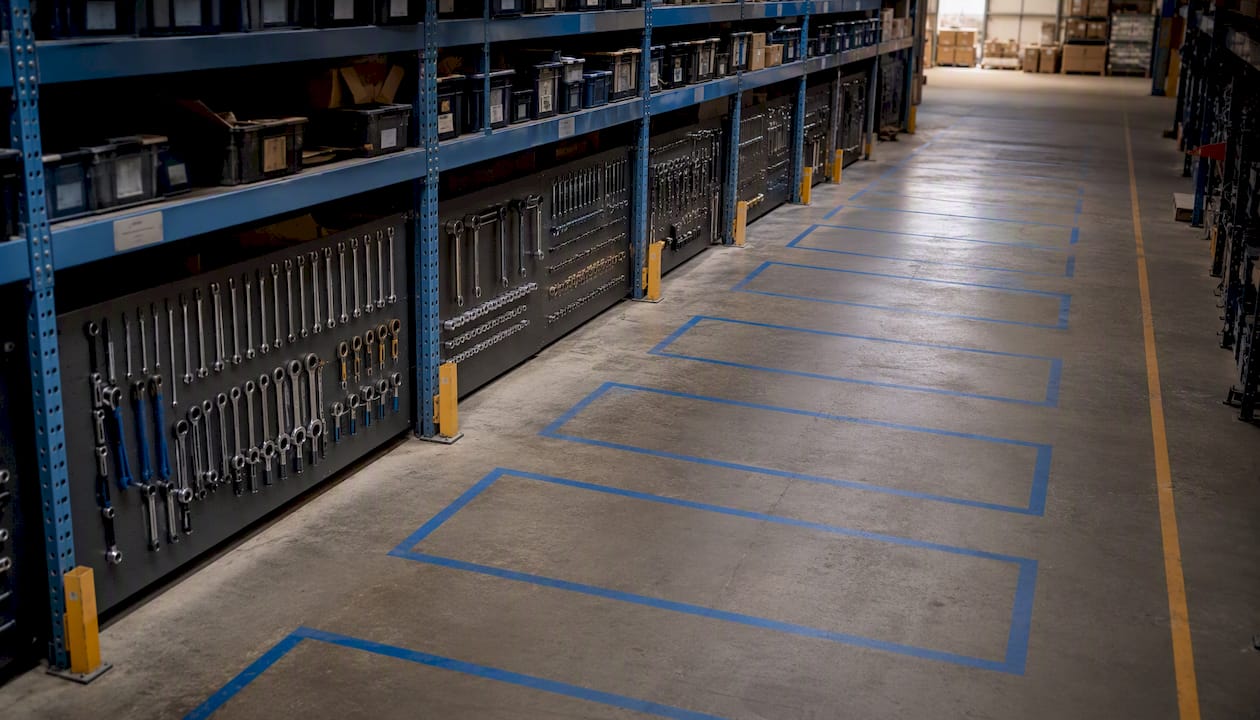
Once only necessary items remain, every item needs a designated place. Shadow boards, where tool outlines are painted or cut into a backing board, make missing tools visible in seconds. Floor tape or painted footprints show exactly where trolleys, bins and equipment belong. In a warehouse, labelled pick locations with maximum and minimum quantity markers serve the same purpose. For a digital folder structure, the equivalent is a clear naming convention and a top-level folder map that every team member follows.
Seiso: shine as inspection
Cleaning is not just housekeeping. When a technician wipes down a machine, they are also looking for oil leaks, loose fasteners and unusual wear. This inspect-while-cleaning habit catches defects early, before they become failures. A simple clean-and-inspect log, posted at the workstation, records what was checked, by whom and when.

Seiketsu: standardise without over-constraining
Wikipedia’s overview of 5S) notes that the modern understanding of Seiketsu emphasises preventing anomalies rather than imposing rigid uniformity. A one-page visual standard, a photo of the correct state, or a colour-coded checklist achieves standardisation without stifling the flexibility that knowledge-work roles need.
Shitsuke: sustain through habit
ASQ’s 5S tutorial is clear that Shitsuke means discipline in the positive sense of habit-forming, not punishment. Teams that own their procedures sustain them; teams that are policed into compliance relapse the moment oversight drops. Short daily five-minute tidy routines, built into shift start or end, are more effective than monthly deep-cleans.
Dica profissional: Attach 5S tasks to existing daily routines rather than scheduling them separately. If the shift already ends with a handover check, add a two-minute visual scan of the 5S standards to that handover. The habit forms faster when it piggybacks on something the team already does.
Why 5S delivers real business value
The gains from a well-run 5S programme fall into four categories, each with direct relevance to operations and maintenance managers:
- Reduced search time: labelled, standardised storage means technicians and operators spend less time hunting for tools, parts or documents
- Fewer defects and errors: a visually ordered workspace makes abnormalities obvious, so quality problems surface earlier
- Improved safety: clear floor markings, tidy aisles and properly stored chemicals reduce trip hazards and non-compliance with UK Health and Safety Executive requirements
- Better morale and first impressions: a clean, organised workplace signals professionalism to visitors, auditors and new staff
5S also acts as the foundation for other Lean methods. Total Productive Maintenance (TPM), Just-in-Time (JIT) and Kaizen all depend on a stable, visually controlled baseline. Without 5S, these methods are harder to sustain because the underlying disorder keeps reasserting itself. ASQ confirms that 5S creates the organised workspace needed to apply broader continuous-improvement programmes effectively.
For maintenance and operations leaders, the business case is straightforward: less time searching, fewer unplanned stoppages and a workspace where problems announce themselves rather than hiding until they cause failures.
How to implement 5S in a UK organisation
A structured roll-out in four phases gives teams a clear path from decision to daily habit.
Phase 1: preparation (weeks 0–2)
- Secure leadership sponsorship and communicate the purpose to all affected staff
- Select the pilot area: choose a contained, visible space with a willing team leader
- Deliver a half-day 5S awareness session covering definitions, the red-tag process and visual standards
- Photograph the current state of the pilot area as a baseline
- Gather materials: red tags, floor tape, label printer, shadow board backing, cleaning supplies
Phase 2: pilot (weeks 2–5)
- Run a red-tag event: the team walks the area and tags every item whose necessity is unclear
- Clear the red-tag holding area within two weeks; document decisions
- Create shadow boards and floor markings for all retained items
- Write a one-page visual standard for the area, including a photograph of the target state
- Measure baseline KPIs: time-to-find a specified tool, number of red-tag items, cleanliness audit score
Phase 3: roll-out (weeks 5–12)
- Train team leaders in adjacent areas using the pilot as a live example
- Cascade the daily five-minute 5S routine across all areas
- Assign a named owner for each zone’s audit
- Schedule weekly team-leader audits and a monthly management review
- Post visual scoreboards showing audit scores by area
Phase 4: sustain (ongoing)
- Fold 5S checks into standard work instructions and maintenance procedures
- Review and update visual standards when processes change
- Celebrate improvements publicly; address relapses promptly without blame
Dica profissional: The pilot area is your most powerful training tool. Before rolling out to the whole site, invite other team leaders to walk the completed pilot with the person who led it. Seeing a real before-and-after in their own workplace is more persuasive than any slide deck.
The indicative timeline and cost considerations for a typical UK SME are shown below.
| Phase | Weeks | Typical cost drivers |
|---|---|---|
| Preparation | 0–2 | Staff time for training; materials budget for labels and tape |
| Pilot | 2–5 | Shadow board fabrication; team time for red-tag event |
| Roll-out | 5–12 | Trainer time; additional visual management materials per area |
| Sustain | Ongoing | Audit time (typically 15 minutes per area per week) |
For UK workplaces, two additional considerations apply. First, consult with any recognised trade unions before introducing new monitoring or audit processes, as transparency about the purpose of 5S audits avoids misunderstanding. Second, align 5S standards with existing Health and Safety Executive requirements for workplace organisation, particularly around storage of hazardous materials and emergency access routes.
Common mistakes that derail a 5S programme
Even well-intentioned 5S drives fail. The failure modes are predictable, and most are avoidable.
- Treating 5S as a one-off clean-up: the most common mistake. Teams tidy up for an audit, then revert. ASQ’s guidance is explicit that Shitsuke requires ongoing habit formation, not periodic campaigns.
- No named ownership: when everyone is responsible, no one is. Each zone needs a named owner whose role includes the daily check.
- Poor communication of purpose: staff who see 5S as surveillance rather than a tool for their own benefit will resist it. Explain what is in it for them: less time searching, a safer workspace, fewer frustrations.
- Over-standardising creative or knowledge-work areas: applying rigid visual standards to a design studio or software development team can harm the flexibility those roles need. Adapt the level of standardisation to the work.
- Skipping the measurement baseline: without a before measurement, you cannot demonstrate progress, which makes it harder to sustain leadership support.
Red flags during audits include: checklists that are signed but not dated, shadow boards with tools consistently missing, and red-tag areas that are never cleared. Each signals a specific governance gap rather than a general failure of effort.
Measuring and sustaining 5S: audits, KPIs and frequencies
Measurement turns 5S from a one-time event into a continuous system. The following KPIs give a balanced view of progress:
- Time-to-find: how long it takes a new team member to locate a specified tool or document; a direct measure of Seiton effectiveness
- Red-tag count: the number of items tagged in each audit cycle; a declining trend shows Seiri is holding
- Audit score: a percentage score from a standardised checklist, tracked weekly per zone
- Incident rate: near-misses and minor injuries in the area; a lagging indicator of safety improvement
- Defects caught during Seiso: the number of equipment anomalies found during cleaning inspections
A structured audit programme with visual scoreboards and frequent short checks is the most reliable way to sustain 5S gains. The US EPA’s Lean guidance recommends scheduled short routines and checklists as the primary sustaining tools.
The table below maps activity to recommended cadence and ownership.
| Activity | Cadence | Owner |
|---|---|---|
| Five-minute visual tidy and check | Daily | Operator / technician |
| Zone audit against checklist | Semanal | Team leader |
| Cross-area audit with scoring | Mensal | Operations manager or 5S coordinator |
| Management review of trend data | Mensal | Site or department manager |
| Full 5S reassessment | Annually | Cross-functional team |
Audit scores should be displayed publicly, by area, so teams can see their own progress and compare with peers.
Practical templates: office, warehouse, digital workspace and maintenance shop floor
Physical area checklist template
A basic 5S audit checklist for a physical zone should include the following fields:
- Area name and zone reference
- Date and auditor name
- For each S: a scored item (0 = not done, 1 = partially done, 2 = fully done), a comments field and a red-tag column for items requiring action
- Total score and percentage
- Owner sign-off and target date for any actions
Before-and-after example: a maintenance workshop
A maintenance workshop at a UK manufacturing site had tools stored in unlabelled drawers across three benches. Technicians reported spending an average of several minutes per job locating the correct spanner or calibration tool. After a two-day 5S event, the team installed shadow boards above each bench, labelled every drawer with its contents, and applied floor tape to mark the trolley park. Within weeks, the team leader reported that tool-search time had dropped noticeably and that damaged tools, previously hidden in a drawer, had been identified and replaced. The clean-and-inspect routine also surfaced a slow hydraulic leak on a press that had gone unnoticed for months.
Digital 5S
The same principles apply to shared drives, email inboxes and project management boards. Universal Robots’ implementation guide describes digital 5S as reducing redundancy, creating a clear folder structure and applying consistent naming conventions to produce visual order in digital environments. Practical steps include:
- Delete or archive files not accessed in the past 12 months (Sort)
- Create a standardised top-level folder structure shared across the team (Set in order)
- Schedule a monthly review of the shared drive for orphaned files (Shine)
- Document and post the naming convention where everyone can see it (Standardise)
- Assign a named owner for each shared folder to maintain the structure (Sustain)
Maintenance-specific checklist
| 5S step | Maintenance task | Asset reliability link |
|---|---|---|
| Sort | Remove obsolete spare parts and expired consumables | Reduces risk of using incorrect parts |
| Set in order | Label spares with part number, asset reference and reorder point | Speeds parts retrieval; supports controle de inventário |
| Shine | Clean equipment during planned maintenance; log anomalies found | Enables early detection of wear and leaks |
| Standardise | Post one-page maintenance visual standards at each asset | Ensures consistent procedure regardless of technician |
| Sustain | Include 5S check in every planned maintenance work order | Embeds 5S into the maintenance cycle |
Why 5S matters for asset management and maintenance reliability
5S is not just a housekeeping exercise for maintenance teams. It is a prerequisite for stable, reliable asset management. The Lean Enterprise Institute notes that 5S creates the visual baseline that makes equipment anomalies detectable before they cause failures, directly reducing mean time to repair and supporting proactive maintenance.
The connection is practical. When spare parts are labelled, stored in designated locations and linked to specific assets, a technician arriving for a repair knows immediately whether the correct part is available. Shadow boards in a workshop show at a glance which tools are in use and which are missing. A clean machine surface makes an oil leak or a cracked seal visible during the next inspection rather than during an unplanned breakdown.
- Faster diagnosis: a visually ordered workspace reduces the cognitive load on technicians, letting them focus on the fault rather than the search
- Proactive maintenance triggers: anomalies found during Seiso cleaning inspections can be logged directly as ordens de serviço, ensuring nothing is forgotten
- Audit-to-action pipeline: 5S audit findings map naturally to corrective and preventive maintenance tasks in a computerised maintenance management system (CMMS)
Fullyops supports this integration directly. Work orders raised from 5S audit findings can be tracked, assigned and closed within the platform, giving maintenance managers real-time visibility of outstanding actions. This turns the 5S audit from a paper exercise into a live input to the maintenance schedule.
For operations managers considering sistemas de gestão de ativos, 5S provides the physical and procedural foundation that makes digital tools work as intended. A CMMS is most effective when the physical environment it monitors is already organised and visually controlled.
When to start 5S and what to realistically expect
The best time to start a 5S pilot is when a team has a visible, contained problem: a workshop where tools are consistently lost, a stores area where parts are regularly ordered twice because nobody can find the first batch, or an office where shared documents are duplicated across three different folders. These are the conditions where 5S delivers a quick, visible win that builds the credibility needed for a wider roll-out.
Realistic expectations matter. At six weeks, a well-run pilot should show a cleaner, visually organised area, a completed shadow board or labelled storage system, and an initial audit score. The team will still be forming habits, and there will be relapses. At three months, audit scores should be trending upward, the daily five-minute routine should feel normal rather than effortful, and at least one defect or safety issue should have been caught through the Seiso inspection habit. At six months, the question shifts from “are we doing 5S?” to “how do we improve our scores and extend the system to the next area?”
The temptation to rush the roll-out is real, particularly when senior managers see the pilot results and want the whole site transformed immediately. Resist it. A pilot that runs for three months and produces a genuinely self-sustaining area is worth more than a site-wide roll-out that collapses after the initial enthusiasm fades. Depth before breadth is the principle that separates organisations that sustain 5S from those that repeat the same launch every two years.
Sources
- 5S – What is it? | Lean Enterprise Institute
- What are the Five S’s (5S) of Lean
- Lean Thinking and Methods – 5S | US EPA
- 5S: ¿qué es, cómo funciona y cómo aplicar la metodología?
FAQ
What is the 5S methodology in simple terms?
5S is a five-step workplace organisation method from Japan: Sort, Set in order, Shine, Standardise and Sustain. Each step builds on the last to create a visually controlled, efficient and safe work environment.
How do you apply 5S in a company?
Start with a contained pilot area, run a red-tag event to remove unnecessary items, install visual storage systems, write a one-page standard and assign a named owner for daily checks. Roll out to other areas once the pilot is self-sustaining.
What does Seiso mean in 5S?
Seiso means “Shine” and refers to cleaning the workspace as an inspection activity. Technicians and operators clean equipment and surfaces while actively looking for defects, leaks or damage, so problems are caught early.
Can 5S be applied outside a factory?
Yes. The same principles apply to offices, warehouses, digital shared drives and field service environments. The tools change (folder structures and naming conventions instead of shadow boards) but the logic of Sort, Set in order, Shine, Standardise and Sustain remains identical.
What is the most important S to sustain long-term results?
Shitsuke (Sustain) is the most critical, because without it the gains from the first four steps erode. As ASQ notes, Shitsuke is about forming positive habits rather than enforcing compliance, which is why embedding 5S tasks into existing daily routines is more effective than scheduling them separately.
Recomendado
- Industrial operations improvement tips for UK manufacturers 2026
- Como ultrapassar os desafios da adoção da Manutenção Preventiva: Um processo em cinco etapas - FullyOps
- Ways to improve operational efficiency: 2026 guide
- Performance benchmarking: a practical guide for managers