

Operational chaos often surfaces when asset failures, maintenance gaps, and unclear costs collide. For operations managers running HVAC systems in commercial spaces across the United States, Canada, Europe, and Asia, transforming scattered observations into structured knowledge is vital. Effective reporting provides the foundation for intelligent asset lifecycle management, creating visibility and accountability where it matters most. By focusing on systematic data gathering and communication, you gain the clarity needed to make proactive decisions that elevate efficiency and reliability.
Table of Contents
- Defining Reporting In Asset Management
- Common Reporting Types And Key Metrics
- How Reporting Powers Decision-Making
- Compliance, Risks And Best Practice Challenges
- Maximising HVAC Efficiencies Through Reporting
Key Takeaways
| Point | Details |
|---|---|
| Reporting is Essential | Proper reporting transforms field data into actionable intelligence, supporting informed decision-making in asset management. |
| Types of Reporting Matter | Different reporting types (performance, compliance, cost, risk) are crucial for various stakeholders and support targeted management strategies. |
| Data-Driven Decisions | Reliable reporting aids in proactive maintenance and capital planning, allowing managers to anticipate issues rather than react to emergencies. |
| Compliance is Non-Negotiable | Meeting regulatory requirements through systematic reporting is imperative to avoid penalties and ensure operational integrity. |
Defining Reporting in Asset Management
Reporting in asset management is the systematic process of gathering, analysing, and communicating data about your equipment’s condition, performance, and operational history. For HVAC operations managers, this means capturing real-time information from every technician visit, maintenance intervention, and equipment inspection.
The core purpose is straightforward: transform raw field data into actionable intelligence that shapes your decisions. When technicians document repairs, note equipment behaviour, and record replacement parts, they’re creating the foundation for intelligent asset management.
What reporting actually captures:
- Equipment performance metrics (efficiency ratings, runtime hours, failure patterns)
- Maintenance history and costs associated with each asset
- Predictive indicators that signal upcoming failures
- Compliance documentation for regulatory requirements
- Cost trends that reveal which assets drain your budget
Understanding asset management and its impact on maintenance efficiency helps you see reporting as more than paperwork. Systematic data gathering and communication about asset conditions and performance supports strategic planning and maintains accountability across your operations.
In HVAC work, reporting transforms scattered observations into structured knowledge. One technician notes a compressor running hot; another logs reduced cooling capacity weeks later. Without reporting, these signals stay isolated. With proper reporting, you connect the dots and identify the problem before the unit fails completely.
Why this matters for your operation:
Reporting creates visibility where chaos once existed. You move from reactive crisis management to planned interventions. Instead of discovering a critical failure when a customer calls angry, you spot warning signs and schedule maintenance proactively.
The data you collect tells a story about each asset’s true cost of ownership. Some equipment consistently outperforms expectations; others burn money through constant repairs. Reporting reveals which assets deserve investment and which ones you should replace.
Reporting is the bridge between field operations and strategic decisions. Without it, you’re flying blind.
Your technicians are already collecting this information during service calls. The question is whether that knowledge stays locked in their heads or flows into a system where it actually drives decisions.
Pro tip: Start by capturing three essential data points from every service visit: what failed or needed attention, what you replaced or repaired, and how long the job took. These basics form the foundation for all downstream analysis and improvement.
Common Reporting Types and Key Metrics
Not all reports serve the same purpose. Your HVAC operation needs different reporting types depending on whether you’re tracking equipment health, managing budgets, or planning replacements. Understanding which metrics matter for each decision keeps you focused on actionable data.
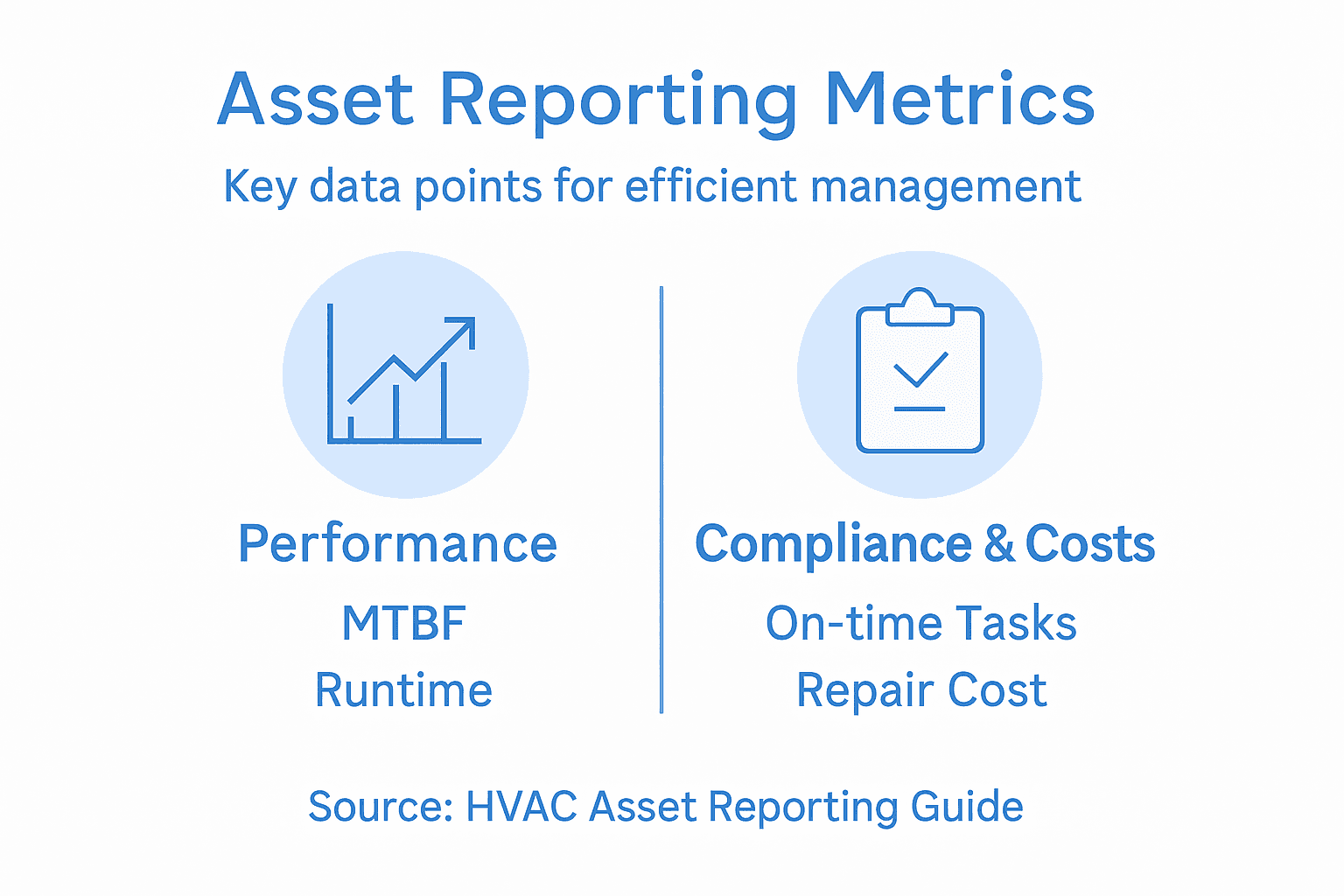
Performance reporting tracks how your equipment actually behaves in the field. This includes efficiency ratings, runtime hours, and failure frequencies. When a chiller consistently underperforms compared to identical units, performance reporting reveals the trend before catastrophic failure occurs.
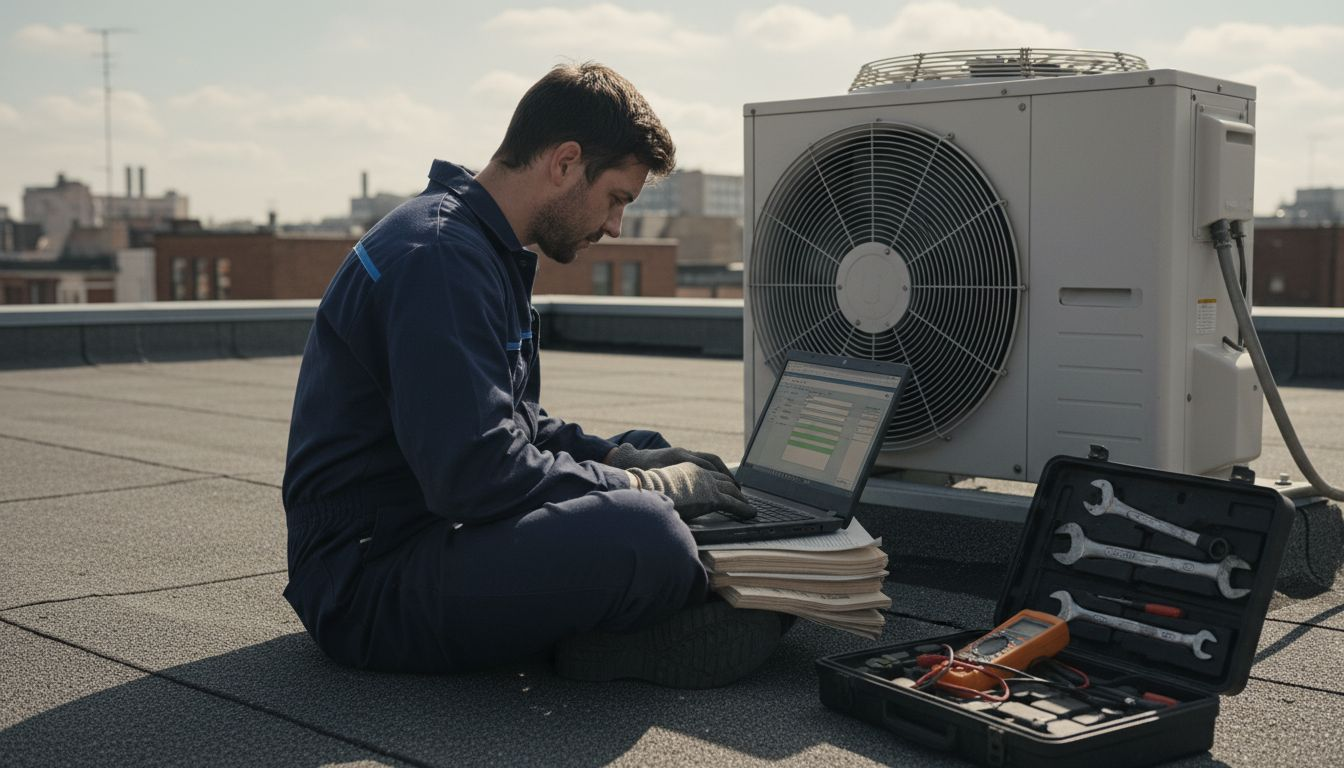
Maintenance compliance reporting documents whether your preventive schedules are happening on time. This covers filter changes, inspections, refrigerant checks, and seasonal preparations. Compliance gaps directly predict future emergency calls and warranty claim denials.
Cost reporting shows you money flowing through your assets. Labour costs per repair, replacement parts spending, and total cost of ownership by equipment type. This transforms abstract maintenance budgets into concrete, comparable data.
Risk and condition reporting identifies assets approaching failure. Key metrics like cost estimates and schedule adherence support leadership decisions about maintenance interventions and capital equipment planning.
Each reporting type answers a specific question:
- Performance: Is this unit working as designed?
- Compliance: Are we following our maintenance plan?
- Cost: Which assets are expensive to maintain?
- Risk: Which equipment needs attention next?
Critical metrics for HVAC operations:
- Mean Time Between Failures (MTBF): How reliable is this equipment?
- Mean Time To Repair (MTTR): How quickly can technicians restore service?
- Cost Per Operating Hour: What does this asset truly cost to run?
- Preventive Maintenance Completion Rate: Are we staying ahead of problems?
- Equipment Age vs. Reliability Trend: When should we replace versus repair?
Different stakeholders need different metrics. Your technicians care about job duration and part availability. Finance cares about cost trends and replacement timelines. Operations cares about uptime and compliance. One reporting system feeds all three audiences with their specific data.
The metric that matters most is the one that answers your immediate decision. Choose metrics aligned with the choices you actually need to make.
Most HVAC companies start by tracking only failures and costs. This is reactive. Once you add performance and compliance metrics, you shift to proactive management. You see patterns. You spot weak assets early. You plan strategically instead of scrambling.
Pro tip: Start with five core metrics: equipment failure count, maintenance cost per unit, compliance percentage, average repair time, and equipment age. Build your reporting system around these five, then expand as your data literacy grows.
For quick reference, here’s how essential HVAC reporting metrics connect to business objectives:
| Metric | Decision Supported | Example Use Case |
|---|---|---|
| Mean Time Between Failures (MTBF) | Asset reliability evaluation | Decide replacement vs service |
| Maintenance Cost Per Unit | Budget optimisation | Identify cost-saving opportunities |
| Compliance Percentage | Regulatory audit readiness | Prove scheduled maintenance completion |
| Average Repair Time (MTTR) | Resource allocation | Allocate technician workload |
| Equipment Age | Capital planning | Plan asset lifecycle replacements |
Here’s a comparison of reporting types and their strategic impact for HVAC operations:
| Reporting Type | Primary Purpose | Typical Stakeholder | Strategic Impact |
|---|---|---|---|
| Performance Reporting | Track operational behaviour | Operations managers | Identifies underperforming equipment |
| Compliance Reporting | Evidence of regulation adherence | Regulatory authorities | Avoids fines and warranty disputes |
| Cost Reporting | Analyse expenditure trends | Finance teams | Guides budgeting and replacement plans |
| Risk Reporting | Predict equipment failures | Leadership | Enables proactive maintenance decisions |
How Reporting Powers Decision-Making
Reporting doesn’t just document what happened. It shapes what happens next. When you have access to reliable, timely data about your assets, you make fundamentally different choices than when you’re guessing based on memory and intuition.
Consider a simple scenario: your facilities manager asks whether you should repair or replace a five-year-old rooftop unit. Without reporting, you debate opinions. One technician says it’s still good; another worries about compressor stress. With reporting, you pull actual data: failure frequency over 18 months, repair costs compared to replacement price, efficiency decline measured against nameplate specs. The decision becomes clear.
Quality reporting enables better resource allocation and improves investment efficiency by reducing uncertainty. You know which assets deserve capital investment and which ones are nearing the end of their useful life.
Reporting powers four critical decisions:
- Capital budgeting: Which equipment replacements should we fund this year?
- Maintenance strategy: Should this unit get preventive service or corrective repair?
- Resource allocation: Where should technicians focus their time and skills?
- Risk management: Which assets pose the greatest reliability or safety risk?
Timely and relevant information supports decision-making, planning, and control through budgeting, forecasting, and variance analysis. When your compressor fails unexpectedly, reporting shows whether this was truly unpredictable or whether warning signs existed for months that you missed.
The difference between reactive and strategic management comes down to information availability. A manager working without reporting data reacts to emergencies. A manager with solid reporting anticipates problems, schedules interventions during convenient windows, and plans capital expenditure strategically.
Reporting also reveals hidden patterns that intuition misses. You might think Unit A and Unit B are identical, so they should cost the same to maintain. Reporting shows Unit B actually costs 34% more annually due to earlier maintenance schedules, higher failure rates, or less efficient operation. This triggers investigation into why the performance gap exists and whether Unit A’s setup or maintenance approach could be replicated elsewhere.
Data transforms gut feelings into defensible decisions. Your operations team moves from “I think we should replace this” to “The data shows we should replace this.”
When budget cuts arrive, reporting saves you from making painful cuts to profitable or essential areas. You cut costs where data shows the highest waste, protecting investments in equipment that performs reliably.
Pro tip: Create a monthly dashboard showing your five most important metrics trended over the past 12 months. Review it before any major maintenance or capital decision. This habit transforms reporting from background paperwork into active decision support.
Compliance, Risks and Best Practice Challenges
Compliance in asset management reporting isn’t optional. Your HVAC operations must meet regulatory requirements, industry standards, and contractual obligations. Yet many organisations struggle to balance compliance demands with operational reality.
Regulatory frameworks vary by jurisdiction and customer type. Building codes mandate certain maintenance records. Environmental regulations require refrigerant documentation. Service contracts demand proof of preventive maintenance completion. Each requirement creates reporting obligations that must be met systematically or you face penalties, warranty denials, and liability exposure.
Common compliance pressures facing HVAC operations:
- Equipment certification and equipment replacement documentation
- Preventive maintenance scheduling and completion proof
- Refrigerant handling and disposal records
- Safety inspection certifications and technician qualifications
- Customer communication and service history transparency
Establishing effective policies and ensuring function independence support compliance best practices while adapting to dynamic risk profiles. Your reporting systems must capture evidence that you followed these policies consistently.
Beyond compliance, reporting must address operational risks. Compliance risk ranks among top near-term concerns alongside regulatory and cybersecurity risks. When reporting systems fail silently, you discover problems too late. A technician forgets to log a maintenance visit. Months later, equipment fails. The customer demands to know why your preventive schedule wasn’t followed. Your records don’t support your defence.
Best practice challenges you’ll face:
-
Data consistency: Different technicians document the same work differently. One logs “compressor serviced”; another logs “oil change, filter replacement, performance test.” Without standardised data fields, your reports become unreliable.
-
Real-time documentation: Technicians completing work at 8 p.m. promise to document everything “tomorrow.” By then, details fade. Hours get rounded. Critical observations vanish.
-
System integration: Your compliance records live in one system, cost tracking in another, scheduling in a third. When systems don’t communicate, you can’t answer basic questions like “total cost for Unit X over three years.”
-
Audit readiness: Compliance audits come without warning. If your reporting system requires hours of manual compilation to answer simple questions, you’re unprepared.
Compliance reporting must be automatic, not heroic. If meeting audit requirements requires special effort outside normal operations, your system has failed.
The best practices challenge isn’t understanding what compliance requires. It’s building reporting routines into daily work so compliance happens naturally, not as an afterthought.
Third-party risks add complexity. Subcontractors, suppliers, and equipment manufacturers all touch your assets. When they don’t provide data in your required format, compliance gaps appear.
Pro tip: Audit your current reporting system against your three biggest compliance obligations. Identify exactly what evidence each obligation requires. Then confirm your system automatically captures and preserves that evidence without extra steps from technicians.
Maximising HVAC Efficiencies Through Reporting
Energy consumption dominates HVAC operating costs. Every percentage point of efficiency gain flows directly to your bottom line. Yet most HVAC operations miss opportunities because they lack visibility into how equipment actually performs during real operation.
Reporting transforms HVAC efficiency from a theoretical specification into a measurable, manageable reality. When you capture performance data systematically, you identify where energy disappears and where you can reclaim it.
Consider a chiller serving a commercial building. The nameplate says it operates at specific efficiency ratings under design conditions. But actual conditions vary constantly. Occupancy changes. Outdoor temperatures shift. Building use patterns differ from design assumptions. Without reporting, you never know whether your chiller operates efficiently in your actual environment.
Reporting on HVAC system performance including control system data empowers operators to identify faults and optimise schedules for energy-saving improvements. When you collect temperature, pressure, and runtime data, you spot inefficiencies that invisible operation would hide.
How reporting drives efficiency gains:
- Scheduling optimisation: Data reveals when equipment runs unnecessarily, allowing adjustment to occupancy patterns
- Fault detection: Gradual performance decline appears in trending data before catastrophic failure
- Load matching: Report data shows whether equipment is oversized, undersized, or correctly matched to demand
- Maintenance timing: You schedule maintenance when data indicates approaching problems, not after failure occurs
- Control tuning: Performance reports guide adjustments to setpoints, cycling logic, and valve positioning
Integrating occupancy and CO₂ sensing data into advanced reporting enables demand-controlled ventilation systems to optimise airflow dynamically, reducing energy consumption by 10-30% whilst maintaining indoor air quality. This represents genuine efficiency opportunity hiding in most conventional systems.
Many HVAC operations underutilise the data their equipment already generates. Modern equipment has sensors tracking temperature, pressure, runtime, and fault codes. That data flows through building management systems but never reaches an operations manager’s attention. Without structured reporting, you lose it.
Efficiency reporting reveals specific problems:
A rooftop unit shows 12% lower cooling output than last season at identical outdoor temperatures. This triggers investigation: coil fouling, refrigerant leak, compressor wear. You address the problem before performance degrades further.
Boiler fuel consumption trends upward each month despite constant building load. This indicates scaling, combustion adjustment drift, or control malfunction. Reporting caught it early instead of waiting for failed heating season.
Efficiency lives in the details. Reporting brings those details into view where action becomes possible.
Capital planning improves dramatically with efficiency data. Instead of replacing equipment on age schedules, you replace based on actual degradation trends. Equipment performing well at year ten stays. Equipment declining at year four gets replaced. You invest capital where efficiency truly improves.
Pro tip: Establish a baseline for your three largest HVAC units by recording their energy consumption and output over a full month of typical operation. Then track these metrics monthly. Any trend deterioration of 5% or more triggers investigation and corrective action before inefficiency becomes your permanent operating reality.
Unlock the Power of Reporting for Asset Management Success
The article highlights a common challenge in asset management: transforming scattered, inconsistent data into clear, actionable insights. Many organisations struggle with unreliable reporting, incomplete documentation, and disconnected systems that prevent strategic decision-making around equipment performance, compliance, and costs. If you recognise the frustration of flying blind without visibility into your assets or wrestling with manual, error-prone reports, know that you are not alone. FullyOps addresses these pain points head-on by delivering an intelligent SaaS platform designed to streamline data collection, unify maintenance records, and automate comprehensive reporting across your operation.
By embracing FullyOps, you empower your technicians, back-office teams, and managers with real-time oversight and standardised workflows. The platform bridges the gap between field operations and strategic leadership with modules tailored to capture essential metrics like Mean Time Between Failures, maintenance compliance, and cost analysis. This creates the foundation for proactive maintenance, improved resource allocation, and confident capital planning as discussed in the article.
Discover how our solutions can eliminate chaotic paperwork and transform reporting into your strongest asset. Don’t wait for costly failures to force your hand. Take control now with FullyOps and experience the difference a smart reporting system makes. Start optimising your asset management today by exploring our digital asset management tools that help you move from reactive fixes to strategic success.
Frequently Asked Questions
What is the purpose of reporting in asset management?
Reporting in asset management serves to gather, analyse, and communicate data about the condition and performance of assets. It transforms real-time field data from technicians into actionable intelligence that informs decision-making and enhances operational efficiency.
What key metrics should be tracked in HVAC performance reporting?
Key metrics for HVAC performance reporting include Mean Time Between Failures (MTBF), Mean Time To Repair (MTTR), Cost Per Operating Hour, Preventive Maintenance Completion Rate, and the Equipment Age vs. Reliability Trend. These metrics aid in evaluating asset reliability, budget allocation, and maintenance compliance.
How does reporting improve decision-making in HVAC operations?
Reporting provides reliable, timely data that shapes asset management decisions. By analysing reporting data, operators can make informed choices regarding repair or replacement, maintenance strategies, and resource allocation, ultimately leading to improved efficiency and reduced costs.
What are the common challenges faced in compliance reporting for HVAC operations?
Common challenges in compliance reporting include data consistency, real-time documentation, system integration, and audit readiness. Ensuring that reporting protocols are standardised and that all compliance documentation is automatically captured is crucial to meeting regulatory obligations.
Recommended
- Role of Data Collection in Transforming Asset Management
- Asset Lifecycle Management – FullyOps
- What Is Asset Management and Its Impact on Maintenance Efficiency
- Why Automate Asset Tracking for Field Service Success