

TL;DR:
- A CMMS manages maintenance work orders and parts inventory, primarily serving maintenance teams. An EAM covers the full asset lifecycle and supports finance, procurement, and organizational accountability. The choice depends on organizational size, strategic asset planning, and readiness for digital transformation.
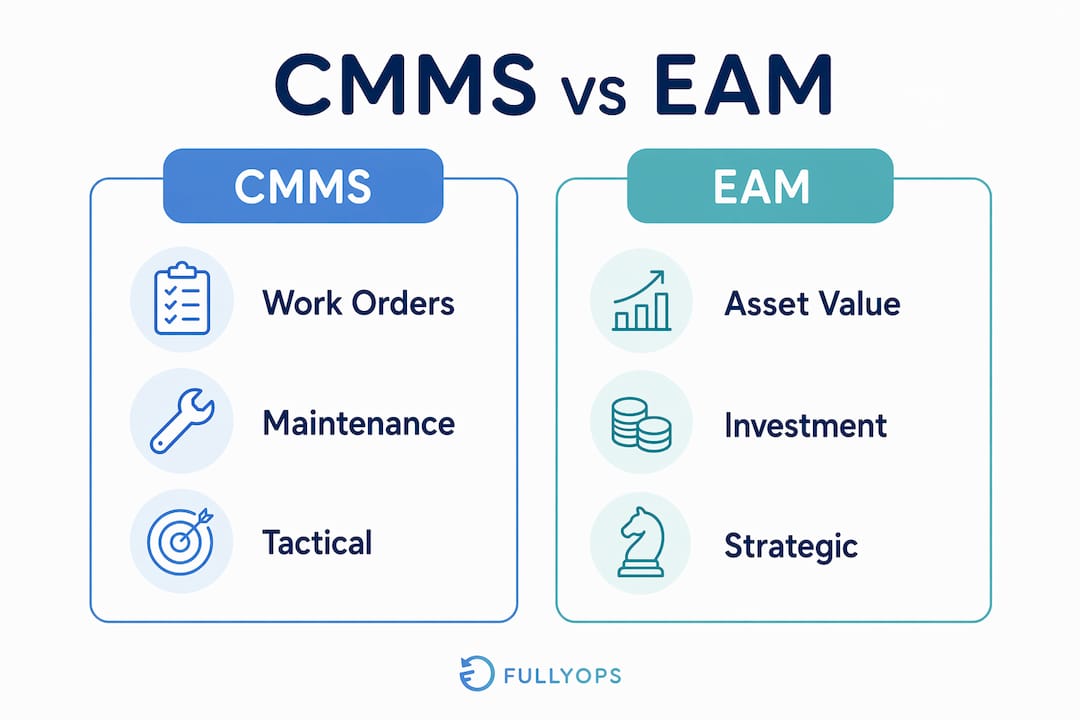
A Computerised Maintenance Management System (CMMS) is defined as software that manages maintenance work orders, scheduling, and parts inventory. An Enterprise Asset Management (EAM) system extends that scope to cover the full asset lifecycle, including procurement, capital planning, depreciation, compliance, and disposal. The difference between CMMS and EAM comes down to this: CMMS serves maintenance teams executing daily repairs, while EAM serves entire organisations managing assets as financial investments. Tools like MaintainX represent the CMMS category, while IBM Maximo is the benchmark EAM platform. CMMS deployments typically complete in 2–12 weeks; EAM projects run 6–24 months.
What are the key functional differences between CMMS and EAM?
CMMS covers the operational layer of maintenance management. Its core modules include work order creation and tracking, preventive maintenance scheduling, spare parts inventory, and technician workflows. A facility manager at a single manufacturing plant uses a CMMS to log a broken conveyor belt, assign a technician, and track parts consumption. The system answers one question: is the asset running?
EAM answers a different question: what is this asset worth over its entire life, and how should the organisation invest in it? EAM extends CMMS functionality by adding procurement workflows, asset depreciation tracking, capital expenditure planning, regulatory compliance reporting, and end-of-life disposal management. Finance and procurement teams use EAM data alongside maintenance teams, which is a fundamental difference in user base.
The table below summarises the functional split clearly.
| Feature | CMMS | EAM |
|---|---|---|
| Work order management | Yes | Yes |
| Preventive maintenance scheduling | Yes | Yes |
| Parts and inventory tracking | Yes | Yes |
| Asset depreciation and financials | No | Yes |
| Procurement and purchasing | No | Yes |
| Capital planning and budgeting | No | Yes |
| Compliance and audit reporting | Limited | Yes |
| End-of-life and disposal management | No | Yes |
| Multi-department user access | Maintenance only | Maintenance, Finance, Procurement, IT |
CMMS is purpose-built for speed and simplicity at the maintenance layer. EAM is built for visibility and accountability across the whole organisation. Choosing the wrong one creates gaps: a CMMS cannot produce the depreciation schedules a CFO needs, and an EAM without proper configuration buries a technician in approval workflows before they can raise a work order.
Pro Tip: Before evaluating any software, list every department that will need to act on asset data. If the list goes beyond maintenance, EAM is worth serious consideration.
How do scale and organisational roles influence CMMS vs EAM selection?
Single-site and mid-market plants generally require CMMS; large multi-site enterprises with complex capital portfolios require EAM. Scale is the most reliable first filter when choosing between the two systems. A regional food manufacturer with one production facility and a maintenance team of eight has no practical use for EAM’s capital planning modules. A utility company managing hundreds of substations across multiple regions cannot function without them.

Organisational accountability is the second filter. EAM shifts asset accountability from the maintenance department to finance and procurement. This is not a software feature. It is a cultural and structural change. Asset records become financial records. Procurement decisions require cross-departmental sign-off. Maintenance teams lose some autonomy over work order approval in exchange for greater organisational visibility.
Choosing EAM when only CMMS functionality is needed risks feature-creep and loss of tactical responsiveness. Maintenance teams get buried in modules they do not use, and the software becomes a liability rather than a tool. The reverse is equally damaging: a CMMS cannot support the compliance and capital reporting that regulators and boards require from large enterprises.
Use these questions to guide your selection:
- How many sites does your organisation manage?
- Does your finance team need direct access to asset cost data?
- Do you track asset depreciation for accounting purposes?
- Is regulatory compliance reporting a formal requirement?
- What is your asset strategy horizon: 2–3 years or 5–10 years?
- How mature is your current maintenance data and digital infrastructure?
CMMS suits a 2–3 year asset strategy horizon, while EAM delivers its full value over a 5–10 year lifecycle optimisation programme. If your organisation is still building its maintenance data foundation, starting with CMMS and migrating later is a legitimate and often wiser path.
Pro Tip: Map your asset accountability structure before selecting software. If your CFO cannot currently answer “what did we spend on Asset X last year?”, your organisation may not be ready for EAM regardless of its size.
What are the differences in implementation timelines and challenges?
CMMS and EAM differ sharply in deployment complexity. CMMS rollouts typically complete in 2–12 weeks, covering data import, user setup, and basic workflow configuration. A maintenance manager can often lead the project without dedicated IT support. EAM projects run 6–24 months and require structured programme management.
EAM implementation challenges fall into four distinct areas:
- Data migration. EAM requires clean, structured asset data including purchase dates, depreciation values, warranty records, and maintenance histories. Most organisations discover their data is incomplete or inconsistent when they begin this process.
- Cross-departmental coordination. EAM implementations involve IT, Finance, Procurement, and Maintenance working in parallel. Aligning four departments on data standards, approval workflows, and system access takes time and governance.
- Change management. Maintenance teams accustomed to raising work orders directly face new approval chains under EAM. Without proper training and communication, resistance is common and productivity drops during the transition period.
- Workflow configuration. Poorly configured EAM workflows create bureaucratic bottlenecks that slow maintenance response times. A work order that previously took minutes to raise can require multiple approval steps if the system is not set up correctly.
Data ownership conflicts are a specific risk when maintenance teams lose direct control over work orders and procurement flows to finance or IT. This bottleneck is not inevitable, but it requires deliberate workflow design to avoid. Organisations that underestimate this risk typically see a dip in maintenance performance in the first six months after EAM go-live.
How do CMMS and EAM each support maintenance efficiency?
CMMS delivers tactical efficiency. Its direct impact is on work order management speed, technician scheduling, and parts availability. Cloud-based CMMS platforms achieve 60% efficiency gains and 25% less downtime compared to paper-based or spreadsheet-driven maintenance management. That is a measurable operational return that most facilities can realise within the first year of deployment.
EAM delivers strategic efficiency. Its value compounds over time through better capital allocation, reduced compliance risk, and informed asset replacement decisions. A plant manager using EAM can see that a particular piece of equipment has consumed three times its original purchase price in maintenance costs over five years. That data supports a replacement decision that a CMMS alone cannot justify with the same financial rigour.
Both systems contribute to maintenance optimisation but at different levels of the organisation. The practical benefits of each system include:
- CMMS: faster work order resolution, reduced technician idle time, better parts stock control, and improved preventive maintenance compliance
- EAM: lower total cost of asset ownership, stronger audit trails for regulators, capital expenditure visibility for boards, and data-driven asset replacement planning
Maintenance maturity and digital infrastructure heavily influence which system delivers better returns. An organisation with no digital maintenance records will gain more from a CMMS in year one than from an EAM, regardless of its size. The foundation must exist before the strategic layer can add value.
Key takeaways
The core difference between CMMS and EAM is scope: CMMS manages maintenance execution, while EAM manages assets as financial resources across their full lifecycle.
| Point | Details |
|---|---|
| Scope defines the choice | CMMS covers maintenance operations; EAM covers the full asset lifecycle including finance and procurement. |
| Scale is the first filter | Single-site facilities typically need CMMS; multi-site enterprises with capital planning needs require EAM. |
| Implementation timelines differ sharply | CMMS deploys in 2–12 weeks; EAM projects run 6–24 months and require multi-department alignment. |
| Wrong system choice carries real risk | Choosing EAM without organisational readiness causes feature-creep and maintenance bottlenecks. |
| Strategic horizon matters | CMMS suits a 2–3 year asset strategy; EAM delivers value over a 5–10 year lifecycle programme. |
My view on the CMMS vs EAM decision in 2026
The most common mistake I see is organisations treating EAM as a bigger, better CMMS. It is not. EAM is a fundamentally different organisational tool that changes who owns asset data and how decisions get made. Buying EAM without that understanding is like buying an enterprise resource planning system to manage a single department’s expenses.
What I have observed consistently is that organisations overestimate their data readiness and underestimate the cultural shift EAM requires. A maintenance manager who has run a tight CMMS operation for five years is not automatically ready to hand procurement authority to a finance team. That transition needs planning, not just software.
My practical advice for 2026: if your maintenance team cannot yet answer basic questions about asset history and repair frequency from a single system, start with CMMS. Build the data foundation. Prove the value of digital maintenance management at the operational level. EAM becomes a natural next step once that foundation is solid, not a shortcut to maturity.
The other factor I would not ignore is user experience. EAM platforms built for enterprise scale can be genuinely difficult for field technicians to use. If your technicians cannot raise a work order in under two minutes, the system is working against you. Prioritise implementation feasibility and day-to-day usability alongside feature scope.
— Pedro
Asset management resources from Fullyops
Fullyops publishes practical guidance for facility managers and industrial operations professionals navigating asset management software decisions. The types of asset management systems guide covers CMMS, EAM, and related platforms in detail, helping teams identify the right fit for their operational context. For those ready to act on their system choice, the resource allocation tutorial provides a structured approach to optimising asset and workforce allocation within any maintenance management framework. Both resources are free and built specifically for operations professionals making real software decisions.
FAQ
What is the main difference between CMMS and EAM?
CMMS manages maintenance work orders, scheduling, and parts inventory for maintenance teams. EAM extends this to cover the full asset lifecycle, including procurement, depreciation, capital planning, and compliance, serving finance and procurement departments as well.
Which system is better for a single-site facility?
CMMS is the right choice for most single-site and mid-market facilities. EAM’s additional modules add complexity without proportional benefit unless the organisation has formal capital planning or multi-department asset accountability requirements.
How long does it take to implement CMMS versus EAM?
CMMS typically deploys in 2–12 weeks. EAM implementations run 6–24 months due to data migration complexity, cross-departmental coordination, and change management requirements.
Can a CMMS be upgraded to an EAM later?
Many organisations start with CMMS and migrate to EAM as their asset strategy matures. Building clean maintenance data in a CMMS first makes the EAM transition significantly smoother and reduces data migration risk.
What is the biggest risk of choosing EAM too early?
Choosing EAM before the organisation is ready causes feature-creep and reduces maintenance team responsiveness. Poorly configured EAM workflows can slow work order processing and create bottlenecks that a simpler CMMS would have avoided entirely.