

TL;DR:
- Effective inventory management cuts operational costs and boosts cash flow by reducing excess inventory and stockouts.
- Real-time visibility with AI and IoT improves accuracy, enabling proactive decisions and minimizing financial risks.
Inventory management is the systematic process of ordering, storing, tracking, and controlling stock from raw materials through to finished goods. For business owners and operations managers, it sits at the centre of both operational efficiency and financial health. Inventory represents 30–50% of total assets in product-based businesses, making it one of the largest capital commitments on the balance sheet. Getting it right reduces costs, protects cash flow, and keeps customers satisfied. Getting it wrong compounds losses across every department.
What are the core benefits of effective inventory management?
Effective stock management delivers measurable gains across cost, cash flow, and customer experience. The benefits are not theoretical. They show up directly in your profit and loss account and in the feedback you receive from customers.

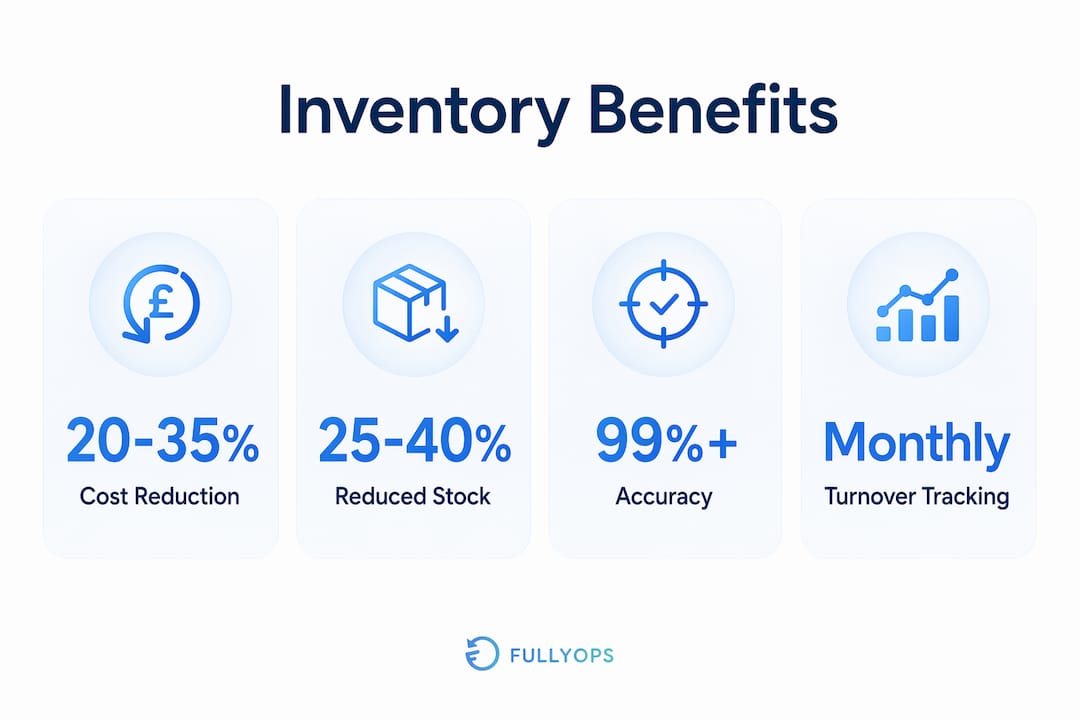
The most direct financial benefit is cost reduction. Proper inventory management can reduce operational costs by 20–35% and improve cash flow. That figure reflects savings from reduced warehousing costs, fewer emergency purchases, and less capital tied up in slow-moving stock.
The operational benefits are equally significant:
- Fewer stockouts. Stockouts reduce revenue and damage customer trust. A customer who cannot get what they need today will often find a competitor who can.
- Reduced overstock. Excess inventory inflates storage costs and erodes margins. Products that sit too long can become obsolete or expire, writing off capital entirely.
- Improved cash flow. Freeing capital from excess stock gives you funds to invest in growth, equipment, or people.
- Higher inventory turnover. Faster-moving stock means your capital works harder and your warehouse operates more efficiently.
- Better customer satisfaction. Eliminating stockouts and overstock improves customer satisfaction and protects brand reputation over the long term.
For operations managers, the reduction in manual processes is equally valuable. Automated stock tracking removes the need for time-consuming physical counts and reduces human error. That time returns to your team as productive capacity.
Pro Tip: Track your inventory turnover ratio monthly. A declining ratio signals that stock is accumulating faster than it is selling, which is an early warning of cash flow pressure.
How does real-time inventory visibility impact operational decisions?
Real-time visibility is the difference between reacting to problems and preventing them. When your stock data is accurate and current, you make better purchasing decisions, allocate resources more effectively, and avoid the costly surprises that come from outdated records.
Effective inventory visibility targets 99%+ stock accuracy to prevent backorders. That level of accuracy requires more than periodic manual counts. It requires continuous data capture across every point in your supply chain.
| Tracking method | Accuracy level | Update frequency | Typical use case |
|---|---|---|---|
| Manual periodic count | Low to moderate | Weekly or monthly | Small, static inventories |
| Barcode scanning | Moderate to high | Per transaction | Retail and light manufacturing |
| RFID and IoT sensors | Very high | Continuous | Warehousing and industrial assets |
| AI-integrated ERP | Very high | Real-time | Multi-site operations |
Transitioning from periodic manual counts to continuous AI and IoT-enabled operations significantly enhances inventory accuracy. The practical implication is that businesses relying on monthly stock counts are always operating on stale data. By the time a discrepancy is found, the financial damage is already done.
Centralising data across warehouses, suppliers, and service locations removes information silos. When a field technician in one location can see stock levels at another site in real time, they avoid unnecessary procurement and reduce downtime. Platforms that integrate inventory data with ERP systems and work order management give operations managers a single source of truth across the entire asset lifecycle.
Pro Tip: Before investing in RFID or IoT hardware, audit your current data entry points. The most common source of inaccuracy is not missing technology but inconsistent data entry by staff at goods-in and goods-out stages.
What inventory management strategies best support efficiency and cost control?
The most effective inventory management strategies share one characteristic: they replace reactive decisions with data-driven ones. Reactive procurement ties capital in slow-moving stock and emergency purchases, while demand-driven approaches improve efficiency and reduce waste.
ABC analysis
ABC analysis segments inventory into three categories based on value and consumption rate. Category A items are high-value and tightly controlled. Category B items receive moderate attention. Category C items are low-value and managed with lighter-touch processes. This segmentation ensures your team spends time and resource where it matters most, rather than applying the same level of scrutiny to every item in the catalogue.
Demand forecasting and reorder points
Leading organisations shift from reactive ordering to demand forecasting with precise reorder points. A reorder point is calculated from average daily usage multiplied by lead time, plus a safety stock buffer. Setting reorder points correctly means stock is replenished automatically before a shortage occurs, without overstocking.
Just-in-Time and consumption-pull models
Just-in-Time procurement reduces the volume of stock held at any one time by aligning orders closely with actual consumption. Implementing consumption-pull models with real-time data integration mitigates the bullwhip effect, which is the tendency for small demand fluctuations to cause large swings in upstream ordering. Reducing the bullwhip effect stabilises your supply chain and lowers procurement costs.
Technology integration
Advanced analytics and AI integration help top-tier companies hold 25–40% less inventory while maintaining service levels. That is a significant competitive advantage. For operations managers considering automated logistics systems, the starting point is usually integrating inventory data with existing ERP or maintenance management platforms before adding hardware.
The four strategies above work together. ABC analysis tells you what to prioritise. Demand forecasting tells you when to order. Just-in-Time tells you how much to hold. Technology integration makes all three possible at scale.
How does inventory management influence financial performance and strategy?
Inventory management is increasingly viewed by CFOs as a strategic finance function, not just an operational logistics task. The reason is straightforward: inventory is a major capital asset, and how it is managed directly affects the balance sheet, the cash conversion cycle, and the credibility of financial reporting.
Accurate inventory management is essential for finance leaders building credible business cases and supporting ERP investments. Inaccurate stock records undermine financial statements, complicate audits, and reduce lender confidence. For businesses seeking external financing or preparing for acquisition, this matters enormously.
- Cash conversion cycle. Faster inventory turnover shortens the time between spending on stock and receiving payment from customers. That directly improves working capital.
- Audit readiness. Reliable inventory valuation is a prerequisite for external audits. Discrepancies between physical stock and recorded values create audit qualifications that damage credibility.
- M&A and capital raises. Inventory management supports strategic initiatives like M&A by providing reliable valuations and demonstrating operational discipline to potential acquirers or investors.
- Capital efficiency. Holding less stock without compromising service levels frees capital for higher-return investments.
“Inventory management is no longer just a warehouse function. It is a core input to financial planning, audit preparation, and strategic decision-making at board level.”
For inventory tracking in maintenance operations, the financial stakes are particularly high. Untracked spare parts and consumables create hidden costs that only surface during audits or equipment failures. Bringing these assets under systematic control closes a significant gap in financial reporting.
Key takeaways
Effective inventory management reduces operational costs, protects cash flow, and provides the financial accuracy that underpins credible reporting, strategic planning, and sustainable growth.
| Point | Details |
|---|---|
| Cost reduction potential | Proper stock management can reduce operational costs by 20–35% through fewer emergency purchases and less overstock. |
| Real-time accuracy target | Aim for 99%+ stock accuracy using continuous tracking methods rather than periodic manual counts. |
| ABC analysis prioritisation | Segment stock into A, B, and C categories to focus control effort on high-value items first. |
| Strategic finance function | Accurate inventory records support audits, M&A valuations, and capital raises, not just day-to-day operations. |
| Technology integration | AI and IoT-enabled systems allow businesses to hold significantly less stock while maintaining service levels. |
Why I think most businesses still underestimate inventory management
Having worked with operations teams across manufacturing, field service, and industrial maintenance, I have seen the same pattern repeatedly. Inventory management gets treated as an administrative task delegated to a warehouse coordinator, when it should be a board-level concern.
The businesses that struggle most are not the ones with bad intentions. They are the ones using spreadsheets and periodic counts while their competitors run continuous, data-integrated systems. The gap compounds over time. Every month of inaccurate data means worse purchasing decisions, more capital tied up unnecessarily, and weaker financial reporting.
The shift I find most underappreciated is the move from stock management as a cost centre to stock management as a strategic asset. When your inventory data is accurate and real-time, it feeds better decisions in procurement, maintenance scheduling, customer service, and financial planning simultaneously. That is not an operational improvement. That is a structural advantage.
The practical advice I give consistently: do not wait for a full ERP implementation to improve accuracy. Start by auditing your highest-value stock category, applying ABC logic, and setting reorder points for your top 20 items. The discipline you build there will make any subsequent technology investment far more effective.
— Pedro
How Fullyops supports inventory and asset management in operations
Fullyops is built for operations managers who need real-time visibility across assets, stock, and maintenance activities in a single platform. The platform connects inventory tracking for maintenance teams with work order management, intervention records, and performance reporting, giving you a complete operational picture without switching between systems. For teams looking to move from reactive to demand-driven procurement, the resource allocation tutorial provides a structured starting point for aligning stock levels with actual operational demand. Fullyops also supports warehouse automation integration for teams ready to extend their tracking capabilities beyond manual processes.
FAQ
What is inventory management and why does it matter?
Inventory management is the process of ordering, storing, tracking, and controlling stock across the supply chain. It matters because inventory represents 30–50% of total assets in product-based businesses, making it a direct driver of financial performance and operational efficiency.
How does poor inventory management affect a business?
Poor stock management causes stockouts that reduce revenue and overstock that inflates costs and destroys margins. Both outcomes damage customer satisfaction and weaken the business’s financial position.
What is ABC analysis in inventory management?
ABC analysis segments stock into three categories by value and consumption rate, applying the strictest controls to high-value Category A items. This ensures management effort is concentrated where it has the greatest financial impact.
How can small businesses improve inventory management?
Small businesses benefit most from setting precise reorder points for their top-selling items and moving from manual periodic counts to barcode or digital tracking. These two steps alone significantly reduce stockouts and excess purchasing without requiring large technology investment.
What role does technology play in inventory accuracy?
AI and IoT-enabled systems support continuous stock tracking, replacing periodic manual counts with real-time data. Companies using advanced analytics and AI integration hold 25–40% less inventory while maintaining the same service levels.
Recommended
- Inventory management tips for operations teams
- Inventory tracking: the essential guide to maintenance efficiency
- Streamline the inventory management process: 5 key steps