

Multi-site maintenance is the practice of running upkeep, repairs, and asset management across several locations under one shared set of rules rather than as isolated, site-by-site operations. The single best first move is to set up a central governance layer paired with one centralised work-order system, so every site follows the same standards while local teams keep the autonomy to act fast. Certification frameworks and dedicated software both exist specifically to support this model.
TL;DR:
- Centralized governance and standard work-order systems are essential for scalability, but local teams must retain autonomy for daily operations.
- Proper data taxonomy, shared asset registers, and integrated inventory tracking prevent costly errors and reporting inconsistencies across sites.
- A phased rollout, starting with a pilot involving two to three sites, reduces risk and accelerates successful full-scale implementation.
- Clear roles, approval thresholds, and vendor contract standardization are critical to avoid delays and manage costs effectively.
- FullyOps offers a unified platform that streamlines work orders, asset management, and inventory, supporting effective multi-site maintenance.
Table of Contents
- What is multi-site maintenance and why does it matter?
- How does multi-site governance actually work?
- What technology and data setup enables multi-site operations?
- What’s the rollout checklist from pilot to full scale?
- What challenges come up most, and how do you fix them?
- Which KPIs and dashboards give you portfolio-level visibility?
- Lessons from FullyOps on running multi-site maintenance
- Why phased governance beats a big-bang rollout
- Getting your multi-site programme running with FullyOps
- Sources
- FAQ
What is multi-site maintenance and why does it matter?
Multi-site maintenance means one organisation, one set of policies, and one reporting structure applied across several physical locations, whether that’s three regional warehouses or forty retail branches. The core idea splits work into two layers: what gets decided once at the centre, and what gets executed locally by the people who actually know the building or the machine.
Get that split wrong and you end up with either a head office micromanaging boiler repairs it’s never seen, or forty sites each inventing their own version of a preventive maintenance schedule. Neither works at scale.
Typically centralised:
- Maintenance policy, standard operating procedures, and safety protocols
- Vendor contracts, framework agreements, and service level agreements (SLAs)
- Budget approval thresholds and capital expenditure decisions
- Reporting formats, KPI definitions, and audit requirements
- Software configuration, data taxonomy, and system access rules
Typically local:
- Day-to-day scheduling and technician dispatch
- Site-specific risk assessments and minor purchasing
- First-line diagnostics and emergency response
- Local supplier relationships for low-value, urgent parts
The business case for getting this right is straightforward. Consistency reduces the odds that a fault fixed cheaply at one site turns into an expensive breakdown at another because nobody shared the fix. Centralised purchasing and shared spare-parts pools cut procurement costs through volume, and standardised documentation makes compliance audits far less painful.
That last point matters more than most facility teams expect. Certification bodies have formalised what “good” multi-site governance looks like. PEFC’s multisite certification guidance describes how a central management function can hold responsibility for planning and policy while individual sites are assessed against that shared standard, rather than each site being certified separately. SGS applies a similar logic in its own multisite certification framework, which explains how centralised functions get assessed once and local sites are then sampled against that baseline. Neither framework was built for maintenance specifically, but the governance principle transfers directly: centralise the thinking, standardise the audit trail, let local teams execute.
How does multi-site governance actually work?
A workable governance model has three moving parts: a central authority that sets the rules, a site-level structure that applies them, and a clear map of who decides what. Skip any one of these and the model collapses back into either chaos or bottleneck.
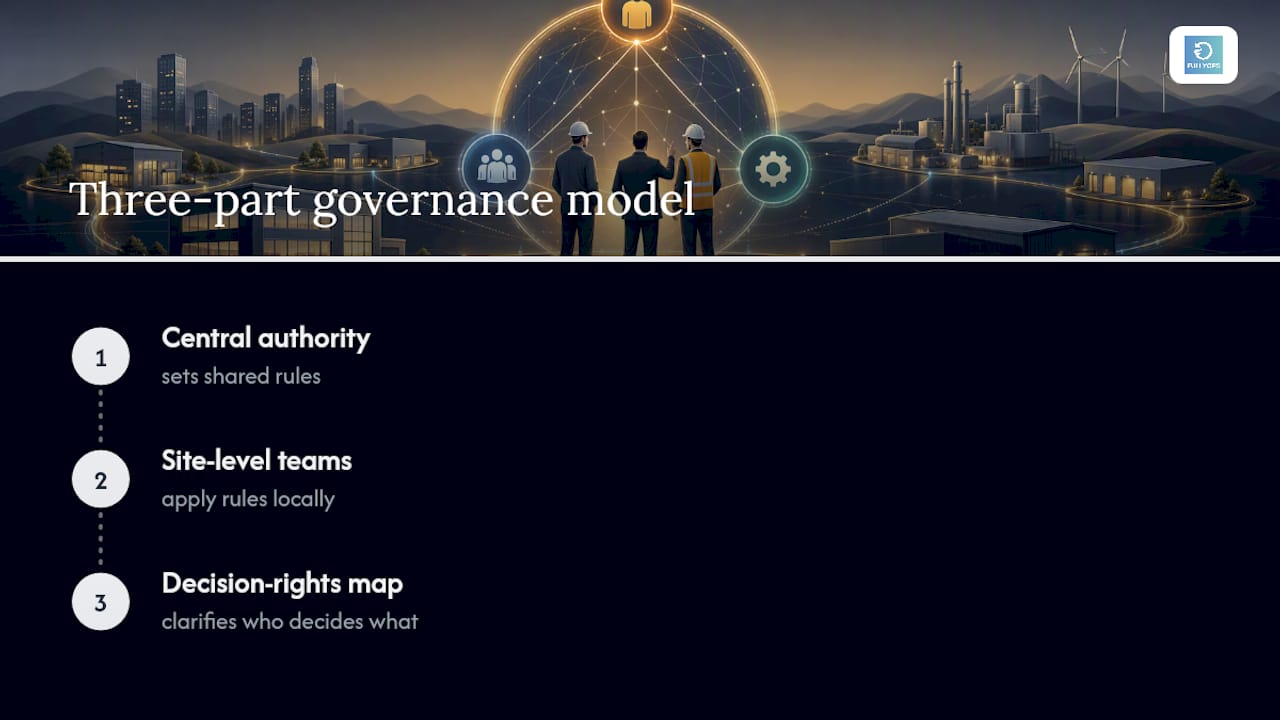
1. Build a central maintenance office
Most organisations running five or more sites benefit from a small central team, sometimes called a centre of excellence, that owns:
- Maintenance policy and SOP libraries, kept in one version-controlled place
- Vendor and supplier contracts negotiated at portfolio scale
- The technology stack: which CMMS, which mobile app, which integrations
- Portfolio-level reporting and the KPI definitions everyone reports against
- Budget guardrails, including thresholds above which local sites need sign-off
This team doesn’t fix equipment. It sets the conditions under which local teams fix equipment consistently.
2. Define site-level roles clearly
Every site needs a named person accountable for maintenance outcomes, even if that person also wears three other hats. A simple roles matrix avoids the ambiguity that kills multi-site programmes in year one:
| Role | Owns | Reports to |
|---|---|---|
| Site maintenance lead | Daily scheduling, local technician dispatch, minor purchasing | Regional or central maintenance manager |
| Regional coordinator | Cross-site resource sharing, escalation, regional KPIs | Central maintenance office |
| Central maintenance manager | Policy, vendor contracts, system configuration, portfolio KPIs | Facilities director or COO |
3. Decide what gets centralised policy status
Not everything needs a central rule. Focus centralisation on the things that create risk or cost when they’re inconsistent: safety-critical SOPs, spare-parts specifications, vendor SLAs, and the data fields technicians must fill in on every work order. Leave scheduling flexibility, minor local purchasing, and day-to-day prioritisation with the site.
4. Set approval and budget authority in advance
Budget disputes are one of the fastest ways to stall a multi-site rollout. Write down, before you launch, the value threshold above which a site manager needs regional or central sign-off, and who can approve emergency spend outside normal hours. Ambiguity here causes more delay than any technical integration problem.
What technology and data setup enables multi-site operations?
Centralised visibility depends entirely on whether every site is logging the same information, in the same format, against the same asset register. Get the data model wrong and no dashboard will fix it later.
Core system capabilities to prioritise:
- A shared work-order management system so every request, whether raised in Lisbon or Porto, follows the same workflow and status codes
- A unified asset register with consistent naming conventions, so “Chiller 2” in one site doesn’t mean something different to “Chiller 2” in another
- Inventory tracking that shows stock levels across the whole portfolio, not just per site, so parts can be shared instead of duplicated
- A mobile app technicians actually use in the field, capturing time, parts, and photos at the point of work rather than at a desk hours later
- Dashboards that roll up site-level data into regional and portfolio views without manual spreadsheet consolidation
A platform such as FullyOps approaches this by combining work-order control, asset lifecycle tracking, and operational analytics in one system, which matters most in a multi-site context because it avoids the fragmentation of running separate spreadsheets or point tools per location. The digital work order becomes the single source of truth that ties a repair, a technician, a part, and a cost together, wherever it happens.
Integration needs to go beyond the maintenance system itself. ERP integration keeps cost data aligned with finance’s own reporting. Procurement integration lets central purchasing negotiate volume deals while local sites still raise their own low-value orders. IoT sensors, where the estate justifies the investment, feed condition data back into the same asset register rather than into a separate monitoring silo.
Get the taxonomy right before you scale. Asset categories, failure codes, and priority levels need to mean the same thing at every site, or portfolio-level reporting becomes an exercise in reconciling ten different definitions of “critical.” This is tedious work and it’s the difference between a dashboard that drives decisions and one that just looks impressive.
Pro Tip: Don’t attempt predictive maintenance across the whole estate on day one. Pick two or three asset types with the highest failure cost, get clean historical data flowing for those, and prove the model before extending it. Predictive maintenance is a data problem before it’s an algorithm problem.
What’s the rollout checklist from pilot to full scale?
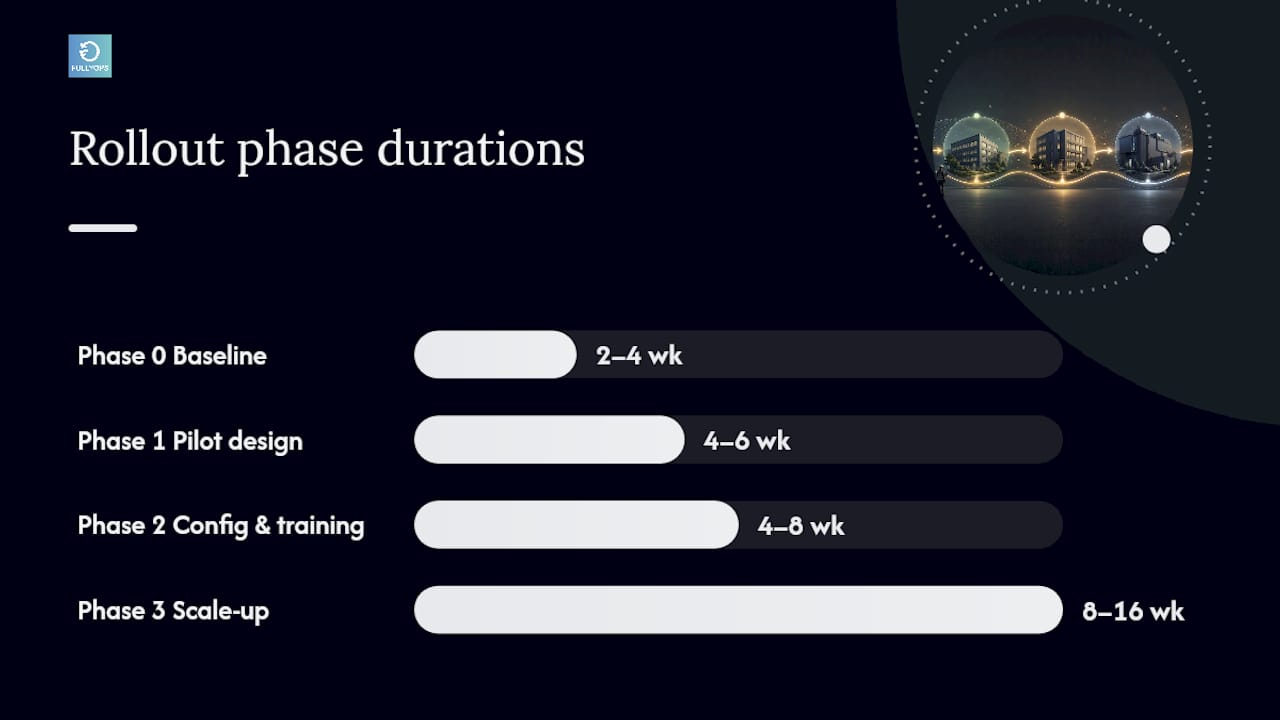
A realistic multi-site maintenance programme moves through five phases, and the biggest mistake facility teams make is skipping the pilot to “save time.” That almost always costs more time later, once problems surface across twenty sites instead of two.
Phase 0: Portfolio baseline (2 to 4 weeks)
- Inventory every site: asset counts, current maintenance approach, existing software or spreadsheets in use
- Capture baseline KPIs per site, even rough ones: current downtime, average response time, maintenance spend
- Identify the two or three sites best suited to a pilot, ideally ones with engaged local leads and typical asset profiles
Phase 1: Pilot design (4 to 6 weeks)
- Draft the core SOPs and policy set that the pilot sites will follow
- Agree the KPI definitions everyone will report against, before the pilot starts
- Assign a site maintenance lead and a regional coordinator for the pilot group
Phase 2: System configuration and training (4 to 8 weeks)
- Configure the chosen CMMS or field service platform, including asset register and work-order templates
- Set up integrations with ERP and procurement systems where relevant
- Train technicians on the mobile app and admins on the reporting dashboards, ideally in person for the first cohort
Phase 3: Scale-up (2 to 4 months, depending on estate size)
- Roll out site by site or in regional waves, never all at once
- Set up shared spare-parts pools and renegotiate vendor contracts at the new, larger scale
- Adjust the roles matrix as regional coordinators take on more sites
Phase 4: Optimisation (ongoing)
- Review KPI trends quarterly and retire or revise policies that aren’t working
- Extend predictive maintenance to additional asset categories as data quality allows
- Re-benchmark vendor SLAs annually against the portfolio’s actual performance
Total timeline from baseline to a fully scaled rollout typically runs six months to a year for a mid-sized estate, and closer to eighteen months for larger, more complex portfolios with regulatory or safety-critical assets. The maintenance planning work done in Phase 1 is what determines whether Phase 3 goes smoothly or drags.
What challenges come up most, and how do you fix them?
Every multi-site rollout hits some version of the same four problems. None of them are unusual, and none of them are fatal if you plan for them early.
People and change resistance. Local teams that have run their own way for years often see central policy as interference, not support. The tactical fix is involving site leads in drafting the SOPs rather than handing down a finished policy; the longer-term fix is showing them their own site’s KPI improvement once the new system is running.
Logistics and inventory duplication. Sites without shared visibility tend to over-order the same spare parts out of caution, tying up cash across the estate. Centralised inventory tracking, even a simple shared view of stock levels, usually reduces this within a few months of going live.
Data quality and inconsistent tagging. If ten sites name the same asset ten different ways, no report will ever be trustworthy. Fix this with a locked taxonomy before rollout, not after: it’s far cheaper to enforce naming conventions from day one than to clean historical data later.
Vendor coordination. Contractors serving multiple sites in a portfolio sometimes apply inconsistent SLAs from one location to the next. Centralising vendor contracts, with the same response times and pricing written into every site’s agreement, closes that gap. Academic reviews of multi-site implementation projects consistently flag change management, data inconsistency, and logistics coordination as the recurring failure points, which matches what most facility teams encounter in practice.
Pro Tip: Run a “shadow week” before full go-live: have one experienced technician from a working pilot site visit the next site being onboarded. Peer-to-peer coaching resolves more local resistance than any policy memo ever will.
Which KPIs and dashboards give you portfolio-level visibility?
A multi-site dashboard only earns its place if the numbers on it drive real decisions, not just look tidy in a monthly deck. Five metrics cover most of what a facilities director actually needs to see:
- Mean time to repair (MTTR), tracked per site and rolled up regionally, to spot which locations are struggling
- Preventive maintenance compliance, the percentage of scheduled PM tasks completed on time
- Downtime, both unplanned and total, ideally tied to cost impact per site
- Cost per site, normalised by asset count or square metreage so sites of different sizes can be compared fairly
- Technician utilisation, showing whether labour is stretched thin at some sites and underused at others
Dashboard structure matters as much as the metrics themselves. A useful layout starts with a portfolio roll-up view, lets a regional manager filter down to their own sites, and allows drill-down to a single asset’s history when something needs investigating. Site-level teams want daily or weekly views of their own numbers; regional coordinators need weekly to monthly rollups; executives typically want a monthly or quarterly summary tied to spend and risk.
Where reporting connects to compliance, it’s worth noting that EU corporate sustainability reporting rules are pushing more organisations toward structured, auditable operational data, which makes a clean multi-site KPI framework useful well beyond maintenance itself.
Use the KPI trends to prioritise investment, not just to report history. A site consistently missing PM compliance targets probably needs a staffing or training fix before it needs new equipment. A site with high MTTR and low technician utilisation likely has a scheduling problem, not a skills problem.
Lessons from FullyOps on running multi-site maintenance
Multi-site rollouts tend to succeed or stall on the same handful of decisions, and Fullyops has watched that pattern repeat across facility teams moving from spreadsheets and site-by-site systems to one shared platform.
The improvements that consistently move the needle are rarely glamorous:
- Replacing paper or WhatsApp-based fault reporting with digital work orders that log time, parts, and photos automatically
- Centralising inventory so shared parts pools reduce duplicate ordering across sites
- Standardising the asset register early, before adding more sites, not after
- Giving site leads their own dashboard view so local buy-in comes from seeing their own progress, not from being told to comply
Teams that pilot on two or three sites before scaling tend to reach stable, portfolio-wide reporting faster than teams that try to onboard everything at once. On the procurement side, involving finance and site leads in the same conversation from the start avoids the budget disputes that otherwise stall rollouts at Phase 3. Vendor negotiations also go further once volume across the whole portfolio, not just one site, is on the table.
Why phased governance beats a big-bang rollout
The conventional advice on multi-site maintenance leans heavily on technology, as if buying the right software solves the governance problem on its own. It doesn’t. The organisations that struggle most are usually the ones that configured a system properly but never wrote down who’s allowed to approve a €5,000 repair without waiting a week for sign-off.
What the evidence actually supports is sequencing: govern first, then pilot, then scale, then optimise. Skipping the pilot to hit a rollout deadline is the single most common reason programmes stall around site fifteen or twenty, once the inconsistencies that a small pilot would have caught start compounding across the estate.
If there’s one thing to prioritise above all else, it’s the data taxonomy. Everything downstream, from KPI dashboards to predictive maintenance to vendor negotiations, depends on every site describing the same asset the same way. Fix that before worrying about integrations or advanced analytics.
— Pedro
Getting your multi-site programme running with FullyOps
Fullyops is built for exactly the governance and visibility problem this guide has walked through: one central system for work orders, asset registers, and inventory, with role-based access so site leads, regional coordinators, and central managers each see what they need without drowning in noise. Instead of stitching together spreadsheets, WhatsApp threads, and separate CMMS instances per location, a multi-site team gets one platform tracking every asset, every technician, and every part across the whole estate.
A pilot typically starts with two or three sites configured with a shared asset register and standard work-order templates, giving you clean before-and-after KPI data before committing to a full rollout. Plans are structured around role to scale with the estate rather than forcing every technician onto features they don’t need. Visit the FullyOps platform to see the current plans and request a demo configured around your own portfolio.
Sources
Facility teams formalising multi-site governance can draw directly on existing certification frameworks rather than building policy from scratch. PEFC’s multisite certification guidance sets out how centralised planning functions are assessed alongside sampled local sites. SGS’s own multisite certification document describes a comparable assessment logic for centralised functions. For management systems more broadly, ISO’s standard references are worth reviewing, and bodies such as Preferred by Nature and AENOR offer further certification pathways relevant to organisations formalising multisite controls.
- Certificação Multisite — PEFC Portugal
- Certificação Multi-Site pela SGS ICS (PDF)
- Desafios na Implementação e Manutenção de um Sistema — institutional repository
FAQ
What does “multi-site maintenance” actually mean?
It means managing maintenance activity across several locations under one shared governance structure, rather than each site running its own independent process. Policy, vendor contracts, and reporting are typically centralised, while day-to-day scheduling stays local.
How long does a multi-site maintenance rollout take?
A mid-sized estate typically takes six months to a year from baseline assessment to full scale, moving through a pilot before wider rollout. Larger or more regulated portfolios often need twelve to eighteen months to reach stable, portfolio-wide reporting.
What software features matter most for managing multiple sites?
A shared work-order system, a unified asset register, portfolio-wide inventory visibility, and roll-up dashboards matter most, since they’re what turn scattered site data into one consistent view. FullyOps combines these functions in a single platform built around work orders, asset tracking, and operational analytics.
Do I need formal certification to run a multi-site maintenance programme?
No, certification isn’t a requirement to operate a multi-site maintenance model, but frameworks such as PEFC’s multisite certification offer a useful reference structure for how centralised governance should work. Many organisations use these frameworks as a design template even without pursuing formal certification.
What’s the biggest reason multi-site maintenance rollouts fail?
Skipping the pilot phase and scaling policy and systems to every site at once is the most common cause of stalled rollouts. Inconsistent data tagging and unclear approval thresholds tend to surface only once the estate is too large to fix quickly, which is exactly why a small pilot matters before full-scale deployment.
Recommended
- Top 6 Equipment Maintenance Software for Field Teams 2026
- Top 7 Maintenance Management Software 2026