

Facility managers struggle to keep asset records, work orders and vendor billing aligned across multiple sites without wasting hours on manual data entry and reconciliation. Most traditional facility management software either lacks strong integration with finance and CRM tools or demands separate systems for accounting and maintenance, which leads to errors and lost visibility. After reading you will be able to compare three multi-site facility management platforms on integration quality, operational automation and ease of procurement to choose a solution that addresses your specific pain points.
Table of Contents
FullyOps
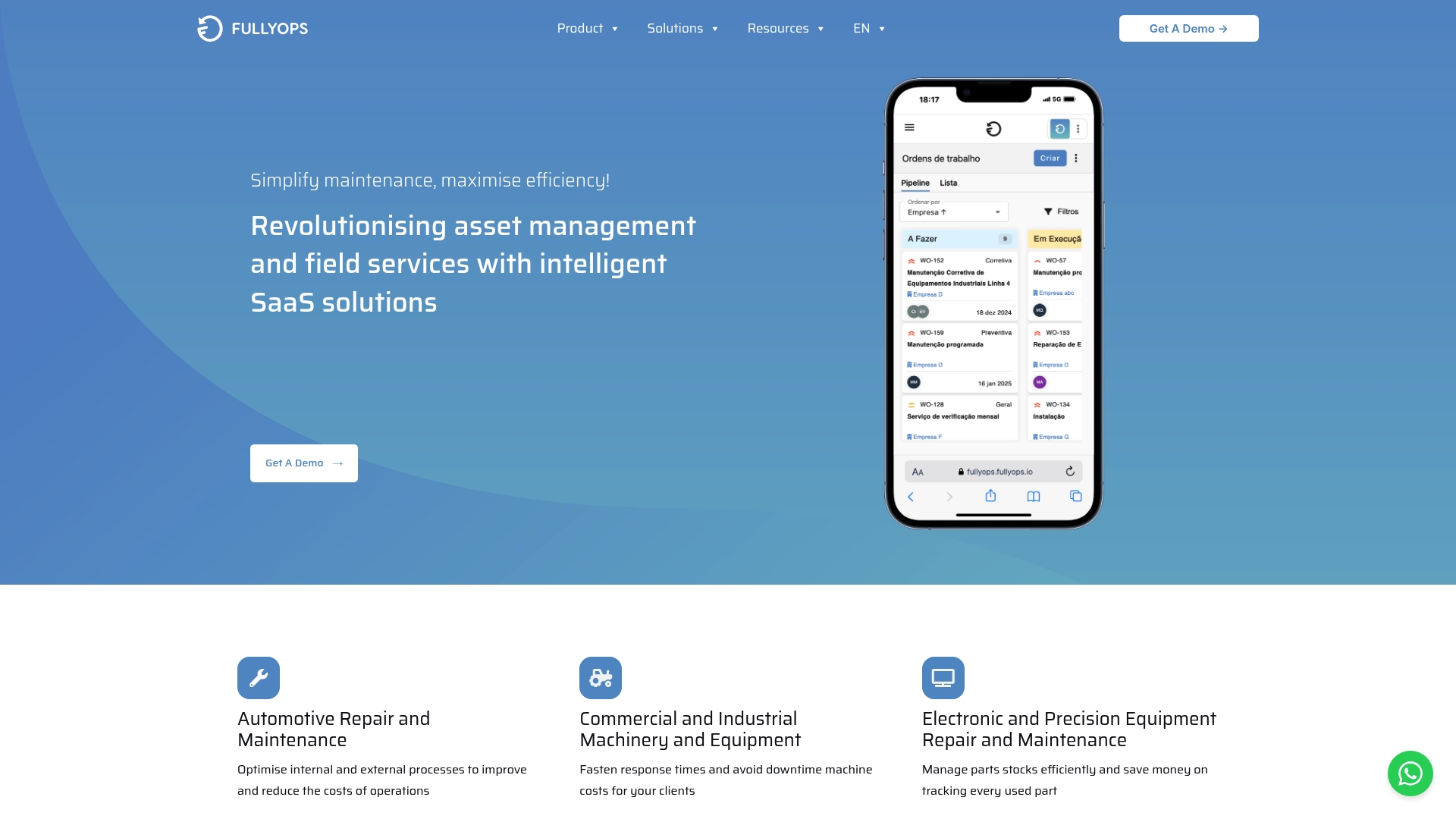
At a Glance
FullyOps provides industry-specific modules and ties them to deep integrations such as Sage Cloud and Hubspot, making it straightforward to link asset records to finance and CRM systems without manual reconciliation.
Core Features
Work Orders Management with automated reporting and digital signatures reduces paperwork and speeds technician handover.
Asset Lifecycle Management centralises equipment histories so you can see failure patterns and service costs per asset.
Resources Management, operations analytics and automated reports complete the suite for day to day field service control.
Key Differentiator
The platform’s defining characteristic is its combination of industry-specific modules with broad integration coverage. That pairing lets you manage assets, schedules and work orders in one system while synchronising with back office and HR systems.
Pros
-
Reduces administrative load by automating work orders and generating signed reports, so technicians spend more time on-site and less time on paperwork.
-
Deep integrations with Sage Cloud, Hubspot and others mean asset and billing data flow between teams, which cuts duplicate data entry and billing errors.
-
Mobile access and notifications keep field teams aligned with dispatch changes and job details, improving first-time fix rates.
-
Tailored modules for sectors such as automotive and electronics provide context specific fields and workflows so setups match operational reality.
-
Scalable plans let you add features for supervisors or give field technicians a slimmed down interface, avoiding licence waste as the organisation grows.
Cons
- The platform may require significant setup and dedicated training to configure customised workflows, which can delay time to value for teams without implementation support.
Notable Integrations
- Sage Cloud
- Pipedrive
- Google Calendar
- PHC
- Hubspot
- Microsoft Calendar
- Cegid
- Sage HR
Who It’s For
Service and maintenance teams in manufacturing, automotive and electronics that need a single system for assets, field scheduling and reporting. Best for mid-sized and larger teams that can invest in initial configuration and training.
Unique Value Proposition
FullyOps offers industry-specific modules with deep integration options that link field work to finance and CRM systems. That connection reduces reconciliation work and gives operations a single source of truth for asset histories and service costs.
Real World Use Case
A manufacturing plant schedules preventive maintenance through FullyOps. Automated work orders and resource allocation reduce unplanned downtime and let managers quantify cost savings by asset and by shift.
Pricing
Pricing is available on request. Plans are tiered by number of users, feature set and integrations so you can scale from a technician-only package to a full supervisor and reporting licence.
Website: https://fullyops.com
Ecotrak
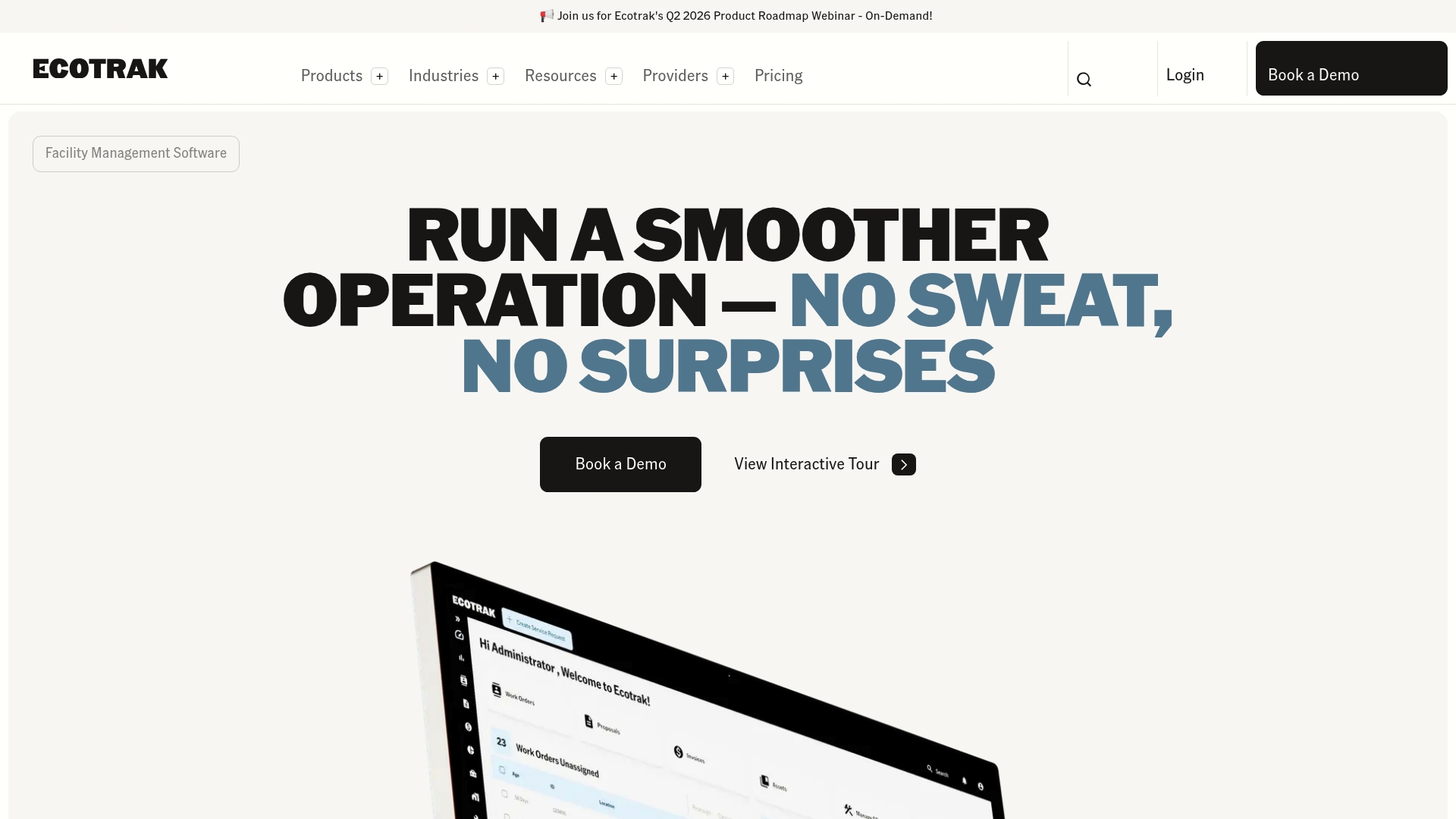
At a Glance
An in-platform service provider directory links you to vetted technicians so repairs are handled faster across multiple sites. Ecotrak combines that network with hands-on onboarding and site-level analytics to reduce downtime and get teams working to a steady rhythm.
Core Features
Ecotrak groups the essentials you need to keep distributed facilities operational and visible from a single dashboard.
- Asset Management — Track and catalogue assets with location and status to cut guesswork during interventions.
- Work Order Management — Create, prioritise and close work orders while keeping stakeholders updated.
- Parts & Inventory Management — Maintain parts levels and reorder rules to avoid stock outages.
- Service Provider Directory for vetted vendors and dispatching.
- Reporting and analytics for trending failures and cost insights.
Key Differentiator
Ecotrak pairs strong onboarding with an embedded vendor network so you get both process and execution support from day one. Compared with Fullyops, Ecotrak serves a narrower set of verticals and prioritises fast operational readiness over broad ecosystem connectivity.
Pros
- Simple to use which reduces training time for frontline technicians and site managers. Most teams get productive within a few days.
- Good value for money with the mix of asset, work order and inventory control in a single system for multi-site operations.
- High quality customer support and onboarding. The hands-on approach shortens the ramp for chains rolling out new locations.
- Proactive analytics surface recurring failure patterns so you can target the highest cost drivers rather than reacting to breakdowns.
- Scalable across restaurants, retail and healthcare sites with vendor access built into the platform.
Cons
- Pricing is not published. You must contact sales for a quote which makes rapid procurement comparisons harder for procurement teams.
- Integration detail is light. Outside of the vendor network there is limited published information about third party connectors or APIs.
- The product focus is vertical. Organisations outside hospitality, retail or healthcare may find parts of the feature set unnecessary.
Notable Integrations
Ecotrak features an integrated vendor network and mentions resource management tools to coordinate external service providers. Expect the strongest connectivity where service partner workflows and dispatch are involved rather than broad ERP or IoT platform integrations.
Who It’s For
Facility managers and operational leaders in hospitality, retail and healthcare running multiple sites who need a practical system that pairs work order control with vendor access. Best for teams that want rapid rollout and vendor coordination without heavy custom integration work.
Unique Value Proposition
Robust onboarding combined with an in-platform vendor directory shortens the time to first fix. That pairing turns a software purchase into an operational capability you can use immediately, which matters when chains measure success by uptime and repair-cycle length.
Real World Use Case
A regional restaurant chain uses Ecotrak to schedule preventive maintenance, route work orders to preferred vendors and track parts levels across kitchens. The result is fewer emergency callouts and clearer cost reporting per site.
Pricing
Pricing is available on enquiry only. There are no standard public plans so budget conversations start with a tailored quote from sales and a demo showing vendor workflows.
Website: https://ecotrak.com
Facil-IT
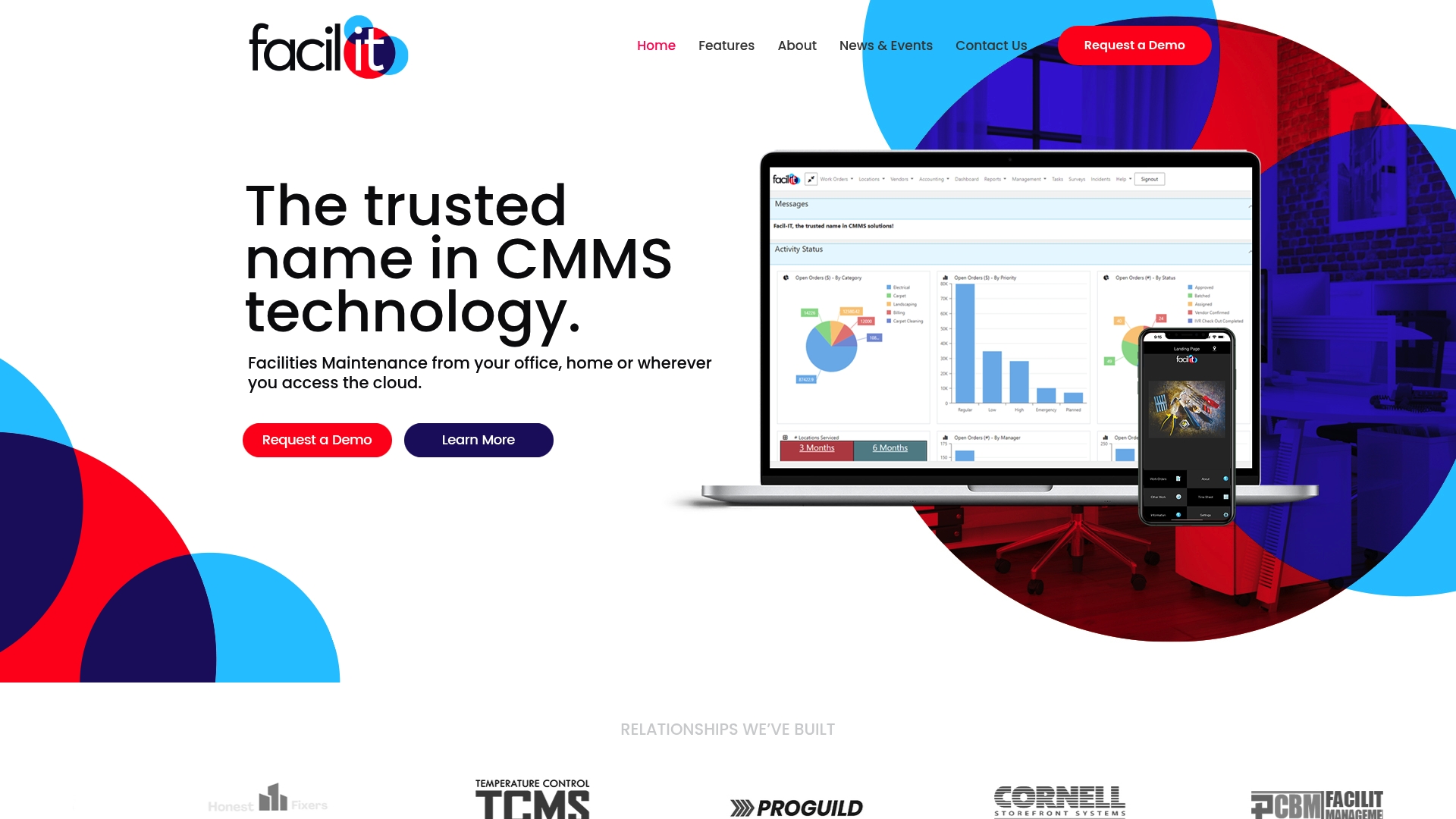
At a Glance
Facil-IT includes an integrated accounting system for billing and vendor payments inside the CMMS, a concrete capability that reduces the need to switch between finance and maintenance tools. The platform also combines maps and weather tools for operational scheduling across sites.
Core Features
- Work Order Customisation & Alerts with email parsing and automation for incoming job creation and assignment.
- Integrated Accounting for billing, vendor payments and a cleaner audit trail between operations and finance.
- Advanced Reports and Dashboards plus maps, weather and scheduling tools to plan field activity across multiple locations.
Key Differentiator
Facil-IT brings configurable workflows, third-party communication tools and mobile portals into one platform focused on multi-site operational teams. That focus makes it a practical choice where maintenance, vendor billing and reporting must be managed inside a single system rather than stitched together.
Pros
- Mobile portals let technicians update job status and attach evidence on site, reducing back-office data entry and improving record completeness.
- Built-in accounting links maintenance spend to vendor payments, which shortens the reconciliation cycle and reduces manual handoffs between teams.
- Maps and weather-aware scheduling help planners reschedule field visits by location and conditions, which keeps visits efficient across dispersed assets.
- Advanced reporting with Power BI or Tableau compatibility supports customised dashboards for operations directors and compliance reports.
- Email parsing and automation convert inbound requests into work orders, cutting manual intake time for busy help desks.
Cons
- Public third-party reviews are scarce, so independent confirmation of user experience and long term reliability is limited.
- Documentation about scalability and deep customisation limits is not publicly detailed, making capacity planning harder for large estates.
- Pricing is not published on the website, which means procurement timelines can extend while you seek commercial terms and total cost of ownership.
When It May Not Fit
If you manage thousands of assets and need independently validated scalability metrics, Facil-IT’s lack of public scalability evidence may be a blocker. Similarly, organisations requiring transparent online pricing for rapid procurement rounds will find the absence of published rates slows decision making.
Notable Integrations
- Email parsing technology for automated work order creation.
- Connectors to third-party accounting tools to synchronise vendor billing and payments.
- Export or direct feeds into MS Power BI or Tableau for bespoke operational and financial dashboards.
Who It’s For
Facilities managers and operations professionals in retail, property management, health clubs and restaurant groups that run multiple sites and want maintenance, vendor payments and reporting handled inside one platform.
Unique Value Proposition
An integrated accounting module sits alongside mobile work order portals and automation. That combination reduces handoffs between operations and finance and shortens the audit trail. For multi-site operators that want invoicing and vendor payment flows visible in the same system as maintenance records, this delivers clearer operational accountability.
Real World Use Case
A regional property manager uses Facil-IT to route tenant reports by email into work orders, dispatch nearest technicians via the mobile portal, and reconcile vendor invoices in the same system, which reduces response time and simplifies month end reporting.
Pricing
Pricing is not specified on the website. Prospective buyers will need to contact Facil-IT for a tailored quote and to discuss deployment scope and commercial terms.
Website: https://facilit.fm
Where These Platforms Excel in Field Service Management
To pinpoint the most suitable field service management platform for your organization, evaluating unique offerings like industry specificity, integration extensiveness, and lifecycle handling reveals stark contrasts among the options reviewed.
Industry-specific Adaptability and Operations Support
FullyOps distinguishes itself by coupling its industry-specific modules with scalable integration capabilities, addressing essential operational needs like work order and asset lifecycle management within manufacturing and automotive sectors. In contrast, Ecotrak emphasizes simplicity and vendor access for retail and hospitality, and Facil-IT merges financial and operational workflows for multi-site property management but lacks robust deep integrations.
Integration and Data Synchronization Depth
One of FullyOps’ core strengths is its extensive integration framework, synchronizing significant back-office systems such as finance through platforms like Sage Cloud and Hubspot. This level of connectivity surpasses the lighter integration emphasis seen in Ecotrak’s system, focusing more on in-platform vendor management, and Facil-IT, offering functional ties like accounting without broader financial ecosystems.
Best Fit Scenarios
- FullyOps: Optimal for manufacturing, electronics, or automotive industries requiring customization paired with deep integration, ensuring aligned workflow continuity.
- Ecotrak: Suited for retail and hospitality management needing fast project ramp-up and integrated vendor support.
- Facil-IT: Benefits large property management firms aiming to centralize financial and operational workflows in one environment.
- Recommendation: Ecotrak is a viable choice over FullyOps when rapid onboarding plus immediate vendor access significantly outweighs the need for expansive integration frameworks.
Why FullyOps Is the Right Fit
FullyOps stands out as the only platform offering customizable workflows deeply integrated across prevalent industry systems like Sage Cloud, empowering teams to adopt seamless interdepartmental coordination. For firms balancing detailed lifecycle tracking alongside interlinked financial data management with minimal errors, this becomes the clear selection.
Field Service Management Platforms Comparison
Choosing the right solution for field service management involves evaluating features, integrations, and scalability to meet operational needs efficiently.
| Product | Key Differentiator | Notable Features | Best For | Notable Limitation |
|---|---|---|---|---|
| FullyOps | Industry-specific modules integrated seamlessly | Asset management, work orders, analytics | Manufacturing, automotive, electronics teams | Requires setup and training for customised workflows |
| Ecotrak | Combines vendor network with operational analytics | Service directory, asset & inventory control | Hospitality, retail, healthcare operations | Limited third-party system integration details |
| Facil-IT | Integrated accounting with maintenance and reporting | Billing, weather-aware scheduling, reporting | Retail and property management professionals | Limited information on scalability and user reviews |
Discover a Smarter Way to Manage Your Facilities
Choosing the right facility management platform can feel like a tough decision when facing challenges such as manual reconciliation, fragmented asset data, and lengthy technician handovers. FullyOps directly addresses these concerns by offering industry-specific modules that connect your asset management with finance and CRM systems effortlessly. This approach not only cuts down administrative tasks but also gives you clear insight into asset histories and service costs.
Experience how FullyOps transforms maintenance efficiency with features like automated work orders and mobile technician access. Act now to reduce downtime and improve operational control by visiting FullyOps. Explore how tailored solutions from FullyOps can put you in control of your maintenance processes and deliver measurable cost savings today.
Frequently Asked Questions
How does FullyOps streamline work order management for maintenance teams?
FullyOps automates work orders, complete with digital signatures and automated reporting, reducing paperwork significantly. This allows technicians to spend more time on-site instead of on administrative tasks, improving overall efficiency in maintenance operations.
Can FullyOps integrate with Sage Cloud and Hubspot for seamless data transfer?
Yes, FullyOps offers deep integrations with Sage Cloud and Hubspot, allowing for efficient linkage of asset records with finance and CRM systems. This integration cuts down on the possibility of billing errors and duplicate data entry, enabling smoother operations for service and maintenance teams.
What is the difference between FullyOps and Ecotrak in terms of onboarding support?
While Ecotrak provides strong onboarding support, FullyOps excels with its tailored industry-specific modules that ensure your workflows match operational realities. FullyOps is particularly well-suited for manufacturing, automotive, and electronics sectors, offering a comprehensive system for asset management, scheduling, and reporting all in one platform.
What unique features does FullyOps offer for asset lifecycle management?
FullyOps centralises equipment histories, enabling teams to easily track failure patterns and service costs associated with each asset. This feature empowers organisations to make data-driven decisions, minimising unplanned downtime and enhancing financial visibility.
Can I scale FullyOps as my team grows?
Absolutely! FullyOps offers scalable plans that allow you to add features for supervisors or a simplified interface for field technicians. This flexibility prevents wasted licenses as your organisation expands, making it a practical choice for growing teams.
Recommended
- Top 5 Field Service Management Tools in 2026 for Operations Managers Worldwide
- Top 5 field service management software 2026
- Top 7 maintenance management platforms comparison 2026