

En bref
- Smart maintenance uses real-time data and predictive analytics to prevent equipment failures.
- Technologies like IoT sensors, cloud software, and data analysis enable proactive asset care.
- Implementing smart maintenance requires a phased approach, staff training, and strong change management.
Waiting for machinery to break before acting is a costly gamble. Many operations teams still rely on reactive approaches, responding to failures rather than preventing them, and the financial consequences are significant. Unplanned downtime alone can cost manufacturers tens of thousands of pounds per hour. Smart maintenance changes this equation entirely, using real-time data, connected sensors, and predictive analytics to keep assets running reliably. This guide explains what smart maintenance is, how its core technologies work, and how your organisation can begin implementing it to reduce costs and improve operational efficiency.
Table des matières
- Defining smart maintenance: Concepts and principles
- How smart maintenance works: Technologies and tools
- Benefits of smart maintenance for asset-intensive industries
- Implementing smart maintenance: Steps and pitfalls
- What most managers miss about smart maintenance
- Take the next steps with smart maintenance solutions
- Questions fréquemment posées
Principaux enseignements
| Point | Détails |
|---|---|
| Definition clarified | Smart maintenance combines real-time monitoring and predictive analytics for proactive asset care. |
| Technology focus | Sensors, cloud platforms, and data analytics are central to modern maintenance strategies. |
| Industry benefits | Reduced downtime, lower costs, and longer asset life are proven outcomes of smart maintenance. |
| Implementation steps | Start small, prioritise key assets, and use phased rollouts for lasting results. |
| Culture counts | Successful smart maintenance needs both the right technology and organisational buy-in. |
Defining smart maintenance: Concepts and principles
Smart maintenance is a proactive, technology-driven approach to asset care that replaces guesswork with data. Rather than waiting for a fault to occur or following rigid scheduled routines, it uses continuous monitoring and analytical tools to identify when intervention is actually needed. Smart maintenance integrates digital technology to monitor equipment and uses predictive algorithms to anticipate failures before they disrupt operations.
To appreciate the shift smart maintenance represents, it helps to understand the traditional approaches it replaces:
- Reactive maintenance: Equipment is repaired only after failure. Low upfront cost, but high risk of unplanned downtime and expensive emergency repairs.
- Preventive maintenance: Scheduled servicing at fixed intervals, regardless of actual equipment condition. More structured, but often leads to unnecessary work or missed issues between service dates.
- Smart (predictive) maintenance: Continuous data collection informs maintenance decisions based on real equipment condition, reducing both over-servicing and unexpected breakdowns.
The core pillars of smart maintenance are real-time monitoring, data analytics, and predictive action. Sensors and connected devices capture operational data continuously. Analytics platforms process this data to detect anomalies and trends. Maintenance teams then receive alerts and recommendations, enabling them to act precisely when and where it matters.
Organisations that adopt cloud-based maintenance platforms report efficiency improvements of up to 60% and a 25% reduction in unplanned downtime, illustrating the measurable impact of moving beyond reactive practices.
Applying stratégies d'optimisation de la maintenance alongside smart maintenance principles allows organisations to further reduce waste and align maintenance activity with business priorities. Research also confirms that preventive maintenance savings extend well beyond avoided repairs, encompassing energy efficiency, asset longevity, and reduced labour costs.
How smart maintenance works: Technologies and tools
Smart maintenance is powered by an interconnected set of technologies that work together to give maintenance managers a clear, real-time picture of asset health. Understanding these tools helps you evaluate which solutions are most relevant to your operations.
The primary technologies include:
- Sensors and IoT devices: Installed on equipment to measure vibration, temperature, pressure, and other parameters continuously.
- Cloud-based software: Centralises data from multiple assets and sites, enabling remote access and cross-team visibility.
- Data analytics and machine learning: Processes large volumes of sensor data to identify patterns, predict failures, and recommend actions.
- Computerised maintenance management systems (CMMS): Manages work orders, scheduling, and maintenance records, often integrating with sensor data for automated triggers.
| Technologie | Primary function | Key benefit |
|---|---|---|
| Capteurs IoT | Continuous equipment monitoring | Détection précoce des défaillances |
| Cloud software | Centralised data storage and access | Real-time visibility across sites |
| Analytics platforms | Pattern recognition and forecasting | Planification de la maintenance prédictive |
| Intégration CMMS | Work order and resource management | Streamlined operations and compliance |
Digital sensors and IoT enable continuous equipment tracking, leading to rapid fault detection and significantly shorter response times. The preventive maintenance process becomes far more targeted when sensor data informs scheduling rather than calendar dates alone.
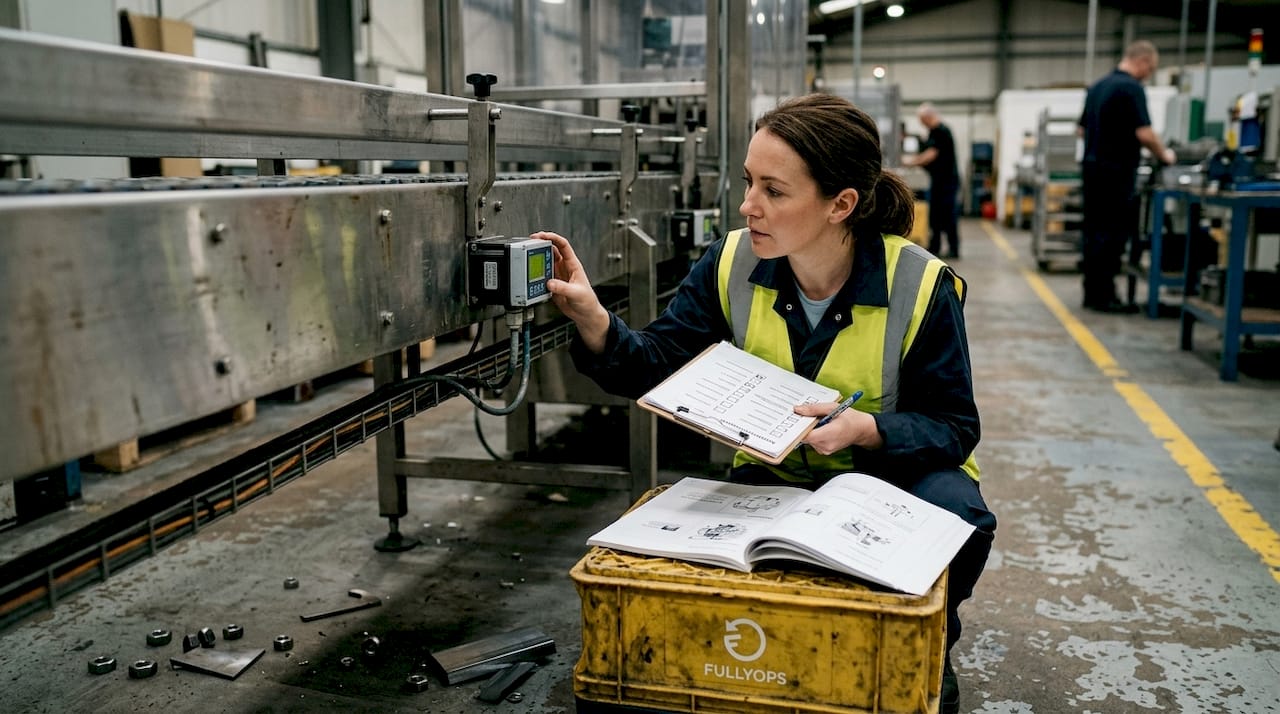
Data collection is only valuable when it connects directly to action. Well-configured systems translate sensor readings into maintenance triggers, automatically generating work orders and alerting the relevant technicians. Following preventive maintenance steps within a data-driven framework ensures that nothing critical is overlooked.
Pro Tip: When beginning sensor installation, prioritise your highest-value or most failure-prone assets first. This approach generates the fastest return on investment and provides the clearest evidence to support wider rollout across your asset base.
Benefits of smart maintenance for asset-intensive industries
For organisations managing heavy machinery, production lines, or complex infrastructure, the practical advantages of smart maintenance are substantial and measurable. These are not theoretical gains. They translate directly into operational performance and financial outcomes.
Les principaux avantages sont les suivants :
- Reduced unplanned downtime: Continuous monitoring catches developing faults early, allowing intervention before failure occurs.
- Extended asset life: Maintenance is performed based on actual condition rather than arbitrary schedules, reducing unnecessary wear from over-servicing.
- Lower operational costs: Fewer emergency repairs, optimised parts usage, and reduced labour hours all contribute to cost savings.
- Improved safety: Early detection of mechanical stress or abnormal readings reduces the risk of dangerous equipment failures.
| Résultat | Maintenance traditionnelle | Smart maintenance |
|---|---|---|
| Downtime | Frequent and unplanned | Reduced and predictable |
| Maintenance costs | High due to reactive repairs | Lower through targeted intervention |
| Asset lifespan | Shortened by neglect or over-servicing | Extended through condition-based care |
| Safety incidents | Higher risk from unexpected failures | Reduced through early warning systems |
| Conformité | Manual records, audit risk | Automated logs, easier compliance |
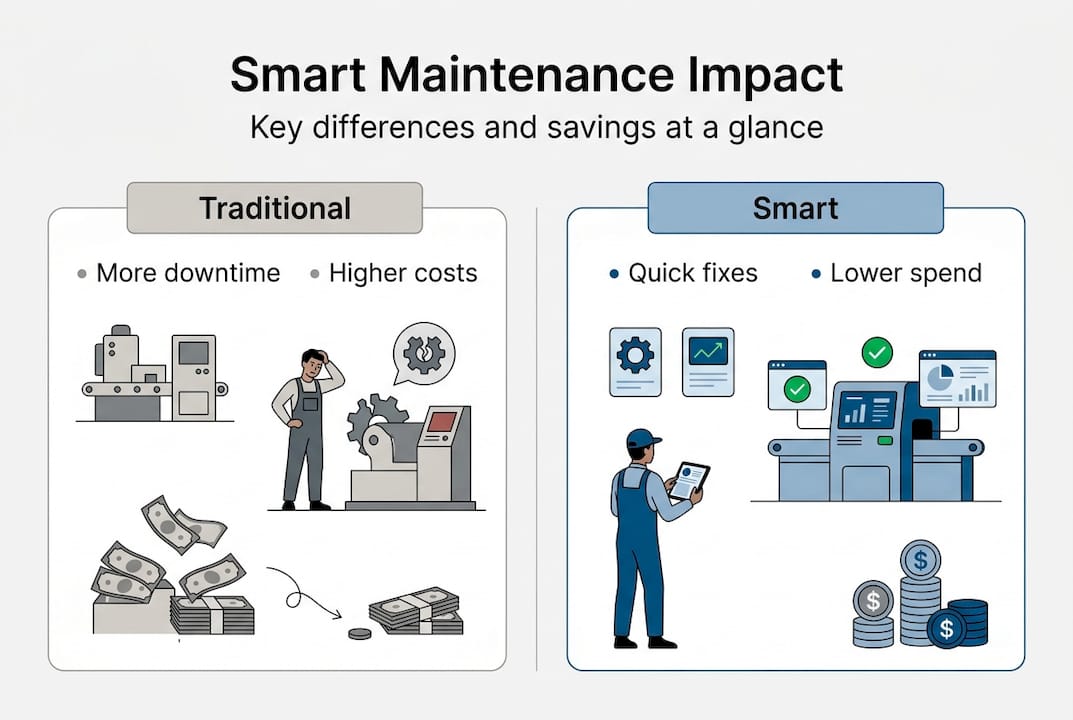
Smart maintenance reduces downtime by up to 30% and cuts operational costs, with many organisations achieving these results within the first year of full implementation. Exploring maintenance cost reduction approaches alongside smart maintenance tools accelerates these outcomes.
The impact extends across three critical areas of operations:
- Production schedules: Fewer unexpected stoppages mean production targets are met more consistently, improving customer commitments and revenue predictability.
- Maintenance budgets: Shifting from reactive to condition-based spending reduces emergency repair costs and allows more accurate budget forecasting.
- Regulatory compliance: Automated data logs and maintenance records simplify audit preparation and demonstrate adherence to safety and operational standards.
Implementing smart maintenance: Steps and pitfalls
Understanding the benefits is one thing. Translating them into operational reality requires a structured approach. Many organisations attempt to adopt smart maintenance too broadly and too quickly, which leads to integration failures and poor adoption. A phased, methodical rollout is consistently more effective.
Follow these steps to build a successful implementation:
- Assess your asset base: Identify which assets are most critical, most failure-prone, or carry the highest downtime cost. These are your starting priorities.
- Select appropriate technology: Match sensor types, analytics tools, and software platforms to the specific requirements of your target assets and operational environment.
- Define your KPIs: Establish clear metrics before launch, such as mean time between failures, maintenance cost per asset, and downtime frequency, so you can measure progress objectively.
- Train your team: Technicians, supervisors, and managers all need to understand how to interpret data outputs and act on system recommendations.
- Launch a pilot programme: Begin with one asset group or facility. This limits risk, accelerates learning, and produces evidence to support wider investment.
- Review and scale: Analyse pilot results against your KPIs, refine your approach, and expand to additional asset groups systematically.
A phased implementation with pilot programmes delivers better long-term outcomes than attempting a full-scale rollout from the outset. Reviewing asset lifecycle tips before you begin helps ensure your technology choices align with each asset’s stage and expected service life. Integrating asset lifecycle management principles from the start also prevents costly mismatches between monitoring investment and asset value.
Common pitfalls to avoid include skipping data integration between your CMMS and sensor platforms, which creates information silos and undermines the predictive capability of the entire system. Underestimating staff training is equally damaging. Technology without informed users produces alerts that are ignored and data that goes unanalysed.
Pro Tip: Start with a single asset group that has a clear failure history and measurable downtime cost. This gives you a controlled environment to demonstrate ROI quickly and build internal confidence for broader adoption.
What most managers miss about smart maintenance
Most smart maintenance initiatives that underperform do not fail because of technology. They fail because of people and processes. The tools are mature and capable. The gap is almost always in change management, cross-team communication, and the absence of structured feedback loops between maintenance data and operational decisions.
Conventional wisdom tends to focus heavily on ROI timeframes, often setting expectations of rapid payback that create pressure to scale before the pilot is truly understood. The longer-term value of accumulated maintenance data, which improves predictive accuracy over months and years, is consistently underestimated. This data becomes a strategic asset in its own right.
Organisations that succeed prioritise culture alongside technology. They invest in making maintenance data visible and meaningful to everyone from floor technicians to operations directors. Following essential preventive steps within a culture of continuous improvement, rather than treating smart maintenance as a one-time project, is what separates sustained performance from short-lived gains.
Take the next steps with smart maintenance solutions
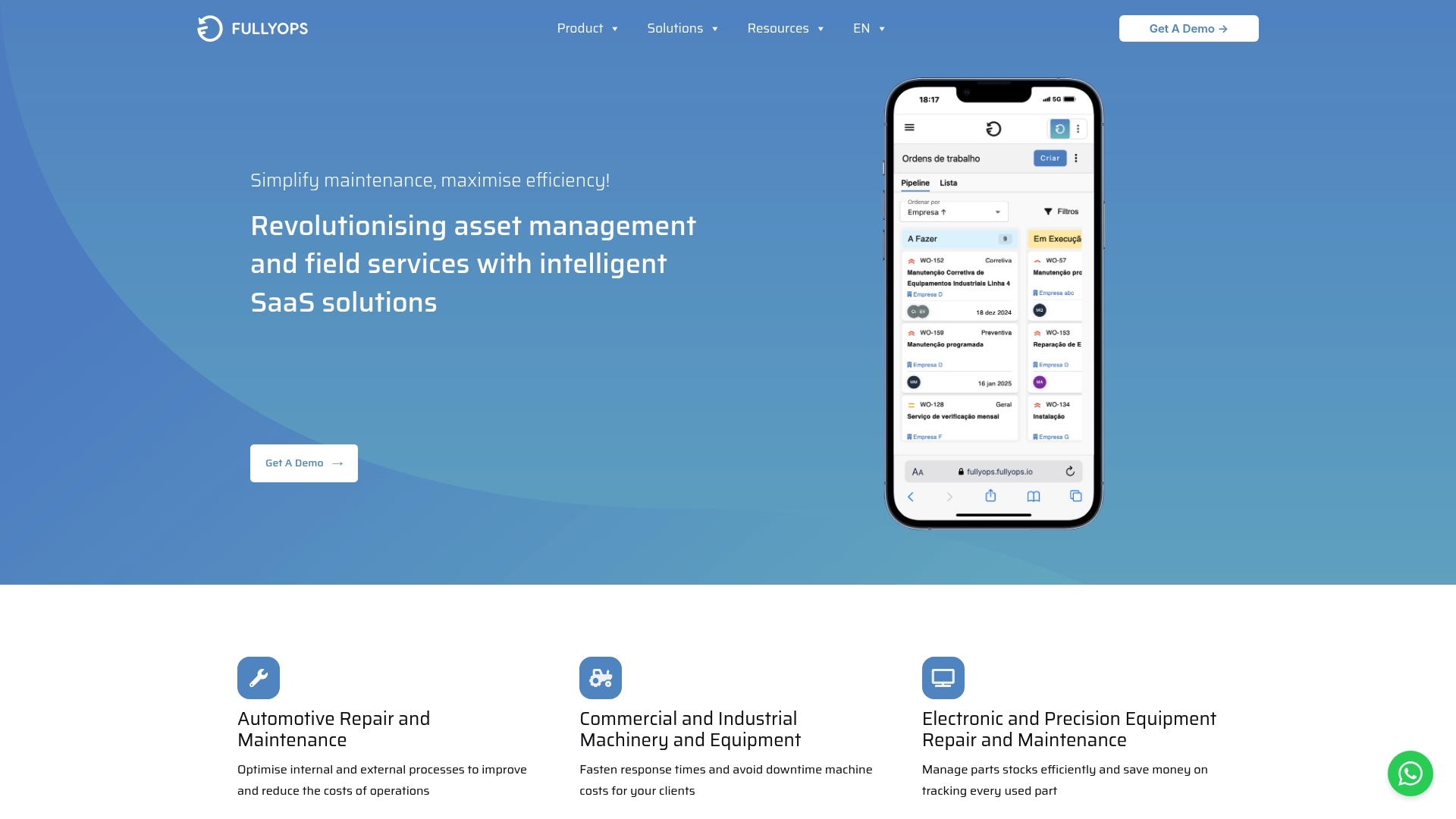
If you are ready to move from reactive to predictive, FullyOps provides the tools to make that transition structured and measurable. The platform supports allocation des ressources pour la gestion d'actifs, giving maintenance managers clear visibility over where time, budget, and personnel are deployed. With support for multiple systèmes de gestion d'actifs and a fully integrated approach to asset lifecycle management solutions, FullyOps helps operations teams build the data foundation that smart maintenance requires. Explore the platform to see how it fits your current operations and where it can deliver the most immediate value.
Questions fréquemment posées
How does smart maintenance differ from preventive maintenance?
Smart maintenance uses real-time data and predictive technologies to determine when intervention is needed, while preventive maintenance follows fixed schedules regardless of actual equipment condition. Smart maintenance is technology-driven and responds to live asset data rather than predetermined intervals.
What equipment is best suited for smart maintenance?
Critical assets with high downtime costs benefit most, including heavy machinery, HVAC systems, and production line equipment. Heavy machinery and essential infrastructure are ideal candidates because the cost of unexpected failure in these categories is highest.
What is the first step to implementing smart maintenance?
Begin by assessing your current asset base and identifying where real-time monitoring or data analytics can deliver the quickest value. A phased, asset-focused approach consistently delivers better outcomes than attempting a broad, simultaneous rollout.
How quickly can smart maintenance reduce costs?
Many organisations observe measurable reductions in downtime and maintenance budgets within 6 to 12 months of implementation. Smart maintenance can cut downtime by up to 30%, with cost savings becoming visible as predictive accuracy improves over time.