

En bref
- Uptime optimization involves proactively improving system availability to meet or exceed service level agreements. It relies on measuring key metrics like uptime percentage, detection and resolution times, and implementing architectural strategies such as redundancy and zero-downtime deployments. Organizational discipline, continuous monitoring, and regular incident reviews are essential to maintain high availability and prevent common failures.
Uptime optimisation is defined as the systematic practice of improving system availability to meet or exceed service level agreements, reducing unplanned downtime through proactive design, monitoring, and incident response. The industry term for this discipline is high-availability engineering, though operations managers and maintenance professionals use “uptime optimisation” to describe the same goal in practical terms. Availability tiers range from 99% for basic environments up to 99.95% and beyond for enterprise systems with automated failover and site reliability engineering. Understanding where your systems sit on that scale is the first step towards closing the gap between current performance and what your service level agreements actually require.

What is uptime optimization, and why does it matter?
Uptime optimisation is the continuous process of identifying, reducing, and preventing the conditions that cause systems or equipment to become unavailable. It sits at the intersection of technical architecture, monitoring discipline, and organisational process. For operations managers, it is not an IT concern alone. Every hour of unplanned downtime carries a direct cost in lost production, delayed service, and reputational damage.
The discipline connects directly to service level agreements (SLAs), which define the minimum availability a system must maintain. SLAs translate into Service Level Indicators (SLIs), which are the actual measurements, and Service Level Objectives (SLOs), which are the internal targets teams set to stay safely above SLA thresholds. Without this three-layer structure, availability targets remain aspirational rather than measurable.
The practical benefits of uptime optimisation extend beyond avoiding penalties. Teams that actively manage availability build faster incident response capabilities, reduce the cognitive load on engineers, and create systems that degrade gracefully rather than failing completely. That last point matters most in industrial and field service environments, where a total system failure can halt an entire production line.
What are the core metrics and components you need to track?
Effective uptime management depends on measuring the right things. The four metrics that operations teams should track consistently are:
- Uptime percentage: the proportion of time a system is available, expressed as a percentage over a defined period.
- Mean Time to Detect (MTTD): how long it takes to identify that a failure has occurred.
- Mean Time to Resolve (MTTR): the total time from detection to full restoration of service.
- Error rate: the frequency of failed requests or failed operations as a proportion of total volume.
MTTR is the metric most directly within an operations team’s control. Reducing MTTR requires clear incident response workflows, documented runbooks, and well-practised escalation paths. A team that detects an incident in two minutes but takes four hours to resolve it has a process problem, not a monitoring problem.
Conseil de pro : Set separate SLO targets for MTTD and MTTR. Treating them as one combined metric hides where your process is actually breaking down.
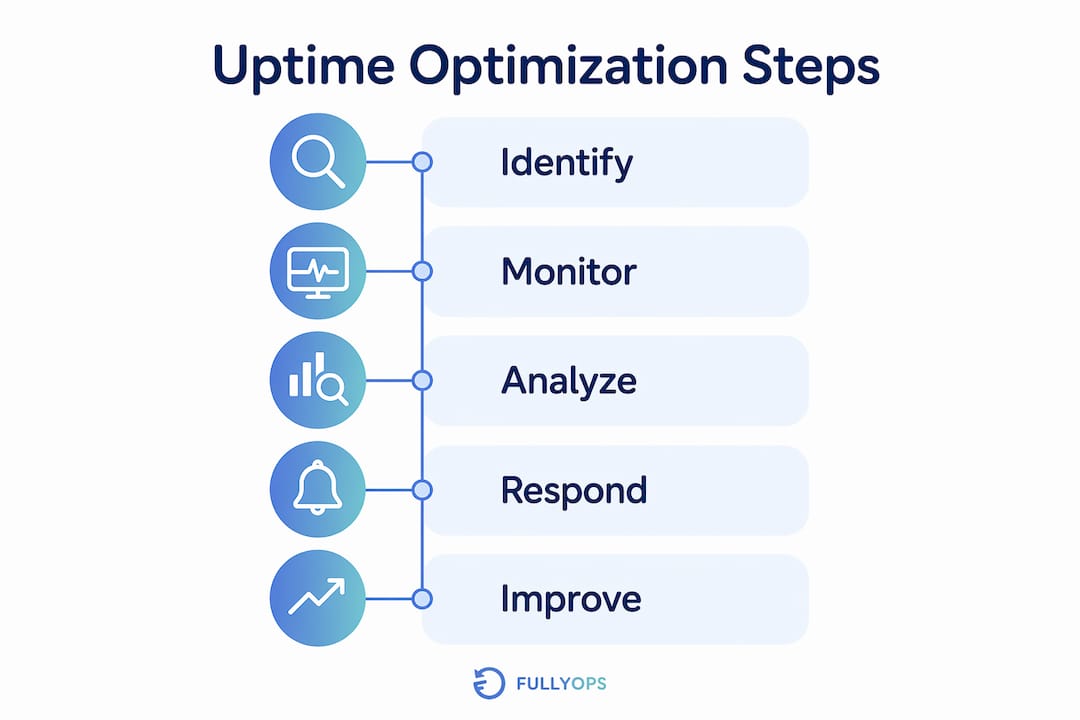
Monitoring falls into two categories: active monitoring, which checks real system behaviour in real time, and synthetic monitoring, which simulates user transactions from external locations to detect failures before real users do. Synthetic checks every 60 seconds from multiple regions give operations teams early warning of localised outages that internal monitoring misses entirely. Post-incident reviews, sometimes called post-mortems, close the loop by identifying root causes and preventing recurrence.
Which technical strategies underpin high-availability systems?
High availability is an architectural outcome, not a configuration setting. The strategies below represent the standard building blocks that operations and infrastructure teams combine to reach the upper availability tiers.
Redundancy: active-active vs active-passive
Active-active redundancy runs two or more identical systems simultaneously, sharing the load. If one fails, the others absorb traffic without interruption. Active-passive redundancy keeps a standby system idle until the primary fails, at which point traffic switches over. Active-active delivers higher resilience but costs more to run. Active-passive is a practical choice for systems where brief failover delays are acceptable.
Failover mechanisms should span at least two availability zones to eliminate hidden single points of failure, even in cloud-based architectures. Load balancers remove broken instances automatically based on health checks, which means failover happens without manual intervention. For operations teams managing industrial assets, the equivalent principle is geographic or physical separation of critical components.
Deployment strategies that avoid downtime
Blue-green deployments enable zero-downtime updates by maintaining two identical production environments. Traffic runs on the active environment (blue) while the new version is prepared on the idle environment (green). After smoke testing confirms the green environment is stable, traffic switches over instantly, with immediate rollback available if problems emerge. Canary deployments take a more gradual approach, routing a small percentage of traffic to the new version before committing fully.
Chaos engineering complements both strategies by deliberately introducing failures in controlled conditions to validate that resilience mechanisms actually work. Controlled chaos experiments in staging and production environments validate incident response readiness before a real failure exposes gaps. Teams that skip this step often discover their failover mechanisms have never been tested under realistic conditions.
Graceful degradation and circuit breakers
Graceful degradation allows systems to continue core functions with reduced capacity during partial failures, preserving the user experience. Non-critical services are temporarily restricted while critical functions remain available. Circuit breaker patterns complement this by automatically stopping requests to a failing component, preventing cascading failures from spreading across the system. For maintenance professionals managing interconnected equipment, graceful degradation is the operational equivalent of isolating a faulty machine without shutting down the entire production line.
Conseil de pro : Design your circuit breakers with explicit fallback responses. A system that returns a clear “service temporarily unavailable” message is far easier to diagnose than one that times out silently.
How can operations teams implement an uptime optimisation framework?
A structured approach removes guesswork from availability improvement. The five-step framework below gives operations teams a repeatable process:
- Assess risks and dependencies. Map every system component and identify single points of failure. Include third-party services, network paths, and physical infrastructure.
- Define SLAs and SLOs. Set availability targets that reflect business requirements, not technical ambition. A 99.95% SLO for a non-critical internal tool wastes resources.
- Deploy active and synthetic monitoring. Cover all critical paths from multiple geographic regions. Alert thresholds should trigger before users notice a problem.
- Establish incident response workflows. Document runbooks for the most common failure scenarios. Organisations that automate runbooks and enable self-healing systems significantly reduce MTTR and operational burden.
- Conduct post-incident reviews. Treat every significant incident as a learning opportunity. Identify root causes, update runbooks, and track whether corrective actions actually prevent recurrence.
Several of the most common outage causes are entirely preventable. Expired SSL certificates, configuration errors, and resource exhaustion account for a significant proportion of user-visible failures. Certificate expiry alerts at 30, 14, and 7 days before expiry give teams ample time to act. Setting early alert thresholds for resource utilisation, such as a disk space alert at 70–80% capacity, prevents sudden crashes and provides buffer time for remediation.
For maintenance professionals managing physical assets, the parallel is clear. Preventive maintenance schedules, parts inventory management, and maintenance optimisation practices follow the same logic: address the conditions that cause failure before the failure occurs.
Conseil de pro : Build your rollback procedure before you deploy, not after something goes wrong. A rollback that has never been tested is not a rollback plan.
What challenges and pitfalls arise in uptime optimisation?
The most common obstacles to sustained high availability are not technical. They are organisational and procedural.
- Alert fatigue. AI-driven alert correlation improves the signal-to-noise ratio by grouping related alerts into single actionable incidents. Teams that receive hundreds of low-quality alerts per day stop responding to them with urgency. Every alert that fires must be actionable, urgent, and accurate.
- Hidden single points of failure. Systems relying on a single availability zone risk complete outages from localised infrastructure events. Audit your architecture regularly for components that lack redundancy.
- Monitoring blind spots. DNS misconfigurations and slow database queries cause degraded performance that basic uptime checks miss entirely. Synthetic monitoring from external locations catches failures that internal health checks cannot see.
- Neglected dependencies. Third-party APIs, payment gateways, and external data feeds all introduce availability risk. Include them in your dependency map and monitor them as you would your own systems.
The cultural dimension is equally important. Uptime optimisation is a continuous improvement process that integrates technical design, monitoring sophistication, and organisational culture. Teams that treat availability as a project with an end date consistently underperform teams that treat it as an ongoing operational discipline. For fleet and field service operations, regular preventive service demonstrates the same principle: consistent attention to asset condition prevents the failures that reactive maintenance cannot.
Conseil de pro : Run a quarterly availability review that includes non-technical stakeholders. When operations managers and finance teams understand the cost of each downtime event, investment in resilience becomes easier to justify.
Principaux enseignements
Uptime optimisation requires a combination of sound architecture, disciplined monitoring, and a continuous improvement culture to sustain availability at enterprise-grade levels.
| Point | Détails |
|---|---|
| Define availability tiers clearly | Availability targets range from 99% to 99.95%+; match your SLO to actual business requirements. |
| Track MTTD and MTTR separately | Separating detection time from resolution time reveals exactly where your incident process breaks down. |
| Use blue-green deployments | Switching traffic between identical environments eliminates downtime during updates and enables instant rollback. |
| Prevent common outage causes | Alert on certificate expiry, resource utilisation at 70–80%, and configuration changes before they cause failures. |
| Treat uptime as a cultural practice | Teams that review incidents systematically and automate runbooks sustain higher availability than those that react to failures alone. |
Why uptime optimisation is harder than it looks
The technical side of high availability is well documented. The harder problem is organisational. In my experience working with operations and maintenance teams, the gap between a team that achieves 99.9% availability and one that struggles to reach 99% is rarely a technology gap. It is a process and prioritisation gap.
Teams that move from basic monitoring to genuine observability, meaning they understand why a system changed state rather than simply that it changed, resolve incidents faster and prevent more failures proactively. AI-driven correlation tools help, but they amplify good processes rather than replace them. A team with poor runbooks and no post-incident discipline will still struggle, even with the best alerting platform available.
The cost-versus-risk calculation also deserves honest attention. Chasing 99.99% availability for every system in your estate is neither practical nor necessary. The right target depends on the business impact of each system’s downtime. Spending heavily to protect a non-critical internal reporting tool is a misallocation of resources. Spending the same on a production control system or customer-facing service is entirely justified.
Graceful degradation is the most underrated strategy in this space. A system that fails partially but keeps its most critical functions running is far more valuable than one that fails completely and cleanly. Operations managers who design for partial failure from the outset build more resilient organisations than those who design only for full availability.
— Pedro
How Fullyops supports uptime and operational efficiency
Fullyops is a field service and asset management platform built for operations managers and maintenance professionals who need real-time visibility across their assets and workflows. The platform covers gestion des ordres de travail, intervention tracking, operational analytics, and inventory management, all in one place. For teams implementing an uptime optimisation framework, Fullyops provides the operational layer that connects maintenance schedules, technician deployment, and asset performance data. The tutoriel sur l'allocation des ressources on the Fullyops website walks operations teams through practical techniques for aligning maintenance resources with asset criticality, a direct input to any availability improvement programme.
FAQ
What is uptime optimization in simple terms?
Uptime optimisation is the practice of improving how reliably a system or asset remains available and operational. It combines proactive maintenance, monitoring, and incident response to reduce unplanned downtime.
What availability percentage should operations teams target?
Availability tiers range from 99% for basic systems to 99.95% and above for enterprise environments with automated failover. The right target depends on the business impact of each system’s downtime.
What is the difference between uptime and system availability?
Uptime measures the total time a system is operational. System availability expresses that figure as a percentage of total possible operating time, making it a more precise metric for SLA management.
How does MTTR relate to uptime improvement?
MTTR measures the average time taken to restore a system after a failure. Reducing MTTR through automated runbooks and clear escalation paths directly increases overall availability.
What causes most preventable outages?
Expired SSL certificates, configuration errors, and resource exhaustion are among the most frequent causes of preventable outages. Early alerting and regular audits address all three before they cause user-visible failures.
Recommandé
- What is equipment downtime? A guide for operations managers
- How to optimise operational performance in 2026
- Resources Management & Resource Allocation For Work Orders
- Maintenance scheduling guide to optimise asset uptime