

En bref
- Preventive maintenance proactively reduces costs, downtime, and asset failure risks.
- Proper documentation and regular scheduling improve asset reliability and safety.
- Implementing a digital system ensures maintenance consistency and strategic oversight.
Waiting for equipment to fail before acting is one of the most expensive habits in industrial operations. Coût des temps d'arrêt imprévus up to 30% more than scheduled maintenance, yet many facilities still run on a reactive basis. For operations managers tasked with keeping production lines moving and assets performing at their best, this approach carries serious financial and operational risk. Preventive maintenance offers a proven alternative: a structured, proactive model that reduces emergency repairs, extends asset life, and gives your team far greater control over operational outcomes. This article explains exactly what preventive maintenance is, why it matters, and how to implement it effectively.
Table des matières
- What is preventive maintenance?
- Why use preventive maintenance: Key benefits
- Preventive maintenance vs other maintenance strategies
- Implementing preventive maintenance: Best practices for success
- Why most operations teams underutilise preventive maintenance
- Take your maintenance strategy further with FullyOps
- Questions fréquemment posées
Principaux enseignements
| Point | Détails |
|---|---|
| Cut unplanned downtime | Preventive maintenance avoids unexpected equipment failures and production stoppages. |
| Lower maintenance costs | Planned upkeep is typically far less expensive than emergency repairs. |
| Boost asset reliability | Preventive routines help assets last longer and perform better. |
| Improve safety and compliance | Routine checks reduce safety hazards and support regulatory standards. |
What is preventive maintenance?
Preventive maintenance is a planned, scheduled approach to maintaining equipment and assets before failures occur. Rather than waiting for a machine to stop working, your team carries out regular inspections, servicing, and component replacements at defined intervals. The goal is to keep assets in optimal condition and intercept problems before they escalate into costly breakdowns.
At its core, preventive maintenance is built around three principles: regularity, documentation, and accountability. Tasks are planned in advance, carried out consistently, and recorded to build a clear history of each asset’s condition. This documented approach is what makes it fundamentally different from reactive maintenance, where work only happens after a failure has already disrupted operations.
Typical preventive maintenance activities include:
- Routine inspections to identify wear, corrosion, or misalignment early
- Lubrication and cleaning of mechanical components to reduce friction and contamination
- Scheduled parts replacement before components reach the end of their service life
- Calibration and testing to verify that equipment performs within specified parameters
- Safety checks to ensure compliance with regulatory requirements
Following clear steps for preventive maintenance is what gives this approach its measurable impact on asset reliability. A planned maintenance approach applied consistently across your asset base dramatically reduces the unpredictability that plagues reactive operations.
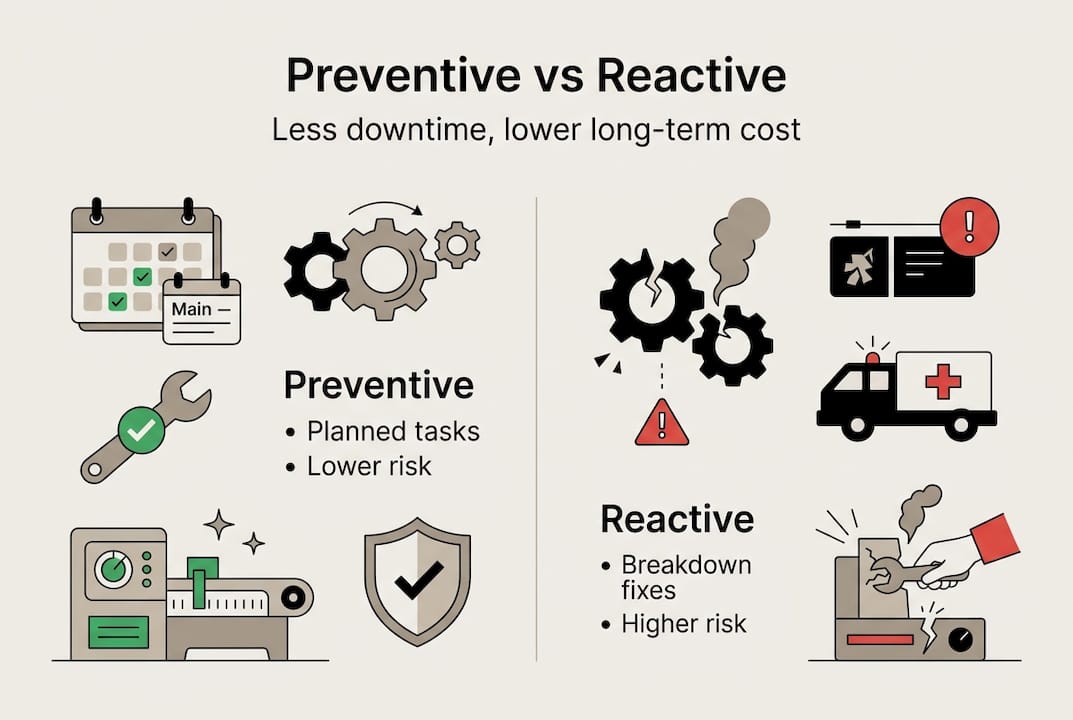
The table below illustrates the key operational differences between preventive and reactive maintenance:
| Factoriser | Maintenance préventive | Reactive maintenance |
|---|---|---|
| Cost | Predictable, lower long-term | Variable, often higher |
| Downtime | Planned and minimised | Unplanned and disruptive |
| Predictability | Haut | Faible |
| Asset longevity | Extended | Shortened |
| Planification des ressources | Structured | Reactive and rushed |
The contrast is clear. Preventive maintenance shifts your team from firefighting mode into a planned, controlled operational rhythm that supports long-term reliability.
Why use preventive maintenance: Key benefits
With a clear understanding of what preventive maintenance is, it is time to examine the benefits that drive its adoption across leading industrial facilities.
The business case for preventive maintenance is well established. Facilities that implement structured maintenance programmes consistently report lower operational costs, fewer emergency call-outs, and stronger safety performance. Here are the primary benefits:
- Reduced repair costs: Catching small problems early prevents them from becoming expensive failures requiring urgent labour and specialist parts.
- Improved asset reliability: Regularly serviced equipment performs more consistently, supporting production targets and reducing process variability.
- Extended asset lifespan: Proper maintenance preserves the condition of machinery, meaning assets remain productive for longer before requiring replacement.
- Better safety performance: Scheduled inspections and testing ensure that equipment operates within safe parameters, reducing the risk of accidents and regulatory non-compliance.
- Stronger compliance posture: Documented maintenance records provide auditable evidence that assets are maintained to required standards.
The financial impact is significant. Programmes designed to reduce maintenance costs can cut unplanned downtime and overall maintenance expenditure by up to 30%. For a mid-sized industrial facility, that figure translates directly into thousands of pounds saved annually.
“A 30% reduction in unplanned downtime is not just an operational win. It represents a material improvement in profitability, team efficiency, and asset value over the long term.”
Beyond costs, there is the question of operational predictability. When equipment fails unexpectedly, it disrupts production schedules, strains supply chains, and puts pressure on maintenance teams who must react quickly with limited resources. Preventive maintenance removes much of that uncertainty.

Reviewing examples of asset life extension across industrial sectors shows a consistent pattern: facilities that invest in preventive maintenance retain asset value far longer than those that rely on reactive approaches. The upfront commitment of time and resource pays back measurably across the asset lifecycle.
Preventive maintenance vs other maintenance strategies
Knowing the core benefits of preventive maintenance, it is important to compare it with the full spectrum of maintenance strategies to understand when and why it is the right choice.
Not every maintenance approach suits every situation. Operations managers working across varied asset types and operational environments need to understand the options available:
- Reactive maintenance: Work is carried out only after failure. It is low in planning effort but high in risk, cost, and disruption. Suitable only for non-critical, easily replaced assets.
- Preventive maintenance: Scheduled tasks are based on time or usage intervals. It is practical to implement across most asset types and offers strong reliability improvements without requiring advanced sensor infrastructure.
- Predictive maintenance: Data from sensors and monitoring systems is used to forecast failures before they occur. More precise than preventive but requires significant investment in technology and data capability.
- Run-to-failure: Assets are deliberately allowed to operate until they fail, with replacements ready. This makes sense only where failure has no safety or production impact and replacement cost is negligible.
As noted by researchers and practitioners alike, proactive vs preventive maintenance discussions often highlight that predictive maintenance leverages data for more precise interventions, but preventive maintenance remains more widely practical for most industrial environments due to its lower implementation complexity.
| Stratégie | Cost | Complexity | Downtime risk | Asset life impact |
|---|---|---|---|---|
| Réactif | Low upfront, high long-term | Faible | Très élevé | Negative |
| Préventive | Modéré | Modéré | Faible | Positive |
| Prédictif | Haut | Haut | Very low | Very positive |
| Run-to-failure | Very low | Very low | Extreme | Negative |
Pro Tip: If your facility is new to structured maintenance, start with preventive maintenance before investing in predictive technologies. Establish your asset inventory, build consistent documentation habits, and measure baseline performance first. Predictive tools deliver far more value when your foundational processes are already reliable.
Implementing preventive maintenance: Best practices for success
After evaluating where preventive maintenance fits in your overall strategy, here is how to ensure your programme delivers real results.
Launching or upgrading a preventive maintenance programme requires structured effort from the outset. Following a proven sequence of steps avoids the common pitfalls that cause programmes to stall or underdeliver:
- Conduct a full asset inventory: List every asset under your remit, including location, age, criticality, and manufacturer maintenance guidance. You cannot schedule what you have not identified.
- Prioritise by criticality: Focus initial planning on assets whose failure would cause the greatest operational or safety impact. Apply the most rigorous maintenance schedules there first.
- Define maintenance tasks and intervals: For each asset, specify what tasks are required and how frequently, based on manufacturer recommendations, regulatory requirements, and operational experience.
- Assign ownership and responsibilities: Every scheduled task should have a named owner. Ambiguity about who is responsible is one of the most common reasons maintenance schedules slip.
- Implement a tracking and recording system: Whether you use a spreadsheet, a computerised maintenance management system (CMMS), or a dedicated work order platform, consistent documentation is non-negotiable.
- Review and adapt regularly: Maintenance schedules should evolve based on failure history, asset performance data, and team feedback. A static plan quickly becomes outdated.
Structured workflows and digital tools enhance the impact of preventive maintenance by ensuring consistency across teams and shifts. Reviewing practical maintenance tips from facilities that have successfully scaled their programmes reveals a consistent theme: the teams that succeed are the ones that treat maintenance scheduling as a living process, not a one-time exercise.
Pro Tip: Implement a CMMS or digital work order system as early as possible. Paper-based systems are prone to gaps and make it nearly impossible to analyse trends or demonstrate compliance. Digital records give you the visibility needed to identify which assets are costing the most to maintain and where schedule adjustments are needed.
Avoid these common pitfalls: skipping task documentation because “the technician already knows what to do,” failing to close feedback loops when field staff identify emerging issues, and neglecting to update task lists after equipment modifications or upgrades.
Why most operations teams underutilise preventive maintenance
Even when the evidence for preventive maintenance is clear and accessible, many operations teams still fall short of its potential. The reason is rarely a lack of knowledge. It is almost always a combination of cultural resistance and short-term financial pressure.
When budgets tighten, planned maintenance tasks are often the first items deferred. The logic appears sound in the moment: the machine is still running, so why spend now? But this short-term thinking quietly accumulates risk that surfaces months later as a major, expensive failure.
Pressure to keep production running also causes teams to revert to reactive habits during high-demand periods. Preventive tasks are postponed, feedback from technicians is not acted upon, and gradually the programme loses its rigour. The tragedy is that this erosion happens precisely when reliable assets matter most.
Reviewing latest asset management trends reveals that the facilities achieving the best outcomes are those that make the invisible visible. They track downtime avoided, not just downtime experienced. They present stakeholders with data on failure costs prevented rather than only costs incurred.
“The true cost of neglect is rarely on the monthly balance sheet, but always on the annual report.”
Making that shift in how performance is reported changes the internal conversation. When decision-makers can see what preventive maintenance is saving rather than only what it costs, the case for sustained investment becomes far easier to defend.
Take your maintenance strategy further with FullyOps
Having reflected on the common pitfalls and the genuine value that structured preventive maintenance delivers, the next step is to put the right tools in place to make it sustainable. FullyOps is built specifically for operations and facilities management teams looking to move beyond reactive practices. From scheduling and work order management to tutoriel sur l'allocation des ressources guidance and performance reporting, the platform gives you the operational visibility needed to maintain assets proactively. Explore systèmes de gestion d'actifs suited to your environment, or work through a practical maintenance compliance checklist to identify your immediate priorities. Book a demonstration to see how FullyOps supports your maintenance goals.
Questions fréquemment posées
How does preventive maintenance reduce downtime?
By scheduling critical equipment upkeep before issues arise, preventive maintenance minimises unscheduled breakdowns and production halts. Preventive maintenance schedules are specifically designed to reduce unplanned stoppages across industrial operations.
What is the main disadvantage of preventive maintenance?
It requires regular planning and resources upfront, which can appear costly when compared with basic reactive fixes in the short term. Consistent scheduling and resource allocation are essential to sustain the programme effectively.
How often should preventive maintenance be performed?
The ideal frequency depends on asset type, usage patterns, and manufacturer guidelines; most plans use time-based or usage-based intervals. Maintenance schedules are typically structured around one or both of these approaches depending on operational context.
Can preventive maintenance improve safety?
Yes; regular inspections and repairs help prevent hazardous equipment failures and ensure compliance with safety regulations. Preventive maintenance supports safer, regulation-compliant operations across a wide range of industrial environments.