

To make your Class B pre-trip inspections compliant and auditable right now, you need three things in place: a DVSA-aligned digital checklist covering every mandatory field, a documented defect-to-repair-to-sign-off workflow, and electronic records retained for at least 15 months and accessible to the transport manager. The DVSA’s Guide to Maintaining Roadworthiness sets the statutory framework; under it, the driver carries legal responsibility for the vehicle’s condition during use, while the operator and transport manager are accountable for providing the system, tools, and oversight.
The six checklist groups every Class B pre-trip record must cover:
- Cab interior: seatbelts, mirrors, dashboard warning lights, wipers, horn, instruments
- Lights and signalling: headlamps, indicators, brake lights, hazards, number-plate light
- Tyres and wheels: tread depth, visible damage, inflation, wheel fixings
- Brakes: service brake feel, parking brake function, brake warning indicator
- Load security: load restraint, body condition, doors and latches
- Documents: operator licence disc, insurance, driver licence, vehicle identity
Table of Contents
- Why do UK legal duties apply to Class B vehicle checks?
- What should a DVSA-aligned Class B checklist contain?
- What data must your digital checklist capture for audit readiness?
- How do you scale inspections and monitor compliance across a fleet?
- Key takeaways
- Why the audit trail matters more than the checklist itself
- Fullyops supports compliant Class B inspection workflows
- Useful sources
- FAQ
Why do UK legal duties apply to Class B vehicle checks?
Operators must provide the inspection system and documented process; drivers or a designated responsible person must carry out and record the walkaround. That split of accountability is not optional — it is a condition of the operator licence.
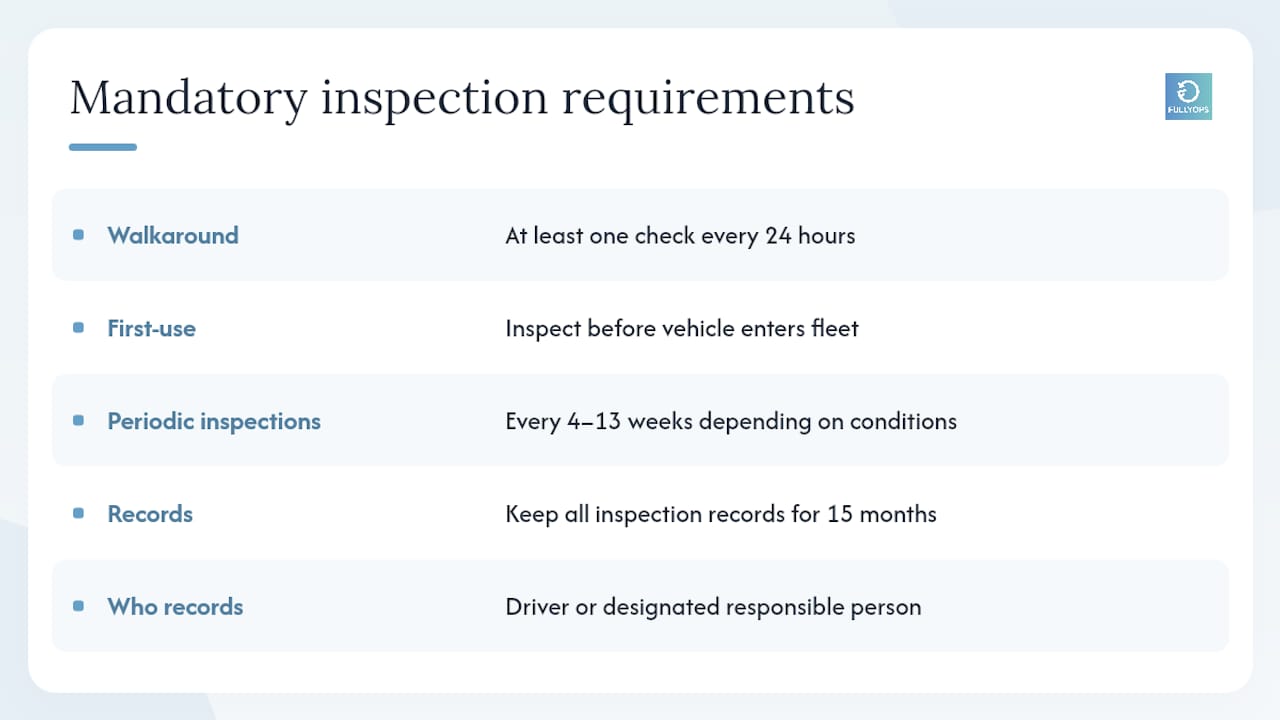
The DVSA guidance requires at least one walkaround check in every 24-hour period a vehicle is in service, a first-use inspection before a vehicle enters the fleet, and periodic safety inspections on a frequency of 4–13 weeks depending on operating conditions. All records must be kept for at least 15 months. The transport manager must review completed inspection sheets and confirm vehicles are declared roadworthy before return to service. When immediate access to records is not possible, written confirmation from the maintenance provider is required.
Compliance signal: A nil-defect report carries the same legal weight as a defect report. Missing nil reports in an audit trail can be treated as evidence that no check occurred, which may trigger enforcement action including fines or vehicle prohibition.
The operator and transport manager responsibilities include supplying a user-friendly digital device for reporting. A system that is difficult to use produces missed reports, and missed reports produce compliance failures. That is the practical argument for investing in well-designed fleet SaaS rather than paper forms.
What should a DVSA-aligned Class B checklist contain?
Every Class B pre-trip inspection checklist must include vehicle identity, cab interior, lights and signalling, tyres and wheels, brakes, fluids, load security, equipment condition, and documents. The DVSA van walkaround guidance lists 19 specific interior and exterior items and recommends the check takes approximately 10 minutes.
Breaking those groups into digital form fields:
- Documents: — operator licence, insurance certificate, driver entitlement
Each item needs a condition field (pass/fail/defect), a defect classification field (dangerous/major/minor), a free-text defect description, and a mandatory “nil defects” option for clean checks. The HGV walkaround guidance lists 27 items for HGVs and reinforces that defects must be recorded and reported in writing to the maintenance controller — the same principle applies to Class B fleets.
Pro Tip: Use conditional logic in your digital form so that towbar checks, tail-lift checks, and refrigeration unit checks only appear when those features are recorded against the vehicle asset. This keeps the form concise for drivers while capturing the right data for each vehicle variant.
What data must your digital checklist capture for audit readiness?
Every digital pre-trip record must capture operator name, date and ISO week, location, vehicle registration, odometer reading, inspector name, the full item list with condition for each, defect details, repair record, and a signed declaration of roadworthiness. Electronic records are acceptable provided they are exportable and readable on demand.
| Field | Data type | Purpose |
|---|---|---|
| Operator name | Text (auto-populated) | Identifies accountable party for audit |
| Date and ISO week | Date/auto-timestamp | Confirms inspection frequency compliance |
| Vehicle registration | Picklist (asset list) | Links record to vehicle history |
| Odometer reading | Numeric | Tracks usage-based inspection intervals |
| Location / depot | GPS stamp or picklist | Confirms where check was conducted |
| Inspector name | Text + electronic signature | Non-repudiable sign-off |
| Item condition (per item) | Picklist: pass/fail/defect | Structured audit trail per checklist item |
| Defect classification | Picklist: dangerous/major/minor | Triggers correct triage workflow |
| Defect description | Free text + photo | Evidence for work order creation |
| Repair record reference | Work order ID (linked) | Closes defect-to-repair loop |
| Roadworthiness declaration | Electronic signature + timestamp | Final return-to-service control point |
Optional but high-value fields include GPS coordinates at time of submission, technician timesheet linkage, part numbers used in repair, and post-repair brake test verification. Linking inspection records to maintenance reporting workflows ensures defect evidence and repair evidence sit in the same audit bundle rather than in separate systems.
Pro Tip: Configure electronic signatures with a timestamp and device ID so that sign-offs are non-repudiable. Export the full record as a PDF bundle (checklist, defect photos, work order, invoice, brake test, declaration) so it can be produced for a DVSA check in minutes rather than hours.
How do you scale inspections and monitor compliance across a fleet?
Set inspection frequency using a risk-based approach: map each vehicle’s operating conditions to the 4–13 week safety inspection guidance, and shorten intervals for arduous or off-road use or for vehicles over 12 years old. For high-use Class B vans in demanding conditions, schedule intermediate checks on tyres, suspension, and ancillary equipment within the operating day.
| Operating condition | Suggested safety inspection interval | Intermediate checks |
|---|---|---|
| Light urban use, low mileage | Up to 13 weeks | Not required |
| Mixed urban/motorway, moderate mileage | 8–10 weeks | Tyres and lights monthly |
| High mileage, multi-drop delivery | 6–8 weeks | Tyres and brakes fortnightly |
| Arduous/off-road, construction sites | 4–6 weeks | Tyres, suspension, and ancillaries weekly |
| Vehicles 12+ years old (any condition) | 4–6 weeks | Tyres and brakes fortnightly |
KPIs to monitor across the fleet:
- Percentage of vehicles with nil-defect reports filed on schedule
- Late or missing periodic maintenance inspection (PMI) reports
- Repeat defects per vehicle (same item failing across consecutive checks)
- Average time from defect report to closed work order
- Percentage of sign-offs with photo evidence attached
Auditing the system should start early, with a sample of three vehicles followed through their last three inspection cycles. Match planner dates to completed inspection records, defect reports, repair evidence, and final sign-offs. Any break in that chain — a late PMI sheet, an unlinked invoice, a missing declaration — is a finding to escalate to the transport manager.
Key takeaways
A compliant Class B pre-trip inspection system requires a DVSA-aligned digital checklist, an enforced defect-to-sign-off workflow, and 15-month electronic record retention accessible to the transport manager.
| Point | Details |
|---|---|
| Daily walkaround is a legal duty | Drivers must complete and record a check at least once every 24 hours the vehicle is in service. |
| Nil-defect reports are mandatory | Missing nil reports can be treated as evidence no check occurred, triggering enforcement action. |
| Records retained for 15 months | All inspection and repair records must be kept for at least 15 months and be exportable on demand. |
| Defect chain must be unbroken | Every defect record must link to a work order, repair invoice, and signed roadworthiness declaration. |
| Fullyops closes the audit trail | Fullyops provides templated DVSA-aligned checklists, automated work order creation, signature capture, and exportable audit bundles. |
Why the audit trail matters more than the checklist itself
The conventional wisdom in fleet compliance focuses on the checklist: get the right items on the form, train the driver, tick the boxes. That framing misses the more consequential half of the problem. A completed checklist that sits disconnected from a repair record, an invoice, and a signed declaration is not evidence of control — it is evidence of a process that started but did not finish.
What DVSA and Traffic Commissioners actually scrutinise is the chain: did the defect get reported, was a decision made, was the repair carried out and verified, and did a responsible person confirm the vehicle was fit before it went back on the road? A fleet that answers yes to all four, with dated and signed records to prove it, is in a fundamentally different position from one that has a well-designed checklist but no enforced workflow downstream.
The practical implication for fleet managers is to invest as much configuration effort in the defect triage rules, work order linkage, and sign-off gates as in the checklist fields themselves. The checklist is the input; the closed, signed audit bundle is the output that matters.
Fullyops supports compliant Class B inspection workflows
Fleet managers who need DVSA-aligned pre-trip inspections mapped into a live system get a concrete operational advantage with Fullyops: templated checklists, automatic defect-to-work-order routing, photo and signature capture, and exportable audit bundles — all in one platform, without building the workflow from scratch; explore Fleet vehicle detailing best practices for fleet managers to complement your inspection protocols.
The specific features to configure for Class B compliance: templated digital inspection forms with conditional logic, automated work order creation triggered by defect classification, electronic signature and timestamp capture for roadworthiness declarations, KPI dashboards tracking nil-report rates and time-to-repair, and 15-month record retention with export. The work order management process in Fullyops closes the defect-to-sign-off loop that paper systems and disconnected spreadsheets cannot reliably maintain. For teams ready to move from reactive record-keeping to predictive maintenance, inspection data feeds directly into asset reliability analysis.
Request a product demo at fullyops.com to see the Class B inspection templates and defect workflow configuration in a live environment.
Useful sources
- guide-to-maintaining-roadworthiness-commercial-goods-and-public-service-vehicles.pdf
- Guide to maintaining roadworthiness: commercial goods and passenger carrying vehicles
- Carry out van daily walkaround checks
- Carry out HGV daily walkaround checks
- The walkaround check: a legal duty and safety priority
- HGV maintenance records: how to prove roadworthiness
FAQ
What items must a Class B van pre-trip inspection cover?
DVSA guidance identifies 19 key areas for van walkaround checks, including cab interior, lights, tyres, brakes, fluids, load security, and documents. Every item must be recorded with a pass, fail, or defect classification.
How long must Class B inspection records be kept?
All inspection and repair records must be retained for at least 15 months. Electronic records are acceptable provided they are exportable and readable on demand by the transport manager or DVSA.
Who is responsible for the pre-trip inspection system?
The driver is legally responsible for the vehicle’s condition during use. The operator and transport manager are responsible for providing the inspection system, reviewing completed records, and confirming vehicles are roadworthy before return to service.
What happens if a dangerous defect is found before departure?
The vehicle must be taken off road immediately and must not be used until the defect is repaired and a responsible person has issued a signed roadworthiness declaration. Operating a vehicle with a dangerous defect risks prohibition, fines, and operator licence consequences.

Can Fullyops manage the full Class B inspection workflow?
Fullyops provides DVSA-aligned digital inspection templates, automated defect-to-work-order routing, electronic signature capture, and exportable audit bundles that cover the complete pre-trip inspection and return-to-service process.
Recommended
- Operation and maintenance: the complete UK guide for 2026
- Maintenance compliance checklist for industrial success
- Computer-aided facility management: a practical UK guide
- What is maintenance compliance? A guide for operations managers