

Unplanned downtime is one of the most expensive problems in industrial operations, and most facilities are not measuring the one thing that could help them control it: maintenance hours. Unplanned downtime costs the industry $50 billion annually, with individual incidents averaging $260,000 per hour. Yet many facility managers still rely on rough estimates or paper logs to account for technician time. Precise hour tracking connects maintenance effort directly to downtime reduction, cost control, and performance improvement, giving you the data foundation needed to move from reactive firefighting to proactive asset management.
Índice
- The real cost of untracked maintenance
- How tracking maintenance hours transforms your operations
- Key maintenance KPIs unlocked by hour tracking
- Practical methods: how to track hours accurately
- Common pitfalls and expert tips
- Take your maintenance hour tracking further with digital tools
- Perguntas mais frequentes
Principais conclusões
| Ponto | Detalhes |
|---|---|
| Expose true maintenance costs | Tracking hours gives a transparent view of where labour and money go in your operation. |
| Unlock actionable KPIs | Logged time enables real measurement of preventive maintenance, downtime, and productivity. |
| Justify preventive investment | Precise hour tracking proves the cost effectiveness of scheduled maintenance strategies. |
| Improve resource allocation | Clear labour data helps you staff efficiently and target bottlenecks across locations. |
The real cost of untracked maintenance
When maintenance hours go unrecorded or are logged inconsistently, the financial consequences accumulate quietly. Hidden overtime, duplicated effort, and misallocated resources all become invisible to management. Without accurate hour data, budget forecasting is little more than guesswork, and justifying investment in preventive strategies becomes nearly impossible.
The gap between reactive and planned maintenance is stark. Reactive maintenance costs three to nine times more per task than planned work, and organisations that shift to preventive strategies report a return on investment of up to 545%. Tracking hours is the mechanism that quantifies this gap and makes the business case undeniable.
Without hour-level visibility, you cannot distinguish between a well-run maintenance programme and one that is quietly haemorrhaging budget on avoidable reactive work.
Consider what untracked hours actually conceal:
- Hidden overtime costs that inflate labour budgets without explanation
- Resource waste from technicians repeatedly attending the same assets due to incomplete repairs
- Blind budget spots where entire job categories are never costed accurately
- Inability to benchmark performance against industry standards or previous periods
Facilities that address this can cut downtime by 30% through better planning alone. Structured maintenance planning steps depend entirely on reliable hour data to sequence work, allocate resources, and measure outcomes.
How tracking maintenance hours transforms your operations
Hour tracking is not simply an administrative task. It is the foundation for operational transparency. When you log time by job type, asset, and technician, patterns emerge that would otherwise remain hidden in the noise of daily operations.

Tracking maintenance hours enables accurate labour cost calculation by multiplying logged hours against hourly rates, revealing precisely where time is spent across work categories such as preventive versus reactive maintenance. This level of detail supports smarter budgeting, fairer workload distribution, and more credible reporting to senior management.
Pro Tip: Break your hour logs into at least three categories: preventive maintenance, reactive maintenance, and inspections. This simple split immediately reveals your planned versus unplanned ratio and gives you a starting point for improvement targets.
The table below illustrates the operational difference between facilities that track hours and those that do not:
| Operational area | Without hour tracking | With hour tracking |
|---|---|---|
| Labour cost visibility | Estimated or unknown | Calculated per job type |
| Bottleneck identification | Reactive and delayed | Proactive and data-driven |
| Budget justification | Difficult to evidence | Supported by logged data |
| Performance benchmarking | Impossível | Enabled against maintenance KPIs |
| Afetação de recursos | Based on intuition | Based on actual time data |
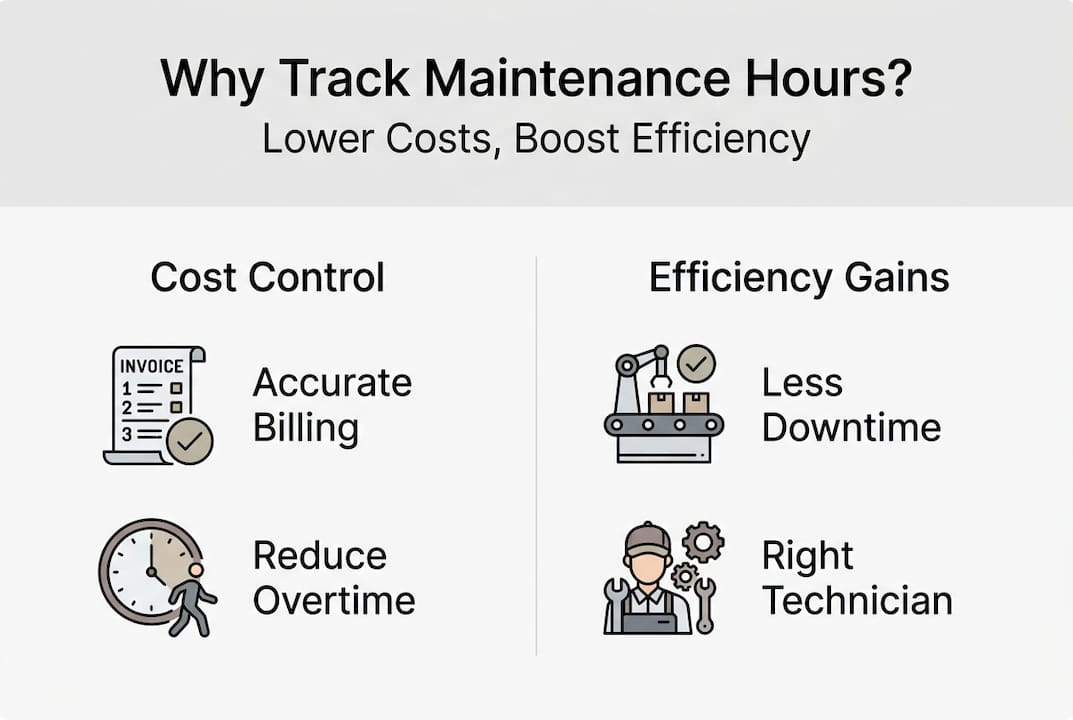
Eficaz gestão de ordens de trabalho relies on this data to assign the right technician to the right job at the right time. Understanding the role of CMMS (Computerised Maintenance Management System) in centralising this information is essential for any facility operating more than a handful of assets.
Key maintenance KPIs unlocked by hour tracking
Hour tracking directly enables a set of performance metrics that are otherwise impossible to calculate with confidence. These are not vanity numbers; they are the indicators that predict future failures and guide staffing decisions.
The most important metrics include:
- Planned Maintenance Percentage (PMP): Calculated as planned hours divided by total maintenance hours, multiplied by 100. The industry average sits at 55 to 65%, while world-class operations achieve 80 to 90%. Higher PMP directly reduces unplanned downtime and associated costs.
- Tempo médio entre falhas (MTBF): Measures asset reliability over time. Industry averages range from 200 to 400 days depending on asset type, and tracking hours against failure events enables accurate MTBF calculation and benchmarking.
- Wrench time: The proportion of technician time spent on hands-on maintenance tasks, as opposed to travel, waiting, or administration.
- Maintenance backlog: Total hours of outstanding work orders, expressed in weeks. This metric signals whether your team is keeping pace with demand or falling behind.
- Schedule compliance: The percentage of planned work completed on time, which depends entirely on accurate hour logging to measure.
For facilities aiming to optimise asset uptime, these KPIs provide the benchmarks needed to set realistic targets and measure progress. Structured maintenance planning becomes far more effective when it is informed by actual performance data rather than assumptions.
A key insight: Facilities that move their PMP from the industry average of 60% to the world-class threshold of 85% typically see a significant reduction in emergency callouts and a measurable improvement in asset lifespan.
Practical methods: how to track hours accurately
Knowing why to track hours is only half the challenge. The other half is building a reliable system that technicians will actually use consistently. The good news is that modern tools make this far simpler than it was even five years ago.
Effective hour tracking methods include:
- Digital timers on work orders: Technicians start and stop a timer directly within the work order, capturing actual time without relying on memory at the end of a shift
- End-of-job entry via mobile devices: Handheld entry immediately after task completion reduces estimation errors and improves data quality
- Direct CMMS integration: Logging hours on work orders and tagging them by type (preventive or reactive) feeds PMP calculations automatically, removing manual aggregation
- Standardised hour codes across sites: Using consistent codes for job types enables apples-to-apples comparison across multiple facilities or shifts
- Tagging by asset criticality: Linking hours to specific assets allows you to identify which equipment consumes the most maintenance resource relative to its operational importance
Pro Tip: If you manage multiple sites, agree on a single set of hour codes before rolling out any tracking system. Inconsistent categorisation is the most common reason multi-site KPI comparisons fail to produce actionable insights.
Adopting software de manutenção baseado na nuvem removes the friction of manual data entry and ensures that hour data is available in real time, rather than being compiled days later from paper records.
Common pitfalls and expert tips
Even well-intentioned hour tracking programmes can produce misleading results if they focus on the wrong metrics or ignore important context. Understanding the most common mistakes helps you avoid them.
Wrench time averages just 25 to 35% of total technician time in most industrial facilities. The remaining time is spent on travel, waiting for parts, planning, and safety checks. Tracking only wrench time gives a distorted picture of productivity and can lead to unrealistic targets that demoralise technicians.
Armadilhas comuns a evitar:
- Over-indexing on wrench time without accounting for necessary non-productive activities like safety briefings, parts collection, and documentation
- Ignoring leading KPIs in favour of lagging indicators; PMP and schedule compliance predict future performance, while MTBF only tells you what has already happened
- Failing to link hours to asset criticality, which means treating a minor pump and a critical production line compressor as equivalent maintenance priorities
- Inconsistent logging practices across shifts or sites, which undermines the reliability of any KPI calculated from the data
Expert guidance consistently recommends focusing on leading KPIs such as PMP and schedule compliance rather than lagging metrics alone, and pairing hour data with asset criticality scores to ensure that resources are directed where they matter most.
For practical guidance on applying these principles, the maintenance optimisation tips available from FullyOps cover how to structure your tracking approach for maximum operational impact.
Take your maintenance hour tracking further with digital tools
Manual tracking methods introduce errors, delays, and inconsistencies that undermine the very KPIs you are trying to improve. FullyOps automates hour capture directly within ordens de serviço digitais, ensuring that every minute of technician time is logged accurately and tagged to the correct asset, job type, and work order. The platform supports multi-site operations with standardised processes, enabling genuine benchmarking across facilities. If you are ready to optimise maintenance performance and move beyond spreadsheets, FullyOps provides the reporting, KPI tracking, and alocação eficiente de recursos tools that industrial maintenance teams need to operate with confidence.
Perguntas mais frequentes
What is the best way to log maintenance hours?
Using a digital CMMS or maintenance software ensures accuracy and enables automated reporting, far outpacing manual spreadsheets or paper logs. Logging hours via timers on work orders and tagging by job type feeds KPI calculations automatically.
How does tracking hours support preventive maintenance?
It quantifies the true split between planned and reactive work, enabling you to prove the cost benefit and justify increasing scheduled maintenance. Reactive maintenance costs three to nine times more than planned work, making the financial case straightforward once hours are accurately logged.
What KPIs are most improved by tracking hours?
Planned Maintenance Percentage, MTBF, and schedule compliance all depend on precise hour data for benchmark tracking and improvement. The industry average PMP of 55 to 65% can be improved significantly with consistent hour logging and structured planning.
Are there any risks with tracking maintenance hours too closely?
Yes, over-focusing on metrics like wrench time can produce a narrow and misleading view of productivity. It is better to track a balanced mix of leading and lagging KPIs, and expert guidance recommends pairing hour data with asset criticality to ensure prioritisation reflects operational risk rather than raw time figures.
Recomendado
- Software de manutenção baseado na nuvem: 60% de eficiência e 25% de menos tempo de inatividade
- Otimização da manutenção em 2026: reduzir o tempo de inatividade em 30%
- Guía Fascinante De Mantenimiento Técnico: Claves 2026
- Gids vrachtwagen onderhoud 2026: praktisch voor transportbedrijven