

Resumo:
- Tracking technician hours provides real-time data essential for controlling costs and improving workforce productivity. Automating time capture and analyzing wrench time uncover systemic inefficiencies, enabling targeted operational improvements. Using transparent communication and flexible tools fosters technician buy-in, ensuring accurate data collection and continuous process enhancement.
Tracking technician hours is defined as the precise, systematic recording of time each technician spends on specific tasks, work orders, and jobs across an industrial operation. This practice, formally known as labour time capture within field service management, gives operations managers and maintenance administrators the real-time labour data needed to control costs, allocate resources accurately, and measure workforce productivity. Tools such as Procore timesheets and TimeClick demonstrate how modern platforms make this process both accurate and auditable. Without reliable hour-level data, budget overruns go undetected until invoicing, staffing decisions rest on guesswork, and productivity losses remain invisible.
Why track technician hours: the direct link to job costing
Tracking technician hours improves job costing accuracy by enabling managers to compare budgeted hours against actual hours in near real time, rather than discovering variances only after a job closes. This distinction matters enormously in industrial maintenance, where a single work order can involve multiple trades, cost codes, and asset systems. When you can see that a planned four-hour electrical inspection has consumed six hours by midday, you can intervene, reassign resources, or revise the scope before the overrun compounds.

Cost code granularity in timesheet records connects each hour worked to a specific task or work package, producing the variance analysis that site-level managers and financial controllers both need. In construction and industrial plant settings, this level of detail separates profitable contracts from loss-making ones. A maintenance team servicing a production line, for example, can attribute labour costs precisely to preventive maintenance, corrective repairs, or capital improvement work, each of which carries different budget authorisations and reporting requirements.
The operational benefit extends beyond finance. When managers hold accurate, current data on hours consumed per job, they can maintain realistic schedules, avoid overloading individual technicians, and make evidence-based decisions about subcontracting or overtime. This is the core reason why the importance of technician time tracking is recognised across sectors from oil and gas to facilities management.
| Tracking element | Vantagem operacional |
|---|---|
| Budgeted vs. actual hours | Enables mid-job corrective action before costs escalate |
| Cost code attribution | Links labour spend to specific tasks for variance analysis |
| Real-time reporting | Supports schedule management and resource reallocation |
| Historical labour data | Informs future job estimates and staffing plans |
Dica profissional: Set up cost code alerts in your time tracking platform so that any work order exceeding 80% of its budgeted hours triggers an automatic notification to the responsible supervisor. This prevents overruns from becoming visible only at month-end.
How does precise time tracking improve payroll accuracy?
Payroll errors in maintenance operations typically originate from manual timesheet entry, memory recall at the end of a shift, and inconsistent recording of breaks and overtime. Precise timestamping eliminates these sources of error by recording every clock-in and clock-out event automatically, with an audit trail that logs any subsequent edits. TimeClick, for instance, records each punch with an exact timestamp, calculates overtime before export, and flags any manual adjustments for review. This means payroll administrators receive clean, verified data rather than handwritten sheets that require reconciliation.
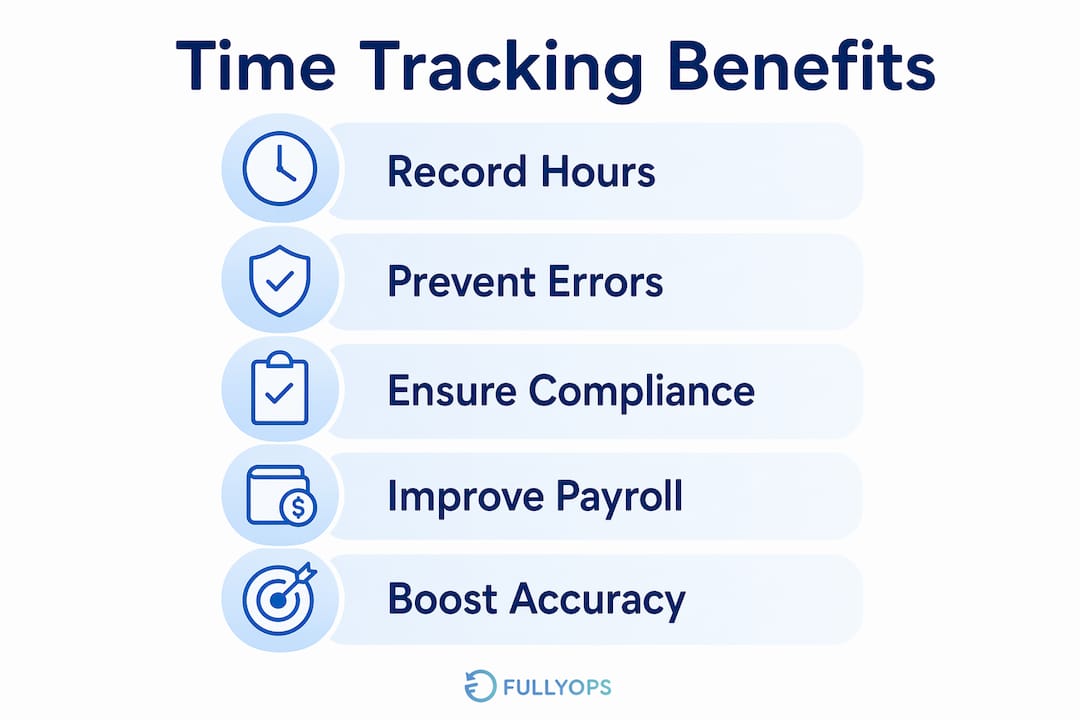
The compliance dimension is equally significant. Automated overtime calculations and break-time records create the documentary evidence required during labour audits or disputes. Automated overtime flagging before payroll export prevents unexpected cost surprises and supports compliance with working-time regulations. For operations running multiple shifts across different sites, this audit trail is not a convenience but a legal necessity.
Beyond compliance, payroll accuracy directly affects workforce morale. Technicians who are consistently paid correctly and on time develop greater trust in management systems. Conversely, repeated payroll errors, even minor ones, erode confidence and increase turnover. The benefits of tracking hours therefore extend well beyond the finance department.
Key payroll and compliance benefits of precise time tracking include:
- Exact timestamps replace error-prone manual entries and end-of-shift memory recall
- Automatic overtime and break calculations reduce administrative workload for payroll teams
- Full audit trails provide documented evidence for compliance reviews and dispute resolution
- Consistent payroll accuracy supports technician morale and reduces voluntary turnover
- Clean data exports to payroll systems reduce reconciliation time and processing errors
What is wrench time and why does it matter?
Wrench time is defined as the percentage of paid working hours a maintenance technician spends on direct, hands-on maintenance tasks, as opposed to travelling to a job, waiting for parts, completing paperwork, or attending briefings. Most plants calculate wrench time incorrectly, missing key inefficiency causes such as waiting for parts or poor job planning, which means their productivity figures are systematically overstated. Understanding this metric requires more than simply logging total hours worked. It demands a breakdown of how those hours are actually spent.
The practical value of wrench time analysis lies in identifying systemic inefficiencies rather than attributing poor output to individual technicians. If a technician spends 40% of a shift waiting for a spare part to arrive from stores, that is a supply chain or inventory management problem, not a performance problem. Technician productivity gains result more from system improvements than from simply logging more hours worked. This reframing is critical for operations managers who want to use time data constructively.
To improve wrench time in your operation, follow this structured approach:
- Establish a baseline. Use a combination of direct observation and CMMS self-reporting to measure current wrench time across your technician workforce. Combining both methods yields the most reliable data.
- Categorise non-wrench activities. Separate lost time into distinct categories: travel, parts waiting, administrative tasks, and unplanned interruptions. Each category points to a different systemic fix.
- Identify the highest-impact causes. Prioritise the categories consuming the most time. Parts waiting and travel are typically the largest contributors in industrial plant environments.
- Implement targeted improvements. Address root causes directly. Kitting parts in advance, repositioning tool stores, and pre-planning work orders are proven interventions.
- Measure again after changes. Wrench time improvement is iterative. Re-measure after each intervention to confirm the impact and identify the next constraint.
Dica profissional: Do not rely solely on self-reported wrench time data. Periodic direct observation studies, even short ones covering a sample of shifts, provide a calibration check that reveals gaps between reported and actual productive time.
How do you overcome technician resistance to time tracking?
Employee resistance to time tracking often stems from fears of surveillance, mistrust of management intent, and concerns about increased administrative workload rather than objections to the tool itself. Technicians who have worked under informal arrangements for years may interpret the introduction of hour-level recording as a signal that management no longer trusts them. This perception, if left unaddressed, will undermine adoption regardless of how well the software functions.
The most effective counter to this resistance is transparent communication about purpose. Framing time tracking as a transparency tool rather than a surveillance mechanism builds a healthier working relationship and reduces resistance. NinjaOne’s guidance on this topic recommends focusing on outcomes, using automated timers to minimise manual effort, and communicating clearly why the data is being collected and how it will be used. When technicians understand that hour data informs staffing decisions, prevents burnout, and supports fair workload distribution, the framing shifts from control to support.
Practical steps to improve adoption include:
- Involve technicians in selecting or configuring the time tracking tool to build a sense of ownership
- Use automated timers and mobile logging to reduce the manual burden on individual technicians
- Share aggregated time data with the team to demonstrate how it informs scheduling and resource decisions
- Avoid using individual hour data punitively, particularly in early adoption phases
- Conduct brief team sessions to explain how tracking prevents overloading and supports fair overtime distribution
Overly rigid or manual time tracking can negatively affect technician morale and adoption rates. Flexible logging options, such as mobile apps that allow technicians to log time at the point of work rather than retrospectively, significantly reduce friction and improve data quality simultaneously.
What are the best tools and practices for automating technician hour tracking?
Automation is the single most reliable way to improve the accuracy and consistency of technician hour recording. PSA platforms such as ConnectWise, Syncro, and Halo PSA automatically log time against tickets and work orders with minimal manual input, reducing the gap between time spent and time recorded. Integrating time tracking with ERP and payroll systems streamlines workflows and ensures accurate cost allocation and billing processes, removing the manual transfer of data between systems that introduces errors.
The table below compares the key capabilities that distinguish basic time logging from fully integrated technician hour tracking:
| Capacidade | Basic time logging | Integrated tracking |
|---|---|---|
| Data entry method | Manual, end-of-shift | Automated, point-of-work |
| Cost code attribution | Manual or absent | Automatic via work order |
| Overtime calculation | Manual, error-prone | Automated before export |
| Audit trail | Limited or none | Full edit history |
| Payroll integration | Manual export | Direct system integration |
| Wrench time analysis | Not available | Available via reporting |
Automation using PSA-integrated tools can log technician time automatically, reducing manual errors and increasing reporting accuracy. Beyond the initial setup, the discipline of regular review sessions is what sustains data quality over time. Weekly scans and quarterly feedback sessions help identify missing entries, inconsistent logs, and provide a basis for constructive feedback without creating a culture of surveillance.
For industrial maintenance operations specifically, the essential features for tracking technician time include precise timestamps, audit logs, automatic overtime management, mobile access for field technicians, and integration with CMMS or ERP platforms. Operations that invest in these capabilities report fewer payroll disputes, more accurate job costing, and better visibility into workforce productivity.
Dica profissional: Schedule a monthly data quality review where a supervisor checks a random sample of work orders for completeness of time entries. This creates accountability without requiring constant monitoring and catches systemic logging gaps before they distort reporting.
Principais conclusões
Tracking technician hours delivers measurable gains in job costing accuracy, payroll compliance, and workforce productivity only when combined with automation, transparent communication, and regular data review.
| Ponto | Detalhes |
|---|---|
| Real-time job costing | Compare budgeted and actual hours mid-job to prevent cost overruns before invoicing. |
| Payroll accuracy and compliance | Automated timestamps and overtime flags reduce errors and create audit-ready records. |
| Wrench time analysis | Identify systemic inefficiencies in how technician time is spent, not just how much is logged. |
| Overcoming resistance | Frame tracking as a workload transparency tool and use flexible mobile logging to improve adoption. |
| Automation and integration | Connect time tracking to ERP and payroll systems to eliminate manual data transfer and improve accuracy. |
The case for treating hour data as operational intelligence
From my experience working with maintenance operations across industrial sectors, the most common mistake I see is treating technician hour tracking as a payroll administration task rather than an operational intelligence function. Managers implement a time capture tool, confirm that hours are being logged, and then stop there. The data sits in a report that nobody reads until there is a budget dispute or a compliance audit.
The operations that genuinely benefit from tracking technician hours are those that use the data iteratively. They measure wrench time, identify the top three causes of non-productive time, fix those causes, and measure again. They share aggregated findings with their technicians, which builds trust and demonstrates that the data is being used to improve conditions rather than to monitor individuals. Leadership communication is not a soft consideration here. It is the factor that determines whether a time tracking programme produces lasting change or quiet non-compliance.
I would also caution against confusing hours worked with productivity. A technician logging ten hours per day is not necessarily more productive than one logging seven. The wrench time breakdown tells you far more than the total. Organisations that understand this distinction stop blaming technicians for output gaps and start fixing the systems, parts availability, job planning, and scheduling, that are actually responsible. That shift in perspective is where the real operational improvement begins.
— Pedro
How Fullyops supports technician hour tracking in industrial operations
Fullyops is built specifically for operations managers and maintenance administrators who need more than a basic time log. The platform combines real-time labour reporting with work order management, cost code tracking, and integration with ERP and payroll systems, giving you a single source of truth for technician hours across all assets and sites. Whether you are managing a single plant or a distributed maintenance team, Fullyops connects time capture directly to job costing and resource allocation without requiring manual data transfer between systems.
For managers starting out, the resource allocation tutorial provides a structured approach to deploying technician hours data for operational improvement. Fullyops also supports integration with PSA and ERP platforms, making it straightforward to automate time capture and connect labour data to billing and compliance workflows. Explore the ferramentas de acompanhamento de manutenção available through Fullyops to find the configuration that fits your operation.
FAQ
Why is tracking technician hours important for operations managers?
Tracking technician hours provides the real-time labour data needed to control job costs, prevent payroll errors, and measure workforce productivity. Without this data, budget overruns and staffing inefficiencies remain undetected until they have already caused financial damage.
What is wrench time and how does it relate to technician productivity?
Wrench time is the percentage of paid hours a technician spends on direct hands-on maintenance work. Most plants calculate it incorrectly, which means productivity losses from parts waiting, travel, and poor job planning go unaddressed.
How do you track technician hours without creating a surveillance culture?
Frame time tracking as a workload transparency tool, use automated timers to minimise manual effort, and share aggregated data with the team to demonstrate its operational purpose. NinjaOne recommends focusing on outcomes and communicating clearly why data is collected.
What features should a technician time tracking system include?
A reliable system requires precise timestamps, automatic overtime calculation, full audit trails, mobile access for field technicians, and integration with CMMS, ERP, or payroll platforms to eliminate manual data transfer.
How does automating time tracking improve payroll accuracy?
Automated systems record every clock event with an exact timestamp, calculate overtime before export, and log all edits for audit purposes. This removes the manual entry errors and memory-recall gaps that cause payroll discrepancies in shift-based maintenance operations.