

The most effective methods for energy conservation in industrial, electronic and automotive fleets are software-enabled and non-capital: energy-centric predictive maintenance, targeted retro-commissioning, sub-metering with data logging, and maintenance policy optimisation using digital twins and adaptive scheduling. None require replacing equipment. All require measuring it properly first.
- Energy-centric predictive maintenance flags power-signature anomalies before they become downtime.
- Retro-commissioning tunes existing controls and set points instead of buying new plant.
- Sub-metering and data logging give you the evidence base to prioritise which assets matter.
- Digital twin-based scheduling rebalances maintenance timing against both reliability and energy cost.
Start with one asset class, one month of meter data, and one clear KPI. Scale only once that pilot proves the savings are real, not modelled.
Principais conclusões
Energy conservation in industrial and facility assets succeeds when maintenance teams measure consumption first and treat energy anomalies as maintenance triggers, not afterthoughts.
| Ponto | Detalhes |
|---|---|
| Measure before you intervene | Baseline power draw for at least two weeks before any retro-commissioning or PM change. |
| Instrument high-value assets first | Motors, compressors and compressed air systems deliver the fastest, most visible savings. |
| Match method to accuracy needed | Use sub-meter analysis or data logging for verified savings, engineering calculations for early estimates. |
| Bundle HVAC and chiller measures | Report retro-commissioning savings as a package using regression against outdoor temperature. |
| Close the loop with software | Fullyops connects meter alerts to automated work orders so savings get verified, not assumed. |
Índice
- Why energy-centric maintenance belongs on your KPI sheet
- What are the core methods for energy conservation on the shop floor?
- Which measurement method proves your energy savings are real?
- How do you take a pilot from one asset to a plant-wide programme?
- How does maintenance software turn energy data into action?
- How much can a chiller retro-commissioning pilot actually save?
- What should you check before signing off a pilot?
- Turn energy data into work orders with less manual effort
- Selected resources to read next
- Sources
- FAQ
Why energy-centric maintenance belongs on your KPI sheet
Calendar-based preventive maintenance treats every asset the same regardless of how much power it is quietly wasting. That is the gap energy-centric maintenance closes. Power draw, power factor and harmonic distortion often shift before vibration or temperature sensors show anything wrong, which means energy-centric predictive maintenance can catch efficiency loss earlier than condition monitoring built around mechanical failure alone.
The financial case sits alongside the reliability case. ENERGY STAR’s operation and maintenance guidance recommends operational tune-ups, documentation and tracking as ways to cut energy use without capital spend, precisely the toolkit most maintenance teams already own.
Three practical shifts make this real:
- Move at least one PM trigger from “every 90 days” to “when power draw deviates from baseline.”
- Log energy consumption against production output, not just against the calendar.
- Treat energy variance as a maintenance ticket trigger, not a facilities-team afterthought.
Dica profissional: Pick your three highest-runtime motors and log their amp draw for two weeks before you touch anything else. That baseline alone usually reveals which PM schedules are already wrong.
What are the core methods for energy conservation on the shop floor?
These are the methods that actually move the needle when you’re managing physical assets rather than office lighting.
- Energy-centric predictive and condition-based maintenance. Monitor power signatures on motors, pumps and compressors to catch efficiency drift ahead of failure, an approach validated in recent smart manufacturing research.
- Sub-metering and targeted data logging. Instrument your highest-consumption assets first, not everything at once.
- Retro-commissioning as a bundled, non-capital measure. Recalibrate set points, sequencing and controls on existing HVAC and chiller plant rather than replacing units.
- Compressed air, steam trap, filter and VFD optimisation. These four areas routinely deliver outsized savings for minimal spend because leaks and worn filters degrade quietly and rarely trigger alarms.
Motor-driven systems and compressed air networks deserve first attention. Industry analysis of energy-centric predictive maintenance notes that motors account for the majority of industrial electricity draw, and compressed air leaks are among the most common, most fixable sources of waste on any plant floor.
Start small: a clamp meter on three motors, a pressure logger on the compressed air header, and a spreadsheet cross-referencing kWh against output. You do not need a full sensor network to find your first ten percent.
Dica profissional: Instrument compressed air and chiller plant before HVAC air handlers. Compressed air waste is usually invisible until measured, whereas air handler faults tend to announce themselves through comfort complaints.
Which measurement method proves your energy savings are real?
Four established methods estimate pre- and post-implementation energy use, and the LBNL guide on energy savings estimation sets out when each applies:
| Method | Data required | Best use case |
|---|---|---|
| Utility/sub-meter analysis | Monthly or interval billing data, sub-meter readings | Whole-facility or whole-circuit savings over months |
| Continuous data logging | Interval loggers on target circuits or equipment | Isolating one asset’s consumption pattern |
| Spot measurements | Short-duration clamp meter or power quality readings | Quick baseline checks, low-budget pilots |
| Engineering calculations | Nameplate data, run hours, load factors | Estimating savings before installing any metering |
For HVAC and chiller retro-commissioning bundles, treat the measures as one package and use regression against outdoor temperature rather than isolating each fix individually, since weather swings otherwise mask or exaggerate the result.
Verification steps worth building into every pilot report:
- State the baseline period length and weather conditions it covered.
- Note which method (or combination) generated the savings estimate.
- Flag any operational changes during the measurement window that could confound results.
How do you take a pilot from one asset to a plant-wide programme?
Sequence the rollout rather than trying to instrument everything simultaneously.
- Select the pilot asset using four filters: energy intensity, failure impact, data availability and ease of intervention.
- Set a 6 to 12 week window with clear KPIs: kWh, kW demand, energy per unit produced, mean time to repair, and PM compliance rate.
- Collect baseline data for at least two weeks before making any change.
- Implement the intervention and continue logging through the full pilot window.
- Compare against baseline using the measurement method chosen upfront, not whichever looks best afterwards.
- Scale to the next asset class only once the pilot’s savings are verified, not modelled.
Before you start, confirm:
- Meter or logger access is arranged and tested.
- Operations and maintenance stakeholders have both signed off on scope.
- A rollback plan exists if the intervention affects production.
Dica profissional: Bring the operations manager into the pilot kickoff, not just maintenance. Energy interventions that touch set points or scheduling need production buy-in before they need engineering approval.
How does maintenance software turn energy data into action?
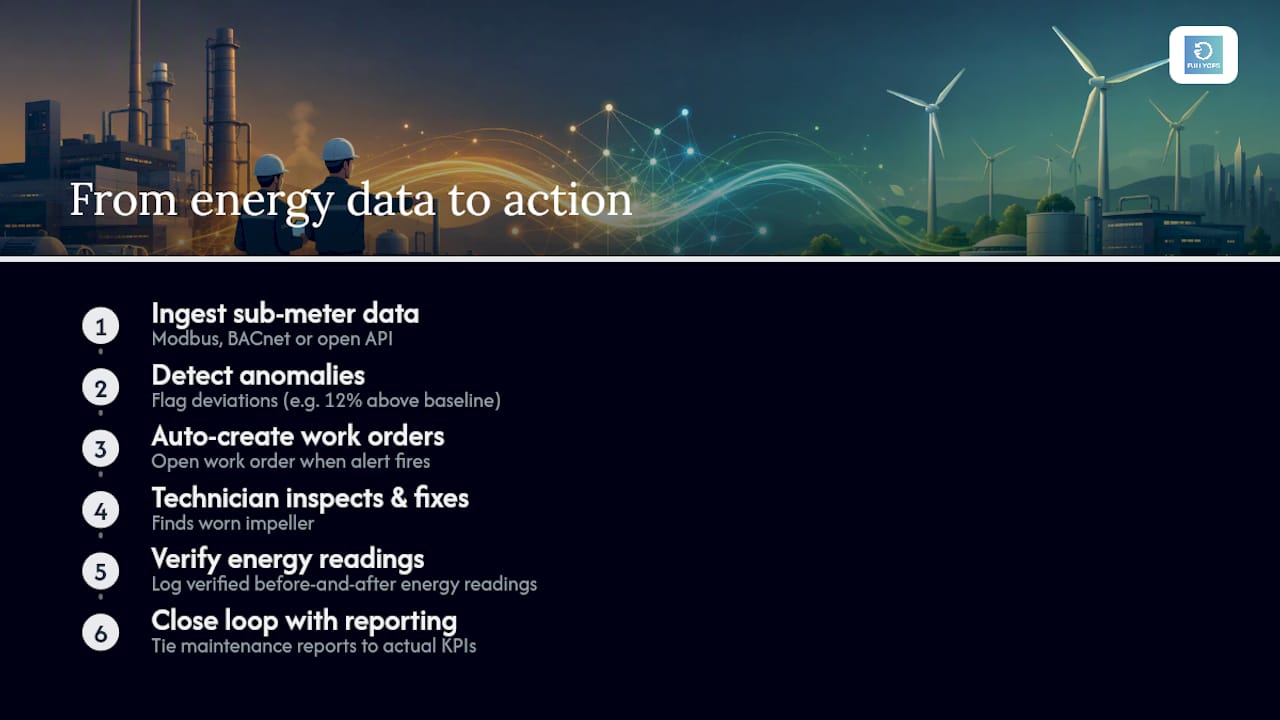
Metering data is only useful once it reaches the people who can act on it. A maintenance platform needs three capabilities to close that loop: sub-meter ingestion via Modbus, BACnet or open API connections, anomaly alerting against a defined baseline, and automated work order generation when that alert fires.
Automating maintenance planning around energy data has measurable upside. Researchers studying an industrial energy management system integrated with maintenance planning.2026.28) found it optimised energy consumption while improving equipment reliability on an automated assembly line, the two outcomes reinforcing each other rather than trading off.
A pump’s kW draw creeps 12% above baseline. The platform flags it, opens a work order automatically, a technician finds a worn impeller, and the fix gets logged against a verified before-and-after energy reading, not a guess.
That final step, closing the loop with relatórios de manutenção tied to actual KPIs, is what separates a genuine energy conservation programme from a dashboard nobody checks.
How much can a chiller retro-commissioning pilot actually save?
Take a plant chiller running 5,500 hours a year. Log hourly power draw and outdoor dry-bulb temperature for four weeks to establish a baseline, then apply the retro-commissioning measures: reset condenser water set points, correct sequencing faults, recalibrate sensors.
Run a simple regression of chiller kW against outdoor temperature for both the baseline and post-intervention periods. If the post-RCx curve sits consistently below baseline at matched temperatures, you have a defensible savings estimate, one LBNL’s methodology treats as standard practice for HVAC bundles.
Reported ranges vary by facility, but industry survey data on predictive maintenance programmes points to energy savings commonly landing in the 5 to 10% band for industrial facilities once measures are properly verified rather than assumed.
- Report savings as a bundle, not measure-by-measure.
- Keep the baseline period long enough to span a full range of outdoor temperatures.
Dica profissional: Re-run the regression a full season later. Chiller performance drifts, and a single verification point can overstate savings that fade by summer.
What should you check before signing off a pilot?
Before committing budget or vendor time, confirm the basics are in place.
- Data access: can you actually pull meter or logger readings without a manual workaround?
- Scope: is the pilot asset list finalised and agreed with operations?
- Success criteria: are KPIs defined in writing before day one?
- Stakeholders: does the pilot have sign-off from both maintenance and production leads?
When evaluating a vendor or platform, ask these directly:
- What protocols does it use for meter and sensor ingestion?
- Does it generate automated alerts against a configurable baseline, or only static thresholds?
- Can alerts auto-create work orders, or does that step stay manual?
- What does its reporting and analytics output actually look like for energy KPIs?
- Is API access included, or is it a paid add-on?
Assign one operations lead to own this checklist. A pilot with no single owner rarely reaches week six.
Author perspective: why measurement-first pilots win
Large capex energy projects promise big numbers and deliver slow, unverifiable ones. Small, measurement-first pilots win because they force a baseline before anyone spends anything, which is the discipline most energy programmes skip. The gains that last are non-capital: recalibrated set points, corrected sequencing, a maintenance schedule that responds to energy data instead of a calendar. None of that sticks without governance to keep the baseline honest a year later.
Turn energy data into work orders with less manual effort
The methods above only pay off if the alert, the work order and the verification actually connect, which is where most spreadsheet-based pilots stall out. Totalmenteops is built for that connection: sub-meter and sensor data flows into automated PM triggers, anomalies generate work orders without a manual handoff, and reporting tracks the before-and-after numbers your pilot needs to prove savings rather than estimate them.

A typical rollout looks like this: connect existing meter data, set a baseline, let the platform flag deviations, and route each one straight to a technician’s queue. For teams managing industrial, electronic or automotive assets across multiple sites, that removes the biggest bottleneck in energy pilots: someone having to notice the anomaly manually. Explore the maintenance software options built for industrial teams and request a demo to see how your own meter data would look inside a live dashboard.
Selected resources to read next
- LBNL’s energy savings estimation guide for the four measurement methods in full technical detail.
- ENERGY STAR’s O&M best practices for non-capital tune-up guidance.
- Energy-centric predictive maintenance research on power-signature anomaly detection.
- Digital twin maintenance policy optimisation for scheduling models against energy cost.
- Measuring HVAC energy efficiency gains after building improvements, a useful verification parallel.
Sources
- Energy savings estimation methods guide (LBNL)
- Energy‑centric predictive maintenance (Smart Manufacturing, 2025)
- Operation and maintenance best practices | ENERGY STAR
FAQ
What are the most effective methods for energy conservation in maintenance?
Energy-centric predictive maintenance, sub-metering with data logging, retro-commissioning, and digital twin-based maintenance scheduling are the most effective software-enabled methods for industrial and facility assets.
Which assets should I instrument first for energy monitoring?
Start with motor-driven systems and compressed air networks, since they typically account for the largest share of industrial electricity use and have repeatable, easy-to-baseline power signatures.
How long should an energy conservation pilot run?
Six to twelve weeks is typical, long enough to establish a solid baseline and measure a verified post-intervention change without waiting for a full capital project cycle.
Can maintenance software help verify energy savings, not just track work orders?
Yes. Platforms like Fullyops can ingest sub-meter data, trigger automated work orders from consumption anomalies, and report the resulting savings against a defined baseline.
Do these methods require capital investment?
Most do not. Retro-commissioning, set point resets, compressed air leak detection and maintenance schedule changes are non-capital measures that deliver savings through better operation of existing equipment.