

Resumo:
- Automation transforms industrial maintenance by reducing resolution times from days to hours through structured request processing. It ensures completeness, speeds dispatch, and enhances data-driven decision-making, moving focus from tracking to resolving operational issues efficiently. Proper implementation hinges on structured data, clear workflows, and metrics that prioritize asset uptime and first-time fix rates.
Maintenance teams in industrial facilities often assume that automation is primarily about visibility, knowing where a request sits in a queue, who logged it, and when it was acknowledged. That assumption is costly. Automated triage can reduce maintenance resolution from 4.2 days to 1.7 days, a reduction of roughly 60%, and that gain comes not from better status reporting but from fundamentally changing how requests are processed, routed, and acted upon. This article explains how automating service requests produces real operational improvements and what operations managers must get right to capture those gains.
Índice
- Why automation matters for industrial service requests
- How automated requests transform maintenance workflows
- Comparing manual vs automated request handling
- Critical success factors and common pitfalls
- What most implementations miss: from tracking to resolving
- Take automation further: actionable resources and solutions
- Perguntas mais frequentes
Principais conclusões
| Ponto | Detalhes |
|---|---|
| Resolution is the metric | Automation should be assessed on how quickly and fully it resolves service requests, not just tracks them. |
| Early data structuring | Capturing structured data from the outset is essential for smooth routing and efficient work order generation. |
| Benchmark improvement | Automated maintenance workflows can cut average resolution times by more than half. |
| Avoid visibility traps | Don’t settle for tools that only monitor ticket status—focus on action and operational outcomes. |
Why automation matters for industrial service requests
Manual service request handling is a persistent source of operational friction in industrial environments. When a technician logs a fault by phone or on paper, the information is rarely structured in a way that downstream systems can act on immediately. Approvals stall because the right person did not receive the right information. Spare parts are unavailable because no one checked inventory before dispatching. Work begins without a clear scope, leading to repeat visits and extended downtime. These are not isolated incidents; they are the predictable output of unstructured processes.
Automation addresses this at the point of intake. When a service request enters a structured digital system, it carries all the data needed to trigger approvals, check parts availability, assign the correct technician, and confirm readiness before work begins. As Oracle’s guidance on work order automation makes clear, “automation of work requests into approved work orders is a key lever to speed dispatch and ensure completeness.” That completeness matters enormously in industrial settings where an incomplete job creates safety risks and regulatory exposure.
“Automated triage can reduce maintenance resolution from 4.2 days to 1.7 days, representing a reduction of approximately 60% in time-to-resolution across facility maintenance operations.”
The practical implications for operations managers are significant. Consider a facility managing fifty assets simultaneously. Under manual handling, each fault report generates a chain of phone calls, email follow-ups, and verbal approvals that can stretch across shifts. Under automation, the same fault triggers an immediate structured work order, routes it to the appropriate team, confirms parts availability, and schedules the job within minutes. The speed improvement does not come from working faster; it comes from eliminating the non-value-adding steps that slow resolution.
Key benefits that structured automation delivers in industrial environments include:
- Reduced time between fault detection and technician dispatch through efficient technician scheduling
- Fewer incomplete jobs because materials and clearances are confirmed before work begins
- Consistent approval chains that reduce the risk of unauthorised or unsafe work
- Accurate historical data that supports predictive maintenance planning
- Lower administrative burden on supervisors who previously managed requests manually
- Improved regulatory compliance through documented, auditable work order records
Automation also changes the quality of data available for operational decisions. When every request is structured at intake, patterns become visible. A particular asset that generates repeated fault requests within a short period signals a reliability problem that preventive maintenance can address before it causes a production stoppage. Manual systems rarely surface these patterns because the data is fragmented across paper logs, email threads, and verbal reports. You can boost efficiency with automation not just at the task level but at the strategic level, using aggregate data to optimise your entire maintenance programme.
How automated requests transform maintenance workflows
Understanding the mechanics of an automated service request lifecycle helps operations managers set realistic expectations and design effective systems. The process is not simply a digital version of a manual workflow; it is a fundamentally different approach where structured data drives decisions at every stage.
The table below illustrates typical stages in an automated maintenance workflow and the actions that automation performs at each point:
| Workflow stage | Manual process | Automated process |
|---|---|---|
| Fault detection | Operator reports verbally or on paper | Sensor or digital form captures structured fault data |
| Request intake | Supervisor logs and categorises manually | System auto-categorises by asset, fault type, and priority |
| Approval routing | Email or phone to relevant manager | Rule-based routing sends to correct approver instantly |
| Parts check | Technician checks stores manually | System queries inventory and flags gaps before dispatch |
| Technician assignment | Supervisor selects based on availability | Algorithm assigns by skill, proximity, and workload |
| Work order closure | Technician reports verbally or on form | Digital sign-off triggers asset history update automatically |
Work request automation enables operational rules and asset fault and parameter events to trigger condition-based work orders without human intervention. This is where the real efficiency gain sits. Rather than waiting for a supervisor to review a report and decide whether to escalate, the system applies pre-defined logic the moment a threshold is crossed. A compressor running above its rated temperature for more than ten minutes automatically generates a high-priority work order, routes it to the mechanical team, and notifies the relevant operations manager.
The typical automated request lifecycle follows this sequence:
- Structured intake: The request enters the system with mandatory fields completed, including asset ID, fault description, severity rating, and location.
- Automatic triage: The system applies priority logic and routes the request to the correct approval queue without manual sorting.
- Approval and resourcing: Pre-defined approval rules process the request, while the system simultaneously checks parts availability and technician schedules.
- Dispatch confirmation: Once approved and resourced, the system issues a work order to the assigned technician with full job details.
- Field execution: The technician accesses job details digitally, records time and materials used, and closes the work order upon completion.
- Post-job update: Asset history, inventory levels, and KPIs update automatically, providing real-time operational data.
This sequence eliminates the gaps between stages that characterise manual handling. In a manual system, each handover requires human action and introduces the possibility of delay or error. In an automated system, the handovers happen programmatically, which means they happen consistently and immediately.
Pro Tip: When configuring automated routing rules, start with your highest-frequency fault types rather than trying to automate everything at once. Getting the most common scenarios right first delivers immediate throughput improvements and builds team confidence in the system before you tackle edge cases.

The connection between streamlining request workflow and measurable output is direct. When technicians arrive at a job with the correct parts, a clear scope of work, and confirmed access permissions, first-time fix rates improve substantially. First-time fix rate is a critical KPI in industrial maintenance because repeat visits are disproportionately expensive. They consume technician time, extend asset downtime, and often indicate that the original diagnostic process was incomplete. Structured intake data supported by digital work order transformation addresses this by ensuring that every work order contains the information a technician needs to complete the job correctly on the first visit.
Comparing manual vs automated request handling
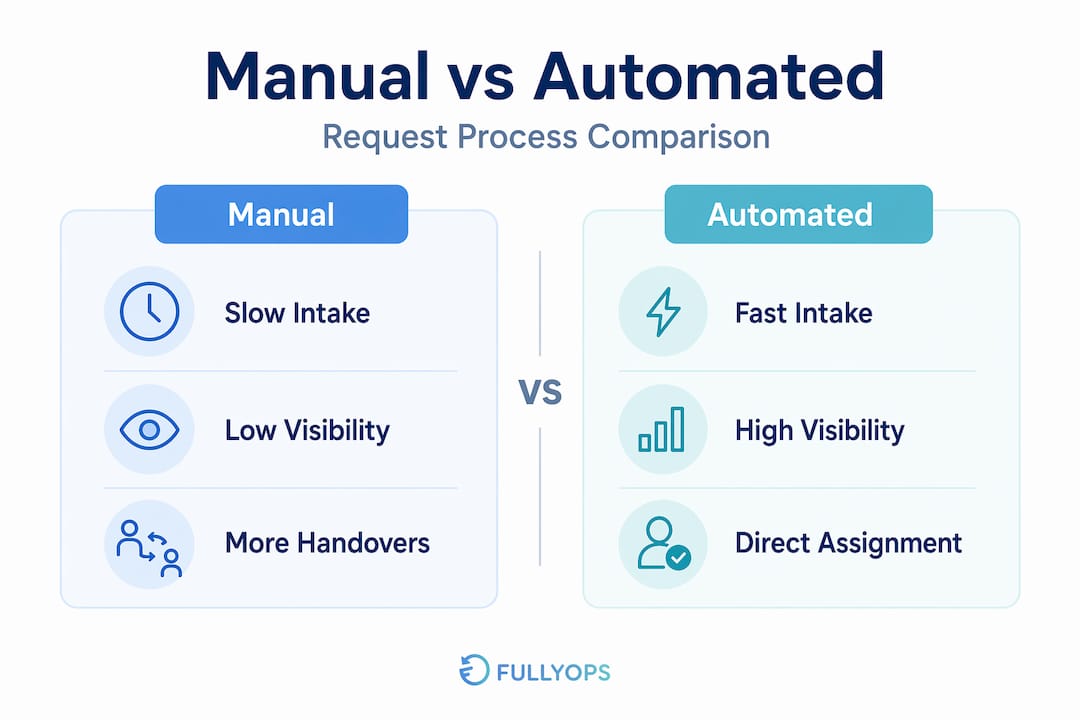
The differences between manual and automated approaches are not simply a matter of speed. They reflect fundamentally different assumptions about where value is created in maintenance operations.
| Dimensão | Manual handling | Automated handling |
|---|---|---|
| Request intake speed | Minutes to hours depending on communication | Seconds, with immediate system acknowledgement |
| Data completeness | Variable, depends on individual discipline | Consistent, enforced by structured forms |
| Approval time | Hours to days depending on availability | Minutes, via rule-based routing |
| Parts availability check | Often skipped or done on-site | Systematic, before dispatch |
| Taxa de fixação da primeira vez | Lower due to incomplete preparation | Higher due to structured pre-job planning |
| Reporting accuracy | Dependent on manual data entry post-job | Automatic, captured during execution |
| Visibility | Status visible but action often delayed | Status visible and action systematically triggered |
The visibility distinction in that final row is worth examining carefully. Many operations managers invest in systems that provide excellent status visibility, dashboards showing where every request sits in the queue, but see limited improvement in resolution times. This reflects a well-documented problem in service management. As Serval’s CEO has argued, legacy tools that focus on tracking rather than resolution consistently underdeliver on the promise of automation. Knowing that a ticket is “in progress” is not the same as ensuring it is being actively resolved.
Manual handling is not without advantages in specific contexts. For complex, non-standard jobs requiring detailed human assessment before any action is taken, a degree of manual judgement remains appropriate. The key is to identify which request types genuinely require manual intervention and which can be handled deterministically through automation. Trying to automate every request type without that distinction can create rigidity that frustrates technicians and supervisors.
The practical decision framework for operations managers should focus on two questions. First, does the automation system actively unblock operational problems or simply record their status? Second, does the measurement framework reward resolution and throughput rather than just logging activity? Reducing downtime with work orders requires the answers to both questions to be affirmative. Systems that score highly on visibility but poorly on resolution are a common and expensive mistake in industrial maintenance investment.
Automation also changes the accountability structure in maintenance operations. When a work order is generated, assigned, and tracked automatically, it is clear at every moment who is responsible for the next action. In manual systems, accountability often dissolves in the space between handovers. A request submitted to a supervisor may sit unactioned while both parties assume the other is handling it. Peak efficiency in request handling depends on eliminating those ambiguous handovers, and automation does precisely that.
Critical success factors and common pitfalls
Knowing that automation delivers significant benefits is not enough. The implementation approach determines whether those benefits materialise or remain theoretical.
The most important success factor is data structure at intake. If requests enter the system without mandatory fields or with inconsistent categorisation, the automation logic downstream has nothing reliable to act on. Structured data for work requests is the foundation on which all automated routing, approval, and dispatch logic rests. Operations managers who attempt to retrofit structure onto an existing informal process typically find that the automation behaves unpredictably, which erodes trust in the system and drives teams back to manual workarounds.
The most common pitfalls that undermine automation programmes in industrial facilities are as follows:
- Incomplete intake forms: Allowing free-text fault descriptions with no mandatory fields means the system cannot categorise or route requests reliably.
- Missing approval logic: Failing to map existing approval hierarchies into the system means requests queue at unknown points and lose the speed benefit of automation.
- Ignoring inventory integration: Automating dispatch without connecting to inventory data means technicians still arrive without the correct parts.
- Measuring the wrong KPIs: Reporting on request volume and status changes instead of first-time fix rate and time-to-resolution misses the actual operational impact.
- Attempting full automation immediately: Rolling out automation across all request types simultaneously overloads the change management process and increases the risk of errors in critical workflows.
Pro Tip: Before configuring your automation rules, run a structured analysis of your last three months of service requests. Categorise them by type, frequency, and resolution time. This data will reveal which request types are the strongest candidates for automation and provide a baseline against which you can measure improvement after implementation.
O request workflow cost savings from a well-implemented automation programme are real and measurable, but they require discipline at the design stage. Organisations that treat automation as a technology deployment rather than a process redesign consistently underperform against their targets. The technology enables the improvement; the process design delivers it.
Resolution-focused metrics are particularly important. It is straightforward to report that your system processed 500 work orders last month, but that figure tells you nothing about whether those work orders resolved the underlying operational problems. The right metrics include first-time fix rate, mean time to resolution by fault category, repeat fault frequency by asset, and technician utilisation against productive work time. These measures reveal whether automation is delivering operational value or simply moving paperwork faster.
What most implementations miss: from tracking to resolving
There is a persistent gap between what automation promises and what most industrial facilities actually achieve, and it comes down to a single distinction: the difference between tracking and resolving.
Most automation implementations are designed by people who think primarily about visibility. They want to know where every request is, who has it, and what its status is. These are legitimate concerns, and good systems address them. But they are secondary concerns. The primary purpose of automation in maintenance operations is to shorten the time between a fault occurring and the asset returning to reliable service. Everything else is supporting infrastructure.
ITSM experts argue that automation benchmarks should be set by action and resolution, not just ticket throughput and status. This principle translates directly to industrial maintenance. A system that processes 300 work orders a week but resolves only 60% of them on the first visit is performing worse than a system that processes 200 work orders with a 90% first-time fix rate. Volume is not value.
The operations managers who extract the most from automation are those who design their systems around the question: what needs to happen for this problem to be fixed? They map the fastest path from fault detection to resolution, identify every step that can be handled deterministically, and automate those steps rigorously. They reserve human judgement for genuinely complex or non-standard situations. And they measure their success by whether assets are back in service faster, not by whether requests are being logged more efficiently.
The shift from tracking to resolving requires a different mindset when selecting and configuring automation tools. It requires automation strategy insights that go beyond software features to address the underlying operational logic. Operations managers should ask prospective system providers not just how their platform tracks requests but how it actively removes the barriers to resolution at each stage of the workflow.
Take automation further: actionable resources and solutions
If the principles in this article resonate with the challenges your facility faces, the next step is applying them to your specific operational context. FullyOps provides a range of resources and tools designed specifically for operations managers who want to move beyond basic tracking and achieve measurable improvements in maintenance resolution times.
Explore our field service management resources for practical guidance on structuring maintenance operations for maximum efficiency. For teams ready to act on specific workflow improvements, our estratégias de otimização de serviços de campo provide step-by-step frameworks for reducing time-to-resolution and improving first-time fix rates. If you are looking at the broader operational picture, our guidance on improving field service efficiency covers the organisational and technical changes that deliver sustained performance improvements across your maintenance programme.
Perguntas mais frequentes
How does automation reduce maintenance resolution times?
Automation speeds up request intake, triage, and dispatch by replacing manual handovers with rule-based routing, reducing average resolution from days to hours across industrial maintenance operations.
What are the main pitfalls of automating service requests?
Neglecting structured data at intake or focusing only on ticket tracking instead of actual resolution undermines automation’s benefits, as resolution-focused automation consistently outperforms tracking-only approaches in operational settings.
What is the role of operational rules in automated maintenance?
Operational rules allow maintenance systems to auto-generate work orders based on asset fault events and pre-determined parameters, with connected-asset events driving work order creation without manual intervention.
Does automating requests mean less control over maintenance operations?
No. Automation increases control by providing more accurate information and more predictable workflows, because structured data for routing and approval creates deterministic, auditable processes rather than informal, variable ones.
Recomendado
- Streamline service request handling for peak efficiency
- Why automate service workflows: boost efficiency and cut costs