

Every HVAC maintenance manager knows that unscheduled downtime can disrupt operations and dent client trust. Setting up an effective maintenance schedule is more than just filling in a calendar—it starts with a complete understanding of your assets, their condition, and their true maintenance needs. By focusing on comprehensive asset inventories and digital tracking, you lay the groundwork for schedules that actually protect reliability and reduce costly surprises.
Índice
- Step 1: Assess Asset Inventory And Maintenance Needs
- Step 2: Define Maintenance Intervals And Priorities
- Step 3: Configure Schedule Using Software Tools
- Step 4: Assign Resources And Set Task Reminders
- Step 5: Verify Schedule Effectiveness And Adjust
Resumo rápido
| Principais informações | Explicação |
|---|---|
| 1. Conduct a thorough asset audit | Document each asset’s condition and history to inform maintenance needs. |
| 2. Prioritise maintenance schedules | Classify assets to optimise maintenance frequency and reduce failures. |
| 3. Utilise digital management tools | Implement CMMS to streamline tracking, scheduling, and task management. |
| 4. Assign resources strategically | Align technician skills with equipment needs to enhance efficiency. |
| 5. Regularly review maintenance performance | Measure effectiveness and adjust schedules based on operational data. |
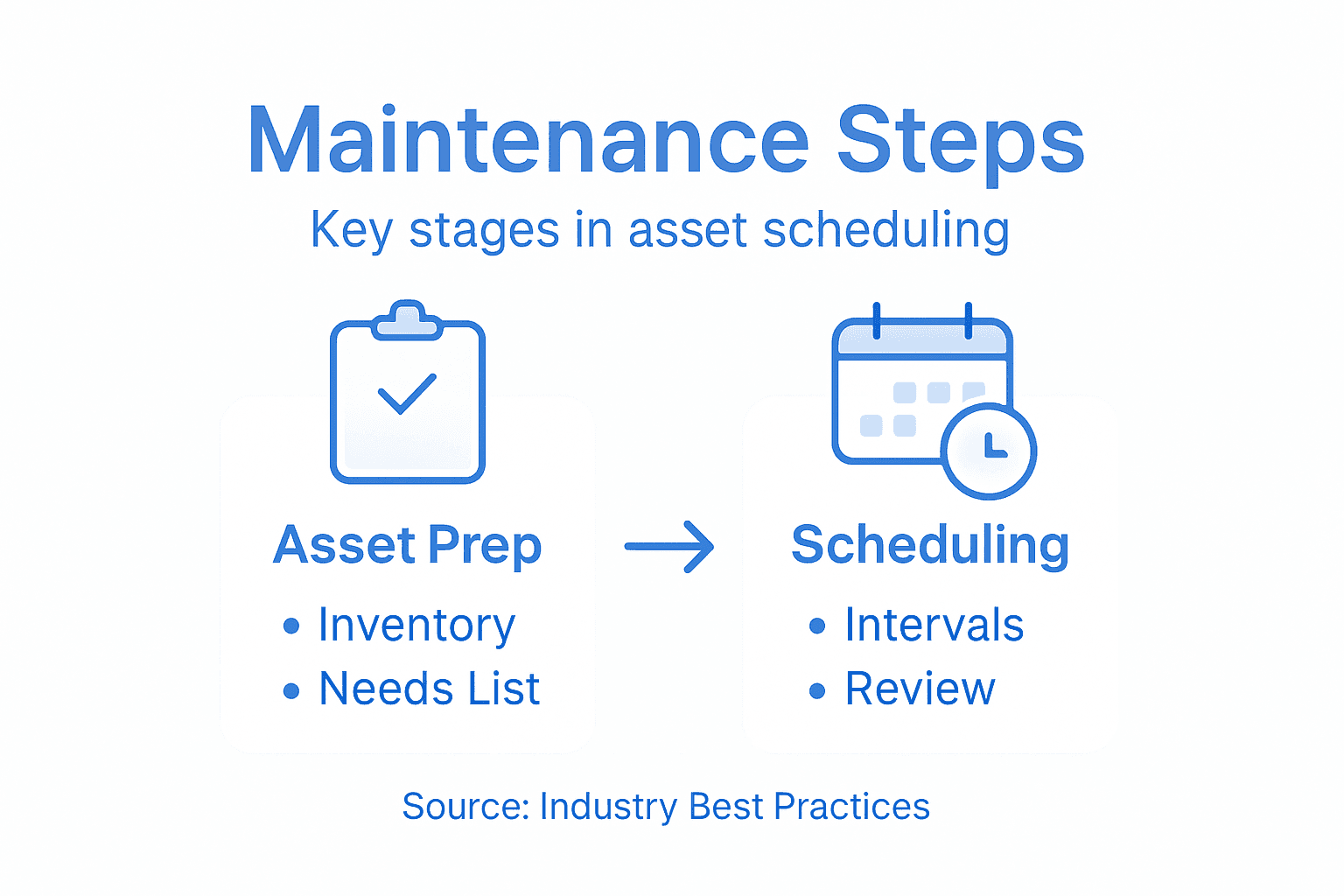
Step 1: Assess asset inventory and maintenance needs
To create effective maintenance schedules, you must first develop a comprehensive understanding of your existing asset landscape. This crucial stage involves systematically documenting every piece of equipment, its current condition, operational history, and potential maintenance requirements.
Begin by conducting a meticulous physical inventory audit which includes gathering critical details for each asset:
- Precise equipment identification numbers
- Manufacturer specifications
- Installation dates
- Estado operacional atual
- Registos históricos de manutenção
- Expected lifecycle and depreciation
O UN Handbook on Infrastructure Asset Management recommends developing a robust data collection framework that captures not just basic equipment details, but also nuanced performance metrics and potential risk factors.
Comprehensive asset inventories are the foundation of reliable maintenance strategies.
Utilise digital tools and spreadsheets to track and categorise your assets, ensuring you can quickly assess their maintenance needs. This process helps identify which equipment requires immediate attention and which can be scheduled for preventative maintenance.

Top recommendation: Implement a standardised digital tracking system that allows real-time updates and provides instant visibility into your entire asset ecosystem.
Step 2: Define maintenance intervals and priorities
Defining strategic maintenance intervals and priorities transforms reactive repairs into a proactive, systematic approach to asset management. By carefully categorising and scheduling maintenance activities, you can significantly reduce unexpected equipment failures and optimise operational efficiency.
To establish robust maintenance priorities, leverage the principles of Reliability Centered Maintenance which focuses on critical asset classification:
- Identify critical equipment with high operational impact
- Assess potential failure consequences
- Evaluate safety and financial risks
- Determine maintenance frequency based on equipment criticality
- Create hierarchical maintenance schedules
Effective maintenance prioritisation balances operational needs with resource constraints.
Classify your assets into strategic categories to streamline maintenance scheduling:
- Critical assets requiring immediate and frequent maintenance
- Essential assets needing regular preventative interventions
- Secondary assets with less frequent maintenance requirements
This systematic approach ensures your most vital equipment receives appropriate attention while preventing unnecessary maintenance expenditures.
Here is a summary of asset categories and their typical maintenance approaches:
| Asset Category | Typical Maintenance Frequency | Example Maintenance Approach |
|---|---|---|
| Critical Assets | Weekly or Monthly | Predictive diagnostics |
| Essential Assets | Monthly or Quarterly | Preventative servicing |
| Secondary Assets | Annually or Biannually | Basic scheduled inspections |
Top recommendation: Develop a dynamic maintenance matrix that adapts to changing operational conditions and equipment performance metrics.
Step 3: Configure schedule using software tools
Transitioning your maintenance planning from traditional paper-based systems to digital platforms represents a transformative leap in operational efficiency. Computerized Maintenance Management Systems provide powerful tools to streamline your maintenance scheduling and tracking processes.
Begin by selecting a CMMS that aligns with your organisational needs and asset complexity. Key configuration steps include:
- Input comprehensive asset inventory details
- Define maintenance task templates
- Set up recurring maintenance intervals
- Configure notification and alert systems
- Establish user access and permission levels
- Create custom reporting dashboards
Digital maintenance scheduling transforms reactive approaches into proactive asset management strategies.
When configuring your software, focus on creating flexible maintenance workflows that can adapt to changing operational requirements. This involves mapping out your existing maintenance processes and translating them into digital parameters that reflect your organisation’s unique operational landscape.
Ensure you integrate data from your initial asset inventory and maintenance priority assessments to create a comprehensive and dynamic maintenance schedule that evolves with your operational needs.
Top recommendation: Conduct comprehensive staff training to ensure smooth software adoption and maximise the potential of your new maintenance management system.
The following table highlights key advantages of using digital maintenance management systems:
| Advantage | Descrição | Impacto nas empresas |
|---|---|---|
| Real-time Asset Tracking | Immediate access to asset status | Minimises downtime |
| Automated Alerts | Notifications for upcoming tasks | Prevents missed maintenance |
| Data-driven Insights | Performance analytics and reporting | Informs better decision-making |
| Scalable Workflows | Adaptable to changing needs | Supports operational growth |
Step 4: Assign resources and set task reminders
Successful maintenance management hinges on strategic resource allocation and intelligent task tracking. Computerized maintenance systems provide robust frameworks for distributing responsibilities and ensuring timely interventions.
When assigning maintenance resources, consider the following key strategies:
- Match technician skills with specific equipment requirements
- Evaluate individual workload capacity
- Prioritise tasks based on equipment criticality
- Balance expertise across different maintenance domains
- Create backup resource plans for unexpected absences
Effective resource assignment transforms maintenance from reactive management to proactive strategy.
Implement a comprehensive task reminder system that provides multiple notification channels. This ensures critical maintenance activities are never overlooked by:
- Setting automated email alerts
- Creating mobile push notifications
- Generating dashboard warning indicators
- Establishing escalation protocols for overdue tasks
Integrate your resource allocation strategy with real-time tracking mechanisms to maintain transparency and accountability across your maintenance team.
Top recommendation: Develop a dynamic resource allocation matrix that adapts to changing operational requirements and individual team member capabilities.
Step 5: Verify schedule effectiveness and adjust
Maintenance schedule optimisation is an ongoing process that requires systematic performance evaluation and continuous refinement. Reliability Centered Maintenance approaches emphasise the importance of iterative assessment and strategic adjustment.
To effectively verify your maintenance schedule’s performance, track these critical metrics:
- Mean Time Between Failure (MTBF)
- Overall Equipment Effectiveness (OEE)
- Maintenance cost per asset
- Planned versus unplanned maintenance ratio
- Equipment downtime percentage
Performance metrics transform maintenance from a reactive task to a strategic asset management approach.
Establish a regular performance review cycle that involves:
- Collecting comprehensive performance data
- Comparing actual results against predetermined benchmarks
- Identifying systemic inefficiencies
- Developing targeted improvement strategies
- Implementing incremental schedule modifications
Ensure your verification process remains dynamic, allowing for rapid responses to emerging operational challenges and technological advancements.
Top recommendation: Create a quarterly maintenance schedule review protocol that encourages team collaboration and data-driven decision-making.
Elevate Your Maintenance Scheduling with FullyOps
Struggling to create reliable maintenance schedules that truly reduce downtime and control costs is a common challenge for many organisations. This article highlights critical steps such as assessing asset inventory, defining maintenance priorities, and using software tools to transform reactive processes into proactive strategies. If you are looking to streamline these complex tasks while ensuring precise resource allocation and real-time oversight, your search ends here.
FullyOps offers an intelligent SaaS platform designed to digitise and optimise your asset management and field service operations. With features that address key pain points like work order management, automated reminders, and detailed analytics, you can build dynamic, adaptable maintenance schedules that evolve with your operational needs. Discover how to implement proven concepts like Reliability Centered Maintenance with our user-friendly modules tailored for technicians, back-office teams, and managers.
Ready to transform your maintenance approach and boost asset reliability without the usual headaches? Explore how a FullyOps can empower your team to achieve seamless scheduling, better resource management, and enhanced decision-making today. Don’t wait until downtime disrupts your operations. Start your journey with FullyOps now and master asset reliability with confidence.
Perguntas mais frequentes
How do I start assessing my asset inventory for maintenance schedules?
Begin by conducting a detailed physical inventory audit of all your equipment. Document essential details such as identification numbers, current conditions, and maintenance history to create a comprehensive asset list.
What factors should I consider when defining maintenance intervals for my assets?
Identify the criticality of each asset by assessing its operational impact and potential failure consequences. Use this information to categorise assets and establish appropriate maintenance frequencies, ensuring prioritisation of critical equipment.
What are the benefits of using software tools for scheduling maintenance?
Utilising software tools like Computerised Maintenance Management Systems allows for real-time tracking, automated alerts, and data-driven insights. Implement these tools to streamline maintenance processes and improve overall operational efficiency.
How can I effectively assign resources for maintenance tasks?
Match technician skills to the specific maintenance needs of your equipment and evaluate their workloads. Create a balanced resource allocation plan that prioritises tasks based on equipment criticality, ensuring all critical maintenance is addressed promptly.
How do I verify the effectiveness of my maintenance schedule?
Regularly track performance metrics such as Mean Time Between Failure (MTBF) and the ratio of planned to unplanned maintenance. Conduct a quarterly review to assess these metrics and adapt your maintenance schedule as needed to enhance efficiency and reduce downtime.
What actions should I take if my maintenance schedule is not performing well?
Identify systemic inefficiencies by comparing actual results against established benchmarks. Take targeted action to modify your maintenance schedule and implement improvements based on performance data.
Recomendado
- Gestão do ciclo de vida dos activos - FullyOps
- Blogue - FullyOps
- Guia de fluxo de trabalho de manutenção de activos para uma eficiência óptima