

Many operations managers believe maintenance planning and scheduling are the same thing. They are not. Maintenance planning is a structured process for developing and controlling maintenance activities, defining what work to do, when, by whom, with what resources, to prevent failures and ensure equipment reliability. Confusing these two functions costs your organisation money, increases downtime, and undermines asset performance. This guide clarifies the true definition of maintenance planning, explains why it matters for industrial and facilities operations, and provides practical strategies to implement effective planning systems that deliver measurable results in resource efficiency and reliability.
Índice
- Principais conclusões
- Understanding maintenance planning: core elements and purpose
- Maintenance planning versus scheduling: common pitfalls and best practices
- Benefits of effective maintenance planning: ROI, downtime reduction, and cost savings
- Implementing maintenance planning: strategies, tools, and KPIs for operations managers
- Explore FullyOps solutions for effective maintenance planning
- What is maintenance planning? FAQs
Principais conclusões
| Ponto | Detalhes |
|---|---|
| Planning and scheduling distinct | Separating planning from scheduling prevents undefined work and reduces wasted technician hours. |
| Asset criticality focus | Begin with a complete asset inventory and criticality ranking to prioritise planning for high impact equipment. |
| Resource and work detail | Define work types, frequencies, spare parts, tools, skills and estimated labour hours to enable accurate planning. |
| Performance measurement | Establish performance metrics to measure planning effectiveness and drive continuous improvement. |
Understanding maintenance planning: core elements and purpose
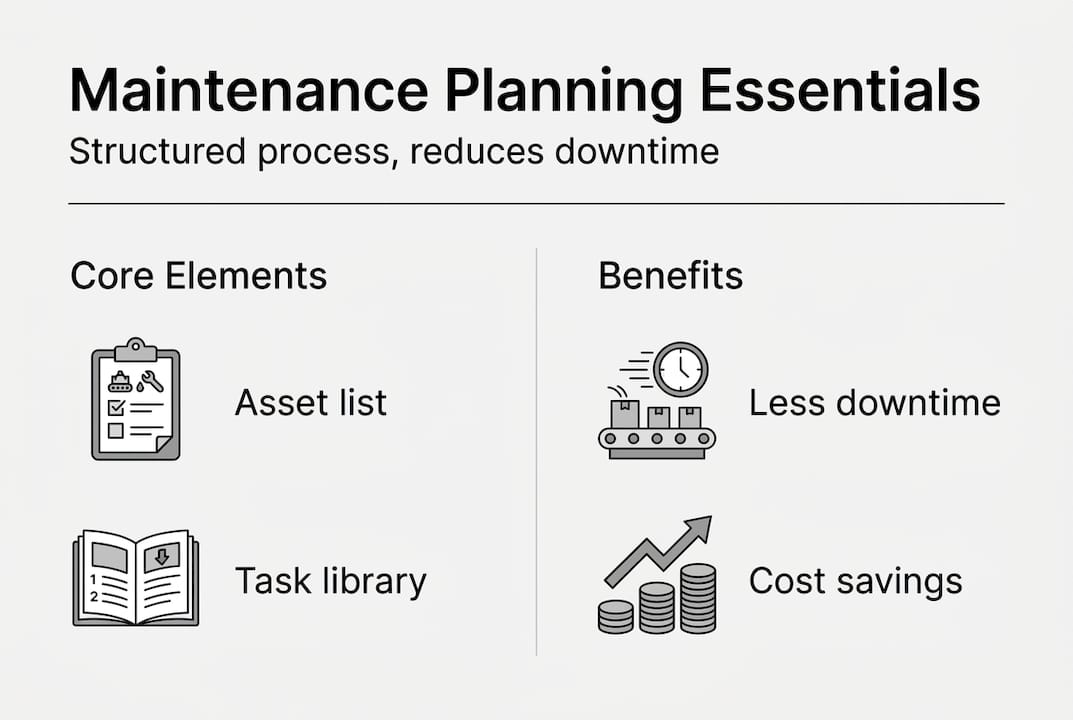
Maintenance planning is a structured process distinct from scheduling. Planning determines what maintenance work needs doing, how to do it, and what resources are required. Scheduling assigns when the work happens and who does it. This distinction matters because planning without scheduling leaves work undefined in time, whilst scheduling without planning assigns poorly prepared tasks that waste technician hours and materials.
Effective maintenance planning encompasses several core components that work together. First, you need a complete asset inventory with criticality rankings that identify which equipment failures impact operations most. Second, define work types and frequencies based on manufacturer recommendations, regulatory requirements, and operational experience. Third, specify resource requirements including spare parts, tools, skills, and estimated labour hours. Fourth, establish performance metrics that measure planning effectiveness and guide continuous improvement. Understanding asset management impact helps you prioritise these planning activities across your facility.
The core elements of maintenance planning include:
- Asset inventory and criticality classification
- Preventive maintenance task libraries and procedures
- Bill of materials and spare parts specifications
- Estimated labour hours and required skill levels
- Safety permits and regulatory compliance requirements
- Performance metrics and continuous improvement processes
Why does planning matter so much? Without structured planning, maintenance teams operate reactively, responding to breakdowns rather than preventing them. Technicians arrive at jobs without proper tools or parts, extending downtime. Work quality suffers when procedures are unclear or missing. Costs spiral as emergency purchases replace planned procurement. Planning transforms maintenance from chaotic firefighting into controlled, predictable operations that maximise equipment reliability whilst minimising resource consumption.
Pro Tip: Start your planning process by ranking assets using a simple criticality matrix that scores operational impact and failure probability. Focus planning resources on high-criticality equipment first to maximise early wins and build organisational support for broader implementation.
Maintenance planning versus scheduling: common pitfalls and best practices
Planning differs from scheduling in fundamental ways that many organisations blur to their detriment. Planning answers what work to do, how to do it, and what resources are needed. Scheduling answers when to do the work and who will do it. When these functions merge, problems multiply. Planners rush to assign work without adequate preparation. Schedulers lack the technical detail needed to coordinate resources effectively. The result is overtime, repeat failures, and growing backlogs that frustrate everyone.
Common pitfalls emerge when planning and scheduling responsibilities overlap. Technicians receive work orders with incomplete instructions, forcing them to improvise procedures or hunt for parts mid-job. Schedulers assign tasks without knowing resource availability, creating conflicts that delay multiple jobs. Managers measure activity rather than outcomes, rewarding busy teams rather than effective maintenance. Backlog grows as poorly planned work takes longer than expected, consuming schedule slots meant for other tasks. Understanding proper calendários de manutenção helps separate these functions clearly.
Best practices maintain clear separation whilst ensuring coordination:
- Assign planning and scheduling to different roles with distinct responsibilities
- Planners prepare work packages completely before releasing to schedulers
- Schedulers coordinate timing and personnel based on complete work packages
- Weekly coordination meetings align planning pipeline with scheduling capacity
- Digital systems track handoffs and prevent incomplete work from entering schedules
- Performance metrics measure both planning quality and schedule adherence separately
The coordination between planners and schedulers determines overall maintenance effectiveness. Planners need sufficient lead time to research procedures, identify parts, and estimate labour accurately. Schedulers need a pipeline of ready work that matches crew capacity and skills. When planners rush, quality suffers. When schedulers lack ready work, crews sit idle or tackle unprepared jobs. The sweet spot is a planning pipeline that stays two to four weeks ahead of the schedule, providing buffer for unexpected complications whilst maintaining urgency.
Pro Tip: Implement a simple traffic light system where planners mark work packages as red (incomplete), amber (in progress), or green (ready to schedule). Schedulers only assign green work, forcing planning discipline whilst giving schedulers confidence that assigned tasks will execute smoothly.
Benefits of effective maintenance planning: ROI, downtime reduction, and cost savings
Empirical benchmarks demonstrate that optimised maintenance planning delivers substantial financial returns. Organisations that implement structured planning see maintenance costs drop 20-35%, equipment availability improve 25-40%, and breakdown frequency decrease 30-50%. These are not theoretical projections but measured outcomes from industrial facilities that shifted from reactive to planned maintenance approaches. The data proves that planning investments pay for themselves many times over through reduced downtime and extended asset life.
| Métrica | Improvement with effective planning | Business impact |
|---|---|---|
| Maintenance costs | 20-35% reduction | Lower operating expenses and budget predictability |
| Equipment availability | 25-40% improvement | Higher production capacity and revenue potential |
| Breakdown frequency | 30-50% fewer failures | Reduced emergency costs and schedule disruptions |
| Preventive maintenance compliance | >90% completion rate | 75% less unplanned downtime when targets met |
| Mean time between failures | 40-60% increase | Extended asset life and deferred capital replacement |
The financial impact of unplanned downtime makes planning ROI compelling. Industry benchmarks suggest maintenance budgets should run 2-4% of asset replacement value annually. Facilities that achieve preventive maintenance compliance above 90% experience up to 75% less unplanned downtime than those with poor compliance. Each avoided breakdown saves not just repair costs but also lost production, emergency procurement premiums, and overtime labour. Planning enables the preventive work that prevents these expensive failures.
Key benefits extend beyond direct cost savings:
- Lower mean time to repair through better preparation and resource availability
- Reduced maintenance backlog as work executes efficiently on first attempt
- Higher equipment availability supporting production schedules and customer commitments
- Improved technician productivity with clear procedures and ready materials
| Better regulatory compliance through documented procedures and completion tracking - Extended asset life as preventive care reduces wear and catastrophic failures
Understanding the processo de gestão de ordens de trabalho helps you capture these benefits systematically. Effective planning transforms work orders from simple task assignments into comprehensive execution packages that technicians can complete right the first time. This quality improvement cascades through operations, reducing rework, improving schedule adherence, and building team confidence in maintenance systems.

Planning reduces unplanned downtime by up to 75% when preventive maintenance compliance exceeds 90%, directly protecting production schedules and revenue.
The ROI calculation for maintenance planning is straightforward. Calculate current reactive maintenance costs including emergency repairs, overtime, expedited shipping, and lost production. Implement structured planning and measure the same costs after six months. Most organisations see payback within the first year as emergency work drops and planned maintenance prevents failures more cost-effectively than reactive repairs.
Implementing maintenance planning: strategies, tools, and KPIs for operations managers
Effective strategies shift maintenance from reactive firefighting to proactive prevention using data-driven optimisation. This transformation requires deliberate implementation steps, appropriate tools, and clear metrics that prove progress. Operations managers who tailor maintenance plans by asset class optimise resource allocation, focusing intensive planning on critical equipment whilst applying lighter approaches to less important assets. This risk-based strategy maximises planning ROI by concentrating effort where it matters most.
Implementation follows a logical sequence that builds capability progressively:
- Conduct criticality analysis ranking all assets by operational impact and failure probability
- Adopt a computerised maintenance management system to centralise planning data and workflows
- Develop preventive maintenance task libraries with detailed procedures and resource specifications
- Select key performance indicators that measure planning effectiveness and business outcomes
- Train planners and schedulers in their distinct roles and coordination processes
- Establish continuous review cycles that refine plans based on performance data and lessons learned
Essential KPIs measure both planning quality and business results. Preventive maintenance compliance percentage tracks how much planned work actually gets completed on schedule, with targets above 90% indicating good planning and scheduling coordination. Mean time between failures measures equipment reliability, showing whether preventive work effectively prevents breakdowns. Mean time to repair indicates execution efficiency, with lower numbers suggesting better planning and technician preparation. Backlog size reveals whether planning keeps pace with maintenance demand or falls behind, with stable or shrinking backlogs confirming adequate planning capacity.
Understanding the papel dos cmms na manutenção proves essential for modern planning implementation. Digital systems centralise asset data, standardise procedures, track performance metrics, and coordinate planning with scheduling seamlessly. Without CMMS, planning relies on spreadsheets and tribal knowledge that do not scale. With CMMS, organisations capture best practices, analyse trends, and continuously improve maintenance effectiveness based on real performance data rather than assumptions.
Pro Tip: Measure outcomes rather than activity to prove planning ROI. Track equipment availability, total maintenance cost per asset, and unplanned downtime percentage instead of counting work orders completed or hours logged. Outcomes demonstrate business value whilst activity metrics just show busy teams that may not be effective.
Tailoring maintenance plans by asset class optimises resource allocation. Critical production equipment receives intensive planning with detailed procedures, comprehensive spare parts staging, and frequent preventive tasks. Important but less critical assets get moderate planning with standard procedures and normal parts inventory. Low-criticality equipment may use run-to-failure strategies with minimal planning, accepting occasional breakdowns as more economical than preventive maintenance. This tiered approach, guided by proper tutorial de atribuição de recursos principles, ensures planning resources focus where they deliver maximum business value.
The shift from reactive to proactive maintenance requires patience and persistence. Early wins come from focusing planning on your most critical assets and measuring downtime reduction. As teams see results, expand planning to additional equipment classes. Build planning capacity gradually by training existing technicians rather than hiring external planners immediately. Celebrate improvements in preventive maintenance compliance and equipment availability to maintain momentum. Within 12-18 months, most organisations achieve substantial planning maturity with measurable cost savings and reliability improvements.
Explore FullyOps solutions for effective maintenance planning
FullyOps provides comprehensive tools that support every aspect of maintenance planning implementation. Our platform centralises asset data, standardises work procedures, and coordinates planning with scheduling seamlessly. Operations managers use FullyOps to conduct criticality analysis, build preventive maintenance libraries, track KPIs, and continuously improve maintenance effectiveness based on real performance data. The system integrates with existing enterprise software, providing a single source of truth for maintenance operations across multiple facilities.
Explore our detailed resource allocation tutorial to learn how data-driven planning optimises technician deployment and spare parts inventory. Discover the cmms role in maintenance to understand how digital systems multiply planning effectiveness. Review our approach to gestão do ciclo de vida dos activos to see how planning fits within broader asset strategy. FullyOps partners with operations teams to transform maintenance from cost centre to competitive advantage through smarter planning and execution.
What is maintenance planning? FAQs
What exactly is maintenance planning and why does it matter?
Maintenance planning is the process of defining what maintenance work needs doing, how to do it properly, and what resources are required for successful completion. It matters because proper planning prevents equipment failures, reduces maintenance costs by 20-35%, and improves asset availability by 25-40% through better resource preparation and execution quality.
How does maintenance planning differ from scheduling?
Planning determines what work to do, how to do it, and what resources are needed. Scheduling assigns when the work happens and who does it. Confusing these functions leads to poor execution, overtime costs, and repeat failures because work gets assigned before adequate preparation.
What are the core components of effective maintenance planning?
Core components include complete asset inventory with criticality rankings, preventive maintenance task libraries with detailed procedures, spare parts specifications and bills of materials, estimated labour hours and required skills, safety permits and compliance requirements, and performance metrics for continuous improvement. These elements work together to ensure maintenance work executes efficiently.
How do I get started with maintenance planning in my facility?
Start by conducting criticality analysis to rank assets by operational impact and failure probability. Focus initial planning efforts on your most critical equipment to maximise early wins. Adopt a CMMS to centralise planning data and standardise workflows. Select key performance indicators like preventive maintenance compliance and mean time between failures to measure progress and prove ROI.
What role do digital tools like CMMS play in maintenance planning?
CMMS centralises asset data, standardises procedures, tracks performance metrics, and coordinates planning with scheduling seamlessly. Digital systems capture best practices, analyse trends, and enable continuous improvement based on real performance data rather than assumptions. Without CMMS, planning relies on spreadsheets and tribal knowledge that do not scale as operations grow.
Why should operations managers prioritise maintenance planning investment?
Maintenance planning delivers measurable ROI through reduced downtime, lower costs, and extended asset life. Organisations with planning maturity experience up to 75% less unplanned downtime when preventive maintenance compliance exceeds 90%. Planning transforms maintenance from reactive firefighting into controlled operations that protect production schedules and maximise equipment reliability whilst minimising resource consumption.
Recomendado
- Planeamento da manutenção passo a passo: Reduzir o tempo de inatividade em 30%
- Otimização da manutenção em 2026: reduzir o tempo de inatividade em 30%