

TL;DR:
- Proper preparation of asset data and history streamlines service request management and reduces downtime.
- A standardized digital workflow with clear escalation and documentation improves resolution times.
- Digital transformation enhances traceability, compliance, and operational efficiency compared to paper systems.
Unresolved service requests do not simply create inconvenience; they directly erode asset uptime, inflate maintenance costs, and stretch technical teams beyond sustainable limits. In medium to large industrial operations, a single mismanaged request can cascade into hours of unplanned downtime, missed production targets, and compliance gaps that take weeks to correct. The good news is that most of these problems are preventable with the right preparation, a disciplined step-by-step workflow, and measurable oversight. This guide covers all three areas in depth, giving operations managers practical tools to handle service requests with consistent, repeatable precision.
Table of Contents
- What you need to prepare for efficient service request handling
- Step-by-step guide to handling service requests
- Avoiding common mistakes and troubleshooting bottlenecks
- Measuring success and continuous improvement
- Why digital transformation trumps paper in service request handling
- Level up your service request handling with FullyOps
- Frequently asked questions
Key Takeaways
| Point | Details |
|---|---|
| Preparation is essential | Effective service request handling relies on organised resources, data, and processes from the outset. |
| Standardised workflows work best | Following a clear, repeatable process prevents errors and cuts response times. |
| Avoid manual pitfalls | Manual processes often lead to lost information and delays; go digital for best results. |
| Measure and refine | Track KPIs and use continuous feedback to optimise your service request processes. |
What you need to prepare for efficient service request handling
After recognising the risks of inefficient handling, the logical first move is to set the foundation with strong preparation. Many industrial operations underestimate how much disorganisation at this stage multiplies problems downstream. Before a single request is logged, three categories of information must be readily accessible to everyone involved.
Key resources and data to organise before requests arrive:
- Asset information: Equipment identifiers, location codes, manufacturer specifications, warranty status, and current condition ratings must be centralised and current. Without this, technicians waste valuable diagnostic time on avoidable searches.
- Service history: Past interventions, recurring fault patterns, parts replaced, and technician notes enable faster triage and smarter assignment decisions.
- Team availability: Real-time visibility into technician schedules, skill certifications, and shift rosters prevents double-booking and ensures the right person is assigned first time.
- Parts and inventory status: Knowing whether a required component is in stock before a work order is issued prevents mid-job delays that frustrate clients and inflate labour costs.
- Escalation contacts: A clearly defined escalation matrix, showing who to contact when a request exceeds the assigned technician’s authority or expertise, reduces stalling at critical moments.
Applying field service optimisation tips early in the preparation process helps align team structure with the demands of your request volume.
Comparison of tools commonly used for service request handling:
| Tool | Primary function | Key strength | Limitation |
|---|---|---|---|
| CMMS (computerised maintenance management system) | Asset and work order management | Deep asset lifecycle tracking | Can be complex to configure initially |
| Digital work order platform | Request logging and assignment | Fast deployment, mobile access | May lack advanced asset analytics |
| Communication tools (e.g., team messaging apps) | Technician coordination | Immediate, familiar interface | No formal record or traceability |
| Integrated field service software | End-to-end request and resource management | Unified data, real-time reporting | Higher upfront investment |
Standard operating procedures (SOPs) are equally critical. An SOP defines exactly how each request type must be logged, categorised, assigned, and closed. Without one, individual judgement fills the gap, and individual judgement varies. Pair your SOPs with a clear escalation matrix that identifies thresholds (severity levels, response time limits, asset criticality ratings) and the steps that follow when those thresholds are breached.
Pro Tip: Use a centralised dashboard that pulls asset data, open work orders, and technician availability into a single view. Operations managers who rely on a streamlined service request workflow consistently report faster triage and fewer assignment errors than those working across disconnected systems.
Step-by-step guide to handling service requests
With foundational preparation covered, the next priority is an actionable workflow that can be applied consistently across daily operations. Each step below builds directly on the last, and skipping any one of them introduces gaps that accumulate over time.
Sequential workflow for service request management:
- Request logging: Every request must be captured in a standardised format, including the requestor’s details, asset identifier, fault description, and timestamp. Incomplete submissions must be returned immediately rather than passed forward with missing data.
- Triage and prioritisation: Assess each request against defined criteria: asset criticality, safety risk, production impact, and estimated urgency. Assign a priority level (critical, high, medium, low) based on objective scoring, not subjective impression.
- Assignment: Match the request to the most suitable available technician based on skill set, proximity, workload, and the asset’s service history. Follow scheduling best practices to prevent bottlenecks before they form.
- Execution: The assigned technician accesses all relevant asset data, parts requirements, and procedural instructions before attending. Real-time updates during the job keep the operations team informed of progress and any complications.
- Closure and sign-off: Upon resolution, the technician documents the work performed, parts used, time logged, and the final condition of the asset. A supervisor or system-based review confirms the closure meets quality standards.
- Documentation and record update: The completed request record is linked directly to the asset’s maintenance history, ensuring future triage benefits from accurate, up-to-date information.
- Client or stakeholder notification: Where applicable, notify the requestor that the issue is resolved and share relevant details about the intervention.
- Process review: Each closed request feeds into a regular review cycle where patterns, delays, and performance gaps are identified and addressed.
Manual versus digital approaches to key workflow steps:
| Workflow step | Manual approach | Digital approach |
|---|---|---|
| Request logging | Paper forms or email; prone to incompleteness | Structured digital form; mandatory fields enforced |
| Prioritisation | Supervisor judgement; inconsistent | Rules-based scoring; objective and auditable |
| Assignment | Phone calls or whiteboard scheduling | Automated matching based on skills and availability |
| Documentation | Handwritten notes; risk of loss or illegibility | Timestamped digital records; searchable and linked to assets |
| Reporting | Manual compilation; time-consuming | Automated dashboards; real-time and accurate |
Organisations that move from manual to digital request handling frequently report significant reductions in resolution times and operational costs. Linking each service request workflow step to asset management records creates a complete audit trail that supports both operational decision-making and regulatory compliance.

Pro Tip: When closing a work order, require technicians to tag the intervention type (corrective, preventive, emergency) and the root cause code. This small discipline transforms your historical data into a predictive resource for future maintenance planning.
Avoiding common mistakes and troubleshooting bottlenecks
Once the workflow is established, it is critical to know where the process most commonly fails and how to address those failure points before they cause serious disruption.
Top mistakes that undermine service request handling:
- Incomplete request information at submission: Requests that arrive without sufficient detail force technicians to investigate before they can even begin, doubling the time to resolution.
- Unclear or inconsistent priority assignment: When priority levels are applied subjectively, genuinely critical issues can sit in the queue behind lower-impact requests.
- Poor communication between teams: Technicians, supervisors, and requestors operating on different information create confusion, duplicate effort, and delayed responses.
- Manual data entry errors: Transcription mistakes in asset identifiers, parts codes, or timestamps corrupt the maintenance history and lead to repeat failures.
- Failure to close and document completed requests: Requests left open or closed without proper documentation are invisible to future planning and create false reporting of outstanding workloads.
- No structured escalation path: Without a defined escalation protocol, requests that exceed a technician’s capacity stall indefinitely rather than being redirected efficiently.
Applying work order best practices to your standard process reduces the frequency of these errors significantly, particularly around documentation and escalation.
“Poor documentation and miscommunication in service request handling are among the leading causes of repeat failures and unplanned downtime in industrial environments. When critical details are lost between teams, the cost is not just one missed repair; it is a recurring pattern that compounds over time.”
For recurring bottlenecks, a structured troubleshooting approach produces better results than ad hoc fixes. Root cause analysis (RCA) applied to high-frequency or high-impact failures reveals whether the problem lies in process design, tool capability, or team behaviour. Regular process audits, ideally quarterly, surface issues that are invisible in day-to-day operations. Where plumbing scheduling insights illustrate the value of pre-approved workflows in reactive service environments, the same principle applies in industrial maintenance: predefined decision trees reduce the cognitive load on technicians and supervisors under pressure.
Investing in field service optimisation strategies provides a tested framework for identifying and correcting these systemic weaknesses rather than treating each incident in isolation.
Measuring success and continuous improvement
After fixing bottlenecks, the next priority is closing the loop with measurement and ongoing process refinement. Without quantitative oversight, improvements are difficult to sustain and even harder to justify to senior leadership.
Key metrics every operations manager should track:
- Average resolution time: The time from request submission to confirmed closure, segmented by priority level and asset category.
- Repeat request rate: The percentage of requests relating to the same asset or fault within a defined period, a strong indicator of incomplete or ineffective repairs.
- Asset downtime per incident: Total production or operational time lost per service request, directly linked to revenue impact.
- First-time fix rate: The proportion of requests resolved correctly on the first visit, without requiring a return intervention.
- Technician utilisation rate: The percentage of available working hours spent on productive service activity versus administrative or travel time.
- Request backlog volume: The number of open requests at any given time, weighted by priority, revealing capacity gaps before they cause crises.
Sample KPI tracking table:
| KPI | Target | Tracking method | Review frequency |
|---|---|---|---|
| Average resolution time | Under 4 hours (critical) | Digital work order timestamps | Weekly |
| Repeat request rate | Below 10% | Asset history reports | Monthly |
| First-time fix rate | Above 85% | Closure reports with outcome codes | Monthly |
| Technician utilisation | 75-85% productive time | Time-tracking module | Weekly |
| Asset downtime per incident | Trending downward | Production logs linked to requests | Quarterly |
Improvement tactics that sustain progress over time:
- Regular team training: Skills gaps identified through performance data should translate directly into targeted training schedules, not generic programmes.
- Process audits: Scheduled reviews of the end-to-end workflow identify steps that have drifted from the SOP or become obsolete as operations evolve.
- Technology upgrades: As asset portfolios grow and request volumes increase, tools that were sufficient at lower scale may require replacement or enhancement.
- Structured feedback loops: Gathering input from technicians after complex or problematic requests surfaces practical insights that managers may not observe directly.
Optimising field service management is not a one-time project. It is an ongoing discipline that requires dedicated oversight and a genuine commitment to acting on what the data reveals.
Why digital transformation trumps paper in service request handling
Having walked through the practical steps, it is worth stating something that many operations managers still resist: the gap between paper-based and digital service request handling is not a matter of preference. It is a matter of operational survival at scale.
Legacy paper processes carry an invisible cost that rarely appears on a budget line. A technician spending fifteen minutes searching for a handwritten maintenance record, a supervisor phoning around to confirm availability, a manager compiling a weekly report from multiple spreadsheets. These activities feel normal because they have always been part of the job. But cumulatively, they represent a significant drain on capacity that digital tools eliminate almost entirely.
Digital-first processes ensure speed because requests move through the workflow without physical handoffs or waiting periods. They ensure traceability because every action, from submission to closure, is timestamped and attributed to a named user. They ensure cost control because accurate data on resolution times, parts usage, and repeat failures enables fact-based decisions rather than intuition-driven ones. Reviewing field service digital tips reinforces this consistently: organisations that digitise their service request processes report measurable gains in both efficiency and compliance within the first year of adoption.
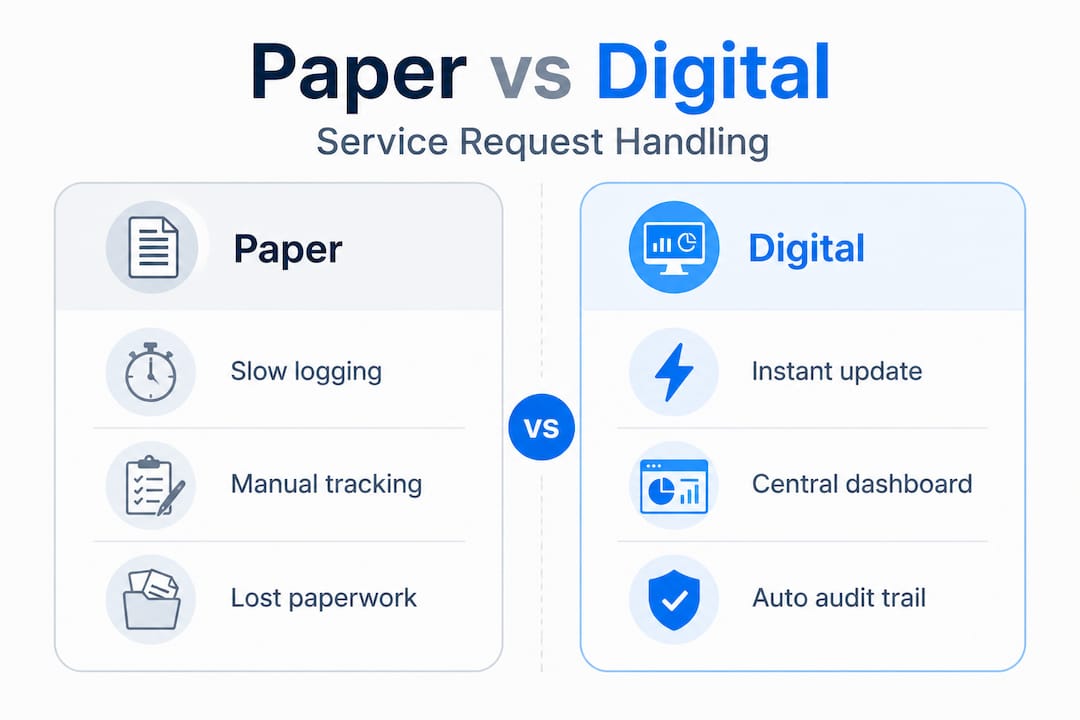
The compliance benefit deserves particular attention. Regulatory audits in industrial environments increasingly require documented evidence of maintenance activity, parts traceability, and technician qualifications. Digital records satisfy these requirements automatically. Paper records require manual collation, introduce the risk of loss or alteration, and often fail to meet the detail standard auditors expect. Exploring digital field service cases shows how this translates across different industrial sectors, with consistent results regardless of asset type.
Pro Tip: Feed insights from your digital dashboards back into your SOP revision cycle at least twice per year. If the data consistently shows a particular step causing delays or errors, the SOP should change to reflect the operational reality, not the other way around.
The organisations that resist digital transformation typically cite implementation complexity or upfront cost as barriers. Both are legitimate concerns. But the long-term cost of maintaining paper-based systems, factoring in error rates, compliance risk, and lost productivity, reliably exceeds the investment in a well-chosen digital platform.
Level up your service request handling with FullyOps
Applying the principles in this guide becomes significantly more straightforward when you have the right platform supporting every stage of the process. FullyOps is built specifically for industrial operations managers who need real-time visibility into work orders, asset history, technician availability, and performance metrics from a single, integrated environment.
Whether you are looking to improve resource allocation across your maintenance team, build maintenance optimisation strategies that reduce unplanned downtime, or establish a reliable work order management process that scales with your operation, FullyOps provides the tools and reporting capabilities to make it happen. Explore the platform’s tutorials and product guides to see how automation and integration can take your service request handling from reactive to proactive.
Frequently asked questions
What is the most important step in service request handling?
Accurately logging and prioritising requests is the most critical step, as errors at this stage cascade throughout the entire process and compound resolution times at every subsequent stage.
How do I reduce delays when handling service requests?
Standardising your workflow and using a digital platform can cut delays significantly by streamlining communication and assignment, since digital workflow platforms reduce manual handoffs and improve visibility across the team.
What process metrics should operations managers track?
Key metrics include average resolution time, number of repeat requests per asset, first-time fix rate, and total asset downtime incidents, all of which reveal different dimensions of process health.
How does digitalisation impact compliance in service request management?
Digital platforms improve traceability by automatically timestamping and recording every action, making regulatory audits and compliance reporting considerably faster and more reliable than paper-based alternatives.
Are there industry examples of successful service request handling?
Yes, field service case studies consistently demonstrate significant efficiency gains when organisations replace manual request processes with integrated digital management systems.
Recommended
- Streamline your service request workflow: 26% cost savings
- Field Service Management: Optimize & Boost Efficiency – FullyOps
- 7-Step Field Service Management Checklist for HVAC Efficiency
- Streamline IT helpdesk workflows for stress-free operations – IT Start
- Workflow automation tips: boost SaaS team efficiency fast | Rule27 Design