

TL;DR:
- Effective compliance management depends on capturing and retrieving evidence of maintenance tasks instantly to pass audits efficiently. Centralized documentation, automated workflows, and proactive exception handling transform compliance from a reactive burden into a strategic operational advantage. Regular monitoring and digital tools ensure evidence integrity, supporting continuous audit readiness and operational excellence.
Imagine an inspector arrives unannounced and requests documented evidence of every preventive maintenance task completed over the past 18 months. Your team performed all the work, scheduled and executed to standard, yet the records are scattered across spreadsheets, paper forms, and email chains. The audit risk in industrial maintenance is rarely about failing to do the work; it is almost always about failing to prove it. This guide will show you how to build a compliance management workflow that makes evidence instantly retrievable, transforms audit preparation from a crisis into a routine, and turns regulatory adherence into a genuine operational advantage.
Table of Contents
- Understanding the compliance management workflow challenge
- Readying your tools and requirements for workflow success
- Step-by-step: Building a best-in-class compliance workflow
- Advanced optimisation: Multiple frameworks and automation
- Proving, monitoring, and adapting your workflow for audit-readiness
- A fresh perspective: Why audit-ready evidence is the true differentiator
- Empower your compliance journey with industrial-ready tools
- Frequently asked questions
Key Takeaways
| Point | Details |
|---|---|
| Documentation is proof | Auditors care more about your ability to demonstrate maintenance than about the work itself. |
| Centralise and automate | A single source of truth and automated alerts drive workflow efficiency and proactive compliance. |
| Build for evidence at execution | Capture compliance evidence as work happens, not retroactively. |
| Optimise for scale | Managing multiple standards requires mapping shared controls and automating wherever possible. |
| Continuous improvement | Monitor, test, and adapt your workflow for audit-ready resilience and long-term success. |
Understanding the compliance management workflow challenge
A compliance management workflow is the structured sequence of activities, checks, and documentation steps that an industrial maintenance organisation follows to meet regulatory, safety, and contractual obligations. It is not simply a maintenance schedule. It includes how evidence of every completed task is captured, stored, and retrievable on demand. That distinction matters enormously.
The central problem for most operations managers is not that maintenance is not being performed. It is that documentation gaps drive failures rather than operational ones. Technicians complete inspections, replace parts, and sign off on jobs, but the evidence trail is incomplete or inconsistent. When an auditor requests records, the scramble begins.
“The compliance gap is rarely a performance gap. It is a proof gap. Organisations that master evidence capture gain a structural advantage over those that treat documentation as an afterthought.”
Centralising documentation and automating monitoring substantially improves compliance efficiency, yet many facilities still rely on disconnected tools that create fragmented records. To understand the full scope of what you are managing, consider the typical workflow elements alongside their evidence requirements:
| Workflow element | Evidence requirement |
|---|---|
| Scheduled inspection | Timestamped completion record with technician ID |
| Corrective action | Work order, root cause note, parts used, sign-off |
| Calibration task | Calibration certificate, tool ID, tolerance range |
| Contractor visit | Licence verification, induction record, access log |
| Regulatory deadline | Scheduled date, completion date, approver signature |
The risks of operating without centralised compliance evidence are significant and compound over time. Key risks include:
- Inability to retrieve records quickly during a surprise audit
- Duplicate or conflicting documentation from multiple sites or teams
- Expired certifications and licences going undetected until work begins
- Manual follow-up processes that create delays and errors
- No audit trail for corrective actions or exceptions
A robust maintenance compliance checklist helps close these gaps by formalising what evidence must be captured at each stage. Pairing this with clear compliance workflow strategies ensures that every team member understands their documentation responsibilities before a task begins, not after it ends.
Readying your tools and requirements for workflow success
Preparation is essential, so before designing actual workflow steps, align your tools, people, and baseline requirements. Starting without this foundation is one of the most common and costly mistakes operations managers make.
Begin by assembling the core documentation and tools your workflow will depend upon. Essential items include:
- A current asset register with maintenance schedules and regulatory deadlines
- Regulatory standards relevant to your industry (ISO 55000, OSHA, local health and safety codes)
- Existing work order templates and their current completion rates
- Contractor and vendor compliance records (licences, insurance certificates)
- Any audit findings from the previous two years that identified documentation weaknesses
Stakeholder roles must be clearly defined before workflow design begins. The operations manager owns the process. Maintenance supervisors are responsible for ensuring evidence is captured at execution. Technicians are accountable for completing documentation at the point of work. Finance or procurement teams may own contractor compliance records. Without clear ownership, documentation accountability diffuses across the organisation and records become unreliable.
Workflow efficiency improves measurably through centralised policies and risk-based scheduling, meaning you should prioritise your highest-risk assets and regulatory deadlines when designing your initial workflow scope. Do not try to automate everything at once.

The choice between manual and automated compliance tools has significant practical implications. The table below summarises the key differences:
| Feature | Manual tools (spreadsheets, paper) | Automated compliance software |
|---|---|---|
| Evidence capture | After the fact, inconsistent | At point of work, timestamped |
| Audit retrieval | Hours to days | Seconds to minutes |
| Deadline tracking | Relies on individual memory | Automated alerts and escalations |
| Multi-site consistency | Prone to drift | Standardised templates enforced |
| Reporting | Manual compilation | Automated dashboards |
Standardisation and harmonised KPIs are particularly critical for organisations managing multiple facilities. Without enforced standards, documentation drift occurs across sites, and what passes as complete evidence in one location is insufficient in another. A detailed maintenance compliance guide can help anchor your baseline standards across teams.
For sector-specific preparation, reviewing a fire sprinkler compliance workflow provides a useful example of how evidence requirements are mapped to individual task steps in a regulated environment. This principle applies across all industrial maintenance contexts.
You should also use your maintenance scheduling guide to ensure your scheduling approach aligns with compliance frequency requirements, because a task scheduled correctly but not documented completely still fails an audit.
Pro Tip: Before finalising your workflow design, validate your baseline by asking one question: are you currently tracking the right things? Many organisations track task completion rates but not evidence completeness rates. These are not the same metric.
Step-by-step: Building a best-in-class compliance workflow
With foundations in place, map the workflow itself using these actionable, research-backed steps. This is where the structural work translates into daily operational practice.
-
Define requirements. List every regulatory, contractual, and internal compliance obligation affecting your assets. For each obligation, specify what constitutes acceptable evidence. Ambiguity here causes problems downstream.
-
Design data collection points. Evidence must be captured at execution, not retroactively. Map each task in your workflow to a specific evidence capture step, completed before the job is closed, not at the end of the shift.
-
Set up verification steps. Assign a reviewer for high-risk tasks. Verification does not need to be manual. Automated approval workflows can flag incomplete records and route them to supervisors before a job order is marked complete.
-
Enforce access control. Contractor workflow management requires that access to facilities and equipment is conditional on verified, current compliance documentation. No licence, no access. Build this into your digital workflow as a hard gate, not a reminder.
-
Configure ongoing monitoring. Set automated alerts for expiring certifications, overdue inspections, and documentation exceptions. Monitoring should run continuously, not just during scheduled reviews.
-
Build exception handling into the design. What happens when a technician cannot complete a task due to equipment lockout? What if a contractor’s insurance lapses mid-project? Every workflow needs defined escalation paths for exceptions, not just the main process. Most compliance failures during audits trace back to undocumented exceptions rather than missed scheduled tasks.
Understanding maintenance compliance at a process level helps you design these steps correctly, while mapping them to preventive maintenance steps ensures your workflow integrates with your broader maintenance operations rather than running in parallel to them.
Pro Tip: Plan explicitly for exception handling before you launch the workflow. Define what a “non-conformance” looks like, who owns it, and how it must be documented. Exceptions that are ignored or informally resolved become audit liabilities.
Advanced optimisation: Multiple frameworks and automation
Once a workflow is in place, optimise for complexity and scale using automation and smart standardisation. For many industrial maintenance operations, compliance is not a single framework. It involves OSHA, ISO standards, sector-specific regulations, and contractual obligations, all running simultaneously.
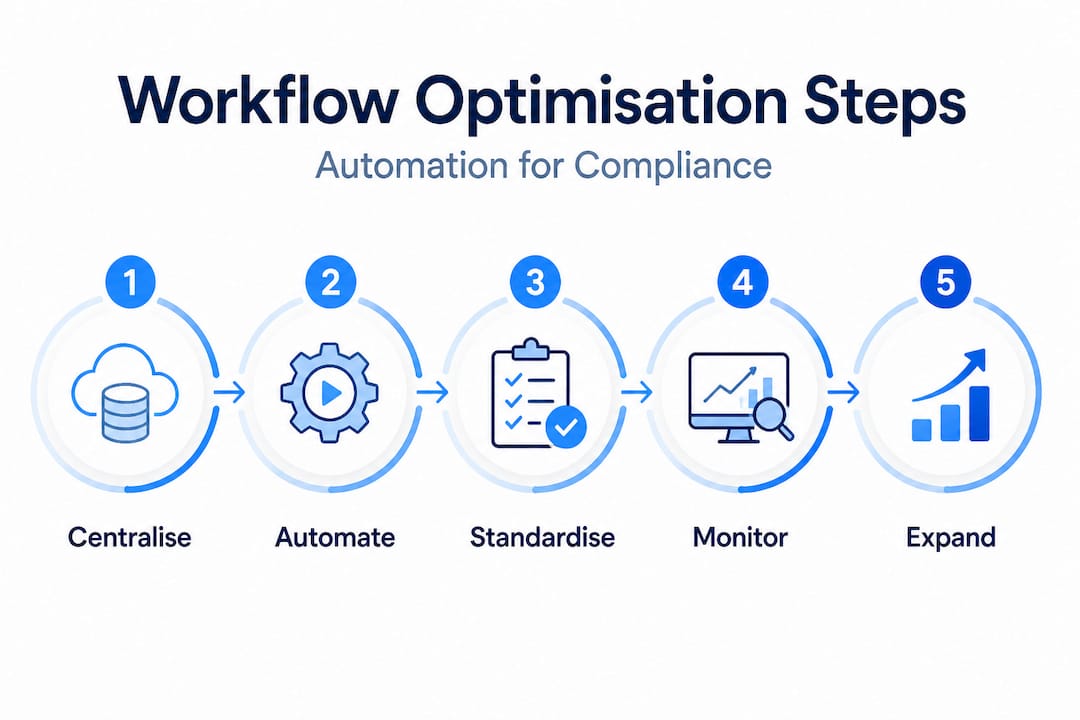
The most effective approach is to identify where requirements from different standards overlap and design shared controls that satisfy multiple obligations at once. Overlapping requirements should inform shared controls, and Governance, Risk, and Compliance (GRC) tools provide the automation layer that makes this practical at scale. GRC tools can map a single evidence record to multiple framework requirements, eliminating duplicated effort.
| Automation feature | Benefit for multi-framework compliance |
|---|---|
| Automated control testing | Reduces manual verification across frameworks |
| Continuous evidence collection | Closes the gap between work performed and proof stored |
| Cross-framework mapping | One control satisfies multiple standards |
| Real-time dashboards | Instant view of compliance status across all frameworks |
| Audit trail generation | Exportable records for any framework on demand |
Common pitfalls in multi-framework operations include:
- Treating each framework as a separate workflow, creating duplication and confusion
- Failing to update shared controls when one standard is revised
- Assuming that completing a task satisfies compliance without verifying the specific evidence format required by each standard
- Not testing retrieval speed for each framework separately during audit simulations
Engineering-style approaches require explicit exception handling and realistic testing to remain reliable under pressure. Compliance workflows designed only for the ideal path tend to fail when conditions are not ideal, which is precisely when auditors are most interested in your records.
“Automation does not replace compliance judgement. It removes the manual burden that prevents that judgement from being applied consistently.”
Refer to your compliance checklist regularly when expanding your workflow to cover additional frameworks. It provides a practical structure for ensuring no new requirement goes unmapped.
Proving, monitoring, and adapting your workflow for audit-readiness
After implementing your workflow, ongoing monitoring and audit readiness become the key to sustained success. A workflow that is implemented but not actively monitored will degrade over time, a process known as documentation drift.
Benchmarking compliance relies on evidence timeliness and frequency of monitoring rather than simply tracking whether tasks are scheduled. The key KPIs to track include:
- Schedule adherence rate: percentage of tasks completed within the required time window
- Evidence completeness rate: percentage of closed work orders with all required documentation attached
- Audit readiness latency: average time to retrieve a full evidence package for any given asset
- Overdue certification rate: number of certifications within 30 days of expiry that are not yet renewed
- Non-conformance closure rate: percentage of documented exceptions resolved within the defined escalation time
Monitoring completion and error rates provides the quantitative signal needed to identify where your workflow is weakening before an auditor finds it first.
Common signals of documentation drift include:
- Increasing time gaps between task completion and evidence upload
- Rising rates of retroactively edited work orders
- Repeated exceptions for the same asset or technician
- Inconsistent evidence formats across sites or shifts
- Overdue items appearing in batches rather than being caught individually
Regular maintenance of your maintenance reliability steps framework also supports compliance monitoring, because reliability and compliance share many of the same evidence requirements.
Pro Tip: Conduct a simulated audit at least once every quarter. Select a random sample of assets and attempt to retrieve a complete evidence package within ten minutes. The time and friction involved in that exercise will tell you more about your workflow health than any dashboard metric alone.
A fresh perspective: Why audit-ready evidence is the true differentiator
Most compliance frameworks in industrial maintenance ask organisations to do the work correctly. Very few explicitly require the ability to produce evidence instantly, yet that capability is what determines whether an organisation is genuinely compliant or merely operationally competent.
There is a widely held assumption in maintenance operations that compliance equals completion. If the task was done, the obligation was met. This belief underestimates the regulatory reality significantly. Documentation integrity is the core differentiator between organisations that pass audits consistently and those that pass occasionally and survive the rest.
The operational ROI of instant evidence extends well beyond regulatory risk. When your team can retrieve any maintenance record in under a minute, they can also resolve contractor disputes faster, respond to equipment incidents with complete histories, and make asset investment decisions based on accurate cost-of-compliance data. These are operational benefits, not just compliance ones.
The transformation from reactive compliance to proactive evidence management also changes how teams engage with documentation. When evidence capture is built into the workflow at execution rather than treated as an admin task afterwards, technicians experience it as part of the job rather than a burden layered on top of it.
Viewing your facility compliance strategies through this lens, the investment in workflow design and digital tooling is not primarily a risk mitigation cost. It is an operational efficiency investment that happens to produce audit readiness as a by-product.
“The organisations that treat compliance as a continuous operational practice rather than a periodic event are the ones that maintain regulatory confidence without disruption to their core maintenance work.”
Empower your compliance journey with industrial-ready tools
Translating the steps in this guide into daily practice requires the right combination of structured processes and capable tooling. Whether you are starting from scratch or standardising an existing approach, purpose-built industrial platforms make the difference between compliance as a burden and compliance as a workflow strength. FullyOps maintenance software provides work order management, evidence capture, and operational reporting designed specifically for industrial maintenance teams, reducing the manual effort that creates documentation gaps. To understand how asset management strategy supports compliance, explore the range of asset management systems available for industrial contexts. For teams ready to structure their planning approach, the resource allocation tutorial offers practical guidance on aligning technician capacity with compliance-critical scheduling priorities.
Frequently asked questions
What is the most common cause of compliance audit failure in industrial maintenance?
Failed or incomplete documentation that cannot be produced on demand is the leading cause, as audit failures consistently relate to documentation gaps rather than tasks that were not performed.
How can I reduce manual effort in compliance workflows?
Centralised, automated monitoring reduces the need for manual checks by triggering alerts, routing approvals, and consolidating evidence records without requiring individual follow-up actions.
What KPIs should operations managers track for compliance workflow health?
Key KPIs include schedule adherence, evidence completeness rate, and audit readiness latency, as benchmarking should prioritise evidence timeliness over simple task completion counts.
How do I handle compliance across multiple frameworks or standards?
Identify shared controls across frameworks and use GRC software to automate evidence collection across standards, reducing duplication and ensuring consistent reporting.
Why is exception handling important in compliance workflows?
Exception handling and realistic testing ensure the workflow remains robust when conditions vary, preventing undocumented deviations from becoming audit liabilities.
Recommended
- Compliance in service management: the operational value
- Asset Maintenance Workflow Guide for Optimal Efficiency
- What is maintenance compliance? A guide for operations managers
- Rubber stamp compliance: avoid pitfalls, boost efficiency – Stamp Design 4U
- Why financial compliance matters for UK SMEs: 2026 guide