

TL;DR:
- Distributed and hybrid architectures in maintenance automation enable real-time, localized fault detection while enhancing long-term analysis capabilities. Successfully scaling these systems requires organizational planning, data quality, cross-disciplinary skills, and iterative implementation. Emphasizing operational agility over technology alone is crucial for achieving lasting maintenance improvements in 2026.
Maintenance managers in industrial sectors are navigating a fundamental shift in how automation is understood and applied. The old narrative, that automation simply means machines replacing people on the shop floor, no longer reflects operational reality. In 2026, distributed architectures spanning sensors, controllers, gateways, and edge servers are redefining where intelligence sits within maintenance systems, and this architectural evolution is creating both new opportunities and new responsibilities for anyone managing industrial assets at scale.
Table of Contents
- How automation is reshaping maintenance in 2026
- Hybrid intelligence: Decentralised detection, centralised optimisation
- Overcoming practical barriers: Integration and scalability
- From theory to application: Future-ready maintenance frameworks
- Why the future of maintenance must embrace operational agility over blind automation
- Next steps: Empowering your maintenance automation journey
- Frequently asked questions
Key Takeaways
| Point | Details |
|---|---|
| Distributed architectures lead | Modern maintenance automation relies on layered intelligence across sensors, controllers, and edge servers. |
| Hybrid models maximise value | Combining decentralised real-time detection with centralised optimisation drives both agility and insight. |
| Barriers are organisational | Integration, data gaps, and continuous model management determine how well automation scales. |
| Application trumps complexity | Success stems from frameworks enabling teams to translate automation investments into reliable operational outcomes. |
| Agility is essential | Future-ready maintenance means adapting quickly, not simply adding more technology. |
How automation is reshaping maintenance in 2026
For much of the past two decades, maintenance automation followed a centralised model. Data from machines would travel to a central server or cloud platform, where algorithms would analyse it and generate alerts or recommendations. This worked reasonably well when connectivity was reliable and asset estates were relatively uniform. However, as industrial environments have grown more complex, with older brownfield assets sitting alongside newer connected equipment, the limitations of pure centralisation have become clear.
The emerging view in 2026 is decentralised processing distributed across sensors, controllers, gateways, and edge servers rather than relying on a single intelligence location. This layered approach allows maintenance systems to act locally on real-time data while still feeding aggregated insights upward for broader analysis. For maintenance managers, this means faster fault detection, reduced latency in response, and greater resilience when network connectivity is interrupted.
Understanding the layers of a distributed maintenance architecture is essential for planning any automation initiative:
- Sensors and instrumentation: These capture raw data at the machine level, measuring vibration, temperature, pressure, and other operational parameters.
- Controllers and gateways: These filter, pre-process, and route data, making early decisions about which information warrants immediate attention.
- Edge servers: Positioned close to the operational environment, these run local AI models to detect anomalies and trigger alerts in near real time.
- Centralised platforms: Cloud or on-premise servers that aggregate data from multiple edge nodes, run complex analytics, and continuously improve predictive models.
“The intelligence in modern maintenance automation is no longer located in one place. It is distributed, adaptive, and increasingly capable of acting autonomously at the point of need.”
This architecture is particularly relevant when integrating automation into brownfield environments, which are facilities with existing operational technology (OT) that was not designed for connectivity. Rather than replacing legacy systems outright, distributed architectures allow you to layer intelligence incrementally. Refer to asset management trends 2026 for a broader view of how industrial organisations are adapting their asset strategies to accommodate this shift.
Reviewing maintenance tracking tips also helps illustrate how practical tracking disciplines underpin any successful automation roll-out, regardless of the architecture chosen.
| Architecture type | Data processing location | Latency | Resilience | Best suited for |
|---|---|---|---|---|
| Centralised | Cloud or central server | High | Moderate | Greenfield, stable networks |
| Distributed (edge) | Local servers and gateways | Low | High | Brownfield, mixed environments |
| Hybrid | Edge and central combined | Low to moderate | Very high | Complex, large-scale estates |
Understanding automation efficiency breakdowns can help you quantify the operational gains each architecture type delivers in your specific context, which is critical when building a business case for investment.
Hybrid intelligence: Decentralised detection, centralised optimisation
The most significant automation pattern emerging in 2026 is what practitioners are calling hybrid intelligence. According to ZEDEDA’s 2026 industry predictions, this approach combines decentralised real-time detection at the edge with centralised analytics and model improvement elsewhere. In practical terms, this means a machine on your factory floor can detect an anomaly and trigger a maintenance alert within milliseconds, while the broader platform learns from that event to improve future predictions across your entire asset estate.

The distinction between purely edge-based and hybrid models is important. An edge-only system can react quickly but lacks the broader context needed to improve over time. A purely centralised system offers rich analytics but cannot respond fast enough to prevent failures in real time. Hybrid intelligence resolves this by assigning each task to the most appropriate layer.
| Model type | Detection speed | Learning capability | Scalability | Connectivity dependency |
|---|---|---|---|---|
| Traditional (centralised) | Slow | High | Moderate | High |
| Edge-only | Very fast | Low | Limited | Low |
| Hybrid intelligence | Fast | High | High | Low to moderate |
Practical steps for maintenance teams looking to leverage hybrid architectures:
- Audit your current asset estate. Identify which assets are already instrumented and which require new sensors or connectivity upgrades.
- Define response time requirements. Determine which failure modes demand millisecond responses (edge processing) and which can tolerate longer analysis windows (central analytics).
- Select edge hardware appropriate to your environment. Industrial edge servers must meet ingress protection ratings suitable for your operating conditions.
- Integrate edge outputs with your central maintenance platform. Ensure alerts, work orders, and historical data flow seamlessly between layers.
- Establish a model update cadence. Plan for how improved AI models will be pushed to edge nodes as your central system learns from accumulated data.
Pro Tip: When evaluating hybrid intelligence platforms, test the latency of local fault detection under realistic network disruption conditions. A system that reverts to centralised processing when connectivity drops offers far less operational resilience than one that continues functioning autonomously at the edge.
For teams managing building services and HVAC systems, HVAC automation efficiency demonstrates how hybrid approaches are already delivering measurable uptime improvements in real-world deployments. Real-world HVAC automation case studies provide further context on how these principles translate across different asset types.
Adopting preventive workflow automation in conjunction with hybrid intelligence architectures can also significantly reduce reactive maintenance costs by catching developing faults before they escalate into unplanned failures.
Overcoming practical barriers: Integration and scalability
The technical sophistication of distributed and hybrid systems is genuinely impressive, but the barriers to successful implementation are often organisational rather than technological. Research from IndustryWeek indicates that automation outcomes can be undermined by organisational capacity and planning or data gaps, not simply by technical limitations. Understanding these barriers in advance is the clearest path to avoiding costly setbacks.
The most common operational hurdles maintenance managers encounter include:
- Legacy system integration: Many industrial facilities run OT systems that are decades old and were never designed to interface with modern automation platforms. Bridging this gap requires careful protocol mapping and often bespoke middleware solutions.
- Data quality and availability: AI and edge models depend on clean, consistent, labelled historical data to function accurately. Facilities that have relied on paper-based maintenance records or inconsistent digital logging will find model training slow and unreliable.
- Workforce skills gaps: Technicians who are proficient in traditional maintenance methods may need structured upskilling to work effectively alongside automated systems and interpret AI-generated alerts.
- AI model lifecycle management: Once deployed, edge models are not static. They require regular updates as equipment behaviour changes, and pushing updates across a distributed network of edge nodes introduces its own operational complexity.
- Budget and prioritisation: Automation initiatives frequently lose momentum when initial pilots fail to demonstrate clear return on investment within expected timeframes.
“The automation projects that stall are rarely failing because of the technology. They stall because the organisation underestimated the planning, data preparation, and change management required to make them work.”
Reviewing preventive maintenance challenges provides a structured five-step approach for managing these transitions without disrupting ongoing operations.
Pro Tip: Avoid what practitioners call pilot purgatory, where automation initiatives remain indefinitely in the trial phase without clear criteria for scale-up. Before launching a pilot, define the three to five metrics that will determine whether the project advances. This discipline converts a promising experiment into a committed programme with organisational backing.
Strong maintenance history tracking practices are also foundational. Without accurate historical records of asset performance, failure events, and intervention outcomes, even the most sophisticated edge AI model will struggle to generate reliable predictions.
From theory to application: Future-ready maintenance frameworks
Understanding distributed and hybrid architectures, and knowing the barriers to overcome, creates the basis for practical action. The next step is deploying automation in a structured, scalable way that delivers results within your specific operational environment.
A future-ready deployment follows a clear sequence:
- Baseline assessment: Document current asset condition, maintenance frequency, failure history, and existing data capture capabilities.
- Pilot selection: Choose two to three high-impact assets where failures carry significant cost or safety risk. These become your proving ground.
- Architecture design: Define where edge processing will sit, how it connects to your central platform, and what failure modes you are targeting.
- Data preparation: Clean and structure historical maintenance data. Supplement with sensor data collection where gaps exist.
- Model development and validation: Train initial AI models and validate against known failure events before going live.
- Live deployment with monitoring: Deploy edge nodes and central integrations, then monitor closely for false positives and missed detections during the initial operational period.
- Scale and iterate: Use results from the pilot to refine models, expand to additional assets, and improve your central analytics capabilities.
The EE Times analysis of predictive maintenance architecture reinforces that scaling predictive maintenance in 2026 depends on getting this architectural foundation right from the outset, rather than retrofitting it later when complexity has increased.
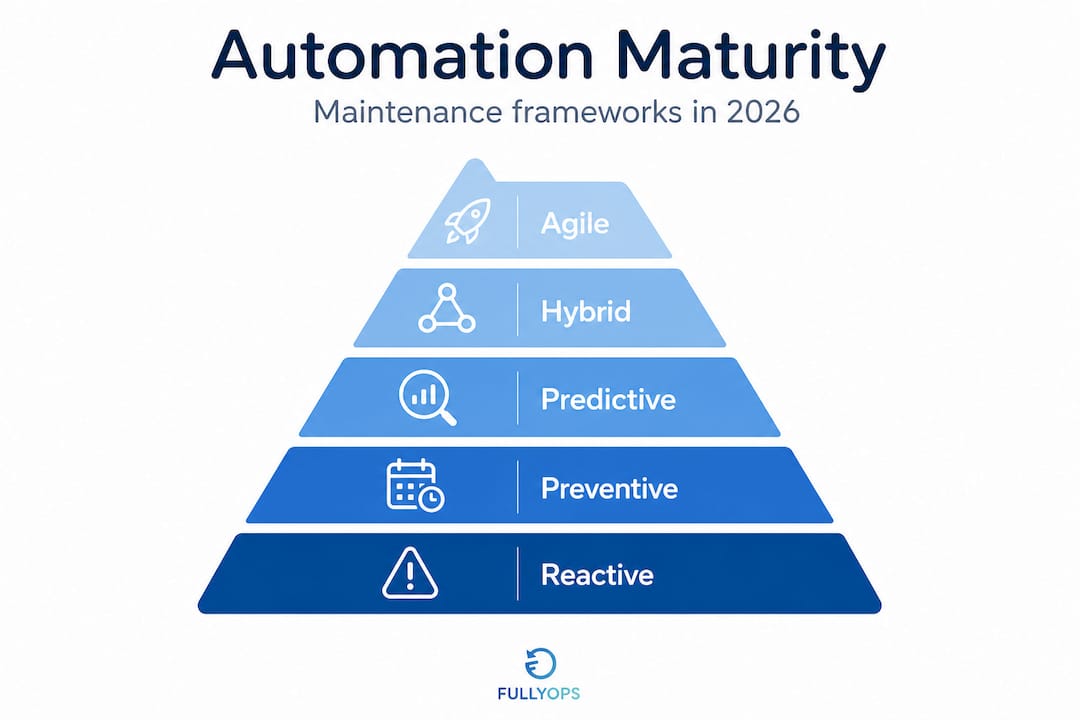
| Automation maturity level | Data approach | Maintenance model | Response capability | Example technology |
|---|---|---|---|---|
| Legacy | Paper records or basic CMMS | Reactive and calendar-based | Manual review only | Standalone CMMS |
| Transitional | Digital records with basic sensors | Condition-based, partly preventive | Semi-automated alerts | Connected CMMS with sensor feeds |
| Advanced | Full edge and central AI integration | Predictive and proactive | Autonomous detection and work order creation | Hybrid edge AI with integrated EAM platform |
Understanding how reducing breakdowns through automation impacts total maintenance cost is essential when presenting the business case for moving from a transitional to an advanced maturity level. For further context on how automation is being applied across diverse service business environments, automation examples for service businesses offer practical reference points.
The predictive maintenance guide available through FullyOps also provides actionable guidance on building a reliability-focused maintenance culture alongside any technical investment.
Why the future of maintenance must embrace operational agility over blind automation
There is a risk in 2026 that the excitement around distributed architectures, edge AI, and hybrid intelligence leads maintenance managers to prioritise technology acquisition over operational readiness. The hard-won lesson from organisations that have successfully scaled automation is not that they bought the best sensors or deployed the fastest edge servers. It is that they built processes and cultures capable of adapting continuously as the technology and their own data matured.
Technology alone does not guarantee maintenance success. An edge AI system installed in a facility with poor data governance, undertrained technicians, and fragmented work order processes will underperform relative to a simpler system deployed within a well-structured operational framework. Automation amplifies what is already present in your organisation, both the strengths and the weaknesses.
Cross-functional planning is non-negotiable. Maintenance automation decisions affect operations, IT, finance, and health and safety simultaneously. When these functions plan in silos, integration projects stall, budgets overrun, and adoption fails. The organisations achieving the strongest results in 2026 are those where maintenance managers actively collaborate with IT counterparts on architecture decisions and with operations leaders on defining what success looks like for each asset class.
There is also a talent dimension that is frequently underestimated. Technicians who understand both the physical behaviour of assets and the logic of AI-generated alerts are significantly more effective than those who understand only one domain. Investing in cross-disciplinary training is not a soft people initiative. It is a hard operational necessity that directly affects automation return on investment.
Finally, tracking efficient asset management trends over time, rather than making one-off technology decisions, positions your operation to adapt as architectures and capabilities continue to evolve through the late 2020s and beyond.
The organisations that will lead in maintenance performance are not those with the most advanced hardware. They are the ones with the agility to learn from their data, adapt their processes, and continuously raise the quality of human decision-making alongside automated monitoring.
Next steps: Empowering your maintenance automation journey
FullyOps is designed specifically to support maintenance managers who are ready to move from reactive operations to genuinely proactive, data-driven asset management. Whether you are beginning your automation journey or looking to scale an existing programme, the platform provides the tools to manage work orders, track asset interventions, and integrate operational data from across your estate. Explore maintenance optimisation tools to understand how FullyOps reduces downtime and controls costs in 2026 industrial environments. For a structured starting point, the preventive maintenance steps guide offers a clear reliability-focused approach, and the workflow solutions resource helps you build the operational infrastructure that automation depends on.
Frequently asked questions
How does automation impact legacy maintenance systems?
Automation in 2026 uses distributed processing layers that can interface with existing systems incrementally, meaning facilities can upgrade capabilities without replacing all legacy infrastructure at once.
Is full centralisation or full edge intelligence better for maintenance?
A hybrid intelligence approach combining local real-time detection with centralised analytics consistently outperforms either extreme, offering both speed and long-term learning capability.
What is the biggest barrier to scaling maintenance automation?
Legacy integration and AI model lifecycle management across distributed edge nodes are the most commonly cited operational barriers, alongside data quality gaps from inconsistent historical records.
Can automation replace maintenance workers?
No. Automation handles continuous monitoring and pattern recognition, but skilled technicians remain essential for diagnosing complex failures, executing physical interventions, and making judgement calls that current AI models cannot reliably replicate.
How can maintenance managers start with automation if resources are limited?
Begin with a focused pilot on one or two high-impact assets, define clear success metrics before launch, and scale incrementally based on measurable results rather than committing large budgets before the model is validated.