

TL;DR:
- Collaborative maintenance involves real-time, shared information across teams, reducing errors and costs. It links planning, execution, and feedback through unified digital tools, fostering a culture of accountability and continuous improvement. Implementing effective processes and leadership support ensures sustained success in minimizing downtime and maximizing asset reliability.
Poor maintenance decisions rarely stem from technical ignorance alone. In most industrial operations, the real culprit is fragmented information, where one team acts on outdated records while another has already identified the root cause. Real-time shared maintenance information improves coordination for preventive maintenance execution and measurably reduces errors and misunderstandings across teams. For operations managers and maintenance directors, understanding why collaboration fails and how to fix it is no longer optional. It is the difference between reactive firefighting and a genuinely resilient asset management strategy.
Table of Contents
- What is collaborative maintenance and why is it different?
- The business impact: How collaboration reduces downtime and costs
- Key enablers: Tools, processes, and culture for sustainable collaboration
- Putting collaboration into practice: Steps for operations managers
- Why collaboration fails in maintenance and what actually works
- Streamline your maintenance with the right tools
- Frequently asked questions
Key Takeaways
| Point | Details |
|---|---|
| Collaboration cuts costs | Scaling knowledge and teamwork across maintenance teams can deliver significant service cost savings and improved asset performance. |
| Unified information is crucial | Real-time, shared information ensures everyone operates from the same facts, reducing mistakes and speeding up resolutions. |
| Success needs more than tools | True sustainable collaboration depends on team culture, leadership, and linking planning with daily execution—not on software alone. |
| Start with clear steps | Adopting collaborative maintenance starts with practical actions like up-to-date communication and proactive engagement across roles. |
What is collaborative maintenance and why is it different?
Collaborative maintenance is the practice of coordinating all maintenance activities through shared, technology-enabled processes that keep every stakeholder working from the same source of information in real time. It is not simply about having multiple technicians work side by side. It means that planners, technicians, supervisors, and procurement teams all contribute to, and benefit from, a single unified knowledge base rather than maintaining separate logs, spreadsheets, or verbal briefings.
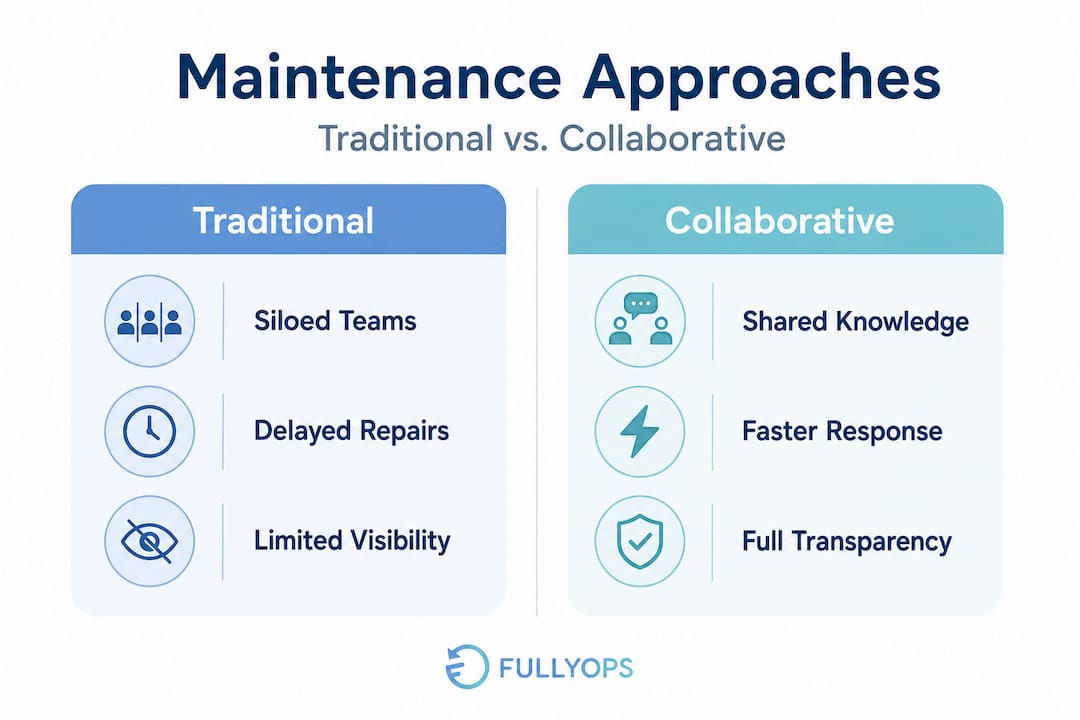
Traditional maintenance approaches are defined by silos. A planner creates a work order without visibility into current inventory levels. A technician closes a job without recording failure codes that would help the next engineer. A manager reviews performance data that is already a week old. These gaps are not rare exceptions; they are the structural default in many organisations that have not yet invested in connected maintenance processes.
| Traditional maintenance | Collaborative maintenance |
|---|---|
| Siloed work orders and logs | Unified digital work order management |
| Reactive communication between teams | Real-time status updates and alerts |
| Knowledge held by individuals | Shared knowledge base accessible to all |
| Delayed performance reporting | Live dashboards and instant reporting |
| Manual planning disconnected from execution | Planning linked directly to execution data |
The gap between these two approaches has a direct financial consequence. According to a 2026 Field Service Benchmark, scaling knowledge across teams and reducing siloed operations can drive double-digit service cost savings and significantly fewer failed resolutions per visit. That figure alone should prompt any operations manager to re-examine how information flows across their maintenance teams.
“Scaling knowledge across the workforce and reducing operational silos can unlock up to 26% in service cost savings.” — Aquant’s 2026 Field Service Benchmark
Simply following standard operating procedures is no longer sufficient. In industrial environments with growing asset complexity, increasing uptime expectations, and leaner teams, collaboration has become a core operational competency, not a nice-to-have enhancement. For a structured approach to building these processes, reviewing a solid maintenance planning guide is a practical starting point.
Key characteristics that define collaborative maintenance include:
- Shared digital work orders visible across all relevant roles in real time
- Integrated scheduling that accounts for technician availability, parts stock, and asset criticality
- Documented failure history accessible to every engineer, not stored in one person’s notebook
- Cross-functional communication that connects operations, maintenance, and procurement
- Continuous feedback loops so analysis informs future planning without delay
The business impact: How collaboration reduces downtime and costs
With collaboration defined, it is critical to see its real effect across operations, budgets, and team performance. The performance gap between collaborative and non-collaborative maintenance is not theoretical. It shows up in downtime duration, resolution speed, parts consumption, and ultimately in cost per asset over its operational lifecycle.
| Performance metric | Without collaboration | With collaboration |
|---|---|---|
| Mean time to repair (MTTR) | High, due to delayed information | Reduced by faster diagnosis and resource coordination |
| First-time fix rate | Low, due to incomplete job preparation | Improved through pre-shared failure history and parts availability |
| Unplanned downtime frequency | Higher, preventive actions poorly coordinated | Lower, with aligned preventive scheduling |
| Maintenance cost per asset | Escalating, driven by rework and duplication | Contained, with shared knowledge reducing repeat visits |
| Technician productivity | Fragmented, with time lost seeking information | Increased through clear, pre-loaded work instructions |
The numbers reinforce this picture. Field service analytics confirm that organisations which scale knowledge across teams can achieve up to 26% reduction in service costs, a figure that compounds significantly across large asset portfolios.
The top drivers of cost reduction in collaborative maintenance include:
- Eliminating duplicate work caused by poor communication between shifts
- Reducing the frequency of unnecessary return visits through better first-time information
- Improving parts procurement accuracy by linking work orders to live inventory data
- Accelerating root cause analysis with historical data shared across teams
- Lowering training overhead because documented knowledge is reusable across the workforce
To make this concrete, consider a numbered scenario of how collaborative maintenance resolves a real industrial problem:
- A production line vibration sensor flags an anomaly at 06:00. The alert is automatically routed to the on-call technician and the maintenance planner simultaneously.
- The technician accesses the asset’s full service history, including a similar fault resolved six months prior, directly from their mobile device.
- The planner confirms that the required replacement bearing is in stock and assigns it to the work order before the technician reaches the equipment.
- The technician completes the repair in one visit, records the failure code and corrective action, and closes the work order with full documentation.
- The maintenance manager reviews the completed job and the updated failure pattern data in a live dashboard later that morning, with no manual reporting required.
This kind of outcome is not exceptional. It is what consistently well-structured collaborative maintenance delivers. Strategies to reduce downtime in planning and to cut maintenance costs are both grounded in the same principle: connected teams working from accurate, shared information produce faster, cheaper, and more reliable results.
Key enablers: Tools, processes, and culture for sustainable collaboration
The positive results are clear, but only achievable if the right enablers are in place, from software to team alignment. Three distinct dimensions must work together: digital tools, integrated processes, and organisational culture.
Digital tools
A Computerised Maintenance Management System (CMMS) is the operational backbone of any collaborative maintenance programme. It centralises work orders, asset records, maintenance histories, parts inventories, and scheduling into a single platform accessible to every relevant team member. Shared dashboards provide real-time visibility into asset status, open jobs, and team workload, removing the lag and distortion that occur when information passes through manual handoffs.

As modern reliability-centred approaches recommend, the CMMS must do more than store records. It should link reliability logic directly into work orders and job plans so that every technician operates from the same analytical framework, and so that every completed job feeds back into performance tracking automatically.
Integrated processes
Technology alone does not produce collaboration. Processes must be designed to connect planning with execution at every stage. This means that preventive maintenance schedules are built from live asset data, not annual calendars. It means failure analysis findings are recorded in formats that inform future planning, not filed away in reports that nobody reads. And it means procurement decisions are triggered automatically by work order requirements rather than waiting for manual requests.
Well-designed maintenance scheduling integrates all these connections, ensuring that each stage of the maintenance cycle informs the next without human delay or translation errors.
Culture and change management
This is the enabler that most organisations underestimate. Even well-structured maintenance methodologies can fail due to culture and budget constraints, which means that collaboration and alignment efforts must be managed as organisational change, not just process redesign. If senior technicians resist logging their work because they view it as a bureaucratic burden, the shared knowledge base degrades quickly. If managers treat the CMMS as a reporting tool rather than an operational aid, adoption stalls.
Common barriers and their practical solutions:
- Budget constraints: Start with a phased implementation that demonstrates measurable ROI before requesting full investment
- Entrenched silos: Involve team leads from multiple departments in the design of new workflows, not just the rollout
- Legacy attitudes toward documentation: Frame data entry as a professional contribution, not administrative overhead
- Lack of leadership sponsorship: Secure visible commitment from operations directors before launching any change initiative
- Tool complexity: Choose platforms with role-appropriate interfaces so technicians, planners, and managers each see what is relevant to them
Pro Tip: Build trust in your collaborative process through daily transparent updates at team level, not just monthly performance reports. When technicians see their input reflected in improved scheduling and fewer repeat callouts, they become the strongest advocates for the system.
Putting collaboration into practice: Steps for operations managers
It is time to translate what works into concrete next actions, whether starting from scratch or upgrading existing habits. The following steps provide a practical roadmap for initiating or strengthening collaborative maintenance in any industrial organisation.
-
Audit your current information flows. Map where maintenance data is created, stored, and shared today. Identify the specific points where information breaks down or is delayed between teams.
-
Define a single source of truth. Choose a platform that centralises work orders, asset records, and scheduling. Every team member should access the same system, not local spreadsheets or separate departmental databases.
-
Set up real-time information sharing. Configure alerts and notifications so that relevant stakeholders receive updates as they happen, not after the fact. Shared maintenance information at the point of execution reduces coordination errors and keeps preventive programmes on track.
-
Engage stakeholders across functions. Collaborative maintenance requires input from operations, maintenance, procurement, and management. Run structured sessions to align on shared goals and clarify each team’s responsibilities within the new process.
-
Establish documentation standards. Define what data must be captured at each stage of a work order, from fault description to resolution notes, and make this a non-negotiable part of job closure.
-
Create feedback loops. Schedule regular reviews where performance data from the CMMS informs planning adjustments. Make it routine for maintenance outcomes to feed directly back into future scheduling and resource allocation.
-
Measure and communicate progress. Track key metrics such as first-time fix rate, mean time to repair, and planned versus unplanned maintenance ratio. Share results with all teams to reinforce the value of the collaboration effort.
A well-structured approach to creating maintenance schedules supports several of these steps directly, particularly in aligning preventive work with accurate asset and resource data.
Pro Tip: Start with one asset group or production line rather than attempting a full organisational rollout. Document the performance improvements clearly, then use those results to build internal support for wider adoption. Incremental wins are far more persuasive than theoretical business cases.
Why collaboration fails in maintenance and what actually works
Most organisations approach collaborative maintenance the same way they approach a software implementation. They purchase a platform, run a training session, and expect behaviour to change. It rarely does. The honest assessment is that the primary reason collaborative maintenance programmes fail is not the technology, it is the absence of genuine organisational accountability.
Even well-structured maintenance methodologies fail when culture and budget constraints are not addressed head-on. This is not a peripheral concern. It is the central variable. A CMMS with excellent features becomes little more than an expensive filing system if team leaders do not model the behaviours they expect from their technicians.
What actually works is a combination of leadership visibility, clearly defined accountability, and small wins that build momentum. When a maintenance director personally reviews and acts on data from the shared platform every morning, that behaviour signals to the entire team that the system matters. When a technician’s documented fault history prevents a costly repeat failure two months later, and that story is shared in a team briefing, adoption accelerates without any further mandate.
The other critical insight is that linking planning with daily execution is not a technical challenge. It is a discipline challenge. Reliability logic sitting in an analysis document that never reaches the technician’s work order is wasted effort. The organisations that see sustained results are those that enforce the discipline of connecting every insight from the analysis layer to the execution layer, and then measuring whether that connection produced the expected outcome.
Collaboration is not a software feature. It is a team sport with rules, referees, and a scoreboard. The organisations that treat it as such, investing in leadership alignment as seriously as they invest in platform selection, consistently outperform those that rely on technology alone to drive the change.
Streamline your maintenance with the right tools
If you are ready to move from theory to action, the practical next step is selecting tools and resources that match your operational context. Reviewing the leading maintenance software for industrial companies gives a clear view of which platforms best support collaborative work order management, real-time visibility, and integrated reporting. Pairing that with a structured approach to resource allocation strategies ensures your teams are not just connected but also working with optimally deployed assets and personnel. For a broader view of how digital infrastructure supports long-term asset reliability, exploring the range of asset management systems available for industrial maintenance provides a solid strategic foundation for your next investment decision.
Frequently asked questions
How does collaborative maintenance reduce operational costs?
Collaborative maintenance allows teams to share real-time knowledge and resolve issues faster, which minimises errors, prevents duplication, and can cut service costs by double digits according to field service benchmark data. Fewer failed first visits and reduced rework are among the most direct financial benefits.
What are the most common barriers to collaborative maintenance?
The main barriers are entrenched organisational culture, lack of leadership support, and outdated tools, all of which can undermine even well-designed maintenance methodologies if not addressed as part of a managed change programme. Budget constraints are a secondary but significant barrier for many industrial organisations.
How does technology enable collaborative maintenance?
Digital systems like CMMS connect all data and updates in real time, ensuring that every team member works from the same accurate information. Shared real-time maintenance data specifically improves coordination during preventive maintenance execution and reduces the communication errors that lead to costly rework.
Does collaborative maintenance work for small teams?
Yes, even small maintenance teams benefit significantly from shared knowledge and aligned processes, particularly in environments where one technician’s expertise would otherwise be inaccessible to colleagues handling similar assets. The overhead of implementing collaborative tools scales proportionally, so smaller teams often see faster returns on their investment.
Recommended
- Asset Maintenance Workflow Guide for Optimal Efficiency
- Reduce maintenance costs for efficient asset management
- Asset management trends boosting efficiency in 2026