

A catálogo de ativos is a single, authoritative inventory of equipment and installations, identified, located and linked to maintenance history, that reduces unplanned downtime and ensures the right spare parts and service records are available when a technician needs them. It works because every asset carries a unique identity that connects location, criticality and repair history into one record. Fullyops and similar platforms give teams a structured way to run this as a live system rather than a static spreadsheet.
En resumen:
- A phased approach to building the asset catalogue allows for quicker, more reliable implementation, focusing first on critical assets and high-impact areas.
- Essential fields include a permanent unique identifier, clear description, site location, parent asset, and manufacturer details; additional information is added based on asset significance.
- Linking spare parts to materials catalogues and linking maintenance data to workflow systems improves accuracy, scheduling, and inventory management over time.
- Regular ownership, audits, and standardization of naming conventions are crucial to maintaining a living, trustworthy asset registry.
- Fullyops streamlines ongoing maintenance by enforcing data consistency, linking asset records to work orders, and automating scheduling and history tracking in a scalable, role-based platform.
Índice
- What fields belong in an asset catalogue?
- How do you build an asset catalogue from scratch?
- How do you keep an asset catalogue accurate over time?
- How does an asset catalogue connect to maintenance workflows?
- What actually goes wrong with asset catalogues in practice?
- Where Fullyops fits once you’re ready to scale
- Sources
- PREGUNTAS FRECUENTES
What fields belong in an asset catalogue?
An asset catalogue only earns its keep if the fields on each record answer the questions a technician actually asks on site: what is this, where is it, what has happened to it before, and how urgent is a failure. Skimp on these and the catalogue becomes decoration. Overload it with attributes nobody updates, and it decays just as fast.
Every asset record needs a baseline set of mandatory fields:
- Unique identifier: a tag number that never gets reused, even after disposal.
- Clear name: a description a non-specialist can understand, not just an internal code.
- Site and area location: down to the building, floor, or line where the asset physically sits.
- Parent asset: the system or line the unit belongs to, so hierarchy queries work.
- Make, model and serial number: taken from the nameplate, not from memory or an old purchase order.
- Manufacturer y commissioning date: for warranty tracking and lifecycle planning.
Beyond that baseline sit the operational fields that make the catalogue useful for day-to-day maintenance: criticality rating, maintenance frequency, last service date, next inspection due date, warranty expiry, and linked material numbers for the spares that asset typically consumes.
A smaller set of advanced fields earns its place only on higher-value or higher-risk assets: photographs of the nameplate and installation, manuals or wiring diagrams, IoT or sensor IDs for condition monitoring, and a lifecycle status flag (active, standby, decommissioned). Add these selectively. A pump worth a few hundred euros rarely needs the same documentation depth as a compressor that stops a whole line.
Parts should never live as free text on the asset record. Instead, link each spare to its own entry in a materials catalogue using a material number, supplier reference and stocking location, so ordering and inventory checks stay accurate.
How do you build an asset catalogue from scratch?
Most teams stall on an asset catalogue not because the concept is hard, but because they try to capture everything at once, for every asset, on day one. A phased build works better, and it can produce a usable registry within a few months depending on the site’s size and complexity, according to reliability-focused guidance on building trusted asset registries.
- Define scope and appoint an owner. Agree what counts as a maintainable asset (a pump, not every bolt on it), and name one person accountable for the registry’s accuracy.
- Set naming conventions and hierarchy. Structure the tree as site, area, system, equipment, component, and assign unique IDs that follow a consistent pattern technicians can predict.
- Run physical walkdowns. Tag each asset, photograph its nameplate, and capture the minimum fields on site rather than from old drawings that rarely match reality.
- Import and validate the data. Pull existing records from spreadsheets or an ERP, then apply validation rules and sample audits to catch duplicates, missing IDs and mismatched locations before go-live.
- Rank criticality and link spares. Assign an initial criticality score to each asset and connect the top spare parts to their materials catalogue entries so stock and asset data agree from day one.
Resourcing depends heavily on scale. A single production line with fifty assets might take a technician a week of dedicated walkdown time; a multi-site industrial operation with thousands of assets needs a proper project plan and probably a few months of phased rollout.
Consejo profesional: Pilot on your highest-impact area first, the line or system where a failure hurts most, rather than trying to catalogue the whole site at once. A tightly scoped pilot that enforces naming and links twenty critical assets to their spares tends to expose most of your process gaps within weeks, long before a site-wide rollout would.
How do you keep an asset catalogue accurate over time?
A catalogue built well and then abandoned degrades fast. Ownership and audit routines are what separate a living registry from an expensive one-off exercise.
Assign a named owner for the registry, someone whose job description includes keeping it current, not a task that floats between whoever has spare time. Tie every update to existing management-of-change and procurement processes, so a newly installed motor or a decommissioned tank gets logged automatically as part of that workflow rather than relying on someone remembering weeks later.
A structured asset repository reduces maintenance planning time and improves financial transparency precisely because the data behind it stays trustworthy. That only holds if audits happen on a set cadence, quarterly spot checks on your most critical assets, for example, with a defined method for reconciling what the register says against what is actually on the floor.
A few data rules keep the catalogue lean and maintainable:
- Only record detail your team can realistically keep updated; component-level fields are rarely worth the admin unless a component fails often enough to matter.
- Standardise naming immediately. “Pump 3” and “P03” referring to the same asset is a governance failure, not a typo.
- Reconcile new installations and disposals against the register within days, not at the next annual audit.
The most common mistake is treating the initial build as finished work. Adopting a recognised classification standard such as ISO 14224 for failure and equipment class data can jump-start consistency, but even a good standard needs someone enforcing it daily.
How does an asset catalogue connect to maintenance workflows?
The catalogue only proves its value once it feeds the systems your team actually works in every day. On its own, it is a reference; connected to your maintenance workflow, it becomes the engine behind scheduling, stocking and reporting decisions.
- Preventive schedules and work orders: asset records with commissioning dates and maintenance frequency let a CMMS generate accurate preventive tasks automatically, instead of technicians guessing intervals from memory.
- Spares accuracy: linking each asset to material numbers and supplier data, as recommended for a properly indexed materials catalogue, cuts the number of wrong parts ordered against a work order.
- Failure history and criticality: capturing what actually failed and when refines criticality scores over time, which in turn sharpens replacement and stocking decisions.
- System integrations: ERP, procurement, condition monitoring sensors and field service apps all need the same asset IDs to talk to each other without manual reconciliation.
This is where software that enforces consistent fields and links work orders to maintenance history earns its cost. Fullyops supports exactly this loop: work-order management tied to specific asset records, intervention tracking that builds the maintenance history automatically, inventory linked to spare parts, and reporting that surfaces which assets are actually costing you the most downtime. A sensible pilot connects one production area’s asset records to preventive scheduling and spares tracking first, then expands once the workflow proves out.
What actually goes wrong with asset catalogues in practice?

Most failed catalogues share the same handful of pitfalls: teams try to record every conceivable attribute instead of the ones that matter operationally, nobody is named as owner, audits get skipped once the initial excitement fades, and the data ends up siloed in three different spreadsheets that disagree with each other.
For the next 30 to 90 days, focus narrowly. Tag your twenty most critical assets properly. Enforce a single naming convention across the team, no exceptions. Run one targeted audit against those twenty assets to confirm the data matches reality. Link their top spare parts to materials catalogue entries. Only once that slice works reliably should you scale the same discipline to the wider site, one area at a time.
— Pedro
Where Fullyops fits once you’re ready to scale
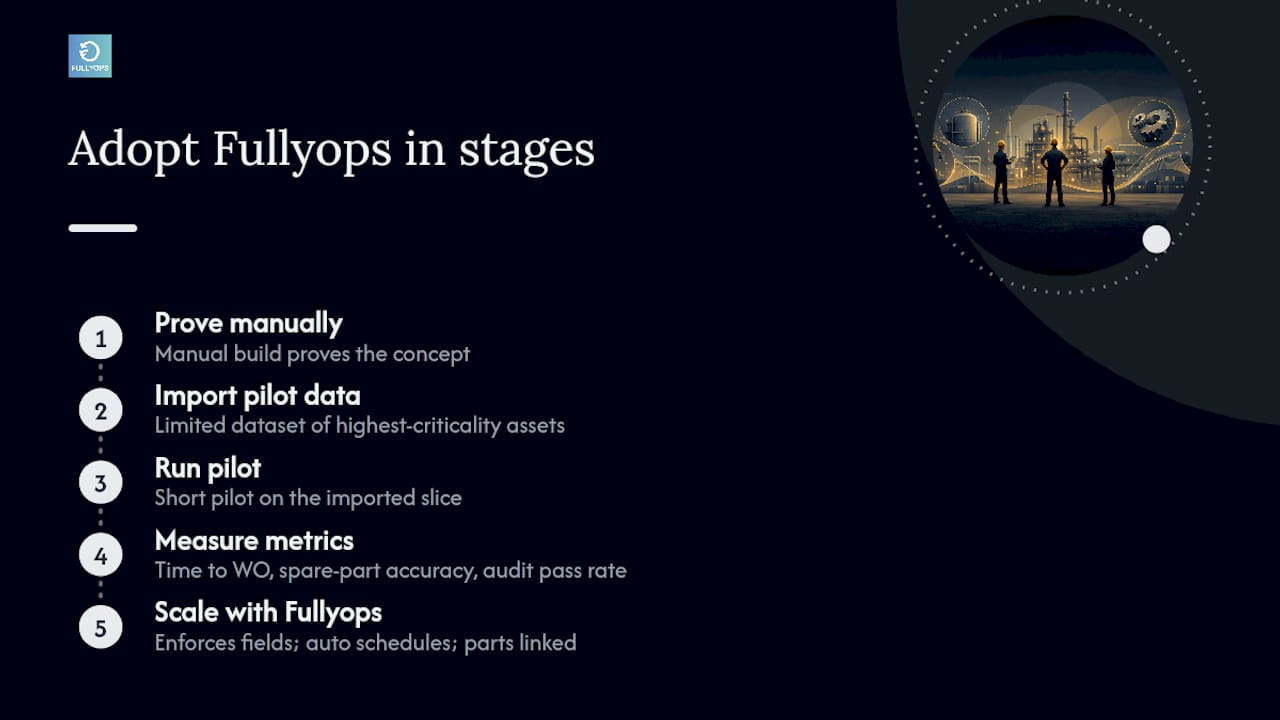
Once the manual build proves the concept, Fullyops gives you a way to run the catalogue as a live operational system rather than a spreadsheet someone has to remember to update. The platform enforces the data fields discussed above at the point of entry, supports tagging and asset hierarchy, and links spare parts directly to work orders, so inventory tracking stays accurate without a separate reconciliation step. Preventive schedules generate automatically from the asset data you have already captured, and intervention tracking builds the maintenance history in real time as technicians close work orders.
Technicians, supervisors and maintenance managers each get a view suited to their role, so the catalogue doesn’t just sit with one administrator. If you’re evaluating whether a SaaS route makes sense for your site, start small: import a limited dataset for your highest-criticality assets, run a short pilot, and measure a handful of concrete metrics, time to create a work order, spare-part order accuracy, and audit pass rate on that pilot slice. Fullyops’s field service management platform is built to support exactly that kind of staged evaluation before any site-wide commitment.
Sources
For readers who want to go deeper on specific parts of the build, Planon’s guide to structured asset repositories covers repository design and standards adoption. ReliaMag’s asset registry guide walks through walkdown practice and naming conventions in more detail. Assetivity’s materials catalogue article is the strongest reference on indexing spare parts correctly against your asset register.
- How to build a structured asset repository | Planon
- How to Build an Asset Registry Your Whole Maintenance Team Trusts
- How good is your materials catalogue? | Assetivity
PREGUNTAS FRECUENTES
What is an asset catalogue used for in maintenance?
It stores every maintainable asset’s identity, location, criticality and maintenance history in one place, so technicians can plan work, order the right parts and pass audits without hunting through separate spreadsheets.
What is the difference between an asset catalogue and a materials catalogue?
The asset catalogue records equipment and installations; the materials catalogue records the parts and spares those assets consume, linked back to the asset record by a material number.
How long does it take to build a usable asset catalogue?
A single area with a handful of critical assets can be tagged and validated within weeks; a full site typically takes a few months depending on scale, following a phased walkdown approach.
Do I need a CMMS to maintain an asset catalogue?
Not initially. A spreadsheet can hold a pilot, but a platform like Fullyops that enforces fields and links records to work orders and inventory becomes necessary once you scale beyond a small pilot area.
How often should an asset catalogue be audited?
Quarterly spot checks on your most critical assets are a reasonable baseline, with reconciliation against new installations and disposals happening continuously through change control rather than waiting for the next scheduled audit.