

En resumen:
- Many operations managers see IoT mainly as a remote monitoring tool, but it fundamentally transforms asset management from reactive to proactive. IoT collects real-time data, enabling predictive maintenance that reduces downtime, optimizes resource use, and improves operational efficiency across industrial sites. Successful implementation depends on careful asset selection, change management, sensor calibration, and integrating data with existing management systems.
Many operations managers still view IoT primarily as a remote monitoring tool, a way to check on assets without walking the floor. That framing significantly underestimates what connected technology actually delivers. IoT enables visibility and remote monitoring that reshapes scheduling, resource allocation, and maintenance decision-making from the ground up. This guide explains how IoT elevates maintenance from a reactive cost centre to a proactive, data-driven function, and what that shift means for asset management efficiency across industrial operations.
Índice
- Understanding the basics: What is IoT-enabled maintenance?
- How IoT shifts maintenance from reactive to proactive
- Building an effective IoT maintenance programme
- Challenges, pitfalls and securing your IoT maintenance approach
- Maximising value: Integrating IoT with overall asset management
- Why most IoT maintenance programmes fail and how to succeed
- Take asset management further with IoT-ready solutions
- Preguntas más frecuentes
Principales conclusiones
| Punto | Detalles |
|---|---|
| IoT enables proactive maintenance | By capturing real-time data, IoT allows teams to act before breakdowns occur and extend asset life. |
| Steps to successful IoT adoption | Instrument your assets, set accurate baselines, train predictive models, and operationalise through automated work orders. |
| Watch out for common pitfalls | Ensure high-quality sensors, secure your IoT network, and invest in staff buy-in to achieve lasting results. |
| Integrate for wider efficiency | Use IoT maintenance data to enhance scheduling, resource allocation, and long-term asset strategies. |
Understanding the basics: What is IoT-enabled maintenance?
The Internet of Things, commonly abbreviated as IoT, refers to a network of physical devices embedded with sensors, software, and connectivity that allows them to collect and exchange data in real time. In an industrial maintenance context, this means attaching sensors to critical assets such as motors, compressors, conveyors, and HVAC systems, and streaming that data continuously to a central platform for analysis and action.
The types of data these sensors capture are more varied than most managers initially expect. Common parameters include temperature, vibration, humidity, pressure, electrical current draw, oil viscosity, and acoustic emissions. Each of these signals tells a specific story about asset health. A gradual rise in bearing temperature, for instance, often precedes mechanical failure by days or even weeks, giving maintenance teams a clear window to act.
Traditional maintenance relies on fixed schedules or physical inspections to identify problems. Technicians walk the floor, check equipment manually, and log findings on paper or in spreadsheets. IoT-enabled maintenance replaces much of that guesswork with continuous, objective data. IoT supports proactive asset management well beyond simple fault detection, extending visibility to entire asset fleets regardless of location or shift pattern.
Key features of IoT-enabled maintenance include:
- Real-time sensor data collection across multiple asset types
- Automated alert generation when parameters breach defined thresholds
- Remote asset health monitoring without physical presence
- Historical data logging for trend analysis and failure pattern recognition
- Integration with work order systems to trigger maintenance actions automatically
“The real power of IoT in maintenance is not just knowing when something breaks. It is knowing when something is about to break, and having the time to plan your response.” This shift from detection to anticipation defines the value proposition for operations managers serious about IoT asset management efficiency.
How IoT shifts maintenance from reactive to proactive
Reactive maintenance is the traditional default. Equipment fails, production stops, a repair team responds. The costs are well understood: unplanned downtime, expedited parts procurement, lost output, and overtime labour. Preventive maintenance improves on this by scheduling interventions at fixed intervals, but it is inherently inefficient since you may service equipment that does not yet need it while missing assets that are quietly deteriorating between cycles.
Predictive maintenance, enabled by IoT, addresses both problems. By continuously monitoring asset condition, it intervenes only when data indicates a genuine need. This approach draws on predictive maintenance strategies that have been refined across sectors including manufacturing, utilities, and logistics. The result is fewer unnecessary interventions, fewer unexpected failures, and better use of maintenance budgets.
Steps in implementing IoT-driven proactive maintenance:
- Identify your highest-risk or highest-value assets as IoT candidates.
- Select appropriate sensors for the failure modes you want to detect.
- Establish baseline behaviour for each asset under normal operating conditions.
- Set alert thresholds based on historical failure data or manufacturer guidelines.
- Integrate sensor alerts with your work order management system for automatic task creation.
- Review alert accuracy regularly and refine thresholds as more data accumulates.
- Train technicians to act on data-driven work orders rather than scheduled rounds.
Remote monitoring reduces manual floor walks and cuts costs associated with unplanned repairs, which makes the business case for IoT straightforward once the initial infrastructure is in place.
| Maintenance type | Average unplanned downtime | Estimated cost impact | Intervention frequency |
|---|---|---|---|
| Reactivo | High (hours to days) | Very high (repairs + lost output) | Unpredictable |
| Preventivo | Low to moderate | Moderate (scheduled, sometimes unnecessary) | Fixed schedule |
| Predictive (IoT) | Very low | Low (targeted, timely interventions) | Condition-based |
Pro Tip: When configuring threshold-based alerts, avoid setting them too sensitive at first. A high volume of false positives erodes technician trust in the system quickly. Start with conservative thresholds based on manufacturer specifications, then tighten them incrementally as your baseline data matures. This approach also supports the development of smart maintenance cultures where data, not habit, drives decision-making.
Building an effective IoT maintenance programme
A well-structured IoT maintenance programme requires both technical and organisational foundations. The technology itself is only as effective as the processes and people supporting it.

The standard implementation sequence, as recommended by industry practitioners, is to instrument target assets, establish baselines, train predictive models, and trigger work orders from sensor alerts. That sequence sounds straightforward, but each step carries important nuance.
Numbered steps for building your programme:
- Asset selection and sensor deployment: Begin with a criticality assessment to prioritise which assets justify IoT investment. Sensor placement matters enormously. A vibration sensor positioned on the wrong axis of a motor housing will produce misleading data.
- Baseline establishment: Run sensors for a defined period under normal operating conditions before setting any alert thresholds. Skipping this step is one of the most common early mistakes.
- Model training and threshold setting: Use your baseline data to define what “normal” looks like for each asset. Anomalies are only meaningful relative to a well-understood norm.
- Work order integration: Connect your IoT platform to your maintenance management system so that alerts automatically generate work orders, assign them to technicians, and capture completion data.
- Continuous review: Schedule regular reviews of alert accuracy, false positive rates, and maintenance outcomes to improve the programme over time.
| Característica | Manual maintenance programme | IoT-based maintenance programme |
|---|---|---|
| Data collection | Periodic, manual | Continuous, automated |
| Fault detection speed | Hours to days | Minutes to hours |
| Intervention accuracy | Schedule-based | Condition-based |
| Cost efficiency | Moderate | High (long-term) |
| Escalabilidad | Limited by headcount | Scales with software |
| Reporting capability | Manual compilation | Automatizado, en tiempo real |
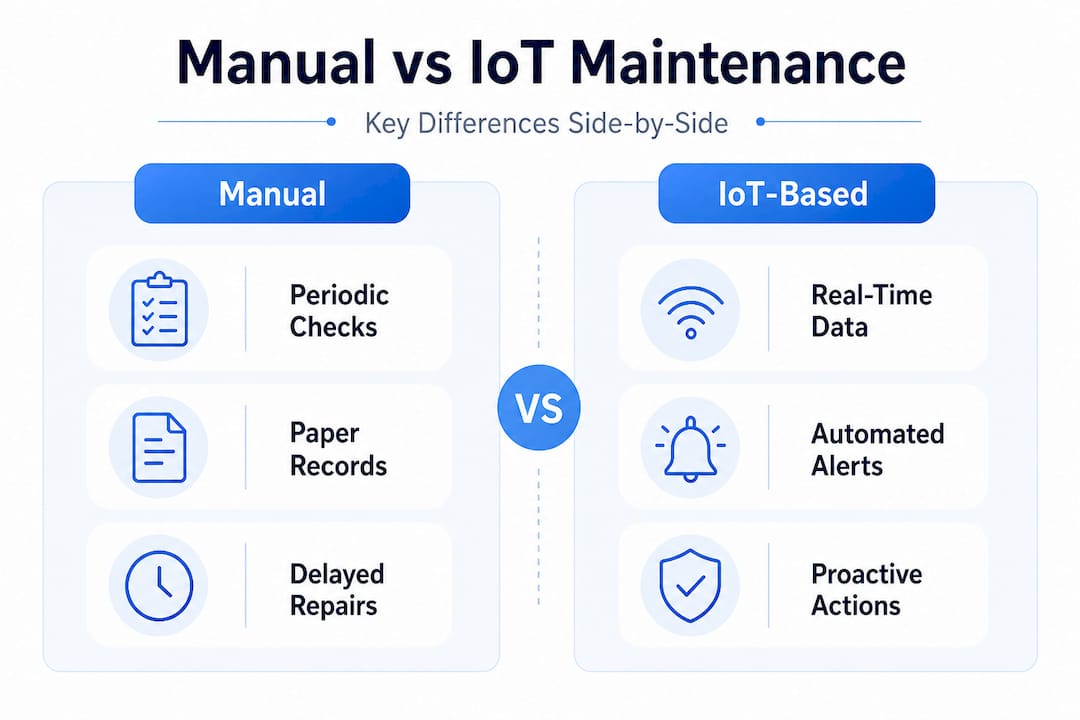
For teams exploring the pasos de mantenimiento preventivo that precede a full IoT rollout, building a structured foundation first makes IoT adoption significantly smoother.
Key success factors for IoT programme adoption:
- Accurate sensor calibration from day one, verified by a qualified technician.
- Stakeholder training that covers not just tool usage but why the data matters.
- IT and OT (operational technology) integration to ensure data flows securely from the shop floor to management dashboards.
- Clear escalation procedures so that every alert has a defined owner and response protocol.
Pro Tip: Do not underestimate the importance of alert prioritisation training. Technicians who receive a mix of critical and minor alerts without context will quickly develop “alert fatigue,” dismissing notifications that actually require urgent action. Build a simple priority matrix and include it in your onboarding materials.
Challenges, pitfalls and securing your IoT maintenance approach
Even the best-designed IoT maintenance programmes encounter obstacles. Understanding the most common failure modes in advance lets you design mitigations into your deployment from the start rather than discovering them under pressure.
Common pitfalls and how to avoid them:
- Poor sensor placement or calibration: Always follow manufacturer guidelines for sensor positioning, and schedule recalibration at defined intervals. Even minor drift in a sensor’s readings can invalidate your baseline models.
- Data trust issues: If technicians do not believe the data, they will not act on the alerts. Build trust by validating early alerts against physical inspections and sharing outcomes transparently with the team.
- Lack of network segmentation: IoT devices connected directly to corporate IT networks create significant security vulnerabilities. Segment your operational technology network from enterprise systems using dedicated firewalls and VLANs.
- Inadequate cybersecurity policies: Update device firmware regularly, enforce strong access credentials, and audit connected devices frequently.
- Insufficient change management: Rolling out IoT without involving maintenance supervisors and technicians from the planning stage creates resistance that can undermine even technically sound programmes.
IoT-driven predictive maintenance can fail when data quality is poor, baselines are inaccurate, or cybersecurity is inadequate, creating risks to both safety and operational reliability.
“In operational environments, a compromised IoT device is not just a data breach risk. It is a production risk, a safety risk, and potentially a regulatory compliance issue. Cybersecurity in IoT maintenance is not an IT problem. It is an operations problem.” This perspective is increasingly reflected in guidance on improving asset reliability across industrial settings, as well as in specialist resources covering the benefits of industrial HVAC maintenance where connected systems are now standard.
Building team trust in data requires consistency. When an alert fires and a technician investigates to find a genuine issue, document that outcome and share it. Positive reinforcement of the system’s accuracy is the most effective way to convert sceptics into advocates.
Maximising value: Integrating IoT with overall asset management
IoT maintenance does not operate in isolation. Its full value is realised when sensor data feeds into a broader asset management strategy that encompasses planning, procurement, budgeting, and compliance.
Consider spares management as one practical example. IoT data can reveal that a particular class of bearing is consistently failing after 18 months of operation across multiple machines. That insight informs your inventory strategy, allowing you to stock replacement parts proactively rather than scrambling for emergency procurement when a failure occurs.
Resource allocation is another area where IoT integration pays dividends. When you know in advance which assets are likely to require attention in the coming weeks, you can schedule technician time, coordinate external contractors, and plan production around maintenance windows rather than reacting to unplanned stoppages.
Integration opportunities with asset management software:
- Connecting IoT platforms to CMMS (Computerised Maintenance Management Systems) for automated work order generation
- Feeding condition data into EAM (Enterprise Asset Management) systems for asset lifecycle tracking and capital planning
- Linking sensor data to inventory modules for automated spare parts reordering triggers
- Exporting IoT analytics to reporting dashboards for management visibility and compliance documentation
- Using IoT data to validate warranty claims and track asset performance against manufacturer specifications
IoT extends visibility and supports better scheduling, reducing manual effort and enabling consistent efficiency across entire asset fleets. For operations managers overseeing multiple sites or large equipment inventories, this scalability is one of the most compelling arguments for IoT adoption.
Best practice for reporting is to establish a regular cadence, weekly or monthly depending on asset criticality, where IoT-generated data is reviewed alongside work order completion rates, mean time between failures, and maintenance cost trends. This turns raw sensor output into strategic insight that leadership can act on.
Why most IoT maintenance programmes fail and how to succeed
Organisations often invest in IoT infrastructure with genuine enthusiasm and then watch adoption stall within six to twelve months. The technology rarely causes these failures. The causes are almost always organisational.
The most common pattern is this: sensors are installed, a platform is configured, alerts start firing, and then nothing changes. Technicians continue following their existing routines because no one has clearly explained what they are supposed to do differently or why. Middle management, caught between new data they do not fully understand and familiar workflows, defaults to the status quo. The IoT system gradually becomes background noise.
What successful programmes share is a deliberate approach to change management alongside the technical deployment. Leadership communicates clearly why the shift is happening, what success looks like, and how individual roles will evolve. Training goes beyond button-clicking to cover data interpretation and decision-making confidence. Early wins are visible and celebrated.
There is also a subtler risk: data overwhelm. Organisations that deploy sensors across all assets simultaneously often generate more alerts and data streams than their teams can meaningfully process. A focused rollout, starting with your highest-criticality assets and expanding only after the team is comfortable, consistently outperforms broad deployments in terms of long-term adoption and value realisation.
En lessons from IoT asset management that endure across industries point to one consistent truth: technology amplifies the capability of well-prepared teams, but it cannot substitute for them. Your investment in people and process is at least as important as your investment in sensors and software.
Take asset management further with IoT-ready solutions
For operations managers ready to move from principle to practice, the right platform makes a substantial difference in how quickly IoT investments translate into measurable outcomes. FullyOps is built specifically for industrial maintenance teams managing complex asset portfolios, offering digital work order management, real-time intervention tracking, and seamless integration with IoT data sources. Whether you are coordinating technicians across multiple sites or looking to tighten your seguimiento de inventario para mantenimiento, FullyOps provides the operational infrastructure to support condition-based and predictive maintenance at scale. Explore how maintenance software for industrial companies and structured resource allocation for asset management can help your team extract full value from your IoT investment.
Preguntas más frecuentes
What types of maintenance benefit most from IoT in industry?
Predictive and condition-based maintenance see the greatest improvement from IoT, delivering lower intervention costs and significantly reduced unplanned downtime compared to reactive or fixed-schedule approaches.
How does IoT help reduce manual maintenance effort?
By monitoring assets remotely and generating alerts only when parameters exceed defined thresholds, IoT eliminates much of the routine floor walking that consumes technician time without producing actionable information.
What is a common reason IoT maintenance projects fail?
The most frequent causes are poor sensor calibration, untrusted alerts, and insufficient team engagement, rather than any fundamental flaw in the technology itself.
Does IoT maintenance require new asset management systems?
Many existing CMMS and EAM platforms include IoT integration modules or support third-party connectors, but compatibility should be confirmed before committing to a specific sensor or data platform.
Is IoT-based maintenance secure?
Security depends on correct network segmentation, regular firmware updates, and enforced access controls. Without these measures, operational risks from inadequate cybersecurity can escalate rapidly in connected industrial environments.
Recomendado
- El IoT en la gestión de activos: un aumento de la eficiencia del 30%
- Essential asset tracking tips for industrial managers
- What is smart maintenance? Boost efficiency & cut costs
- How IoT transforms equipment tracking for service businesses