

TL;DR:
- Proactive maintenance prevents failures by addressing root causes before breakdowns occur.
- It reduces unplanned downtime and extends asset lifespan compared to reactive approaches.
- Building a reliability culture and using the right tools are key to long-term success.
Reactive maintenance feels manageable until it isn’t. A single unplanned failure can cascade into hours of lost production, emergency repair costs, and compliance risks that no operations manager wants to explain to senior leadership. The hidden cost of waiting for things to break is far greater than most facilities account for, and proactive strategies help avoid these pitfalls by shifting the entire approach from response to prevention. This article explains what proactive maintenance means in practical terms, why it matters for industrial operations, and how you can start implementing it across your facility today.
Table of Contents
- What is proactive maintenance?
- Why proactive maintenance matters in industry
- Core components of a proactive maintenance strategy
- Common challenges and how to overcome them
- The overlooked advantage: A culture of proactive problem-solving
- Take the next step: Tools and systems for proactive maintenance
- Frequently asked questions
Key Takeaways
| Point | Details |
|---|---|
| Prevention over reaction | Proactive maintenance identifies and fixes problems before they cause breakdowns. |
| Lower costs and downtime | Adopting proactive strategies cuts unplanned downtime and reduces emergency repairs. |
| Data-driven decisions | Using analytics and digital tools makes maintenance planning smarter and more effective. |
| Cultural shift needed | Success relies on team mindset as much as new processes or technology. |
What is proactive maintenance?
Proactive maintenance is a systematic approach to managing assets and equipment by identifying and addressing potential failure causes before they result in breakdowns or operational disruption. It sits at the advanced end of the maintenance spectrum, moving beyond both reactive maintenance (fixing things after they break) and basic preventive maintenance (servicing on a fixed schedule) to focus on the underlying conditions that lead to failure.
The distinction matters. Reactive maintenance responds to symptoms. Preventive maintenance operates on time intervals. Proactive maintenance targets root causes, meaning the goal is to understand why a component might fail and eliminate that cause entirely. As noted in guidance on preventive maintenance steps, proactive maintenance targets failure prevention and asset reliability by addressing root causes rather than simply reacting to what has already gone wrong.
Reactive vs preventive vs proactive: a quick comparison
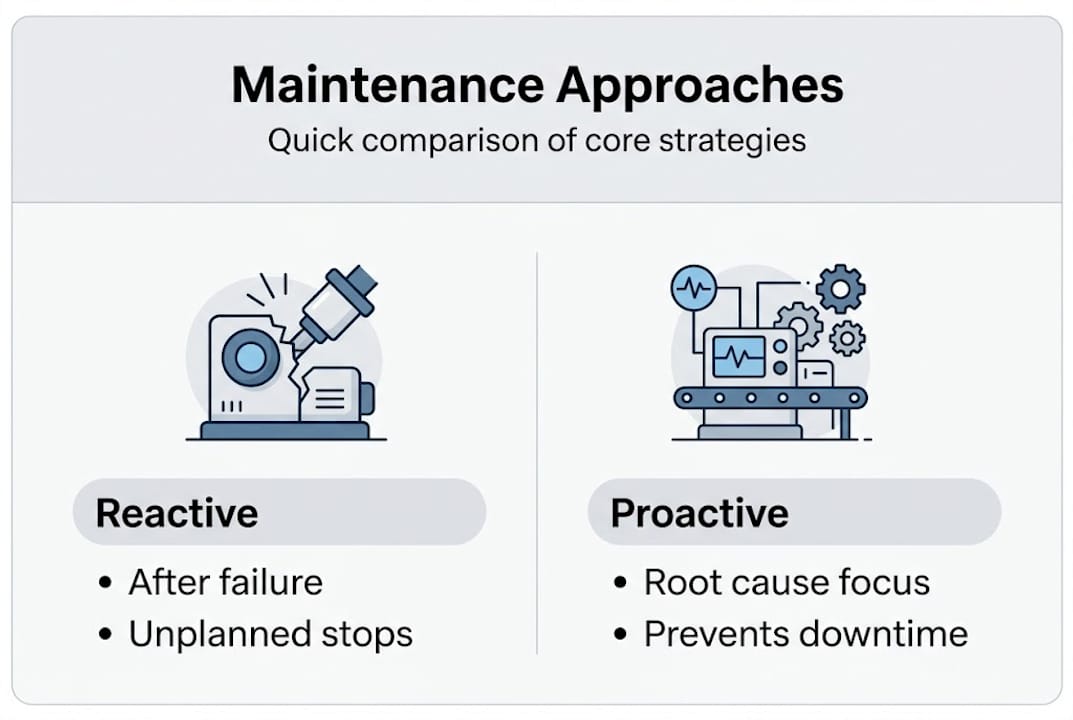
| Approach | Trigger | Focus | Outcome |
|---|---|---|---|
| Reactive | Equipment failure | Repair | Restores function |
| Preventive | Time or usage interval | Scheduled servicing | Reduces failure frequency |
| Proactive | Condition and root cause | Root cause elimination | Prevents failure onset |
Key characteristics of a proactive maintenance approach include:
- Early detection: Identifying signs of wear, contamination, or misalignment before they escalate
- Root cause analysis: Investigating the underlying reasons for deterioration, not just the symptoms
- Condition-based monitoring: Using real-time data and inspections to assess asset health continuously
- Planned interventions: Scheduling corrective actions based on actual asset condition rather than arbitrary time windows
- Continuous improvement: Feeding findings back into operational processes to prevent recurrence
This approach requires more upfront planning and investment in monitoring tools, but it delivers significantly more reliable outcomes over the asset lifecycle. For operations teams managing complex industrial environments, it represents a fundamentally more intelligent way to protect critical equipment and maintain throughput.
Why proactive maintenance matters in industry
The business case for proactive maintenance is well-established, and the numbers are hard to ignore. Reducing downtime by up to 30% is achievable through proactive strategies, and that figure alone can represent a substantial financial recovery for facilities running continuous or near-continuous operations.
In industrial settings, the stakes of reactive maintenance are particularly high. Safety risks increase when equipment operates beyond its reliable condition. Regulatory compliance becomes harder to demonstrate when failures occur unexpectedly. Supply chain commitments are missed when production lines go offline without warning. These are not abstract risks; they are documented outcomes that operations managers and maintenance supervisors face regularly.
“Facilities that shift to proactive maintenance consistently report improved asset reliability, lower emergency repair costs, and stronger compliance records compared to those still relying on reactive approaches.”
The contrast in operational outcomes becomes clear when you compare the two approaches side by side:
Reactive vs proactive maintenance outcomes
| Metric | Reactive maintenance | Proactive maintenance |
|---|---|---|
| Unplanned downtime | High | Significantly reduced |
| Maintenance costs | Unpredictable, often high | Controlled and plannable |
| Asset lifespan | Shortened by repeated failures | Extended through early intervention |
| Safety incidents | Higher risk | Lower risk |
| Regulatory compliance | Harder to evidence | Easier to document and audit |
| Team workload | Reactive, stressful | Planned, manageable |
For maintenance supervisors, the shift also has a direct impact on workforce management. Reactive environments generate last-minute call-outs, overtime costs, and high stress levels that contribute to staff turnover. Proactive environments allow teams to plan their work, build expertise, and respond to issues with proper preparation. Practical maintenance tips consistently point to workforce stability as one of the underappreciated benefits of moving away from reactive approaches.

Core components of a proactive maintenance strategy
Knowing the benefits is one thing; building the strategy is another. A robust proactive maintenance programme relies on specific components working together across technology, process, and people.
Structured maintenance plans, frequent inspections, and predictive analysis tools help organisations foresee and prevent issues before they become costly failures. These elements are not optional add-ons; they are the core infrastructure of any effective proactive maintenance approach.
Here is a practical framework for implementing the key components:
- Establish asset health monitoring: Deploy sensors, vibration analysis, thermal imaging, or oil sampling to continuously assess the condition of critical assets. This gives you real data rather than assumptions.
- Define failure modes for key assets: Work with your technical team to map out the ways each critical piece of equipment can fail, and identify early indicators for each failure mode.
- Build a structured inspection schedule: Move away from purely time-based schedules and incorporate condition-triggered inspections based on the data your monitoring systems generate.
- Integrate a CMMS or asset management platform: A computerised maintenance management system (CMMS) centralises work orders, inspection records, asset histories, and scheduling in one place, making it far easier to act on insights quickly.
- Train teams to recognise early warning signs: Equip technicians with the knowledge and authority to flag issues before they escalate. The best monitoring system is ineffective if the people using it cannot interpret what they observe.
- Review and refine regularly: Use performance data to assess whether your interventions are working and adjust your approach based on outcomes.
Pro Tip: Use your CMMS analytics to identify which assets generate the most unplanned work orders. These are your highest-priority candidates for condition-based monitoring, and addressing them first will deliver the fastest return on your investment in overcoming maintenance challenges.
Common challenges and how to overcome them
Transitioning to proactive maintenance involves overcoming resistance, cultural shifts, and initial costs, and these obstacles are real. Acknowledging them honestly is the first step to managing them effectively.
The most common barriers facilities encounter include:
- Upfront investment: Monitoring equipment, software licences, and training all require budget before the savings materialise. This can make it difficult to secure approval, particularly where leadership has not yet seen the full cost of reactive failures.
- Skills gaps: Predictive tools such as vibration analysis or thermography require trained operatives. Many maintenance teams do not currently have these skills in-house.
- Legacy habits and culture: Teams accustomed to firefighting often struggle to adjust to planned, methodical work. The urgency of reactive work can feel more rewarding in the short term, even when it is less efficient overall.
- Lack of systems: Without a CMMS or equivalent digital platform, managing the data volume that proactive maintenance generates becomes unworkable.
Practical ways to address each of these obstacles:
For budget concerns, build a cost-per-failure analysis using your existing maintenance records. Quantifying the true cost of recent reactive incidents, including lost production, overtime, and expedited parts, makes a compelling case for investment. For skills gaps, start with vendor-supported tools that include training, and phase in more advanced techniques over time. For cultural resistance, involve your maintenance team early in the planning process. Their ground-level knowledge is genuinely valuable, and their early involvement builds ownership. For system limitations, start with a focused CMMS implementation covering your highest-priority assets before scaling across the facility. Ensuring maintenance compliance is documented from the outset also helps demonstrate regulatory value to leadership.
Pro Tip: Target one or two quick wins early in your transition, such as preventing a historically recurring failure on a specific piece of equipment. Visible results build team confidence and leadership support faster than any presentation.
The overlooked advantage: A culture of proactive problem-solving
Most discussions of proactive maintenance focus on tools, schedules, and data. These matter enormously, but they are not what makes a proactive programme sustainable over the long term. The real differentiator is organisational culture.
Facilities that genuinely succeed with proactive maintenance share a common characteristic: their teams actively look for problems. Technicians surface anomalies without waiting to be asked. Supervisors treat a prevented failure as a win worth recognising. Managers allocate time for inspection and analysis rather than only rewarding fast fixes. This mindset does not emerge from a software implementation alone; it has to be built deliberately.
In our experience, the facilities that struggle with proactive maintenance are rarely failing on tools or budget. They are failing on habit. When building a reliability culture becomes a stated organisational priority, backed by consistent leadership behaviour, the tools become far more effective. Continuous improvement habits, where every failure is treated as a learning opportunity rather than a crisis to survive, compound over time and deliver results that no single technology solution can replicate.
Take the next step: Tools and systems for proactive maintenance
Understanding proactive maintenance principles is a strong foundation, but translating that knowledge into daily operational practice requires the right digital infrastructure. Modern asset management platforms and CMMS solutions remove the complexity of managing inspection data, work orders, and asset histories manually, making it far easier to act on insights at scale.
FullyOps supports operations teams in building structured, scalable maintenance programmes through tools designed for efficient resource allocation and real-time operational visibility. Whether you are just beginning to move away from reactive maintenance or looking to optimise an existing programme, exploring purpose-built maintenance management solutions can significantly accelerate your progress.
Frequently asked questions
What is the main goal of proactive maintenance?
The main goal is to prevent equipment failures by addressing root causes before issues occur, rather than responding after a breakdown has already happened. This approach, centred on early detection and root cause elimination, keeps assets running reliably and reduces unplanned disruption.
Is proactive maintenance more cost-effective than reactive maintenance?
Yes, over time proactive maintenance leads to lower costs due to reduced unplanned downtime and fewer emergency repairs. Proactive strategies can cut downtime by up to 30%, translating into significant cost savings across the asset lifecycle.
What tools support proactive maintenance?
Computerised maintenance management systems (CMMS), asset management software, and predictive analytics tools are key supports for any proactive maintenance programme, enabling teams to monitor asset health and act on data-driven insights.
Can small facilities benefit from proactive maintenance?
Absolutely. Proactive maintenance practices are scalable and benefit all facility sizes, helping smaller operations lower long-term costs and increase asset reliability without requiring enterprise-level investment from the outset.
How often should proactive maintenance activities be reviewed?
Reviews should be conducted at least annually, but quarterly checks align better with continuous improvement goals and allow teams to course-correct before small gaps become systemic issues.
Recommended
- Maintenance Planning Step by Step: Cut Downtime by 30%
- Maintenance Optimization in 2026: Cut Downtime by 30%
- Workflow for Preventive Maintenance: Cut Costs by 30% in 2026